With advances in smart cockpit and intelligent driving, and enormous strides of Tesla, OEMs care more about automotive operating system (OS). Yet, it is by no means easy for both new carmakers and traditional OEMs to develop base software for intelligent cars. It is in the report that world’s vehicle OS vendors are compared and analyzed.
Auto OS is generally classified into four types:
1) Basic auto OS: it refers to base auto OS such as AliOS, QNX, Linux, including all base components like system kernel, underlying driver and virtual machine.
2) Custom-made auto OS: it is deeply developed and tailored on the basis of basic OS (together with OEMs and Tier 1 suppliers) to eventually bring cockpit system platform or automated driving system platform into a reality. Examples are Baidu in-car OS and VW.OS.
3) ROM auto OS: Customized development is based on Android (or Linux), instead of changing system kernel. MIUI is the typical system applied in mobile phone. Benz, BMW, NIO, XPeng and CHJ Automotive often prefer to develop ROM auto OS.
4) Super auto APP (also called phone mapping system) refers to a versatile APP integrating map, music, voice, sociality, etc. to meet car owners’ needs. Examples are Carlife and CarPlay.
OEMs are not only striving to gain control of vehicle base software and hardware and apt to use neutral OS, but exerting itself to reduce the development cycle and costs by more collaborations and leveraging open source software organizations.
Preference to Neutral and Free OS
It can be seen in the table below that most Chinese automakers select Android, while foreign peers choose AGL. Both Android and and AGL are neutral and free operating systems.
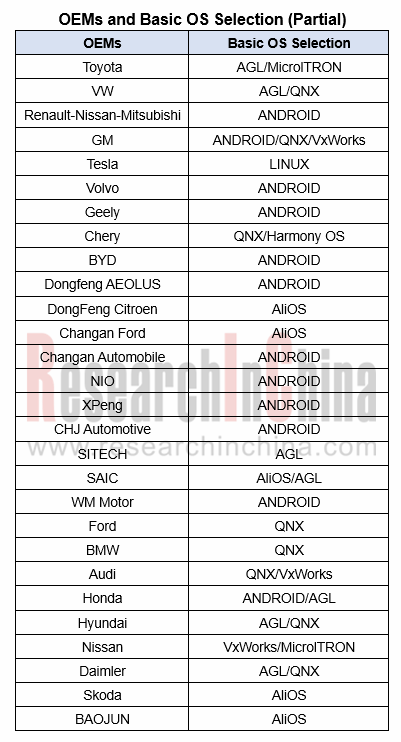
AGL now has the support of 11 OEMs including Toyota, VW, Daimler, Hyundai, Mazda, Honda, Mitsubishi, Subaru, Nissan, SAIC , etc.
AGL addresses 70% of OS development work, while the remaining 30% can be developed by OEMs. This facilitates development progress and cuts costs significantly.
More than 140 AGL members work together to develop a common platform for infotainment, which will be further available to ADAS, OTA, gateway, V2X and automated driving in the future.
ANDROID ecosystem, compared with AGL, is more mature and widely used by Chinese OEMs. However, OEMs felt risky to apply ANDROID as Google banned Huawei from using the Google Mobile Services (GMS) on Huawei phones in 2019, giving vitality to other operating systems. For instance, AliOS has already been seen in at least nine auto brands.
Reduce Development Cycle and Costs with the Help of Open Source Software Organizations
The GENIVI Alliance was jointly founded by giants like BMW, GM and Intel in 2009, aiming to offer applicable standards and open source codes for in-vehicle infotainment (IVI) platform. The alliance associates with the users of Android, AUTOSAR, Linux, and other in-car software and the solution suppliers to form a productive and collaborative community of 100+ members worldwide encompassing leading automakers, Tier 1 suppliers, semiconductor suppliers, software developers and service providers. GENIVI alliance always leads in field of open source cockpit software development.
The successful operation of GENIVI Alliance shows the industry’s urgent need to reduce development costs and avoid the duplication of development via open source software organizations.
The Autoware Foundation is a non-profit organization founded in Dec. 2018, aiming to develop open source software for autonomous vehicle. With nearly 40 members globally, Autoware is adopted by over 200 organizations in the world.
IT firms Marry Cars and Various Smart Hardware via OS
LG acquired webOS (developed by Palm) from HP in 2013, and then extended webOS as a mobile phone OS to the suitable one for TVs, smart refrigerators, smart watches and smart cars. At present, LG has sold millions of its webOS-enabled Smart TVs. In the early 2020, LG’s webOS is increasingly seen in automotive sector.
Samsung has ambitious plans for Tizen, an open operating system, which has already been found in Samsung’s wearables and smart fridges, and will be applied to floor mopping robots, washing machines, air conditioners and even cars in future.
Huawei does alike in Harmony OS, a microkernel-based, distributed OS designed to deliver a 'smooth experience' across all devices in all scenarios. It enables seamless cross-terminal synergy across multiple devices and platforms including smart phone, TV, Tablet PC and automotive infotainment.
IT companies are attempting to realize intelligence of all scenarios from mobility, home to office by centering on OS. It remains to be seen whether OEMs will adopt the plan and when the plan will be actually carried out.
AI-Defined Vehicle (AIDV) OEMs' Deployment Strategies Research Report, 2026
AIDV Research: Deployment Strategies of 22 OEMs
The AI-Defined Vehicle (AIDV) OEMs' Deployment Strategies Research Report, 2026, released by ResearchInChina, analyzes the AI deployment strategies of ...
OEMs’ Passenger Car Model Planning Research Report, 2026
Vehicle Model Planning Research: Chinese OEMs Launch Sub-Brands Intensively, While Multinational OEMs Apply the Brakes to Electrification Strategies
ResearchInChina released the OEMs’ Passenger Car M...
Autonomous Driving Simulation and World Model Research Report, 2026
Autonomous driving simulation research: "Simulation test + world model"-driven test system has become R&D infrastructure.
The "Autonomous Driving Simulation and World Model Research Report, 2026"...
Cockpit-Driving Integration Central Domain Controller SoC and AI Supercomputing Architecture Research Report, 2026
Cockpit-Driving integration and AI supercomputing research: The One Chip solution is rapidly installed in vehicles, and AI supercomputing architectures are moving towards full-domain integration.
AI ...
Intelligent Driving End-to-End Large Model Research Report, 2026
Research on Intelligent Driving Large Models: A Critical Period for Technological Competition and Paradigm Integration
As autonomous driving technology rapidly iterates from L2 to L3?L4, intelligent...
Automotive Digital Key Industry Trend Report, 2026
Digital Key Research: Automotive BLE, UWB and SLE Hardware Layout
The Automotive Digital Key Industry Trend Report, 2026, released by ResearchInChina, analyzes and predicts the digital key market, co...
Monthly Report on Automotive New Technology (May 2026)
UHD gaze technology, full-color LiDAR, UWB, etc. promote the upgrade of intelligent driving perception capabilities
This report is published once a month and is available for annual subscription.The...
In-Cabin Monitoring Systems (DMS, OMS, etc.) Research Report, 2026
In-Cabin Monitoring System Research: DMS to Become Mandatory in 2027, Expected to be Installed in Over 14 Million Vehicles
ResearchInChina released the In-Cabin Monitoring Systems (DMS, OMS, etc.) Re...
Automotive Service-Oriented Architecture (SOA) and Cross-Domain Middleware Industry Report, 2026
Research on automotive SOA and cross-domain middleware: The era of AI atomic services and AI cross-domain fusion agents is coming.
Automotive SOA evolves towards AI + full SOA servitization Driv...
Automotive Display, Center Console and Cluster Industry Report, 2026
Automotive Display Research: Multi-Screen Application Slows Down, While OLED and MiniLED Are Introduced in Vehicles Quickly
In 2026, automotive displays will no longer excessively pursue the number a...
Global and China Intelligent Vehicle Standard System Construction and Certification Research Report, 2026
Intelligent Driving Standards and Certification: With the Maturing Standardization System, China Will Participate in Formulation of Global Standards
China's automotive industry is transforming from ...
Automotive Intelligent Diagnosis Industry Report, 2026
Automotive Intelligent Diagnosis Research: Powered by AI, Remote Diagnosis Is Being Upgraded towards Intelligence.
ResearchInChina released the Automotive Intelligent Diagnosis Industry Report, 2026....
Automotive Cloud Service Platform Research Report, 2026
Research on automotive cloud service platform: with architecture upgrade and computing power improvement, cloud services enter a new stage
In 2026, the Internet of Vehicles industry generates petaby...
Integrated Battery and Innovative Battery Technology Research Report, 2026
Power Battery Research: Sales of High-Capacity Vehicles Keep Rising, and Solid-State Batteries Begin to Be Installed in Vehicles
I. Sales of High-Capacity Vehicles Sustain Growth, and Those with A C...
Chinese Independent OEMs’ ADAS and Autonomous Driving Report, 2026
Research on OEMs' Intelligent Driving: Era of Physical AI, Standard Configuration of D2D, and Initial Exploration of L3 Commercial Pilot Projects
From 2023 to 2025, the intelligent driving installati...
Intelligent Vehicle New Technology Application Analysis Report, 2025-2026
New Technology Research: Innovative Products such as Bionic Cameras, Vision-LiDAR Fusion Sensors, Auditory Sensors Further Enhance Vehicle Perception Capabilities
ForewordResearchInChina released th...
Automotive Optical Fiber Communication (Optical Fiber Ethernet, PON) and Supply Chain Research Report, 2026
Research on Automotive Optical Fiber Communication: Introduction of Optical Fiber in Vehicles Accelerates, with Priority Deployment in High-Speed Communication Link (10+Gbps) Scenarios
Automotive opt...
Automotive Intelligent Cockpit SoC Research Report, 2026
Automotive Cockpit SoC Research: Passenger Cars in the Price Range of RMB100,000–200,000 Account for Nearly 50% of Total Sales, and New-Generation Cockpit SoC Products Largely Enter Mass Production
P...