Millimeter wave radar installations soared by 44.37% year-on-year in 2019 and were available in more scenarios, encroaching on Lidar and ultrasonic.
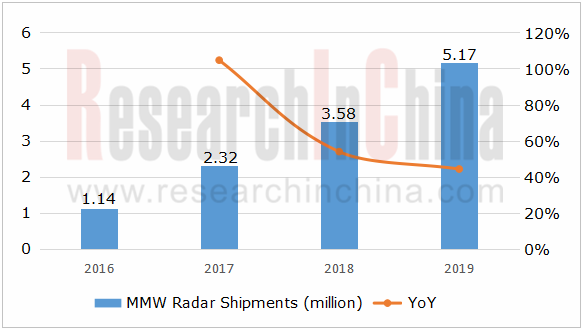
Automotive radar wins popularity and gets increasingly installed. In 2019, 5.17 million mm-wave radars were installed in passenger cars in the Chinese market with an annualized spurt of 44.37%, particularly 77GHz radar installations with an upsurge of 69.3% from a year earlier.
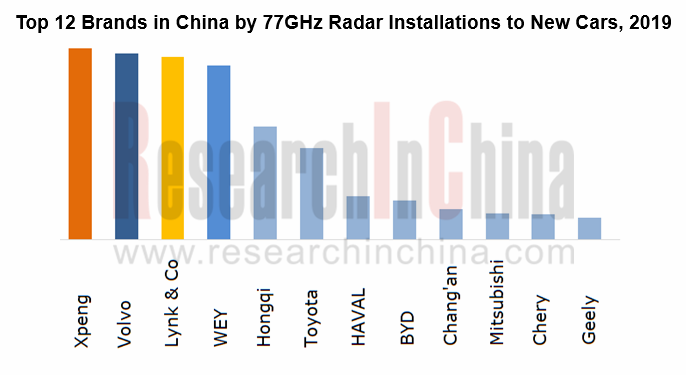
Chinese carmakers have more radar installations than joint venture brands. For the newly launched models, Geely Geometry, WM Motor, BAIC ARCFOX, Chang’an, SAIC Roewe / MAXUS, FAW Hongqi, Xpeng and other homegrown brands all emphasize L2 / L2.5 / L3 autonomous driving technology and install more sensors including mm-wave radar.
Well-known radar suppliers are promoting 77GHz radar vigorously, like the latest generation of medium- and long-range 77GHz radar launched by Bosch and Continental, and at the same time famous radar chip makers are mostly rolling out the 77GHz-centric chip generally in favor of the high modulation bandwidth 2GHz and with 3 transmitters and 4 receivers to detect farther.
The upcoming RXS816xPL is a highly integrated device that addresses the needs of 77-79 GHz radar for all safety-critical applications from automatic emergency-braking (AEB) to high-resolution radar in automated driving and that performs all functions of a radar front-end in a single device – from FMCW signal conditioning to generation of digital receive data output. It resorts to high modulation bandwidth 2 GHz to realize precise distance measurement and simultaneous transmitter operation for MIMO, capable of detecting and identifying objects within 300 meters.
Texas Instruments plans to launch the 77GHz AWR2243, an integrated single-chip FMCW transceiver working in the 76- to 81-GHz band. The device has a tiny footprint and unprecedented integration and supports 5G bandwidth. Simple programming model changes enable a wide variety of sensor implementation (short, medium, long range). Additionally, the device is provided as a complete platform solution to reduce development costs.
MMW radar chip vendors have released suitable chips for more applications, especially in ultra-short range and short range.
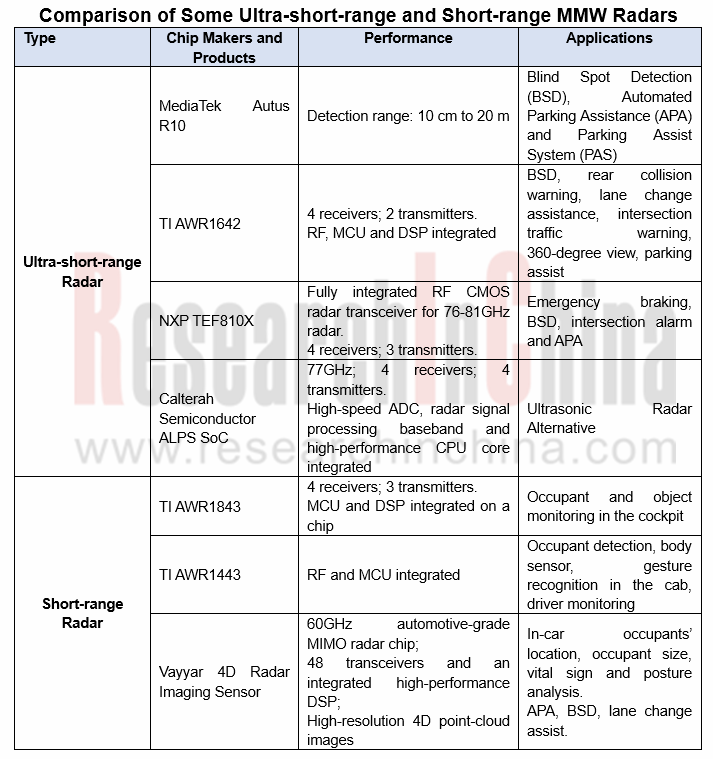
Radar finds wider applications in scenarios like cockpit and occupant monitoring, automated parking, collaborative vehicle infrastructure system (CVIS) and intelligent transportation with the help of radar chips.
Cockpit and Occupant Monitoring
Vayyar Imaging, an Israeli provider of radar imaging sensor technology, said in November 2019 it raised $109 million in a Series D funding led by Koch Disruptive Technologies, bringing its total raised to-date to $188 million. In the automotive domain, Vayyar claims its chip enables in-cabin passenger location and classification, occupant size, vital sign and posture analysis, as well as 360° exterior mapping, including monitoring cars, objects and pedestrians around a vehicle, in all lighting and weather conditions, and in real time. At the 2018 Paris Motor Show, Valeo indeed announced it was integrating Vayyar’s radar sensors with its products to monitor infants’ breathing and trigger an alert in case of emergency. Brose and Vayyar collaborate on sensor technology for new door and interior functions. Sensors recognize occupancy in the interior at all times to ensure the necessary level of safety in the interaction of mechanical and electronic systems. These sensors will also make it possible for side doors to open and close automatically and if other vehicles or obstacles are in the way, the movement ends before the door comes into contact with any object.
For L2, L3 and L4 autonomous driving, occupant monitoring is of growing importance. Autonomous vehicle interiors are fairly flexible, like sliding seats, screens and consoles, suitable for work and relaxation. The short-range radar and visual sensors work together to identify the situation in the car in real time, and the mechanical and electronic systems interact to ensure the safety.
Automated Parking
In December 2019, ZongMu Technology released in Xiamen city the second-generation autonomous parking product -- AVP Gen.2 that has main sensors including four fisheye cameras, 12 ultrasonic sensors, and four 4D MMW radars.
When all of four surround-view cameras are blocked and only mm-wave radar is available, AVP Gen. 2 can still fully implement AVP because the radar can deliver the dense point cloud information comparable to that of Lidar and clearly outline the surrounding buildings to achieve high-precision localization based on radar point clouds.
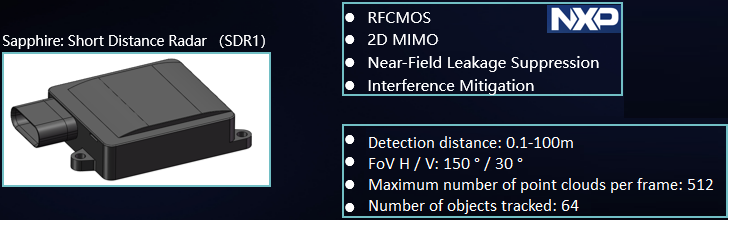
The radar used by AVP Gen.2 is called SDR1, which gets specially optimized in the typical parking scenarios (underground / ground parking lots, parks, etc.) on the basis of traditional angle radar ADAS functions to perfectly meet all parking needs. SDR1 takes into account both of low-speed parking scenarios and high-speed ADAS, and can work under extreme conditions such as wind, heavy snow, night, etc. The product will be spawned in the fourth quarter of 2020.
CVIS and Intelligent Transportation
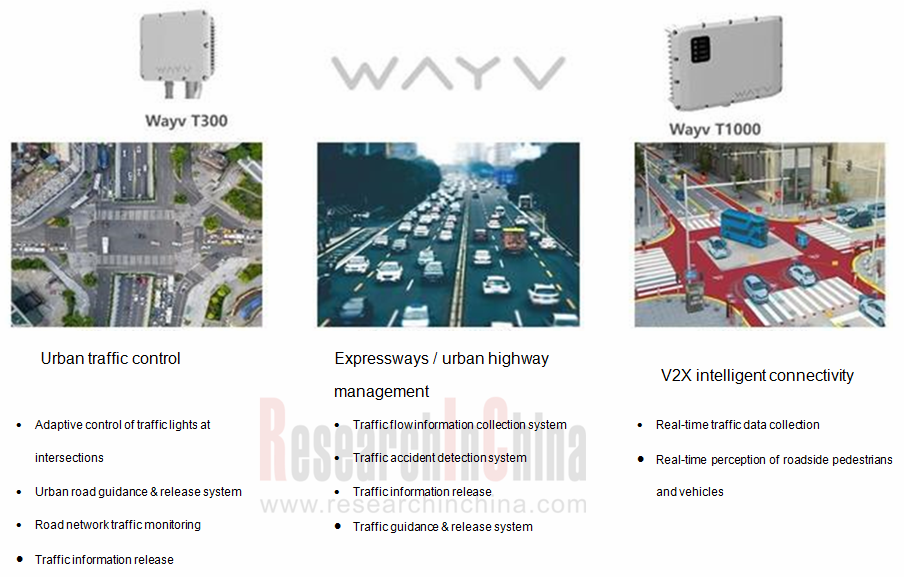
In April 2020, Muniu Tech rolled out three WAYV-branded radars: WAYV Air, WAYV and WAYV Pro. WAYV includes T300 and S300, which are used in intelligent transportation and intelligent security respectively. WAYV Pro breaks the detection distance limit of video and infrared sensors to reach 1,000 meters, ideal for highway accident monitoring and large-area security.
With a detection range of 300 meters, Wayv T300 covers 8 lanes, detects and tracks 128 objects simultaneously, mainly serving urban traffic data perception and planning. Wayv T1000 works at a maximum distance of 1,000 meters, suitable for long-distance and highway deployment. It can detect and track 256 objects on 10 lanes simultaneously.
Market Shares of Lidar and Ultrasonic Radar Are Squeezed
Millimeter-wave radar is developing radically, with the imaging radar as an alternative to Lidar and the ultra-short-range radar as a substitute for ultrasonic.
The thriving angle radar has lured mm-wave radar vendors to develop ultra-short-range solutions for parking, AEB and short-range blind spot detection as the alternative of traditional ultrasonic sensors.
With far better performance than ultrasonic sensors on the market, the Autus R10 chip of MediaTek offers a wider detection range. Other than distance information, it can also provide speed information while ultrasonic does not. The Autus R10 chip can be used for multiple applications including blind spot detection (BSD), parking assist system (PAS), automatic parking assistance (APA), rear automatic emergency braking, cross-traffic alerts, door opening alerts and ultra-short-range BSD.
The most cost-effective ultrasonic sensor has a slow response to object detection, and it cannot classify objects into human and non-human, while mm-wave radar can perform object classification and biometric monitoring.
Many chip vendors, including traditional radar chip giants such as NXP, TI and Infineon, have launched solutions that shore up high-resolution radar. High-resolution imaging radar will outperform Lidar in terms of cost and performance. In some cases, imaging radar may identify objects such as bicycles, pedestrians, or small obstacles on the road and it also can deal with severe weather conditions.
Lidar will be replaced by Camera + imaging MMW Radar + V2X, said by Lars Reger, CTO of the NXP Semiconductors Automotive Division. The focus of the collaboration between NXP and HawkEye Technology is to create high-resolution imaging radar.
MMW Radar Boosts the Plasticization of Automotive Exterior Parts
Radars are generally fixed behind the car logo or the grille, and integrated into the lights, roof, etc. Millimeter wave radar detects the object, distance, speed and position by emitting electromagnetic waves, which are extremely sensitive to metals, and detecting echoes. In the traditional design, car head and door panels mostly made of metal cannot hide the radar.
Radars must come with plastic peripheral parts whose electrolyte conductivity should be low, especially the materials cannot contain carbon fiber or metals with electronic shielding effect. Covestro, BASF, Lotte, Orinko, Sumitomo, Mitsubishi and the like have developed wave-transparent materials PC, PP, ABS and so on for automotive exterior parts.
AI-Defined Vehicle (AIDV) OEMs' Deployment Strategies Research Report, 2026
AIDV Research: Deployment Strategies of 22 OEMs
The AI-Defined Vehicle (AIDV) OEMs' Deployment Strategies Research Report, 2026, released by ResearchInChina, analyzes the AI deployment strategies of ...
OEMs’ Passenger Car Model Planning Research Report, 2026
Vehicle Model Planning Research: Chinese OEMs Launch Sub-Brands Intensively, While Multinational OEMs Apply the Brakes to Electrification Strategies
ResearchInChina released the OEMs’ Passenger Car M...
Autonomous Driving Simulation and World Model Research Report, 2026
Autonomous driving simulation research: "Simulation test + world model"-driven test system has become R&D infrastructure.
The "Autonomous Driving Simulation and World Model Research Report, 2026"...
Cockpit-Driving Integration Central Domain Controller SoC and AI Supercomputing Architecture Research Report, 2026
Cockpit-Driving integration and AI supercomputing research: The One Chip solution is rapidly installed in vehicles, and AI supercomputing architectures are moving towards full-domain integration.
AI ...
Intelligent Driving End-to-End Large Model Research Report, 2026
Research on Intelligent Driving Large Models: A Critical Period for Technological Competition and Paradigm Integration
As autonomous driving technology rapidly iterates from L2 to L3?L4, intelligent...
Automotive Digital Key Industry Trend Report, 2026
Digital Key Research: Automotive BLE, UWB and SLE Hardware Layout
The Automotive Digital Key Industry Trend Report, 2026, released by ResearchInChina, analyzes and predicts the digital key market, co...
Monthly Report on Automotive New Technology (May 2026)
UHD gaze technology, full-color LiDAR, UWB, etc. promote the upgrade of intelligent driving perception capabilities
This report is published once a month and is available for annual subscription.The...
In-Cabin Monitoring Systems (DMS, OMS, etc.) Research Report, 2026
In-Cabin Monitoring System Research: DMS to Become Mandatory in 2027, Expected to be Installed in Over 14 Million Vehicles
ResearchInChina released the In-Cabin Monitoring Systems (DMS, OMS, etc.) Re...
Automotive Service-Oriented Architecture (SOA) and Cross-Domain Middleware Industry Report, 2026
Research on automotive SOA and cross-domain middleware: The era of AI atomic services and AI cross-domain fusion agents is coming.
Automotive SOA evolves towards AI + full SOA servitization Driv...
Automotive Display, Center Console and Cluster Industry Report, 2026
Automotive Display Research: Multi-Screen Application Slows Down, While OLED and MiniLED Are Introduced in Vehicles Quickly
In 2026, automotive displays will no longer excessively pursue the number a...
Global and China Intelligent Vehicle Standard System Construction and Certification Research Report, 2026
Intelligent Driving Standards and Certification: With the Maturing Standardization System, China Will Participate in Formulation of Global Standards
China's automotive industry is transforming from ...
Automotive Intelligent Diagnosis Industry Report, 2026
Automotive Intelligent Diagnosis Research: Powered by AI, Remote Diagnosis Is Being Upgraded towards Intelligence.
ResearchInChina released the Automotive Intelligent Diagnosis Industry Report, 2026....
Automotive Cloud Service Platform Research Report, 2026
Research on automotive cloud service platform: with architecture upgrade and computing power improvement, cloud services enter a new stage
In 2026, the Internet of Vehicles industry generates petaby...
Integrated Battery and Innovative Battery Technology Research Report, 2026
Power Battery Research: Sales of High-Capacity Vehicles Keep Rising, and Solid-State Batteries Begin to Be Installed in Vehicles
I. Sales of High-Capacity Vehicles Sustain Growth, and Those with A C...
Chinese Independent OEMs’ ADAS and Autonomous Driving Report, 2026
Research on OEMs' Intelligent Driving: Era of Physical AI, Standard Configuration of D2D, and Initial Exploration of L3 Commercial Pilot Projects
From 2023 to 2025, the intelligent driving installati...
Intelligent Vehicle New Technology Application Analysis Report, 2025-2026
New Technology Research: Innovative Products such as Bionic Cameras, Vision-LiDAR Fusion Sensors, Auditory Sensors Further Enhance Vehicle Perception Capabilities
ForewordResearchInChina released th...
Automotive Optical Fiber Communication (Optical Fiber Ethernet, PON) and Supply Chain Research Report, 2026
Research on Automotive Optical Fiber Communication: Introduction of Optical Fiber in Vehicles Accelerates, with Priority Deployment in High-Speed Communication Link (10+Gbps) Scenarios
Automotive opt...
Automotive Intelligent Cockpit SoC Research Report, 2026
Automotive Cockpit SoC Research: Passenger Cars in the Price Range of RMB100,000–200,000 Account for Nearly 50% of Total Sales, and New-Generation Cockpit SoC Products Largely Enter Mass Production
P...