|
|
|
|

Tel: 0086-10-82600828
Fax: 0086-10-82601570
Email:

|

|
|
Index>>Manufacturing>>Automotive
|
 |
Shared Mobility Industry Research--Autonomous Driving Leads Shared Mobility 3.0
|
The global shared mobility industry is experiencing a hard time. It is since 2019 that shared mobility enterprises have been exposed to financial fragility and have closed down one after another amid a nosedive in financing amount and rounds. The COVID-19 pandemic makes things worse. Shared mobility companies such as Uber and Lyft have cut jobs, while many automakers and Robotaxi companies have dabbled in the shared mobility market.
Tan Yi from GoFun believes that Shared Mobility 1.0 refers to the current public transit system, 2.0 means the new formats -- ride-hailing and timeshare rental occurring now, and 3.0 represents the application of autonomous driving in the future.
Shared mobility is closely related to autonomous driving. It is difficult for both of them to make money at this stage.
By 2030, the global Robotaxi fleet market will be worth at least US$2 trillion annually, 12% of new cars will be sold to Robotaxi fleets globally, and 26 million Robotaxis will be in operation, as estimated by UBS Evidence Lab.
To have a bite of the future shared mobility market, the giants have offered subsidies to squeeze small and medium-sized mobility firms. Only the full exertion of autonomous driving can make the shared mobility market scale up, but the current immature autonomous driving technology, regulations and business models makes the goal impossible.
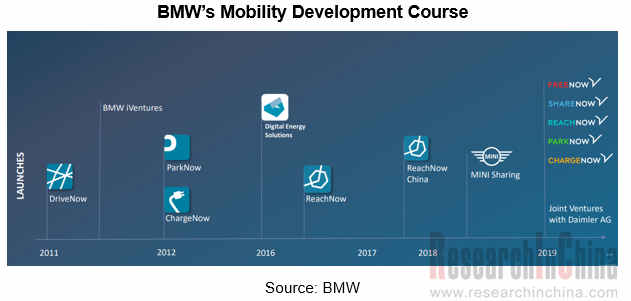
The shared mobility market is the battlefield of vibrant players who still need fight in alliance. WAYMO has tested Robotaxi for ten years. BMW has been groping for shared mobility business for almost a decade, but it eventually allied with Daimler to push on deeper cooperation on autonomous driving and shared mobility.
A study by General Motors shows that the cost of shared mobility will be slashed from $ 3 / mile to $1 / mile through autonomous driving by 2025, thereby diluting the operation cost through a large scale. After 2030, the mobility mileage of Robotaxis will constitute 75% of the total.
 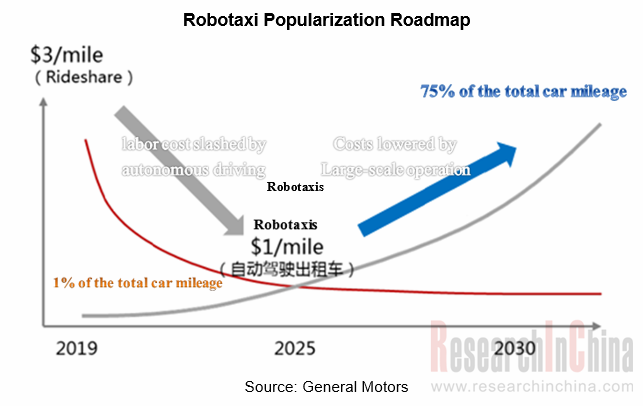
That is to say, autonomous driving will not give much impetus to shared mobility until 2025. From now on, it is a challenge for ambitious companies to make a layout in just five years. Looking back at the players’ Robotaxi trials in 2019, we can see that fiercer rivalry is under way.
Trial Operation of Robotaxi
Three major forces are competing for the Robotaxi market, including:
(1) Didi, Uber, Lyft and other mobility platforms;
(2) Waymo, Aptiv, Baidu, Pony.ai and other Robotaxi solution providers;
(3) OEMs. Tesla plans to launch a Robotaxi network involving over a million Robotaxis on the road. Waymo has secured US$3 billion in financing for enlarging the Robotaxi test fleet. Baidu announced in April 2020 the availability of China's first Robotaxi services which are being offered on mobile apps to the public.
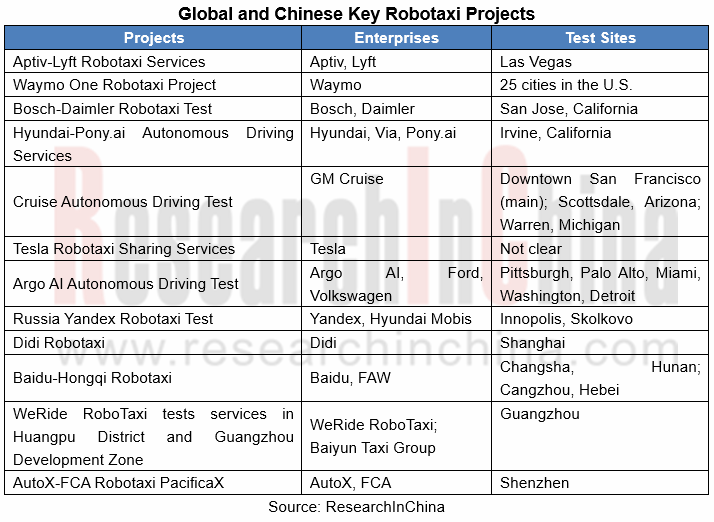
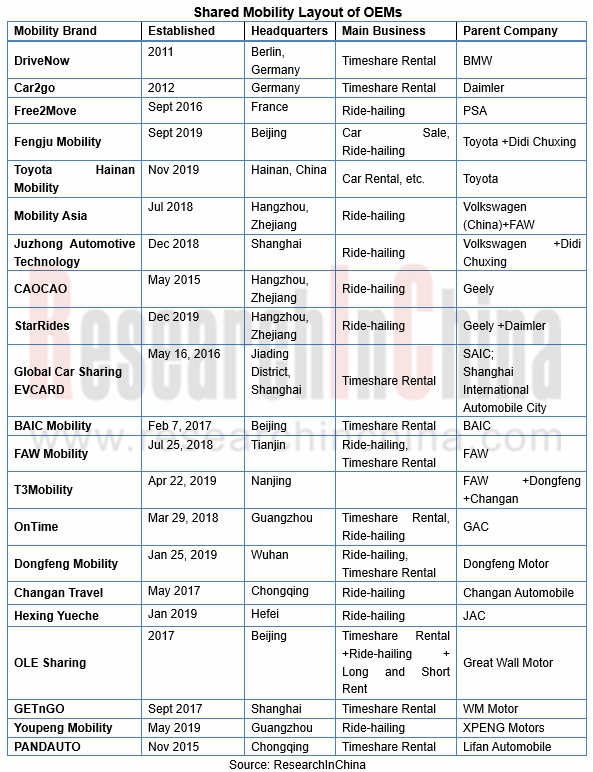
Although a few giants and top Robotaxi startups are making long-term plans, it is still too early for most automakers, most of which have launched their own mobility service brands successively and made attempts in the lucrative but fiercely contested mobility market.
1. Concept, Classification and Operation Models of Shared Mobility
1.1 Concept of Shared Mobility
1.2 Classification of Shared Mobility
1.3 Market Features of Shared Mobility
1.4 Operation Models of Shared Cars
1.5 Shared Cars +Autonomous Driving
1.6 Three Development Stages of Shared Cars +Autonomous Driving
1.7 Two Development Paths of Shared Cars +Autonomous Driving
2. Global and China Shared Mobility Industry
2.1 Status Quo of Global Shared Mobility Industry
2.1.1 Global Shared Mobility Industry Policies
2.1.2 Global Shared Mobility Market Size
2.1.3 Main Players in Global Shared Mobility Market
2.1.4 Competition in Global Ride-hailing Market
2.1.5 Competition in Global Timeshare Rental Market
2.1.6 Car Picking Process Comparison of Timeshare Rental Companies
2.1.7 Telematics Comparison of Timeshare Rental Companies
2.2 Status Quo of China Shared Mobility Industry
2.2.1 Status Quo of China’s Sharing Economy
2.2.2 Status Quo of China’s Public Transit
2.2.3 Features of Shared Mobility Development in China
2.2.4 Transaction Size of China Shared Mobility
2.2.5 China Shared Mobility Industry Chain
2.2.6 Competitive Landscape in Chinese Shared Mobility Market
2.2.7 Development Features of Shared Mobility
2.2.8 Development Trend of Shared Mobility in China
2.2.9 User Survey of Shared Mobility in China
2.3 Status Quo of China Ride-hailing Industry
2.3.1 Development Course of Chinese Ride-hailing Market
2.3.2 China’s Policies on Ride-hailing
2.3.3 Ride-hailing Policies in Major Cities
2.3.4 User Scale in Chinese Ride-hailing Market
2.3.5 Transaction Size in Chinese Ride-hailing Market
2.3.6 Competitive Landscape in Chinese Ride-hailing Market
2.3.7 Survey on Chinese Ride-hailing Market
2.3.8 Market Features Survey on Main Ride-hailing Brands in China
2.3.9 Survey on Ride-hailing Business Process in China
2.3.10 Main Problems of Chinese Ride-hailing Market and Solutions
2.4 Status Quo of China Timeshare Rental Industry
2.4.1 Policies for Chinese Timeshare Rental Market
2.4.2 Financing of Chinese Timeshare Rental Market
2.4.3 User Scale of Chinese Timeshare Rental Market
2.4.4 Chinese Timeshare Rental Market Size
2.4.5 Competitive Landscape in Chinese Timeshare Rental Market
2.4.6 Active User Scale of Chinese Timeshare Rental Platforms
2.4.7 Operation of Chinese Timeshare Rental Market
2.4.8 Layout of Chinese OEM Automakers in Intelligent Shared Mobility
2.4.9 Consumer Survey of Chinese Timeshare Rental Market
2.4.10 Development Trend of Chinese Timeshare Rental Market
3. Global and China Robotaxi Industry
3.1 Status Quo of Global Robotaxi
3.1.1 Necessity of Global Robotaxi Development
3.1.3 Forecast for Global Robotaxi Popularity
3.1.2 Forecast for Global Robotaxi Market Size
3.1.4 Global Robotaxi Demonstration Operation
3.1.5 Key Robotaxi Projects Worldwide
3.2 Global Robotaxi Technical Solutions
3.2.1 Waymo’s Robotaxi Solution
3.2.2 Aptiv and Lyft Launch Robotaxi Services Jointly
3.2.3 Toyota’s Robotaxi Service Platform
3.2.4 GM Postpones Robotaxi Plan
3.2.5 Summary-Comparison of Global Robotaxi Technical Solutions
3.2.6 Hardware Configuration of Global Robotaxi Companies
3.3 Status Quo of Chinese Robotaxi
3.3.1 Development Trend of Chinese Robotaxi
3.3.2 Dynamics of Chinese Robotaxi Companies
3.3.3 Operation of Chinese Robotaxi on Open Roads
3.3.4 Challenges for Chinese Robotaxi
3.4 China’s Robotaxi Technology Solutions
3.4.1 Baidu’s Apollo Robotaxi Solution
3.4.2 Baidu’s Robotaxi Solution
3.4.3 WeRide’s Robotaxi Solution
3.4.4 WeRide’s Robotaxi Operation
3.4.5 Collaboration between AutoX and FCA
3.4.6 Didi’s Autonomous Ride-hailing Solutions
3.4.7 Summary – Comparison of Chinese Robotaxi Technology Solutions
3.4.8 Suggestions for Robotaxi Development in China
4. Global and Chinese Independent Shared Mobility Companies
4.1 Uber
4.1.1 Uber - Profile
4.1.2 Uber - Development Course
4.1.3 Uber - Financing
4.1.4 Uber - Operation
4.1.5 Uber - Development in China
4.1.6 Uber - Autonomous Driving
4.2 Lyft
4.2.1 Lyft - Profile
4.2.2 Lyft - Development Course
4.2.3 Lyft - Financing
4.2.4 Lyft - Business Model
4.2.5 Lyft - Business
4.2.6 Lyft - Autonomous Driving
4.3 Ridecell
4.3.1 RideCell - Profile
4.3.2 RideCell - Financing
4.3.3 RideCell - Business
4.3.4 RideCell - Autonomous Driving
4.4 Grab
4.4.1 Grab - Profile
4.4.2 Grab - Financing
4.4.3 Grab - Business Development
4.4.4 Grab - Intelligent Driving Dynamic
4.5 Ola Cabs
4.5.1 Ola Cabs - Profile
4.5.2 Ola Cabs - Financing
4.5.3 Ola Cabs - Dynamics
4.6 99Taxis
4.6.1 99Taxis - Profile
4.6.2 99Taxis - Dynamics
4.7 Careem
4.7.1 Careem - Profile
4.7.2 Careem - Dynamics
4.8 Didi Chuxing
4.8.1 Didi Chuxing - Profile
4.8.2 Didi Chuxing - Development Course
4.8.3 Didi Chuxing - Financing
4.8.4 Didi Chuxing - Business
4.8.5 Didi Chuxing - International Expansion
4.8.6 Didi Chuxing - Autonomous Driving Advantages
4.8.7 Didi Chuxing - Autonomous Driving Subsidiaries
4.8.8 Didi Chuxing - Autonomous Driving Test Layout
4.8.9 Didi Chuxing - Autonomous Driving Operation and Business Model
4.8.10 Didi Chuxing - Robotaxi Test System
4.8.11 Didi Chuxing - Autonomous Driving Development Plan
4.9 UCAR
4.9.1 UCAR - Profile
4.9.2 UCAR - Development Course
4.9.3 UCAR - Financing
4.9.4 UCAR - Business
4.9.5 UCAR - Intelligent Driving Dynamic
4.10 Dida Chuxing
4.10.1 Dida Chuxing - Profile
4.10.2 Dida Chuxing - Development Course
4.10.3 Dida Chuxing - Financing
4.10.4 Dida Chuxing - Business
4.10.5 Dida Chuxing - Intelligent Driving
4.11 Shouqi Limousine & Chauffeur
4.11.1 Shouqi Limousine & Chauffeur - Profile
4.11.2 Shouqi Limousine & Chauffeur - Development Course /Financing
4.11.3 Shouqi Limousine & Chauffeur - Business
4.11.4 Shouqi Limousine & Chauffeur - Intelligent Driving
4.12 GoFun
4.12.1 GoFun - Profile
4.12.2 GoFun - Business
4.12.3 GoFun - Intelligent Driving
4.13 LD
4.13.1 LD - Profile
4.13.2 LD - Business
5. Mobility Services of Global and Chinese OEM Automakers
5.1 BMW - DriveNow
5.1.1 BMW - DriveNow - Profile
5.1.2 BMW - DriveNow - Business
5.1.3 BMW - DriveNow - Cooperation
5.2 Daimler - Car2go
5.2.1 Daimler - Car2go - Profile
5.2.2 Daimler - Car2go - Business
5.2.3 Daimler - Car2go - Development in China
5.2.4 Daimler - Car2go - Autonomous Driving
5.3 PSA - Free2Move
5.3.1 Free2Move - Profile
5.3.2 Free2Move - Business
5.3.3 Free2Move - Business Scope
5.3.4 Free2Move - Development in China
5.3.5 Free2Move - Autonomous Driving
5.4 Toyota -Fengju Mobility /Toyota Hainan Mobility
5.4.1 Fengju Mobility - Profile
5.4.2 Fengju Mobility - Business Development
5.4.3 Toyota Hainan Mobility - Profile
5.5 Volkswagen - Mobility Asia/Juzhong Automotive Technology
5.5.1 Mobility Asia - Profile
5.5.2 Mobility Asia - Business
5.5.3 Mobility Asia - Autonomous Driving
5.5.4 Juzhong Automotive Technology - Profile
5.6 Geely - CAOCAO
5.6.1 CAOCAO - Profile
5.6.2 CAOCAO - Development Course
5.6.3 CAOCAO - Business
5.6.4 CAOCAO - Intelligent Driving
5.6.5 Geely and Daimler Mobility Services Form a Premium Ride-hailing Joint Venture in China
5.7 SAIC - Global Car Sharing EVCARD/ SAIC Mobility
5.7.1 Global Car Sharing EVCARD - Profile
5.7.2 Global Car Sharing EVCARD - Business
5.7.3 SAIC Mobility - Profile
5.7.4 SAIC Mobility - Business
5.8 BAIC Mobility (MoreFun)/Jingju New Energy
5.8.1 MoreFun - Profile
5.8.2 MoreFun - Business
5.8.3 Jingju New Energy - Profile
5.8.4 Jingju New Energy - Business
5.9 Faw Mobility
5.9.1 Faw Mobility - Profile
5.9.2 Faw Mobility - Business
5.9.3 Faw Mobility - Autonomous Driving
5.10 Faw + Dongfeng + Changan - T3Mobility
5.10.1 T3 Mobility - Profile
5.10.2 T3 Mobility - Business
5.10.3 T3 Mobility - Intelligent Driving
5.11 GAC + Tencent - OnTime
5.11.1 OnTime - Profile
5.11.2 OnTime - Business
5.12 Dongfeng Mobility
5.12.1 Dongfeng Mobility - Profile
5.12.2 Dongfeng Mobility - Business
5.12.3 Dongfeng Mobility - Intelligent Driving
5.13 Changan Travel
5.13.1 Changan Travel - Profile
5.13.2 Changan Travel - Business
5.13.3 Changan Travel - Intelligent Driving
5.14 Great Wall Motor - OLE Sharing
5.14.1 OLE Sharing - Profile
5.14.2 OLE Sharing - Business
5.14.3 OLE Sharing - Intelligent Driving
5.15 WM Motor - GETnGO
5.15.1 GETnGO - Profile
5.15.2 GETnGO - Business
5.16 XPENG Motors - Youpeng Mobility
5.16.1 Youpeng Mobility - Profile
5.16.2 Youpeng Mobility - Business
6. Global and Chinese Robotaxi Startups
6.1 Waymo
6.1.1 Waymo - Profile
6.1.2 Waymo - Development Course
6.1.3 Waymo - Autonomous Driving Business Structure
6.1.4 Waymo - Robotaxi Project
6.1.5 Waymo - Robotaxi Development
6.2 GM Cruise
6.2.1 GM Cruise - Profile
6.2.2 GM Cruise - Financing
6.2.3 GM Cruise - Global Layout
6.2.4 GM Cruise - Development Course
6.2.5 GM Cruise - Robotaxi Project
6.3 Argo AI
6.3.1 Argo AI - Profile
6.3.2 Argo AI - Team Members
6.3.3 Argo AI - Main business
6.3.4 Argo AI - Robotaxi Project
6.3.5 Argo AI - Robotaxi Model
6.3.6 Argo AI - Technology Upgrade
6.4 ZMP
6.4.1 ZMP - Profile
6.4.2 ZMP - Development Course
6.4.3 ZMP - Operation and Distribution of Subsidiaries
6.4.4 ZMP - Main Products
6.4.5 ZMP - Autonomous Driving Products
6.4.6 ZMP - Robotaxi Project
6.4.7 ZMP - MaaS + RoboCar
6.5 Voyage
6.5.1 Voyage - Profile
6.5.2 Voyage - Main Products
6.5.3 Voyage - Robotaxi Project
6.6 AutoX
6.6.1 AutoX - Profile
6.6.2 AutoX - Development Course
6.6.3 AutoX - Main Technical Solutions
6.6.4 AutoX - Partners
6.6.5 AutoX - Global Layout
6.6.6 AutoX - Autonomous Driving Technology
6.6.7 AutoX - Robotaxi Project Operation
6.6.8 AutoX - Silicon Valley Robotaxi Project
6.6.9 AutoX - Shenzhen Robotaxi Project
6.6.10 AutoX - Shanghai Robotaxi Project
6.6.11 AutoX - Robotaxi Project
6.7 Baidu Apollo
6.7.1 Baidu Apollo - Profile
6.7.2 Baidu Apollo - Product Solutions
6.7.3 Baidu Apollo - Robotaxi Project Cooperation
6.7.4 Baidu Apollo - Robotaxi Operation
6.7.5 Baidu Apollo - Robotaxi Project
6.8 WeRide
6.8.1 WeRide - Profile
6.8.2 WeRide - Core Team
6.8.3 WeRide - Global Presence
6.8.4 WeRide - Core Technology
6.8.5 WeRide - Development Course
6.8.6 WeRide - Robotaxi Project
6.8.7 WeRide - Development Plan
6.9 Pony.ai
6.9.1 Pony.ai - Profile
6.9.2 Pony.ai - Development Course
6.9.3 Pony.ai - Core Members
6.9.4 Pony.ai - Global Layout
6.9.5 Pony.ai - Main Technologies and Testing
6.9.6 Pony.ai - Perception Technology
6.9.7 Pony.ai - Positioning Technology
6.9.8 Pony.ai - Basic Framework
6.9.9 Pony.ai - Hardware Products
6.9.10 Pony.ai - Models Using Autonomous Driving Technology
6.9.11 Pony.ai - Robotaxi Project
6.9.12 Pony.ai - Development Plan
AI-Defined Vehicle (AIDV) OEMs' Deployment Strategies Research Report, 2026 AIDV Research: Deployment Strategies of 22 OEMs
The AI-Defined Vehicle (AIDV) OEMs' Deployment Strategies Research Report, 2026, released by ResearchInChina, analyzes the AI deployment strategies of ... OEMs’ Passenger Car Model Planning Research Report, 2026 Vehicle Model Planning Research: Chinese OEMs Launch Sub-Brands Intensively, While Multinational OEMs Apply the Brakes to Electrification Strategies
ResearchInChina released the OEMs’ Passenger Car M... Autonomous Driving Simulation and World Model Research Report, 2026 Autonomous driving simulation research: "Simulation test + world model"-driven test system has become R&D infrastructure.
The "Autonomous Driving Simulation and World Model Research Report, 2026"... Cockpit-Driving Integration Central Domain Controller SoC and AI Supercomputing Architecture Research Report, 2026 Cockpit-Driving integration and AI supercomputing research: The One Chip solution is rapidly installed in vehicles, and AI supercomputing architectures are moving towards full-domain integration.
AI ... Intelligent Driving End-to-End Large Model Research Report, 2026 Research on Intelligent Driving Large Models: A Critical Period for Technological Competition and Paradigm Integration
As autonomous driving technology rapidly iterates from L2 to L3?L4, intelligent... Automotive Digital Key Industry Trend Report, 2026 Digital Key Research: Automotive BLE, UWB and SLE Hardware Layout
The Automotive Digital Key Industry Trend Report, 2026, released by ResearchInChina, analyzes and predicts the digital key market, co... Monthly Report on Automotive New Technology (May 2026) UHD gaze technology, full-color LiDAR, UWB, etc. promote the upgrade of intelligent driving perception capabilities
This report is published once a month and is available for annual subscription.The... In-Cabin Monitoring Systems (DMS, OMS, etc.) Research Report, 2026 In-Cabin Monitoring System Research: DMS to Become Mandatory in 2027, Expected to be Installed in Over 14 Million Vehicles
ResearchInChina released the In-Cabin Monitoring Systems (DMS, OMS, etc.) Re... Automotive Service-Oriented Architecture (SOA) and Cross-Domain Middleware Industry Report, 2026 Research on automotive SOA and cross-domain middleware: The era of AI atomic services and AI cross-domain fusion agents is coming.
Automotive SOA evolves towards AI + full SOA servitization Driv... Automotive Display, Center Console and Cluster Industry Report, 2026 Automotive Display Research: Multi-Screen Application Slows Down, While OLED and MiniLED Are Introduced in Vehicles Quickly
In 2026, automotive displays will no longer excessively pursue the number a... Global and China Intelligent Vehicle Standard System Construction and Certification Research Report, 2026 Intelligent Driving Standards and Certification: With the Maturing Standardization System, China Will Participate in Formulation of Global Standards
China's automotive industry is transforming from ... Automotive Intelligent Diagnosis Industry Report, 2026 Automotive Intelligent Diagnosis Research: Powered by AI, Remote Diagnosis Is Being Upgraded towards Intelligence.
ResearchInChina released the Automotive Intelligent Diagnosis Industry Report, 2026.... Automotive Cloud Service Platform Research Report, 2026 Research on automotive cloud service platform: with architecture upgrade and computing power improvement, cloud services enter a new stage
In 2026, the Internet of Vehicles industry generates petaby... Integrated Battery and Innovative Battery Technology Research Report, 2026 Power Battery Research: Sales of High-Capacity Vehicles Keep Rising, and Solid-State Batteries Begin to Be Installed in Vehicles
I. Sales of High-Capacity Vehicles Sustain Growth, and Those with A C... Chinese Independent OEMs’ ADAS and Autonomous Driving Report, 2026 Research on OEMs' Intelligent Driving: Era of Physical AI, Standard Configuration of D2D, and Initial Exploration of L3 Commercial Pilot Projects
From 2023 to 2025, the intelligent driving installati... Intelligent Vehicle New Technology Application Analysis Report, 2025-2026 New Technology Research: Innovative Products such as Bionic Cameras, Vision-LiDAR Fusion Sensors, Auditory Sensors Further Enhance Vehicle Perception Capabilities
ForewordResearchInChina released th... Automotive Optical Fiber Communication (Optical Fiber Ethernet, PON) and Supply Chain Research Report, 2026 Research on Automotive Optical Fiber Communication: Introduction of Optical Fiber in Vehicles Accelerates, with Priority Deployment in High-Speed Communication Link (10+Gbps) Scenarios
Automotive opt... Automotive Intelligent Cockpit SoC Research Report, 2026 Automotive Cockpit SoC Research: Passenger Cars in the Price Range of RMB100,000–200,000 Account for Nearly 50% of Total Sales, and New-Generation Cockpit SoC Products Largely Enter Mass Production
P...
|
 |