Automotive Infrared Night Vision Research: Infrared Thermal Imaging May Handle Extreme Cases Well
Infrared radiation consists of electromagnetic waves in the wavelength region from 0.75 μm to 1,000 μm, lying between visible light and microwave light. The corresponding energy ranges from 0.1eV to 1.0eV, within which all the physicochemical effects can be used for infrared detection. A myriad of detectors have been developed, which can be divided into cooled detectors and uncooled detectors by the operating temperature.
Cadillac equipped its sedans with night vision systems early in 2000, being the world’s first to pioneer such system. Mercedes-Benz, BMW, Audi, etc. followed suit. By 2013, a dozen OEMs had installed night vision systems on their top-of-the-range models but having sold not so well to this day due to the costliness of the night vision system.
4,609 new passenger cars carrying night vision systems were sold in China in 2019, an annualized spurt of 65.6% thanks to the sales growth of Cadillac XT5, Cadillac XT6 and Hongqi H7, according to ResearchInChina.
Now, there is growing concern about safety issues amid strides in ADAS and autonomous vehicle. A controversy arises in the industry particularly after a fatality in Uber's self-driving road test, about whether infrared night vision can be used for autonomous driving to prevent accidents like Uber's incident. Infrared night vision system may be an important option for addressing the safety concern of self-driving in critical situations.
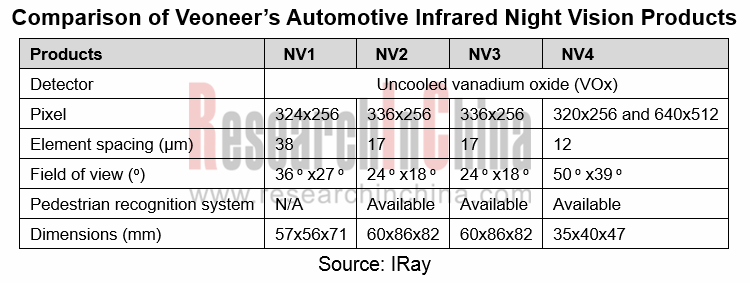
Veoneer is a typical trailblazer that has spawned infrared night vision systems in the world, and its products have experienced four generations. Its 4th-Gen night vision system, expected in June 2020, will have improved field of view and detection distances, reduction in size, weight and cost featuring enhanced algorithms for pedestrian, animal and vehicle detection as well as supporting night time automatic emergency braking (AEB) solutions.
Boson?-based thermal sensing technology from FLIR Systems has been adopted by Veoneer for its L4 autonomous vehicle production contract, planned for 2021 with a “top global automaker”. Veoneer’s system will include multiple thermal sensing cameras that provide both narrow and wide field-of-view capabilities to enhance the safety of self-driving vehicles, and that help detect and classify a broad range of common roadway objects and are especially adept at detecting people and other living things.
Hongqi H7 is provided with an advanced active night vision (ANV) system, which uses the infrared transmitter on the headlights and the camera on the front windshield to simultaneously monitor the area ahead of the vehicle, so that the driver can get clear road conditions at any time.
The near infrared (NIR) night vision system exploited by Hongqi H7 is worth thousands of yuan. Only far infrared thermal imaging technology can see the distance beyond 300 meters.
FLIR has been sparing no effort in the availability of infrared thermal imaging technology in automobiles. In August 2019, FLIR announced its next-generation thermal vision Automotive Development Kit (ADK?) featuring the high-resolution FLIR Boson? thermal camera core with a resolution of 640 × 512 for the development of self-driving cars.
Uncooled infrared imagers and detector technology remain hot in research to date In August 2019, IRay Technology released a 10-μm 1280 × 1024 uncooled infrared focal plane detector. Maxtech predicts that the unit price of uncooled thermal imaging cameras will be below $2,000 after 2021, and the sales will outnumber 3 million units.
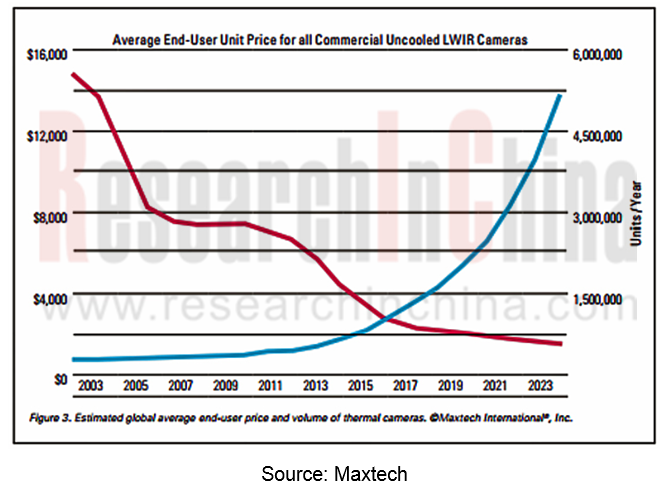
Still, infrared cameras are too expensive for automotive use. Israel-based ADASKY, China's Dali Technology, Guide Infrared and North Guangwei Technology are working on the development and mass production of low-cost infrared thermal imagers.
AI-Defined Vehicle (AIDV) OEMs' Deployment Strategies Research Report, 2026
AIDV Research: Deployment Strategies of 22 OEMs
The AI-Defined Vehicle (AIDV) OEMs' Deployment Strategies Research Report, 2026, released by ResearchInChina, analyzes the AI deployment strategies of ...
OEMs’ Passenger Car Model Planning Research Report, 2026
Vehicle Model Planning Research: Chinese OEMs Launch Sub-Brands Intensively, While Multinational OEMs Apply the Brakes to Electrification Strategies
ResearchInChina released the OEMs’ Passenger Car M...
Autonomous Driving Simulation and World Model Research Report, 2026
Autonomous driving simulation research: "Simulation test + world model"-driven test system has become R&D infrastructure.
The "Autonomous Driving Simulation and World Model Research Report, 2026"...
Cockpit-Driving Integration Central Domain Controller SoC and AI Supercomputing Architecture Research Report, 2026
Cockpit-Driving integration and AI supercomputing research: The One Chip solution is rapidly installed in vehicles, and AI supercomputing architectures are moving towards full-domain integration.
AI ...
Intelligent Driving End-to-End Large Model Research Report, 2026
Research on Intelligent Driving Large Models: A Critical Period for Technological Competition and Paradigm Integration
As autonomous driving technology rapidly iterates from L2 to L3?L4, intelligent...
Automotive Digital Key Industry Trend Report, 2026
Digital Key Research: Automotive BLE, UWB and SLE Hardware Layout
The Automotive Digital Key Industry Trend Report, 2026, released by ResearchInChina, analyzes and predicts the digital key market, co...
Monthly Report on Automotive New Technology (May 2026)
UHD gaze technology, full-color LiDAR, UWB, etc. promote the upgrade of intelligent driving perception capabilities
This report is published once a month and is available for annual subscription.The...
In-Cabin Monitoring Systems (DMS, OMS, etc.) Research Report, 2026
In-Cabin Monitoring System Research: DMS to Become Mandatory in 2027, Expected to be Installed in Over 14 Million Vehicles
ResearchInChina released the In-Cabin Monitoring Systems (DMS, OMS, etc.) Re...
Automotive Service-Oriented Architecture (SOA) and Cross-Domain Middleware Industry Report, 2026
Research on automotive SOA and cross-domain middleware: The era of AI atomic services and AI cross-domain fusion agents is coming.
Automotive SOA evolves towards AI + full SOA servitization Driv...
Automotive Display, Center Console and Cluster Industry Report, 2026
Automotive Display Research: Multi-Screen Application Slows Down, While OLED and MiniLED Are Introduced in Vehicles Quickly
In 2026, automotive displays will no longer excessively pursue the number a...
Global and China Intelligent Vehicle Standard System Construction and Certification Research Report, 2026
Intelligent Driving Standards and Certification: With the Maturing Standardization System, China Will Participate in Formulation of Global Standards
China's automotive industry is transforming from ...
Automotive Intelligent Diagnosis Industry Report, 2026
Automotive Intelligent Diagnosis Research: Powered by AI, Remote Diagnosis Is Being Upgraded towards Intelligence.
ResearchInChina released the Automotive Intelligent Diagnosis Industry Report, 2026....
Automotive Cloud Service Platform Research Report, 2026
Research on automotive cloud service platform: with architecture upgrade and computing power improvement, cloud services enter a new stage
In 2026, the Internet of Vehicles industry generates petaby...
Integrated Battery and Innovative Battery Technology Research Report, 2026
Power Battery Research: Sales of High-Capacity Vehicles Keep Rising, and Solid-State Batteries Begin to Be Installed in Vehicles
I. Sales of High-Capacity Vehicles Sustain Growth, and Those with A C...
Chinese Independent OEMs’ ADAS and Autonomous Driving Report, 2026
Research on OEMs' Intelligent Driving: Era of Physical AI, Standard Configuration of D2D, and Initial Exploration of L3 Commercial Pilot Projects
From 2023 to 2025, the intelligent driving installati...
Intelligent Vehicle New Technology Application Analysis Report, 2025-2026
New Technology Research: Innovative Products such as Bionic Cameras, Vision-LiDAR Fusion Sensors, Auditory Sensors Further Enhance Vehicle Perception Capabilities
ForewordResearchInChina released th...
Automotive Optical Fiber Communication (Optical Fiber Ethernet, PON) and Supply Chain Research Report, 2026
Research on Automotive Optical Fiber Communication: Introduction of Optical Fiber in Vehicles Accelerates, with Priority Deployment in High-Speed Communication Link (10+Gbps) Scenarios
Automotive opt...
Automotive Intelligent Cockpit SoC Research Report, 2026
Automotive Cockpit SoC Research: Passenger Cars in the Price Range of RMB100,000–200,000 Account for Nearly 50% of Total Sales, and New-Generation Cockpit SoC Products Largely Enter Mass Production
P...