|
 |
Automotive OTA Research Report, 2019-2020
|
Automotive OTA Research: 3.838 Million Passenger Cars Packed OTA Capability in China in 2019, Soaring by 60.6% Year on Year
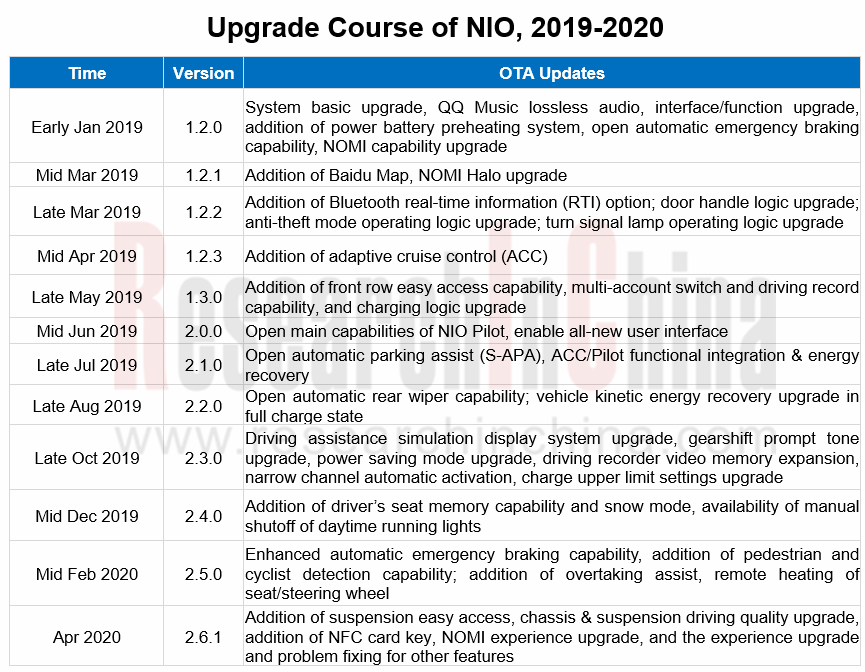
Against all odds, controversial Tesla and NIO were eventually out of the woods. What they live on is FOTA (Firmware-over-the-air). Upgrading software and hardware provides new experience for car owners, making them more satisfied and very loyal.
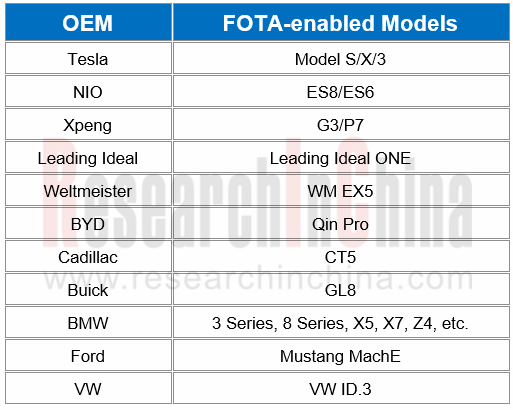
Even nowadays, few vehicle models enable FOTA, really a hard nut to crack.
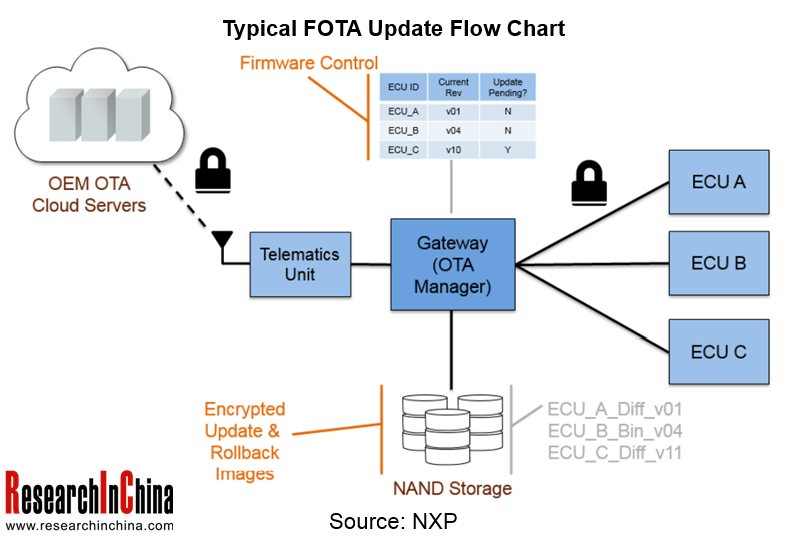
Considering safety and FOTA challenges, traditional automakers mostly choose to tap into vehicle system SOTA (Software-over-the-air) and act prudently in FOTA promotion. Through the lens of a typical FOTA flow, realizing FOTA needs E/E architecture disruption, and the support of new technologies like automotive Ethernet, cyber security, intelligent gateway, great computing power, and large memory.
Conventional OEMs have made slow progress in FOTA development over the past several years. Yet they took a big step forward in 2019. It can be seen from the table below that there is a gap between main OEMs and Tesla. Success of Tesla Model 3 weighs so heavily on traditional automakers that they are highly endangered except sweating for rapid transformation.
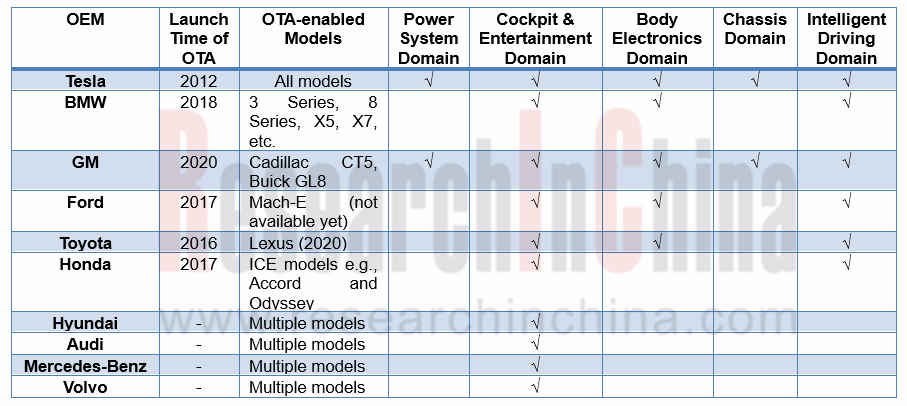
VW is the most aggressive among OEMs, while its counterparts are also working hard. The race to roll out intelligent gateway chip in early 2020 is a reflection of OEM’s eager hoping to enable FOTA as early as possible just as Tesla has done.
Installation of SOTA easier to realize is soaring in both volume and rate. In 2019, 3.838 million passenger cars, or 19% of the total, were provided with SOTA, jumping by 60.6% compared with 2.39 million units, or 11.8% of the total in 2018, according to ResearchInChina.
Among typical OEMs, GM leads in OTA capability. Its new-generation electronic architecture enables FOTA updates on its ICE models, which means OTA is available to recalibrate or upgrade engine and transmission control modules, vehicle communication system, entertainment system, driving control and body control ECU at a later stage.
In 2020, Buick’s latest interconnection system, eConnect3.0 enables OTA updates of 9 major models such as OnStar module, IVI system, intelligent driving control module, body control module, and iBooster brake booster.
In 2020, the latest Cadillac CT5 model will pack GM’s new electronic architecture. CT5 allows OTA updates of more than 30 vehicle control modules including software modules (e.g., IVI and smart connectivity) and firmware electronic modules (e.g., powertrain, chassis and electrical control).
GM plans to apply its next-generation E/E architecture to most of its car lineups before 2023.
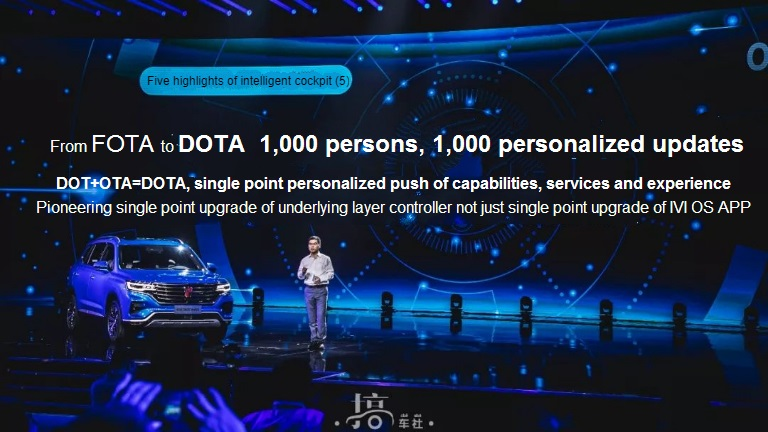
Chinese companies that excel in application layer innovation already make plenty of OTA micro-innovations. Examples include SAIC providing personalized OTA -- DOTA, and BYD and XPENG Motors both offering high temperature disinfection capability enabled by OTA updates.
In April 2020, BYD announced its new models like Tang added with “high temperature disinfection capability” enabled by OTA updates. This capability is not simple upgrade and introduction but involves a complete set of OTA-based working logic of multiple ECUs (e.g., multimedia, air-conditioner controller and PTC heater) in a safe way.
1. Overview of Automotive OTA Industry
1.1 Concept of OTA and Technologies
1.1.1 Definition of OTA
1.1.2 Difference between SOTA and FOTA
1.1.3 Basic Architecture of Automotive OTA
1.1.4 Automotive Software Development Process in OTA Mode
1.1.5 Upgrade Process of Automotive OTA
1.1.6 Transmission Mode of Automotive OTA
1.1.7 Key Technologies on Automotive OTA
1.2 Role of OTA and Challenges
1.2.1 Main Benefits of Automotive OTA
1.2.2 Remote Status Monitoring, Diagnosis and Maintenance
1.2.3 OTA Optimizes the Vehicle Development Process
1.2.4 Remote Diagnosis and Predictive Diagnosis
1.2.5 Major Difficulties in Automotive OTA Use
1.3 OTA Industry Chain
1.3.1 Automotive OTA Industry Chain Structure
1.3.2 Main Business Modes of Automotive OTA
1.3.3 OTA Layout of Major Enterprises: Independent Suppliers
1.3.4 OTA Layout of Major Enterprises: Tier1 Suppliers
1.3.5 OTA Layout of Major Enterprises: OTA Customers of Tier1 Suppliers
1.3.6 Vehicle Models with OTA
2. Independent OTA Technology Providers and Solutions
2.1 Harman
2.1.1 Profile
2.1.2 OTA and Ignite Cloud Platform
2.1.3 OTA Development Course
2.1.4 Remote Vehicle Updating Service
2.1.5 OTA Solution and Latest Features
2.1.6 OTA Business Dynamic
2.1.7 Application Case (1)
2.1.8 Application Case (2)
2.2 Excelfore
2.2.1 Profile
2.2.2 OTA Solution and Features
2.2.3 Application Case and OTA Business Dynamic
2.2.4 eSync Alliance
2.2.5 Major Customers
2.3 Airbiquity
2.3.1 Profile
2.3.2 OTA Solution
2.3.3 Application Case (1)
2.3.3 Application Case (2)
2.3.4 OTA Business Dynamic
2.4 Windriver
2.4.1 Profile
2.4.2 OTA Solution
2.4.3 OTA Business Dynamic
2.4.4 Application Case
2.5 ABUP
2.5.1 Profile
2.5.2 Development Course
2.5.3 Main Products
2.5.4 Customers and Partners
2.6 Redstone
2.6.1 Profile
2.6.2 OTA Solution and Latest Features
2.6.3 Application Case and OTA Business Dynamic
2.6.4 Major Customers
2.7 CAROTA
2.7.1 Profile
2.7.2 OTA Solution
2.7.3 Automotive Remote Intelligent Diagnosis Platform
2.7.4 OTA Solution
2.7.5 Application Case and OTA Business Dynamic
2.7.6 Partners and Strategic Layout
3. OTA Business of Tier 1 Suppliers
3.1 Bosch
3.1.1 OTA Business Layout
3.1.2 OTA Solution
3.1.3 OTA Solution Charge Standard
3.1.4 FOTA Solution
3.1.5 OTA Software Upgrade Management Program
3.1.6 Telematics Service Architecture
3.1.7 OTA Security Solution
3.1.8 OTA Technology Roadmap
3.1.9 Applied Scenario
3.1.10 Partners and OTA Business Dynamic
3.2 Continental
3.2.1 OTA Layout
3.2.2 OTA Solution
3.2.3 Remote Analysis Solution
3.2.4 OTA Security Solution
3.2.5 OTA and EB Corbos Product Integration
3.2.6 Application Case
3.2.7 Partners and Business Dynamic
3.3 Aptiv
3.3.1 OTA Business Layout
3.3.2 OTA Solution and Customers
3.3.3 OTA Business Layout
3.3.4 Application Case and OTA Business Dynamic
3.4 ZF
3.4.1 OTA Solution and Partners
3.5 Denso
3.5.1 OTA Solution and Partners
3.5.2 Cybersecurity Layout
3.6 Faurecia
3.6.1 OTA Dynamic
3.6.2 Cybersecurity Dynamic
3.7 Banma
3.8 Neusoft
3.8.1 OTA Solution
3.8.2 OTA Security Solution
3.9 Desay SV
3.9.1 Profile
3.9.2 OTA Solution
3.9.3 Application Case and OTA Business Dynamic
3.10 Pateo
3.11 Joyson Electronics
3.11.1 Business Introduction
3.11.2 OTA Solution
3.11.3 Layout and Dynamic
3.12 ThunderSoft
3.12.1 OTA Solution
3.12.2 Features of OTA
3.12.3 Application Case and OTA Business Dynamic
4. OTA Features and Layout of Major Foreign Automakers
4.1 Tesla
4.1.1 Vehicle Models Supported and Technical Features of OTA
4.1.2 Main Steps of OTA Upgrade
4.1.3 Upgrade History of OTA
4.1.4 Upgrade of OTA, 2019 -2020
4.1.5 Planning for Vehicle Models
4.1.6 OTA Fee Mode
4.2 General Motors
4.2.1 Vehicle Models Supported and Technical Features of OTA
4.2.2 OTA Feature Layout
4.2.3 Upgrade Process of OTA Features
4.2.4 Partners
4.2.5 Development Plan
4.3 Ford
4.3.1 Vehicle Models Supported and Software Update Mode
4.3.2 OTA Dynamic
4.3.3 Technical Features of OTA
4.3.4 Partners and Development Plan
4.4 Toyota
4.4.1 Vehicle Models Supported
4.4.2 Current Connectivity Services
4.4.3 OTA Layout
4.4.4 Partners and Cooperation
4.4.5 MSPF Platform
4.4.6 Application of OTA Features
4.5 Honda
4.5.1 Vehicle Models Supported
4.5.2 Technical Features of OTA
4.5.3 OTA Capability
4.6 Hyundai
4.6.1 Vehicle Models Supported and Technical Features of OTA
4.6.2 OTA Capability
4.6.3 Partners and Cooperation
4.7 Volkswagen
4.7.1 Vehicle Models Supported
4.7.2 VW.OS for FOTA
4.7.3 OTA Layout and Planning
4.8 BMW
4.8.1 Technical Features of OTA
4.8.2 Vehicle Models Supported
4.8.3 Remote Upgrade Process
4.8.4 Upgrade of OTA Features
4.8.5 Partners and Development Plan
4.9 Daimler
4.9.1 Vehicle Models Supported and Technical Features of OTA
4.9.2 Partners and Development Dynamic
4.10 Volvo
4.10.1 Vehicle Models Supported
4.10.2 Networked Platform
4.10.3 OTA Application
4.11 OTA Deployment of Major Foreign Automakers
5. OTA Features and Layout of Major Chinese Automakers
5.1 SAIC
5.1.1 Vehicle Models Supported and Technical Features of OTA
5.1.2 Upgrade History of OTA
5.1.3 OTA Technology Layout
5.2 Geely
5.2.1 Vehicle Models Supported
5.2.2 Upgrade History of OTA
5.3 GAC
5.3.1 Vehicle Models Supported and Technical Features of OTA
5.3.2 Upgrade History of OTA
5.3.3 Cooperation in OTA
5.4 Changan Automobile
5.4.1 Vehicle Models Supported and Technical Features of OTA
5.4.2 Upgrade History of OTA
5.4.3 Partners and Development Plan
5.5 BYD
5.5.1 Vehicle Models Supported and Technical Features of OTA
5.5.2 Upgrade History of OTA
5.5.3 Partners and Development Plan
5.6 BAIC BJEV
5.6.1 Vehicle Models Supported and Technical Features of OTA
5.6.2 Partners and Development Plan
5.7 NextEV
5.7.1 Vehicle Models Supported and Technical Features of OTA
5.7.2 Upgrade History of OTA
5.8 XPeng
5.8.1 Vehicle Models Supported and Features of OTA
5.8.2 Upgrade History of OTA
5.8.3 Partners and Development Plan
5.9 WM Motor
5.9.1 Vehicle Models Supported and Technical Features of OTA
5.9.2 Upgrade History of OTA
5.10 Leading Ideal
5.10.1 Features of OTA
5.10.2 Upgrade History of OTA
5.11 FAW
5.11.1 Vehicle Models Supported and Features of OTA
5.11.2 Upgrade History of OTA
5.11.3 Partners
5.12 Great Wall Motor
5.12.1 Vehicle Models Supported and Features of OTA
5.12.2 Partners and Dynamics
5.13 Dongfeng Motor
5.13.1 Vehicle Models Supported and Technical Features of OTA
5.13.2 Upgrade History of OTA
5.13.3 Partners and Development Plan
5.14 Chery
5.14.1 Vehicle Models Supported and Technical Features of OTA
5.14.2 Development Plan
5.15 OTA Deployment of Major Automakers in China
6. Development Trend of Automotive OTA
6.1 OTA and Other New Automotive Technologies
6.1.1 OTA and E/E Architecture
6.1.2 OTA and Automotive Chip
6.1.3 OTA and Automotive Ethernet
6.1.4 OTA and Gateway
6.1.5 Other Requirements of FOTA
6.2 OTA Application Case
6.3 OTA Standards and Market
6.3.1 OTA Regulatory Policy Desires to Be Improved
6.3.2 OTA Specification Timelines in Major Countries
6.3.3 China Automotive OTA Scale, 2018-2025E
6.3.4 Global Automotive OTA Scale, 2020-2025E
AI-Defined Vehicle (AIDV) OEMs' Deployment Strategies Research Report, 2026 AIDV Research: Deployment Strategies of 22 OEMs
The AI-Defined Vehicle (AIDV) OEMs' Deployment Strategies Research Report, 2026, released by ResearchInChina, analyzes the AI deployment strategies of ... OEMs’ Passenger Car Model Planning Research Report, 2026 Vehicle Model Planning Research: Chinese OEMs Launch Sub-Brands Intensively, While Multinational OEMs Apply the Brakes to Electrification Strategies
ResearchInChina released the OEMs’ Passenger Car M... Autonomous Driving Simulation and World Model Research Report, 2026 Autonomous driving simulation research: "Simulation test + world model"-driven test system has become R&D infrastructure.
The "Autonomous Driving Simulation and World Model Research Report, 2026"... Cockpit-Driving Integration Central Domain Controller SoC and AI Supercomputing Architecture Research Report, 2026 Cockpit-Driving integration and AI supercomputing research: The One Chip solution is rapidly installed in vehicles, and AI supercomputing architectures are moving towards full-domain integration.
AI ... Intelligent Driving End-to-End Large Model Research Report, 2026 Research on Intelligent Driving Large Models: A Critical Period for Technological Competition and Paradigm Integration
As autonomous driving technology rapidly iterates from L2 to L3?L4, intelligent... Automotive Digital Key Industry Trend Report, 2026 Digital Key Research: Automotive BLE, UWB and SLE Hardware Layout
The Automotive Digital Key Industry Trend Report, 2026, released by ResearchInChina, analyzes and predicts the digital key market, co... Monthly Report on Automotive New Technology (May 2026) UHD gaze technology, full-color LiDAR, UWB, etc. promote the upgrade of intelligent driving perception capabilities
This report is published once a month and is available for annual subscription.The... In-Cabin Monitoring Systems (DMS, OMS, etc.) Research Report, 2026 In-Cabin Monitoring System Research: DMS to Become Mandatory in 2027, Expected to be Installed in Over 14 Million Vehicles
ResearchInChina released the In-Cabin Monitoring Systems (DMS, OMS, etc.) Re... Automotive Service-Oriented Architecture (SOA) and Cross-Domain Middleware Industry Report, 2026 Research on automotive SOA and cross-domain middleware: The era of AI atomic services and AI cross-domain fusion agents is coming.
Automotive SOA evolves towards AI + full SOA servitization Driv... Automotive Display, Center Console and Cluster Industry Report, 2026 Automotive Display Research: Multi-Screen Application Slows Down, While OLED and MiniLED Are Introduced in Vehicles Quickly
In 2026, automotive displays will no longer excessively pursue the number a... Global and China Intelligent Vehicle Standard System Construction and Certification Research Report, 2026 Intelligent Driving Standards and Certification: With the Maturing Standardization System, China Will Participate in Formulation of Global Standards
China's automotive industry is transforming from ... Automotive Intelligent Diagnosis Industry Report, 2026 Automotive Intelligent Diagnosis Research: Powered by AI, Remote Diagnosis Is Being Upgraded towards Intelligence.
ResearchInChina released the Automotive Intelligent Diagnosis Industry Report, 2026.... Automotive Cloud Service Platform Research Report, 2026 Research on automotive cloud service platform: with architecture upgrade and computing power improvement, cloud services enter a new stage
In 2026, the Internet of Vehicles industry generates petaby... Integrated Battery and Innovative Battery Technology Research Report, 2026 Power Battery Research: Sales of High-Capacity Vehicles Keep Rising, and Solid-State Batteries Begin to Be Installed in Vehicles
I. Sales of High-Capacity Vehicles Sustain Growth, and Those with A C... Chinese Independent OEMs’ ADAS and Autonomous Driving Report, 2026 Research on OEMs' Intelligent Driving: Era of Physical AI, Standard Configuration of D2D, and Initial Exploration of L3 Commercial Pilot Projects
From 2023 to 2025, the intelligent driving installati... Intelligent Vehicle New Technology Application Analysis Report, 2025-2026 New Technology Research: Innovative Products such as Bionic Cameras, Vision-LiDAR Fusion Sensors, Auditory Sensors Further Enhance Vehicle Perception Capabilities
ForewordResearchInChina released th... Automotive Optical Fiber Communication (Optical Fiber Ethernet, PON) and Supply Chain Research Report, 2026 Research on Automotive Optical Fiber Communication: Introduction of Optical Fiber in Vehicles Accelerates, with Priority Deployment in High-Speed Communication Link (10+Gbps) Scenarios
Automotive opt... Automotive Intelligent Cockpit SoC Research Report, 2026 Automotive Cockpit SoC Research: Passenger Cars in the Price Range of RMB100,000–200,000 Account for Nearly 50% of Total Sales, and New-Generation Cockpit SoC Products Largely Enter Mass Production
P...
|