As one of the top three Tier1 suppliers in the world, Denso makes adjustments and deployments during the automotive industry disruption.
Sorting out Denso’s existing product lines, up to 200-plus varieties are found, including virtually 70 for CASE (connectivity, automation, sharing and electrification).
Denso’s CASE Products (Part)
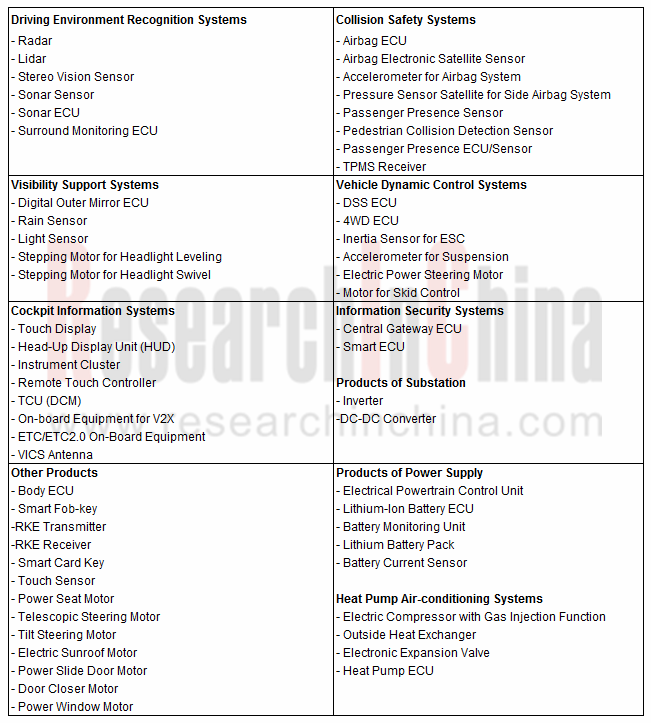
Source: Marklines; ResearchInChina
The number of auto parts will decrease in the trend towards CASE. In a recent opinion, automotive hardware will be standardized and contribute declining revenue and profits, and future competition lies in the ability to develop software-defined vehicles. Emerging carmakers have late-mover advantages with more software talents.
Another view is that Tier1 suppliers will be marginalized by OEMs (e.g., Tesla and VW) who try to lead research and development of operating system, DCU (or vehicle central computer) and core software and hardware systems.
It can be seen from Denso’s CASE layout that the supplier not only makes deployments in all aspects of hardware but spends on software not less than IT-backed firms.
Denso’s Investment in Hardware
The US government’s crackdown on Chinese high-tech companies shows that just developing software and applications at the upper layer is not enough, and holding basic materials, core components and basic software is the only way to be free of others.
Denso lavishes heavily on core fundamental technologies, including magnetic materials, power semiconductors, solid-state batteries, magnetic heat pumps, human-computer interaction, AI, sensors, and quantum computing.
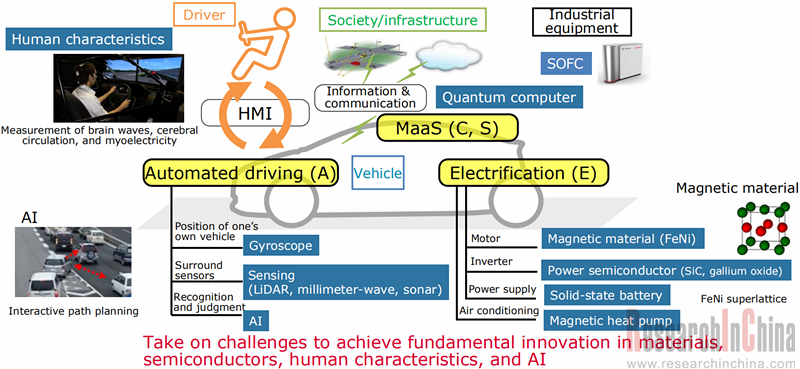
In 2018, Denso invested FLOSFIA and collaborated with the latter on developing a next-generation power semiconductor material (α-Ga2O3) for vehicle application. Schottky Barrier Diode (SBD), Flosfia’s α- Ga2O3 material, can work under 600V and 10A, with rated power of 100W-1kW, outperforming SiC products in both efficiency and cost. SBD is expected to be spawned in 2020. Theoretically, SBD material is seven times more efficient than GaN in low frequency and doubles GaN in high frequency or more.
Denso has been devoted to researching automotive semiconductor technology since its IC Laboratory was set up in 1968, having made improvements in ECU, sensor and other products. In September 2017, Denso founded a subsidiary -- NSITEXE, a developer of next-generation high-performance semiconductors. DFP (data flow processor) independently developed by NSITEXE, differs totally from CPU and GPU. For practical use of DFP, Denso and NSITEXE then invested Blaize and quadric.io, two semiconductor start-ups. Blaize, founded by former workers at Intel in 2012, builds software and process architectures from the underlying layer for better AI computing. NSITEXE helps to develop an autonomous driving technology which makes instant judgment in extreme scenarios, by combining DFP and EPU from quadric.io.
Leading Tier1 suppliers from Japan and Germany often adopt IDM model and have their own chip fabrication plants, compared with IC designers focusing on prevailing FABLESS model in China. Denso Hokkaido is Denso’s key manufacturing site of semiconductor sensors. To meet the robust demand from electrification and autonomous driving markets, Denso plans expansion of its Hokkaido plant. The expansion project will break ground in July 2020 and be completed in June 2021. The number of employees will expectedly rise to about 1,150 in 2025.
Denso’s Investment in Software
In 2025, Denso will boast 12,000 software talents worldwide; it will have more than 1,000 staffs and over 1,100 patents in autonomous driving field.
In addition to workforce enlargement for independent development, Denso also invests quite a few software firms.
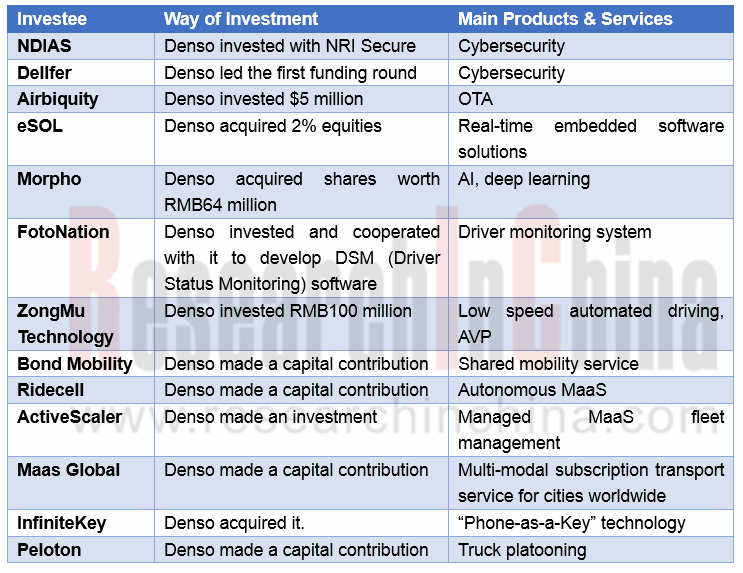
Denso’s Big Competitive Edges in an Age of CASE
From Denso’s alliance, acquisitions and investment map as below as well as the Abstract of this report, it can be seen that Denso is sinking to research and development of core technologies and parts.
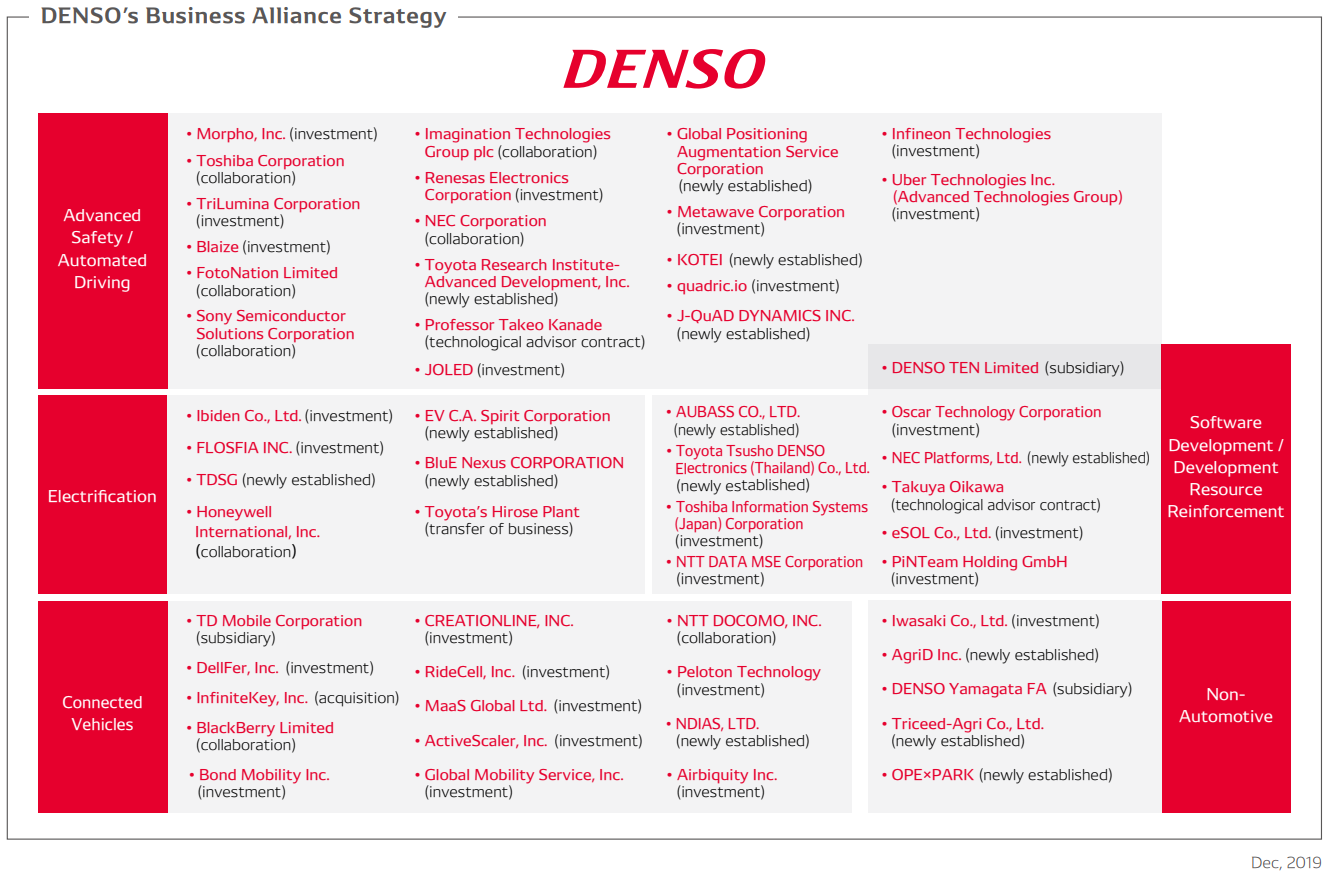
Source: Denso
Tier1 suppliers once gave an impression that they were suppliers of integrated systems for OEMs. As OEMs more set foot in system integration, Denso has turned to research and development of more basic core technologies. Weighed by new entrants from all walks of life, Denso still stays competitive on the strength of its across-the-board product matrices, economies of scale, and software and hardware synergy.
For example, Denso’s cockpit systems integrated with HMI and air-conditioning technologies will offer better user experience. This is an impossibility for the majority of companies who fail as well in high integration at the underlying layer.
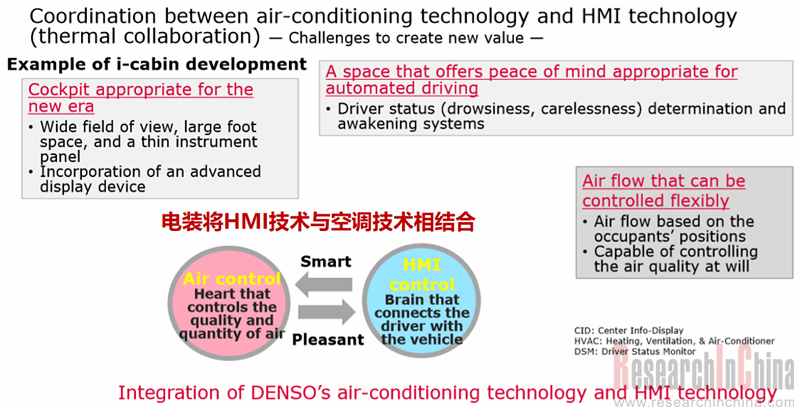
Source: Denso; ResearchInChina
AI-Defined Vehicle (AIDV) OEMs' Deployment Strategies Research Report, 2026
AIDV Research: Deployment Strategies of 22 OEMs
The AI-Defined Vehicle (AIDV) OEMs' Deployment Strategies Research Report, 2026, released by ResearchInChina, analyzes the AI deployment strategies of ...
OEMs’ Passenger Car Model Planning Research Report, 2026
Vehicle Model Planning Research: Chinese OEMs Launch Sub-Brands Intensively, While Multinational OEMs Apply the Brakes to Electrification Strategies
ResearchInChina released the OEMs’ Passenger Car M...
Autonomous Driving Simulation and World Model Research Report, 2026
Autonomous driving simulation research: "Simulation test + world model"-driven test system has become R&D infrastructure.
The "Autonomous Driving Simulation and World Model Research Report, 2026"...
Cockpit-Driving Integration Central Domain Controller SoC and AI Supercomputing Architecture Research Report, 2026
Cockpit-Driving integration and AI supercomputing research: The One Chip solution is rapidly installed in vehicles, and AI supercomputing architectures are moving towards full-domain integration.
AI ...
Intelligent Driving End-to-End Large Model Research Report, 2026
Research on Intelligent Driving Large Models: A Critical Period for Technological Competition and Paradigm Integration
As autonomous driving technology rapidly iterates from L2 to L3?L4, intelligent...
Automotive Digital Key Industry Trend Report, 2026
Digital Key Research: Automotive BLE, UWB and SLE Hardware Layout
The Automotive Digital Key Industry Trend Report, 2026, released by ResearchInChina, analyzes and predicts the digital key market, co...
Monthly Report on Automotive New Technology (May 2026)
UHD gaze technology, full-color LiDAR, UWB, etc. promote the upgrade of intelligent driving perception capabilities
This report is published once a month and is available for annual subscription.The...
In-Cabin Monitoring Systems (DMS, OMS, etc.) Research Report, 2026
In-Cabin Monitoring System Research: DMS to Become Mandatory in 2027, Expected to be Installed in Over 14 Million Vehicles
ResearchInChina released the In-Cabin Monitoring Systems (DMS, OMS, etc.) Re...
Automotive Service-Oriented Architecture (SOA) and Cross-Domain Middleware Industry Report, 2026
Research on automotive SOA and cross-domain middleware: The era of AI atomic services and AI cross-domain fusion agents is coming.
Automotive SOA evolves towards AI + full SOA servitization Driv...
Automotive Display, Center Console and Cluster Industry Report, 2026
Automotive Display Research: Multi-Screen Application Slows Down, While OLED and MiniLED Are Introduced in Vehicles Quickly
In 2026, automotive displays will no longer excessively pursue the number a...
Global and China Intelligent Vehicle Standard System Construction and Certification Research Report, 2026
Intelligent Driving Standards and Certification: With the Maturing Standardization System, China Will Participate in Formulation of Global Standards
China's automotive industry is transforming from ...
Automotive Intelligent Diagnosis Industry Report, 2026
Automotive Intelligent Diagnosis Research: Powered by AI, Remote Diagnosis Is Being Upgraded towards Intelligence.
ResearchInChina released the Automotive Intelligent Diagnosis Industry Report, 2026....
Automotive Cloud Service Platform Research Report, 2026
Research on automotive cloud service platform: with architecture upgrade and computing power improvement, cloud services enter a new stage
In 2026, the Internet of Vehicles industry generates petaby...
Integrated Battery and Innovative Battery Technology Research Report, 2026
Power Battery Research: Sales of High-Capacity Vehicles Keep Rising, and Solid-State Batteries Begin to Be Installed in Vehicles
I. Sales of High-Capacity Vehicles Sustain Growth, and Those with A C...
Chinese Independent OEMs’ ADAS and Autonomous Driving Report, 2026
Research on OEMs' Intelligent Driving: Era of Physical AI, Standard Configuration of D2D, and Initial Exploration of L3 Commercial Pilot Projects
From 2023 to 2025, the intelligent driving installati...
Intelligent Vehicle New Technology Application Analysis Report, 2025-2026
New Technology Research: Innovative Products such as Bionic Cameras, Vision-LiDAR Fusion Sensors, Auditory Sensors Further Enhance Vehicle Perception Capabilities
ForewordResearchInChina released th...
Automotive Optical Fiber Communication (Optical Fiber Ethernet, PON) and Supply Chain Research Report, 2026
Research on Automotive Optical Fiber Communication: Introduction of Optical Fiber in Vehicles Accelerates, with Priority Deployment in High-Speed Communication Link (10+Gbps) Scenarios
Automotive opt...
Automotive Intelligent Cockpit SoC Research Report, 2026
Automotive Cockpit SoC Research: Passenger Cars in the Price Range of RMB100,000–200,000 Account for Nearly 50% of Total Sales, and New-Generation Cockpit SoC Products Largely Enter Mass Production
P...