AUTOSAR Research Report: in the Era of Software Defined Vehicles (SDV), Will an OEM Acquire an AUTOSAR Software Firm?
Software defined vehicle (SDV) and architecture defined vehicle are hotly debated among insiders recently. Yet, the technical standard – AUTOSAR are essential for them.
AUTomotive Open System ARchitecture (AUTOSAR) is a worldwide development partnership of vehicle manufacturers, suppliers, service providers and companies from the automotive electronics, semiconductor and software industry. Since 2003, they have been working on the development and introduction of several open, standardized software platforms for the automotive industry. The "Core Partners" of AUTOSAR are the BMW Group, Bosch, Continental, Daimler, Ford, General Motors, the PSA Group, Toyota and the Volkswagen Group.
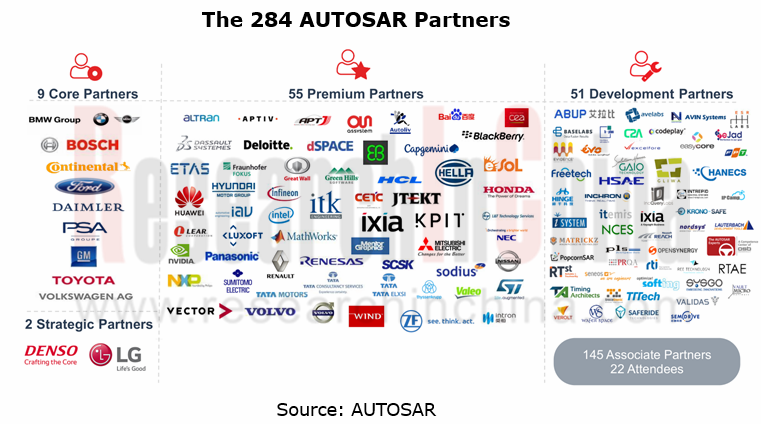
As of May 2020, AUTOSAR has accommodated 284 members, including some Chinese companies, like Great Wall Motor, FAW, Dongfeng Motor, HiRain Technologies, iSoft Infrastructure Software, SAIC and Neusoft Reach.
It seems that not many Chinese companies are on the AUTOSAR member list. Nevertheless, the Automotive Software Ecosystem Member Organization of China (AUTOSEMO), founded in July 2020, involves 9 automakers (FAW, SAIC, GAC, NIO, Geely, Great Wall Motor, Dongfeng Motor, FAW Jiefang and Xiaopeng Motors) and 6 suppliers (Neusoft Reach, HiRain Technologies, Shanghai Nasn Automotive Electronics, Shenzhen VMAX Power, Shanghai Re-Fire Technology and Horizon Robotics). Based on AUTOSAR, AUTOSEMO is striving to develop basic software architecture standards and an industrial ecosystem that are led by Chinese companies. AUTOSEMO will temporarily not include the AUTOSAR’s application programming interface API standards (body, transmission, power, chassis, passive safety, HMI, multimedia and telematics) already under development in the business scope of its standard working groups. System software and testing standards of AUTOSEMO are consistent with AUTOSAR.
It can be seen that AUTOSEMO is basically compatible with AUTOSAR.
AUTOSAR standard aims to ensure standardization, reuse and interoperability of software. Currently, two complementary platforms, AUTOSAR Classic and AUTOSAR Adaptive (AP), have been introduced.
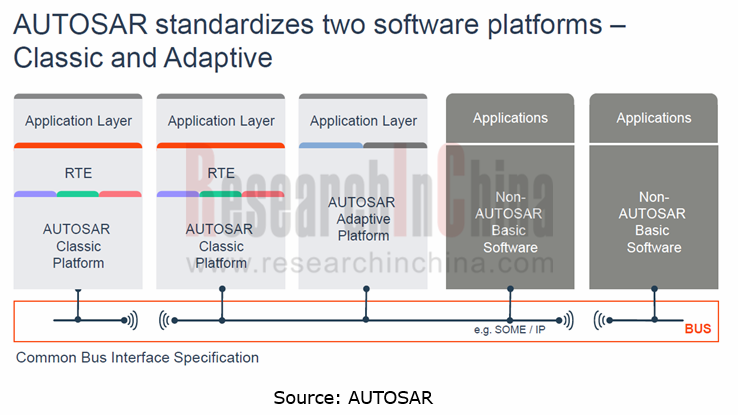
Thereof, AUTOSAR Adaptive Platform is launched to meet needs for developing new-generation autonomous, intelligent connected, electrified vehicles, with features of high flexibility, high performance, HPC support, dynamic communication, and management update. The latest version is R19-11 released in in November 2019.
R19-11 is a layered architecture. It implements the AUTOSAR Runtime for Adaptive Applications (ARA) that consists of Foundation and Service, each of which is comprised of several modules with separate functions.
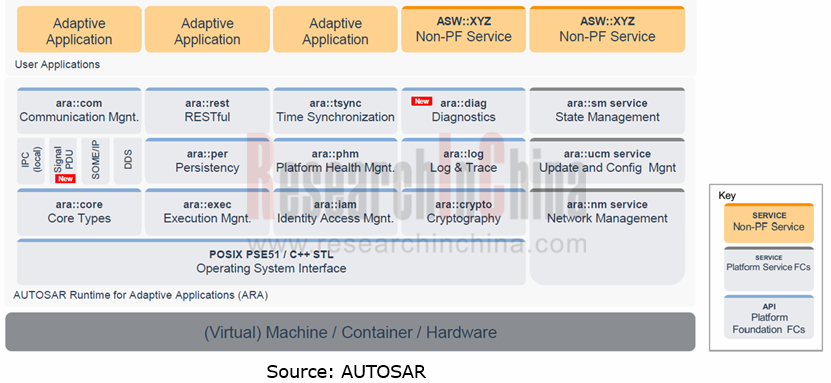
The Service is composed of three functional modules: State Management (SM), Network Management (NM) and Update & Configuration Management (UCM); the Foundation incorporates: Communication Management (COM), Cryptography (Crypto), Log & Trace (Log), Diagnostics (Diag), Persistency (Per), Execution Management (Exec), Time Synchronization (Tsync), etc.. In addition, for OS in the Foundation, the Adaptive Platform requires OS should be those subject to POSIX OS standards, e.g., Linux mcos and QNX.
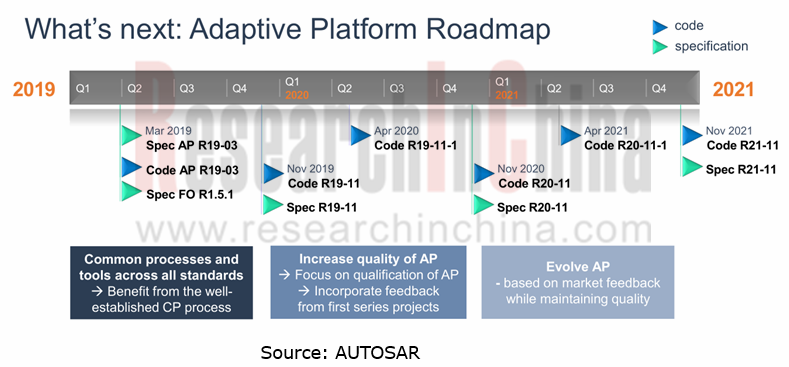
The future version of AUTOSAR Adaptive Platform is expected to pack 23 new features up to multiple requirements such as better interaction between AUTOSAR Classic and AUTOSAR Adaptive, and upgrade of Security and Safety. According to the roadmap, AUTOSAR will offer a new software architecture version every year.
AUTOSAR Adaptive Platform supports all future vehicle APPs, e.g., IVI, V2X, multi-sensor fusion and autonomous driving. AUTOSAR is a standard option of next-generation automotive basic software architecture, for most automakers, components suppliers, software providers and other companies.
ADAS/AD is an applied field of AUTOSAR Adaptive. All autonomous driving domain controllers rolled out by Bosch, Visteon, Continental, Huawei and more, support AUTOSAR Adaptive.
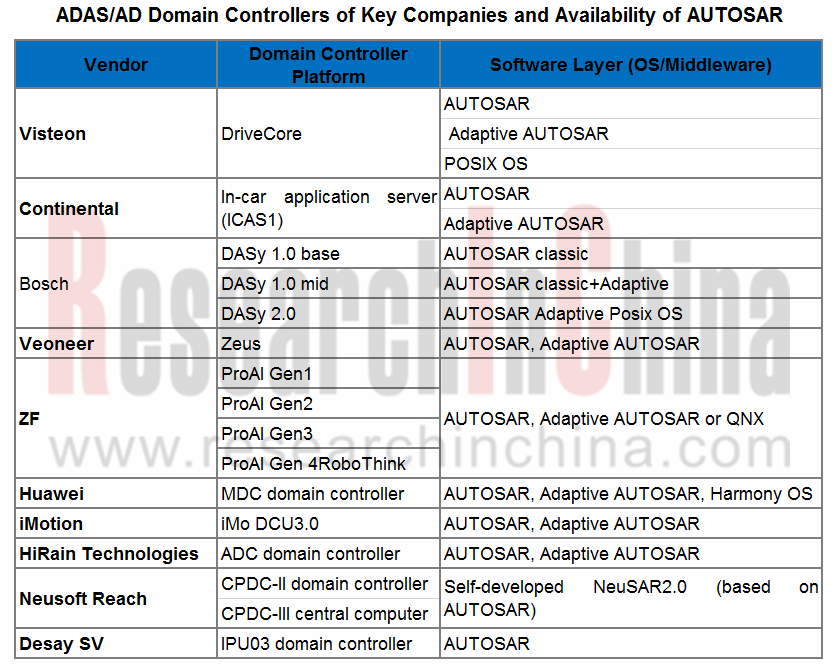
Most of companies make partial use of AUTOSAR standard and few use in a full set, because AUTOSAR Adaptive came out late (the first version became available in 2017) and allows no mixed use of versions and AUTOSAR is complex and expensive with separate charge for every tool chain.
AUTOSAR has built a fairly complex technology system over a decade of development. Tool providers already develop support software to help OEMs accelerate application of AUTOSAR. Well-known AUTOSAR tool software developers include: WindRiver, EB, VECTOR, Mentor, ETAS, KPIT, Neusoft Reach, iSoft Infrastructure Software, HiRain Technologies, TaTa Elxsi and Autron. These AUTOSAR software firms also enrich product lines through mergers and acquisitions for greater competitive edges.
In 2014, Mentor Graphics announced to purchase the AUTOSAR assets, including the Mecel Picea AUTOSAR Development kit, from Mecel AB.
In September 2018, Vector acquired the Swedish embedded software specialist ARCCORE. This acquisition strengthens Vector’s portfolio of products and services in the field of AUTOSAR.
In the coming age of software defined vehicles, AUTOSAR software developers are playing an increasingly important role. It is hard for OEMs to build veteran teams shortly to develop automotive software due to lack of talent, even though they already set up their software firms or software departments in no time. Investing or purchasing AUTOSAR software firms may after all be an option.
In May 2020, Evergrande High Technology Group led the investment of tens of millions of yuan in a Series A funding round of Novauto (Beijing) Co., Ltd.. The “Basic Software Support Platform”, a product of the investee, carries the features: subject to ISO26262 ASIL D; support of AUTOSAR ADAPTIVE; compatibility with AUTOSAR Classic and ROS2; availability of middleware DDS for real-time data communication service; building of a unified, multi-QoS in-vehicle/V2V communication mechanism with high reliability, low latency and high scalability.
AI-Defined Vehicle (AIDV) OEMs' Deployment Strategies Research Report, 2026
AIDV Research: Deployment Strategies of 22 OEMs
The AI-Defined Vehicle (AIDV) OEMs' Deployment Strategies Research Report, 2026, released by ResearchInChina, analyzes the AI deployment strategies of ...
OEMs’ Passenger Car Model Planning Research Report, 2026
Vehicle Model Planning Research: Chinese OEMs Launch Sub-Brands Intensively, While Multinational OEMs Apply the Brakes to Electrification Strategies
ResearchInChina released the OEMs’ Passenger Car M...
Autonomous Driving Simulation and World Model Research Report, 2026
Autonomous driving simulation research: "Simulation test + world model"-driven test system has become R&D infrastructure.
The "Autonomous Driving Simulation and World Model Research Report, 2026"...
Cockpit-Driving Integration Central Domain Controller SoC and AI Supercomputing Architecture Research Report, 2026
Cockpit-Driving integration and AI supercomputing research: The One Chip solution is rapidly installed in vehicles, and AI supercomputing architectures are moving towards full-domain integration.
AI ...
Intelligent Driving End-to-End Large Model Research Report, 2026
Research on Intelligent Driving Large Models: A Critical Period for Technological Competition and Paradigm Integration
As autonomous driving technology rapidly iterates from L2 to L3?L4, intelligent...
Automotive Digital Key Industry Trend Report, 2026
Digital Key Research: Automotive BLE, UWB and SLE Hardware Layout
The Automotive Digital Key Industry Trend Report, 2026, released by ResearchInChina, analyzes and predicts the digital key market, co...
Monthly Report on Automotive New Technology (May 2026)
UHD gaze technology, full-color LiDAR, UWB, etc. promote the upgrade of intelligent driving perception capabilities
This report is published once a month and is available for annual subscription.The...
In-Cabin Monitoring Systems (DMS, OMS, etc.) Research Report, 2026
In-Cabin Monitoring System Research: DMS to Become Mandatory in 2027, Expected to be Installed in Over 14 Million Vehicles
ResearchInChina released the In-Cabin Monitoring Systems (DMS, OMS, etc.) Re...
Automotive Service-Oriented Architecture (SOA) and Cross-Domain Middleware Industry Report, 2026
Research on automotive SOA and cross-domain middleware: The era of AI atomic services and AI cross-domain fusion agents is coming.
Automotive SOA evolves towards AI + full SOA servitization Driv...
Automotive Display, Center Console and Cluster Industry Report, 2026
Automotive Display Research: Multi-Screen Application Slows Down, While OLED and MiniLED Are Introduced in Vehicles Quickly
In 2026, automotive displays will no longer excessively pursue the number a...
Global and China Intelligent Vehicle Standard System Construction and Certification Research Report, 2026
Intelligent Driving Standards and Certification: With the Maturing Standardization System, China Will Participate in Formulation of Global Standards
China's automotive industry is transforming from ...
Automotive Intelligent Diagnosis Industry Report, 2026
Automotive Intelligent Diagnosis Research: Powered by AI, Remote Diagnosis Is Being Upgraded towards Intelligence.
ResearchInChina released the Automotive Intelligent Diagnosis Industry Report, 2026....
Automotive Cloud Service Platform Research Report, 2026
Research on automotive cloud service platform: with architecture upgrade and computing power improvement, cloud services enter a new stage
In 2026, the Internet of Vehicles industry generates petaby...
Integrated Battery and Innovative Battery Technology Research Report, 2026
Power Battery Research: Sales of High-Capacity Vehicles Keep Rising, and Solid-State Batteries Begin to Be Installed in Vehicles
I. Sales of High-Capacity Vehicles Sustain Growth, and Those with A C...
Chinese Independent OEMs’ ADAS and Autonomous Driving Report, 2026
Research on OEMs' Intelligent Driving: Era of Physical AI, Standard Configuration of D2D, and Initial Exploration of L3 Commercial Pilot Projects
From 2023 to 2025, the intelligent driving installati...
Intelligent Vehicle New Technology Application Analysis Report, 2025-2026
New Technology Research: Innovative Products such as Bionic Cameras, Vision-LiDAR Fusion Sensors, Auditory Sensors Further Enhance Vehicle Perception Capabilities
ForewordResearchInChina released th...
Automotive Optical Fiber Communication (Optical Fiber Ethernet, PON) and Supply Chain Research Report, 2026
Research on Automotive Optical Fiber Communication: Introduction of Optical Fiber in Vehicles Accelerates, with Priority Deployment in High-Speed Communication Link (10+Gbps) Scenarios
Automotive opt...
Automotive Intelligent Cockpit SoC Research Report, 2026
Automotive Cockpit SoC Research: Passenger Cars in the Price Range of RMB100,000–200,000 Account for Nearly 50% of Total Sales, and New-Generation Cockpit SoC Products Largely Enter Mass Production
P...