|
 |
Research Report on Telematics Service Providers (TSP) and Their Products, 2021
|
Small and medium TSPs will fade away and TSP giants will come to the front
As “smart car as a service” grows, automakers focus more on introduction of technologies or platforms from big data and cloud computing to security, content platform and artificial intelligence, providing more intelligent, more diversified content and value-added services, while making an expansion in OEM market. As the gateway for vehicle traffic flow, telematics service providers (TSP) are catering to the industrial change by constantly extending services content and boundaries, across fields from initial remote service to phone mirroring and connectivity, then to connected IVI system, finally to integrated telematics system covering people, vehicle and life.
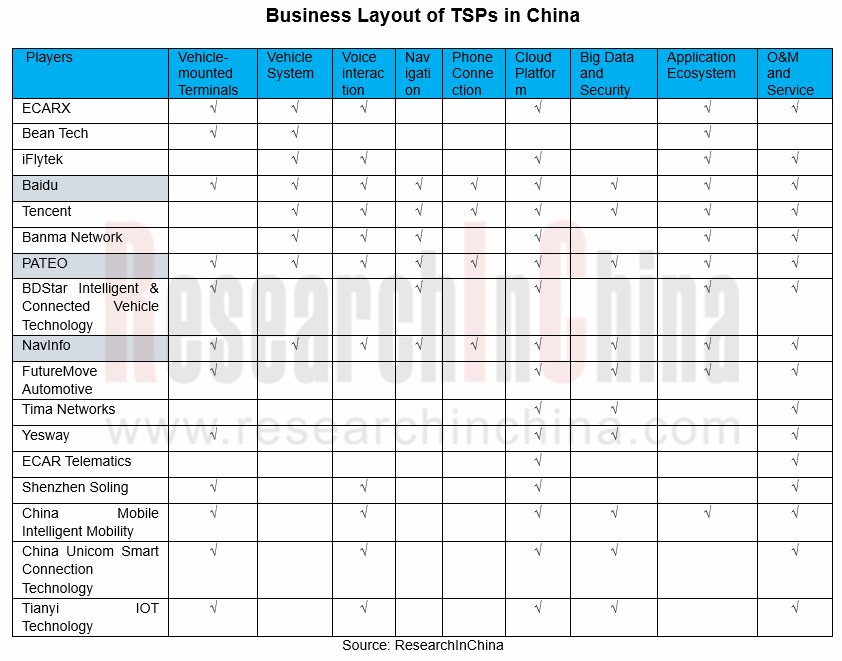
There are four typical types of TSPs: OEMs, telecom operators, internet/technology companies, and third-party platform providers. These players have built a mode of multi-party cooperation. For example, OEMs push for their partnerships with BATH, Pateo and more in their efforts to improve their ability to develop telematics and provide services, and work together with telecom operators to explore 5G + telematics application scenarios and application ecosystem. In the long run, the four major participants will integrate with each other across fields for win-win cooperation.
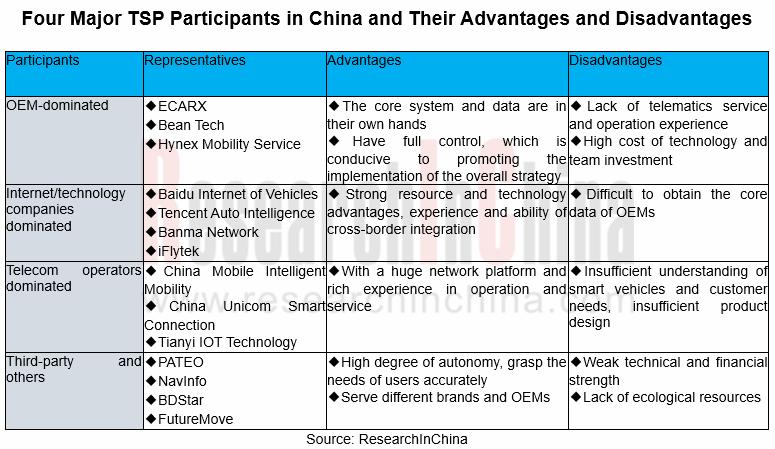
In future, China’s TSP industry will head in the following directions:
1. The closer connection of a vehicle with people, other vehicles, smart home appliances, living services and smart city comes with TSPs’ greater attempts to extend their services and open up their technology and ecosystem for a gradual coverage of all scenarios of mobile phone, car, home and city.
For example, based on extended BATH ecosystem (Baidu, Huawei, Tencent, Suning, Ping An, UnionPay, China Telecom, etc.) and third-party ecosystem, Pateo has made deployments in mobile phone, car, home and city scenarios, and will add “five new operations”, i.e., New Mobility, New Finance, New Retail, New Insurance and New Marketing. Now it has carried out its landing of new car retail strategy together with New Baojun and Sunning Car.
2. As cross-field integration becomes normal, players will achieve complementary advantages, resource sharing, and ecological integration to build a large ecosystem ultimately.
Examples include Baidu, Alibaba and Tencent (BAT) which are establishing closer partnerships with OEMs in more areas. Among them, in late 2020 Alibaba joined hands with SAIC again to set up IM Motors in charge of developing smart electric vehicles, following their establishment of Banma Network Technology (which finished strategic restructuring with AliOS in May 2020, aiming at improving automotive operating system and AI technology and upgrading the cloud-network-edge-terminal open system); based on their in-depth cooperation on intelligent connectivity, cloud technology and Baidu Ecosystem, Baidu and Geely announced they would co-found an intelligent vehicle company in January 2021, with Jidu Auto coming into being on March 2.
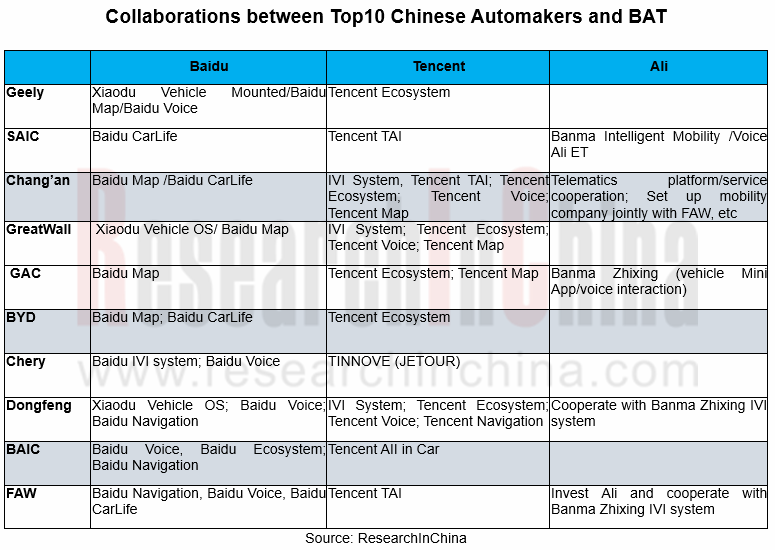
3. OEMs-lead TSPs to provide better IVI system-centric services.
Currently, OEMs have found common ground on intelligent connectivity and digital transformation acceleration. To hold core technology and data, Geely, Great Wall Motor and Honda China have founded their telematics company independently or together with others, with IVI system at the core of their multi-directional deployments:
ECARX: by the end of 2020, GKUI ECARX designed for Geely has been found in more than 40 models under Geely, Lynk & Co, Proton and served a total of over 2.3 million users.
On this basis, ECARX built in-depth cooperation with Baidu, with GKUI19-enabled Boyue PRO access to Baidu Map and Baidu Scenario for recommendation in 2020;
In November 2020, Baidu Map vehicle version became first available to Geely Preface upgrade edition.
In October 2020, ECARX raised RMB1.3 billion in a Series A funding round led by Baidu, which will be spent developing its automotive chip business.
In February 2021, ECARX joined hands with Visteon and Qualcomm to jointly provide intelligent cockpit solutions for the global market; in the same month, ECARX was invested USD200 million in its A+ funding round, which will be used for building an international R&D system and further expanding its global operation.
Bean Tech: Haval Fun-Life 2.0 system co-developed by Bean Tech and Haval integrates with Tencent TAI 3.0 features, and has been installed in several models like Haval Big Dog, Haval F7, Gen 3 H6, and WEY Tank 300. In future, Bean Tech will partner more closely with Haval and Tencent to promote its cloud services (supplied by Tencent Cloud Platform) in Great Wall Motor’s overseas markets and provide full-stack intelligent marketing closed loop services from user profiling and SCRM to advertising and user operation.
4. TSPs face intensified competition and a new reshuffle amid telematics industry change, with four or five giants expected to be born by 2025
Currently, most conventional TSPs have been acquired and integrated into other business by tycoons. A handful of TSPs can run independently. Even Baidu, Alibaba, Tencent and Huawei (BATH) are able to deploy just one of dozens of intelligent connected vehicle product lines each. As OEMs regain dominance in software development, TSPs will contend more fiercely and face a new reshuffle. It is predicted that by 2025, four or five bellwethers that have ability to develop full-stack telematics systems and link vehicles with V2X equipment facilities, earphones, watches, bracelets and various IOT (Internet of Things) device will come out. Small and medium TSPs will be edged out by TSP giants.
1. Overview of TSP
1.1 Position of TSP in Telematics
1.2 Core Modules of TSP
1.3 Core Value of TSP
1.4 Business Model of TSP
2. China TSP Market and Trend
2.1 Telematics steps into the era of vehicle-road-people collaboration, giving birth to a new generation of TSP
2.2 China TSP Market Forms four Camps
2.3 OEM-dominated TSP
2.4 Internet TSP
2.5 Telecom Operator TSP
2.6 Third-party TSP
2.7 Business Layout of Major TSPs
3. OEM-dominated TSPs
3.1 ECARX
3.1.1 Profile
3.1.2 TSP Business
3.1.3 Hardware R&D: Chip Layout
3.1.4 Hardware R&D: Communication Module
3.1.5 Hardware R&D: GKUI AM IVI System
3.1.6 Software R&D: GKUI Ecosystem
3.1.7 Software R&D: Main Functions of GKUI 19
3.1.8 Software R&D: Natural Semantic Recognition and Voice Assistant
3.1.9 Cloud Platform: Developer Platform
3.1.10 Ecological Partners
3.1.11 Ecological Partners: Dynamics
3.1.12 Clients & Services: Geely
3.1.13 Operation & Maintenance and Service
3.2 Bean Tech
3.2.1 Profile
3.2.2 Development Course
3.2.3 TSP Business
3.2.4 Software R&D: Fun-Life
3.2.5 Software R&D: Fun-Life 2.0
3.2.6 Ecological Partners
3.2.7 Clients & Services
4. Internet and Telecom Operators-lead TSPs
4.1 iFlytek
4.1.1 Profile
4.1.2 Development Course of Automotive Business
4.1.3 Intelligent Vehicle Products and Solutions
4.1.4 TSP Business
4.1.5 Hardware R&D: Flying Fish IVI
4.1.6 Software R&D: iFLY OS
4.1.7 Software R&D: Flying Fish OS
4.1.8 Software R&D: Flying Fish OS 2.0
4.1.9 Software R&D: Flying Fish OS 3.0
4.1.10 Software R&D: Flying Fish OS MATE 2021
4.1.11 Software R&D: Flying Fish Assistant MM 2021
4.1.12 Cloud Platform
4.1.14 Ecological Partners
4.1.15 Clients & Service
4.1.16 Operation & Maintenance and Service
4.2 Baidu Internet of Vehicles
4.2.1 Profile
4.2.2 Telematics Solutions
4.2.3 TSP Business
4.2.4 Hardware R&D: Baidu Intelligent Box
4.2.5 Hardware R&D: Baidu “DuMirror”
4.2.6 Hardware R&D: Baidu Honghu Voice Chip
4.2.7 Hardware R&D: Xiaodu Voice Vehicle Bracket
4.2.8 Software R&D: Xiaodu Vehicle Application
4.2.9 Software R&D: Xiaodu Vehicle Application in 2020
4.2.10 Software R&D: Xiaodu Vehicle Application in 2021
4.2.11 Software R&D: Highlights of Xiaodu Vehicle Application in 2021
4.2.12 Software R&D: Xiaodu Vehicle Application Performance (as of Dec.2020)
4.2.13 Software R&D: Baidu CarLife+
4.2.14 Software R&D: Xiaodu Assistant
4.2.15 Software R&D: Vehicle Intelligent Mini Apps
4.2.16 Cloud Platform: Apollo Intelligent Vehicle Cloud
4.2.17 Ecological Partners
4.2.18 Clients & Services
4.3 Tencent Auto Intelligence
4.3.1 Profile
4.3.2 Development Course of Telematics
4.3.3 Tencent Intelligent Mobility Business
4.3.4 Tencent Intelligent Mobility Ecosystem (TIME)
4.3.5 TSP Business
4.3.6 Software R&D: Tencent Ecosystem Telematics Solution
4.3.7 Software R&D: Tencent TAI3.0
4.3.8 Software R&D: Tencent Small Scene
4.3.10 Software R&D: Vehicle Wechat
4.3.11 Software R&D: TINNOVE OS
4.3.12 Software R&D: Core Capabilities of TINNOVE OS
4.3.13 Software R&D: TINNOVE OpenOS
4.3.14 Cloud Platform: Tencent Vehicle Cloud
4.3.15 Ecological Partners
4.3.16 Clients & Services
4.4 Banma Network
4.4.1 Profile
4.4.2 Strategic Reorganization
4.4.3 Development Course
4.4.4 TSP Business
4.4.5 Software R&D: Development Course of Banma Zhixing
4.4.6 Software R&D: Function Highlights of Banma Zhixing 5.0
4.4.7 Software R&D: AliOS System Iteration
4.4.8 Software R&D: AliOS Connected Vehicle Solution
4.4.9 Software R&D: Ali Vehicle Mini Apps
4.4.10 Software R&D: Voice AI
4.4.11 Cloud Platform
............
4.4.17 Ecological Partners
4.4.18 Clients & Application
4.4.19 Operation & Maintenance and Service
4.5 China Mobile Shanghai Industry Research Institute (China Mobile Intelligent Mobility)
4.5.1 Profile
4.5.2 Development Course
4.5.3 TSP Business
4.5.4 Hardware R&D: Intelligent Cockpit
4.5.5 Hardware R&D: V2X Vehicle Terminal Products
4.5.6 Software R&D: TSP Solutions
4.5.7 Cloud Platform: OSCAR Service Operating Platform
4.5.8 Cloud Platform: Wutong Big Data Open Platform
4.5.9 Ecological Partners
4.5.10 Clients & Application
4.5.11 Operation & Maintenance and Service
4.6 China Unicom Smart Connection Technology Co., Ltd.
4.6.1 Profile
4.6.2 Core Business
4.6.3 TSP Business
4.6.4 Hardware R&D
4.6.5 Cloud Platform: C-VIS Service Cloud Platform
4.6.6 Cloud Platform: Big Data of China Unicom
4.6.7 Clients & Application
4.6.8 Operation & Maintenance and Service
4.7 Tianyi IOT Technology
4.7.1 Profile
4.7.2 TSP Business
4.7.3 Software R&D: Telematics Solution
4.7.4 Software R&D: Telematics Enabling Platform
4.7.5 Cloud Platform: Tianyi Cloud
4.7.6 Ecological Partners
4.7.7 Clients & Application
4.7.8 Operation & Maintenance and Service: New Energy Vehicle Operation and Regulation
5. Third-party TSPs
5.1 PATEO
5.1.1 Profile
5.1.2 Development Course
5.1.3 Busines Layout
5.1.4 Basic Telematics Business
5.1.5 Business Model
5.1.6 TSP Business
5.1.7 Software R&D: Operating System (Qing OS)
5.1.8 Software R&D: Mobile Phone Connection (Qing Mobile)
5.1.9 Software R&D: Smart Voice (Qing AI)
5.1.10 Software R&D: Payment (Qing Pay)
5.1.11 Cloud Platform: Qing Cloud
5.1.12 Cloud Platform: Big Data
5.1.13 Ecological Partners
5.1.14 Clients & Application
5.1.15 Operation & Maintenance and Service
5.1.16 Development Dynamics of Telematics
5.2 BDStar Intelligent & Connected Vehicle Technology Co., Ltd. (BICV)
5.2.1 Profile
5.2.2 Acquisition of Chinatsp
5.2.3 Core Business
5.2.4 TSP Business
5.2.5 Hardware R&D: Intelligent Cockpit
5.2.6 Hardware R&D: Intelligent Antenna/Digital Instruments
5.2.7 Hardware R&D: T-BOX/Hud
5.2.8 Software R&D: TSP Intelligent and Connected Platform
5.2.9 Software R&D: Vehicle Ecosystem
5.2.10 Software R&D:APP Customization
5.2.11 Ecological Partners
5.2.12 Clients & Application
5.2.14 Development Dynamics
5.3 NavInfo
5.3.1 Profile
5.3.2 Development Course
5.3.3 Brain of Intelligent Vehicle
5.3.4 Passenger Car Telematics: AUTOAI
5.3.5 Commercial Vehicle Telematics: China Satellite Navigation and Communications Co., Ltd.
5.3.6 TSP Business
5.3.7 Hardware R&D: Intelligent Cockpit
5.3.8 Hardware R&D
5.3.10 Software R&D
5.3.12 Cloud Platform
5.3.15 Ecological Partners
5.3.16 Clients & Service
5.3.17 Operation & Maintenance and Service
5.4 Yesway
5.4.1 Profile
5.4.2 TSP Business
5.4.3 Hardware R&D
5.4.4 Software R&D
5.4.5 Cloud Platform
5.4.6 Clients & Service
5.4.7 Clients & Application
5.4.8 Dynamics
5.5 Tima Networks
5.5.1 Profile
5.5.2 TSP Business
5.5.3 Software R&D
5.5.4 Cloud Platform
5.5.5 Clients & Service
5.5.6 Operation & Maintenance and Service
5.6 FutureMove Automotive
5.6.1 Profile
5.6.2 Business Layout
5.6.3 TSP Business
5.6.4 Software R&D
5.6.5 Cloud Platform
5.6.6 Ecological Partners
5.6.7 Clients & Application
5.6.8 Operation & Maintenance and Service
5.7 ECAR Telematics
5.7.1 Profile
5.7.2 Business Structure
5.7.3 Business Model and Service Capabilities
5.7.4 TSP Business
5.7.5 Software R&D
5.7.6 Ecological Partners
5.7.7 Clients & Application
5.8 Shenzhen Soling Industrial Co., Ltd.
5.8.1 Profile
5.8.2 Business Layout
5.8.3 TSP Business
5.8.4 Cloud Platform
5.8.5 Clients & Application
5.8.6 Operation & Maintenance and Service
AI-Defined Vehicle (AIDV) OEMs' Deployment Strategies Research Report, 2026 AIDV Research: Deployment Strategies of 22 OEMs
The AI-Defined Vehicle (AIDV) OEMs' Deployment Strategies Research Report, 2026, released by ResearchInChina, analyzes the AI deployment strategies of ... OEMs’ Passenger Car Model Planning Research Report, 2026 Vehicle Model Planning Research: Chinese OEMs Launch Sub-Brands Intensively, While Multinational OEMs Apply the Brakes to Electrification Strategies
ResearchInChina released the OEMs’ Passenger Car M... Autonomous Driving Simulation and World Model Research Report, 2026 Autonomous driving simulation research: "Simulation test + world model"-driven test system has become R&D infrastructure.
The "Autonomous Driving Simulation and World Model Research Report, 2026"... Cockpit-Driving Integration Central Domain Controller SoC and AI Supercomputing Architecture Research Report, 2026 Cockpit-Driving integration and AI supercomputing research: The One Chip solution is rapidly installed in vehicles, and AI supercomputing architectures are moving towards full-domain integration.
AI ... Intelligent Driving End-to-End Large Model Research Report, 2026 Research on Intelligent Driving Large Models: A Critical Period for Technological Competition and Paradigm Integration
As autonomous driving technology rapidly iterates from L2 to L3?L4, intelligent... Automotive Digital Key Industry Trend Report, 2026 Digital Key Research: Automotive BLE, UWB and SLE Hardware Layout
The Automotive Digital Key Industry Trend Report, 2026, released by ResearchInChina, analyzes and predicts the digital key market, co... Monthly Report on Automotive New Technology (May 2026) UHD gaze technology, full-color LiDAR, UWB, etc. promote the upgrade of intelligent driving perception capabilities
This report is published once a month and is available for annual subscription.The... In-Cabin Monitoring Systems (DMS, OMS, etc.) Research Report, 2026 In-Cabin Monitoring System Research: DMS to Become Mandatory in 2027, Expected to be Installed in Over 14 Million Vehicles
ResearchInChina released the In-Cabin Monitoring Systems (DMS, OMS, etc.) Re... Automotive Service-Oriented Architecture (SOA) and Cross-Domain Middleware Industry Report, 2026 Research on automotive SOA and cross-domain middleware: The era of AI atomic services and AI cross-domain fusion agents is coming.
Automotive SOA evolves towards AI + full SOA servitization Driv... Automotive Display, Center Console and Cluster Industry Report, 2026 Automotive Display Research: Multi-Screen Application Slows Down, While OLED and MiniLED Are Introduced in Vehicles Quickly
In 2026, automotive displays will no longer excessively pursue the number a... Global and China Intelligent Vehicle Standard System Construction and Certification Research Report, 2026 Intelligent Driving Standards and Certification: With the Maturing Standardization System, China Will Participate in Formulation of Global Standards
China's automotive industry is transforming from ... Automotive Intelligent Diagnosis Industry Report, 2026 Automotive Intelligent Diagnosis Research: Powered by AI, Remote Diagnosis Is Being Upgraded towards Intelligence.
ResearchInChina released the Automotive Intelligent Diagnosis Industry Report, 2026.... Automotive Cloud Service Platform Research Report, 2026 Research on automotive cloud service platform: with architecture upgrade and computing power improvement, cloud services enter a new stage
In 2026, the Internet of Vehicles industry generates petaby... Integrated Battery and Innovative Battery Technology Research Report, 2026 Power Battery Research: Sales of High-Capacity Vehicles Keep Rising, and Solid-State Batteries Begin to Be Installed in Vehicles
I. Sales of High-Capacity Vehicles Sustain Growth, and Those with A C... Chinese Independent OEMs’ ADAS and Autonomous Driving Report, 2026 Research on OEMs' Intelligent Driving: Era of Physical AI, Standard Configuration of D2D, and Initial Exploration of L3 Commercial Pilot Projects
From 2023 to 2025, the intelligent driving installati... Intelligent Vehicle New Technology Application Analysis Report, 2025-2026 New Technology Research: Innovative Products such as Bionic Cameras, Vision-LiDAR Fusion Sensors, Auditory Sensors Further Enhance Vehicle Perception Capabilities
ForewordResearchInChina released th... Automotive Optical Fiber Communication (Optical Fiber Ethernet, PON) and Supply Chain Research Report, 2026 Research on Automotive Optical Fiber Communication: Introduction of Optical Fiber in Vehicles Accelerates, with Priority Deployment in High-Speed Communication Link (10+Gbps) Scenarios
Automotive opt... Automotive Intelligent Cockpit SoC Research Report, 2026 Automotive Cockpit SoC Research: Passenger Cars in the Price Range of RMB100,000–200,000 Account for Nearly 50% of Total Sales, and New-Generation Cockpit SoC Products Largely Enter Mass Production
P...
|