|
 |
Global and China Intelligent Vehicle Personalization Technology Development Report, 2020
|
Our Global and China Intelligent Vehicle Personalization Technology Development Report, 2020 highlights the analysis and summary of personalization status of mainstream auto brands at home and abroad.
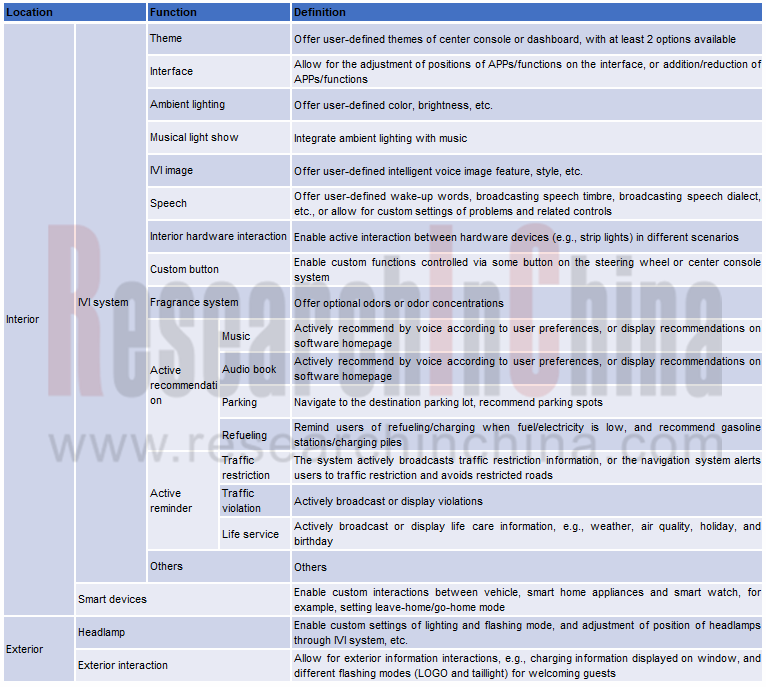
We select, analyze and summarize 19 typical auto brands: Audi, BMW, Mercedes-Benz, Volkswagen, Toyota, Honda, Nissan, Buick, Ford, Geely, SAIC, GAC, Changan Automobile, Great Wall Motor, BYD, Chery, NIO, Xiaopeng Motors, and Weltmeister. The personalized functions we study include: theme (center console display, instrument panel), interface (switching mode, adjustable position of function, addition/reduction of function), ambient lighting (settings of color, brightness, area and mode), musical light show, IVI image (2D/3D switching, optional style), speech (wake-up words, owner's nickname, tone language, language style, AI training, language recognition), interior hardware interaction, custom buttons, fragrance system, active recommendation (music, audio book, parking, refueling), active reminder (traffic restriction, traffic violation, life services), smart devices, custom headlights, and exterior interaction.
This report takes exterior interaction and active recommendation functions as examples to introduce specific personalized functions of an intelligent vehicle.
The wider use of artificial intelligence leads to a shift in IVI service model from passive IVI service instructed by human to active acquisition of information by IVI system and active recommendation to human. In future, the ever deeper fusion of IVI system and third-party service software will come with more mature algorithms and more data accumulated, realizing a service model where more functions can be engaged in an active way.
Music and audio book recommendation
There are currently two leading modes of music and audio book recommendation.
The first is the recommendation feature built in music and audiobook software. Open the software and recommendations will come into sight, a common mode integrated into vehicle software of most auto brands. For example, Kuwo Music for Audi cars offers daily, ranking, Ximalaya FM, and high quality content recommendations; BMW QQ Music recommends daily content and new songs.
The second is the active speech-enabled recommendation according to user habits, preferences or scenarios, which is adopted by Mercedes-Benz, Buick, Ford, Geely, Great Wall Motor and BYD. For instance, Buick judges what users like based on scenarios and their habits, and pushes such as music; Ford IVI system recommends music, radio and point of interest, etc according to user habits; BYD IVI system recommends programs according to what the user often tunes in, sends news during the commuting time, and pushes songs and life programs on weekends and holidays.
Parking recommendation
Parking recommendation refers to recommendation of several nearby parking lots available to the user via a pop-up window from the navigation map in the IVI system before arrival at the destination, for example, SAIC’s IVI navigation system actively recommends 4 parking lots around the destination; Honda’s IVI navigation system enables active pop-up of recommended parking lots when approaching the destination.
Refueling recommendation
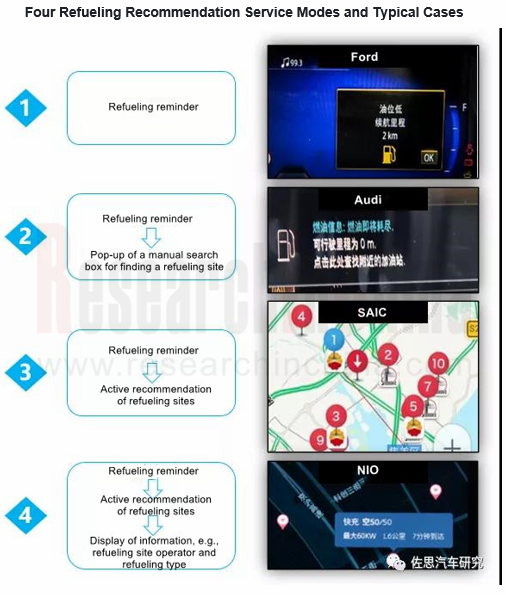
Refueling recommendation can be divided into four modes by way to offer services:
1) when fuel/electricity is low, the system gives a refueling reminder;
2) when fuel/electricity is low, the system gives a refueling reminder, with an active pop-up of a manual search box for finding a refueling site;
3) when fuel/electricity is low, the system gives a refueling reminder and automatically recommends refueling sites available to the user;
4) when fuel/electricity is low, the system gives a refueling reminder, automatically recommends refueling sites available to the user, and displays details of the sites, such as operators and refueling types.
In future, the third and fourth modes will prevail.
Life service recommendation and reminder
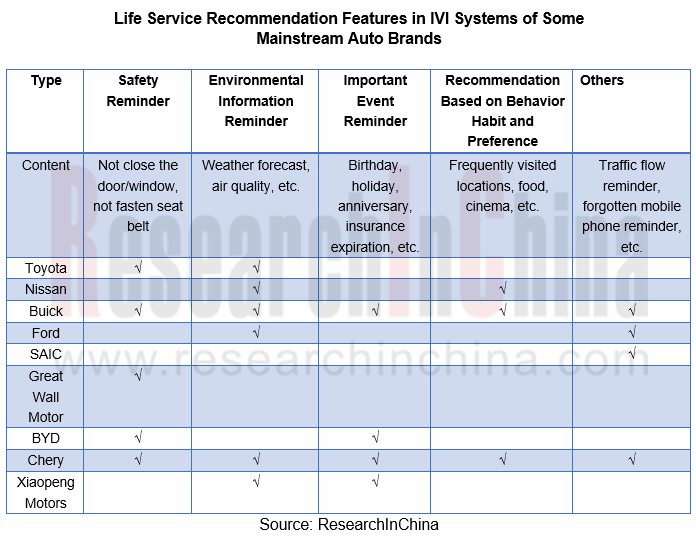
Life service recommendation and reminder feature is gathering pace, and by content is led by: safety, environment, important event, behavior habit and preference reminders. For example, SAIC’s Banma system actively recommends the route to the cinema as the user starts up the car within two hours before the film begins with tickets bought on Tao Piao Piao platform, and also the playlist or music about the film after the cinema lets out; Alipay applet introduced into Xpeng IVI system will proactively ask whether the user needs a breakfast reservation or not when the car detects he/she will go to work.
Exterior interaction personalization
Exterior information interaction refers to display of such information as vehicle status (e.g., charging), LOGO, welcoming and various prompts using lamps, windows or exterior display devices.
In Xpeng P7’s case, the connection between lamp signal system and audio system enables interior ambient lamps and exterior lighting sets to flicker synchronously with musical rhythms.
Weltmeister interactive window projection: when the user gets close to the car with a phone in hand, he/she will be recognized via Weltmeister ID, and the projector on the inside of the exterior rearview mirror will project welcoming message, remaining battery power, range and other information on the window; when the use gets off the car, others can interact with the car through the projection on the window which displays state of charge for example.
1. Overview and Status Quo of Intelligent Vehicle Personalization
1.1 Definition and Research Scope of Intelligent Vehicle Personalization
1.2 Development Characteristics of Intelligent Vehicle Personalization
1.3 Comparison of IVI System Personalization between Major OEMs: Theme & Interface
1.3 Comparison of IVI System Personalization between Major OEMs: Ambient Lighting & Musical Light Show
1.3 Comparison of IVI System Personalization between Major OEMs: IVI Image & Speech
1.3 Comparison of IVI System Personalization between Major OEMs: Interior Hardware Interaction, Custom Button & Fragrance System
1.3 Comparison of IVI System Personalization between Major OEMs: Active Recommendation
1.3 Comparison of IVI System Personalization between Major OEMs: Active Reminder
1.3 Comparison of IVI System Personalization between Major OEMs: IVI System & Others
1.4 Comparison of Personalization between Major OEMs: Smart Devices, Headlights & Exterior Interaction
2. Personalization of Luxury Brand OEMs
2.1 Overview
2.2 Audi
2.2.1 Mass-produced Vehicle IVI System and Personalization Overview
2.2.2 Personalization Details of Mass-produced Vehicle IVI System
2.2.3 Concept Car
2.3 BMW
2.3.1 Mass-produced Vehicle IVI System and Personalization Overview
2.3.2 Personalization Details of Mass-produced Vehicle IVI System
2.3.3 Concept Car
2.4 Mercedes-Benz
2.4.1 Mass-produced Vehicle IVI System and Personalization Overview
2.4.2 Personalization Details of Mass-produced Vehicle IVI System
2.4.3 Concept Car
3. Personalization of Joint-venture Brand OEMs
3.1 Overview
3.2 Volkswagen Mass-produced Vehicle IVI System and Personalization Overview
3.2.1 Personalization Details of FAW-Volkswagen’s Mass-produced Vehicle IVI System
3.2.2 Personalization Details of SAIC Volkswagen’s Mass-produced Vehicle IVI System
3.2.3 Personalization Details of Smart Devices for SAIC Volkswagen’s Mass-produced Vehicles
3.2.4 Personalization Details of Exterior Interaction for SAIC Volkswagen’s Mass-produced Vehicles
3.2.5 Volkswagen Concept Car
3.3 Toyota
3.3.1 Mass-produced Vehicle IVI System and Personalization Overview
3.3.2 Personalization Details of IVI System for FAW Toyota’s Mass-produced Vehicles
3.3.3 Personalization Details of IVI System for GAC Toyota’s Mass-produced Vehicles
3.3.4 Personalization Details of Exterior Interaction for GAC Toyota’s Mass-produced Vehicles
3.3.5 Toyota Concept Car
3.4 Honda
3.4.1 Mass-produced Vehicle IVI System and Personalization Overview
3.4.2 Personalization Details of Mass-produced Vehicle IVI System
3.4.3 Concept Car
3.5 Nissan
3.5.1 Mass-produced Vehicle IVI System and Personalization Overview
3.5.2 Personalization Details of Mass-produced Vehicle IVI System
3.6 Buick
3.6.1 Mass-produced Vehicle IVI System and Personalization Overview
3.6.2 Personalization Details of Mass-produced Vehicle IVI System
3.6.3 Concept Car
3.7 Ford
3.7.1 Mass-produced Vehicle IVI System and Personalization Overview
3.7.2 Personalization Details of Mass-produced Vehicle IVI System
3.7.3 Personalization Details of Mass-produced Vehicle Exterior Interaction
4. Personalization of Chinese Brand OEMs
4.1 Overview
4.2 Geely
4.2.1 Mass-produced Vehicle IVI System and Personalization Overview
4.2.2 Personalization Details of Mass-produced Vehicle IVI System
4.2.3 Concept Car
4.3 SAIC
4.3.1 Mass-produced Vehicle IVI System and Personalization Overview
4.3.2 Personalization Details of Mass-produced Vehicle IVI System
4.3.3 Concept Car
4.4 GAC
4.4.1 Mass-produced Vehicle IVI System and Personalization Overview
4.4.2 Personalization Details of Mass-produced Vehicle IVI System
4.4.3 Concept Car
4.5 Changan Automobile
4.5.1 Mass-produced Vehicle IVI System and Personalization Overview
4.5.2 Personalization Details of Mass-produced Vehicle IVI System
4.5.3 Concept Car
4.6 Great Wall Motor
4.6.1 Mass-produced Vehicle IVI System and Personalization Overview
4.6.2 Personalization Details of Mass-produced Vehicle IVI System
4.6.3 Personalization Details of Smart Devices for Great Wall’s Mass-produced Vehicles
4.6.4 Concept Car
4.7 BYD
4.7.1 Mass-produced Vehicle IVI System and Personalization Overview
4.7.2 Personalization Details of Mass-produced Vehicle IVI System
4.7.3 Concept Car
4.8 Chery
4.8.1 Mass-produced Vehicle IVI System and Personalization Overview
4.8.2 Personalization Details of Mass-produced Vehicle IVI System
4.8.3 Concept Car
5. Personalization of Emerging Auto Brands
5.1 Overview
5.2 NIO
5.2.1 Mass-produced Vehicle IVI System and Personalization Overview
5.2.2 Personalization Details of Mass-produced Vehicle IVI System
5.2.3 Personalization Details of Mass-produced Vehicle Headlamps
5.2.4 Concept Car
5.3 Xiaopeng Motors
5.3.1 Mass-produced Vehicle IVI System and Personalization Overview
5.3.2 Personalization Details of Mass-produced Vehicle IVI System
5.3.3 Personalization Details of Mass-produced Vehicle Headlamps
5.3.4 Concept Car
5.4 Weltmeister
5.4.1 Mass-produced Vehicle IVI System and Personalization Overview
5.4.2 Personalization Details of Mass-produced Vehicle IVI System
5.4.3 Personalization Details of Headlamps and Exterior Interaction for Mass-produced Vehicles
5.4.4 Concept Car
AI-Defined Vehicle (AIDV) OEMs' Deployment Strategies Research Report, 2026 AIDV Research: Deployment Strategies of 22 OEMs
The AI-Defined Vehicle (AIDV) OEMs' Deployment Strategies Research Report, 2026, released by ResearchInChina, analyzes the AI deployment strategies of ... OEMs’ Passenger Car Model Planning Research Report, 2026 Vehicle Model Planning Research: Chinese OEMs Launch Sub-Brands Intensively, While Multinational OEMs Apply the Brakes to Electrification Strategies
ResearchInChina released the OEMs’ Passenger Car M... Autonomous Driving Simulation and World Model Research Report, 2026 Autonomous driving simulation research: "Simulation test + world model"-driven test system has become R&D infrastructure.
The "Autonomous Driving Simulation and World Model Research Report, 2026"... Cockpit-Driving Integration Central Domain Controller SoC and AI Supercomputing Architecture Research Report, 2026 Cockpit-Driving integration and AI supercomputing research: The One Chip solution is rapidly installed in vehicles, and AI supercomputing architectures are moving towards full-domain integration.
AI ... Intelligent Driving End-to-End Large Model Research Report, 2026 Research on Intelligent Driving Large Models: A Critical Period for Technological Competition and Paradigm Integration
As autonomous driving technology rapidly iterates from L2 to L3?L4, intelligent... Automotive Digital Key Industry Trend Report, 2026 Digital Key Research: Automotive BLE, UWB and SLE Hardware Layout
The Automotive Digital Key Industry Trend Report, 2026, released by ResearchInChina, analyzes and predicts the digital key market, co... Monthly Report on Automotive New Technology (May 2026) UHD gaze technology, full-color LiDAR, UWB, etc. promote the upgrade of intelligent driving perception capabilities
This report is published once a month and is available for annual subscription.The... In-Cabin Monitoring Systems (DMS, OMS, etc.) Research Report, 2026 In-Cabin Monitoring System Research: DMS to Become Mandatory in 2027, Expected to be Installed in Over 14 Million Vehicles
ResearchInChina released the In-Cabin Monitoring Systems (DMS, OMS, etc.) Re... Automotive Service-Oriented Architecture (SOA) and Cross-Domain Middleware Industry Report, 2026 Research on automotive SOA and cross-domain middleware: The era of AI atomic services and AI cross-domain fusion agents is coming.
Automotive SOA evolves towards AI + full SOA servitization Driv... Automotive Display, Center Console and Cluster Industry Report, 2026 Automotive Display Research: Multi-Screen Application Slows Down, While OLED and MiniLED Are Introduced in Vehicles Quickly
In 2026, automotive displays will no longer excessively pursue the number a... Global and China Intelligent Vehicle Standard System Construction and Certification Research Report, 2026 Intelligent Driving Standards and Certification: With the Maturing Standardization System, China Will Participate in Formulation of Global Standards
China's automotive industry is transforming from ... Automotive Intelligent Diagnosis Industry Report, 2026 Automotive Intelligent Diagnosis Research: Powered by AI, Remote Diagnosis Is Being Upgraded towards Intelligence.
ResearchInChina released the Automotive Intelligent Diagnosis Industry Report, 2026.... Automotive Cloud Service Platform Research Report, 2026 Research on automotive cloud service platform: with architecture upgrade and computing power improvement, cloud services enter a new stage
In 2026, the Internet of Vehicles industry generates petaby... Integrated Battery and Innovative Battery Technology Research Report, 2026 Power Battery Research: Sales of High-Capacity Vehicles Keep Rising, and Solid-State Batteries Begin to Be Installed in Vehicles
I. Sales of High-Capacity Vehicles Sustain Growth, and Those with A C... Chinese Independent OEMs’ ADAS and Autonomous Driving Report, 2026 Research on OEMs' Intelligent Driving: Era of Physical AI, Standard Configuration of D2D, and Initial Exploration of L3 Commercial Pilot Projects
From 2023 to 2025, the intelligent driving installati... Intelligent Vehicle New Technology Application Analysis Report, 2025-2026 New Technology Research: Innovative Products such as Bionic Cameras, Vision-LiDAR Fusion Sensors, Auditory Sensors Further Enhance Vehicle Perception Capabilities
ForewordResearchInChina released th... Automotive Optical Fiber Communication (Optical Fiber Ethernet, PON) and Supply Chain Research Report, 2026 Research on Automotive Optical Fiber Communication: Introduction of Optical Fiber in Vehicles Accelerates, with Priority Deployment in High-Speed Communication Link (10+Gbps) Scenarios
Automotive opt... Automotive Intelligent Cockpit SoC Research Report, 2026 Automotive Cockpit SoC Research: Passenger Cars in the Price Range of RMB100,000–200,000 Account for Nearly 50% of Total Sales, and New-Generation Cockpit SoC Products Largely Enter Mass Production
P...
|