Research on automotive modularization: the creation of electric modular platforms, the reduction of the number of platforms, and the development of core platforms
The demand for low-cost and short development cycles of new models promotes the development of automotive modular platforms.
An automotive modular platform includes the design and assembly of all sub-systems of a car in a modular manner, and the standardized design and production of auto parts in the form of modules, and the final "assembly" according to the positioning of models.
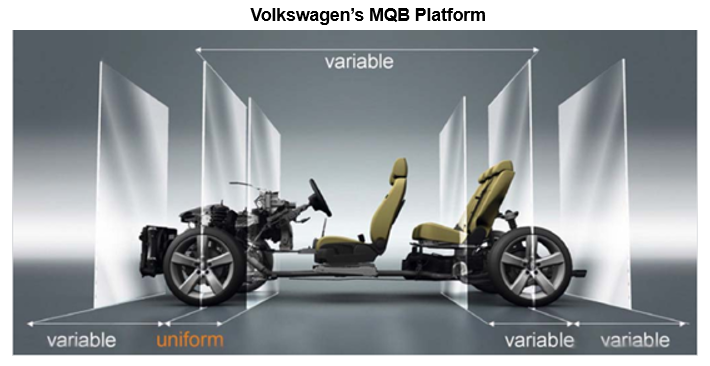
Unlike the traditional automotive platform which is only for models at the same single level, the modular platform reduces R&D and production costs and shortens the development cycle of new models. At the same time, it facilitates to unify quality standards and improve the overall strength of products.
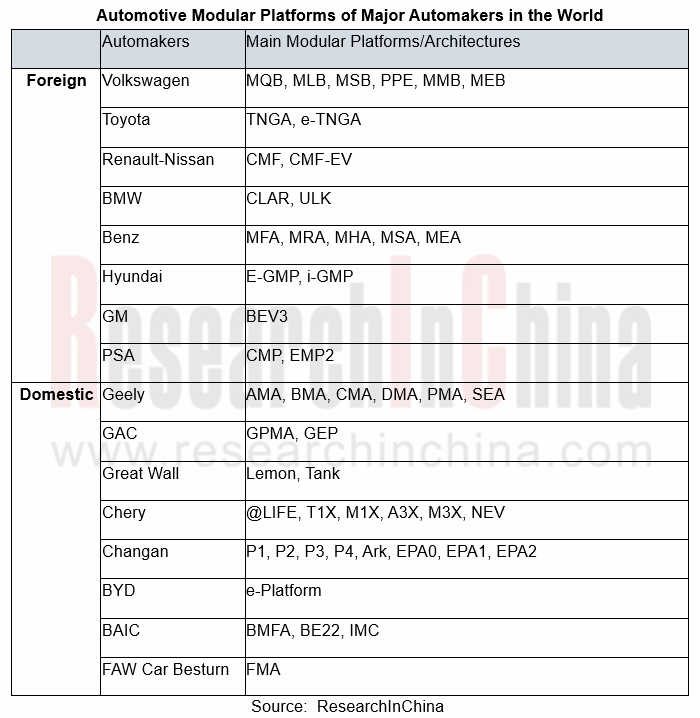
Since Volkswagen launched the MQB platform in 2012, international automakers (including Toyota, Renault-Nissan, Mercedes-Benz, BMW, etc.) and Chinese counterparts (like Changan, Geely, and GAC) have all released their own modular platforms, covering multiple levels and models.
It is an inevitable trend to build a dedicated modular platform for electric vehicles
At present, new energy vehicles have represented the main direction of the transformation and development of the global automotive industry. In 2020, 3.125 million new energy vehicles were sold worldwide with a year-on-year increase of 41.4%. The figure is expected to reach 15 million by 2026.
In this context, it is a mainstream trend to build a dedicated modular platform for electric vehicles. Compared with the oil-to-electricity platform, the modular platform features advantages like longer mileage and better safety. At present, most companies have launched or planned to launch their exclusive platforms for electric vehicles. In addition, companies including Volkswagen, Mercedes-Benz, and PSA that use the oil-to-electricity mode to produce new energy vehicles have also begun to study and unveil their own dedicated platforms for electric vehicles that are being developed.
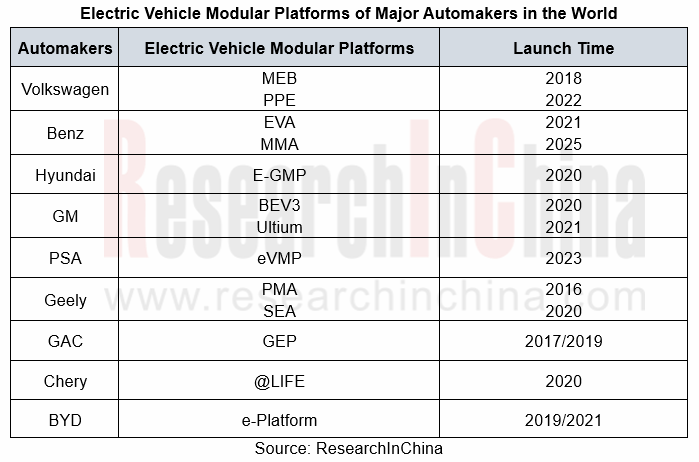
Electric vehicle modular platforms are mainly proposed by traditional automakers that follow the product layout of the fuel vehicle model when manufacturing electric vehicles, but they are more inclined to build a wide range of electric vehicle product lines to meet the demand of different consumers in different market segments. Therefore, modular platforms extend to electric vehicles.
The emerging automakers represented by Tesla adhere to the principle of short product lines, and pay more attention to the design advantages of a single model and the software upgrade of the entire vehicle. Modular platforms are of little significance to them.
Fewer platforms and core platforms embody the development direction
Under normal circumstances, automakers offer multiple modular platforms for different models, and each modular platform covers a limited range of models. In the future, they will focus on reducing the number of platforms, emphasizing core platforms, and raising the output of core platforms. The move will help further reduce costs and improve efficiency of R&D and production.
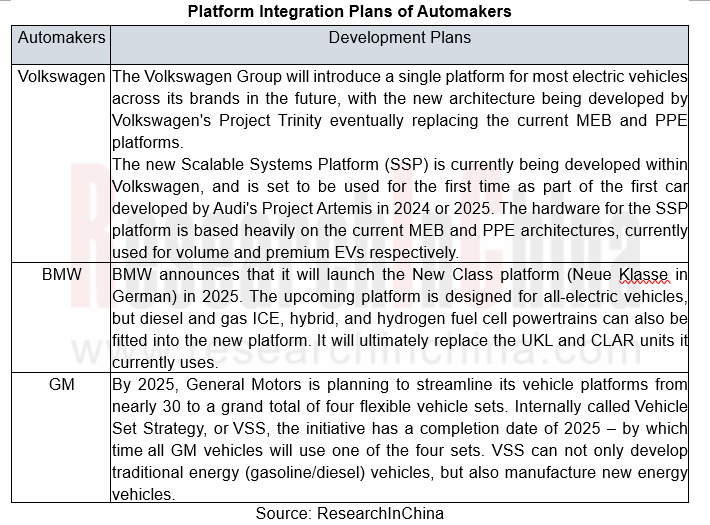
At present, Volkswagen, BMW, and GM have announced their platform integration plans. In the future, they will prioritize the development of core platforms instead of the existing multiple platforms.
Brand new E/E architecture pushes transformation of the profit model of automotive industry
While launching modular platforms, some automakers have begun to upgrade their E/E architectures to "domain integration" or even "centralized" style. For example, the Geely SEA architecture adopts a brand-new E/E architecture which integrates three domains, and it will introduce a centralized architecture in the future. In the future, with the development of modular platforms, it is expected that the E/E architecture of automobiles will be upgraded.
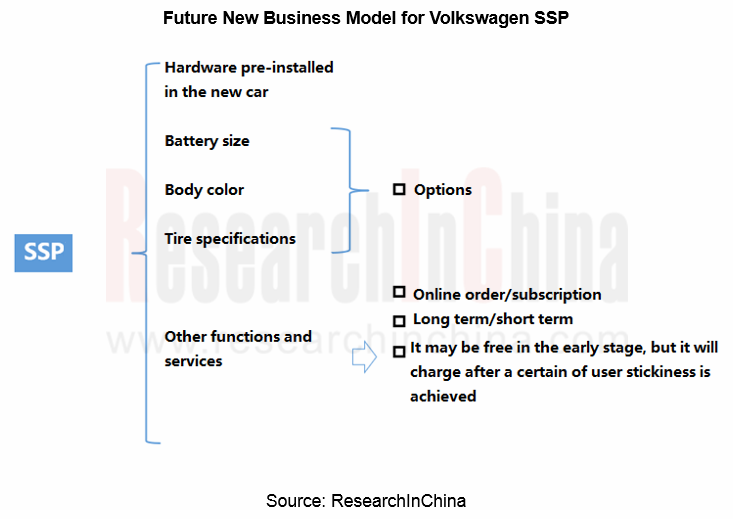
However, due to the adoption of the automotive E/E architecture, the on-board software system has to be re-integrated, which will gradually shift the profit model of the automotive industry from the hardware-oriented mode to the software and services-oriented mode. Currently, Volkswagen has stated that it will launch a new business model for the Scalable Systems Platform (SSP) in 2024.
Modular body is expected to be mass-produced
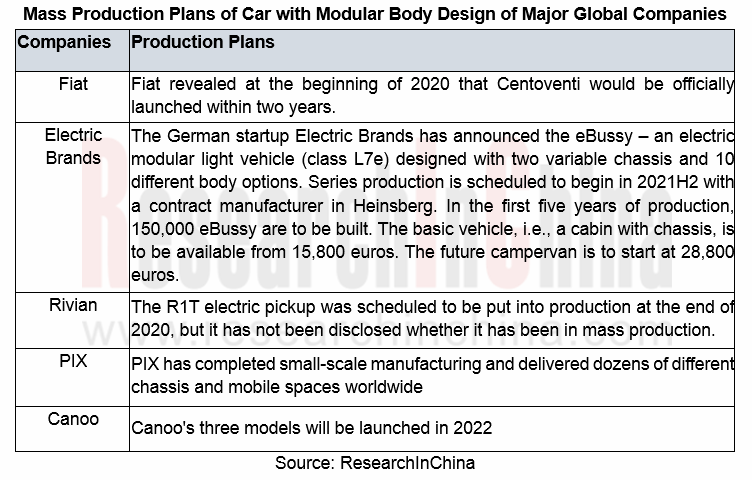
Modular body means that the combination of the same chassis and different modular compartments can be used in different scenarios to improve vehicle utilization. At present, traditional automakers and emerging technology companies including Fiat, Mercedes-Benz, Rinspeed, Rivian, Schaeffler, etc. have launched concept cars with interchangeable bodies.
Although most of the current modular cars are concept cars, some companies have put mass production on the agenda.
AI-Defined Vehicle (AIDV) OEMs' Deployment Strategies Research Report, 2026
AIDV Research: Deployment Strategies of 22 OEMs
The AI-Defined Vehicle (AIDV) OEMs' Deployment Strategies Research Report, 2026, released by ResearchInChina, analyzes the AI deployment strategies of ...
OEMs’ Passenger Car Model Planning Research Report, 2026
Vehicle Model Planning Research: Chinese OEMs Launch Sub-Brands Intensively, While Multinational OEMs Apply the Brakes to Electrification Strategies
ResearchInChina released the OEMs’ Passenger Car M...
Autonomous Driving Simulation and World Model Research Report, 2026
Autonomous driving simulation research: "Simulation test + world model"-driven test system has become R&D infrastructure.
The "Autonomous Driving Simulation and World Model Research Report, 2026"...
Cockpit-Driving Integration Central Domain Controller SoC and AI Supercomputing Architecture Research Report, 2026
Cockpit-Driving integration and AI supercomputing research: The One Chip solution is rapidly installed in vehicles, and AI supercomputing architectures are moving towards full-domain integration.
AI ...
Intelligent Driving End-to-End Large Model Research Report, 2026
Research on Intelligent Driving Large Models: A Critical Period for Technological Competition and Paradigm Integration
As autonomous driving technology rapidly iterates from L2 to L3?L4, intelligent...
Automotive Digital Key Industry Trend Report, 2026
Digital Key Research: Automotive BLE, UWB and SLE Hardware Layout
The Automotive Digital Key Industry Trend Report, 2026, released by ResearchInChina, analyzes and predicts the digital key market, co...
Monthly Report on Automotive New Technology (May 2026)
UHD gaze technology, full-color LiDAR, UWB, etc. promote the upgrade of intelligent driving perception capabilities
This report is published once a month and is available for annual subscription.The...
In-Cabin Monitoring Systems (DMS, OMS, etc.) Research Report, 2026
In-Cabin Monitoring System Research: DMS to Become Mandatory in 2027, Expected to be Installed in Over 14 Million Vehicles
ResearchInChina released the In-Cabin Monitoring Systems (DMS, OMS, etc.) Re...
Automotive Service-Oriented Architecture (SOA) and Cross-Domain Middleware Industry Report, 2026
Research on automotive SOA and cross-domain middleware: The era of AI atomic services and AI cross-domain fusion agents is coming.
Automotive SOA evolves towards AI + full SOA servitization Driv...
Automotive Display, Center Console and Cluster Industry Report, 2026
Automotive Display Research: Multi-Screen Application Slows Down, While OLED and MiniLED Are Introduced in Vehicles Quickly
In 2026, automotive displays will no longer excessively pursue the number a...
Global and China Intelligent Vehicle Standard System Construction and Certification Research Report, 2026
Intelligent Driving Standards and Certification: With the Maturing Standardization System, China Will Participate in Formulation of Global Standards
China's automotive industry is transforming from ...
Automotive Intelligent Diagnosis Industry Report, 2026
Automotive Intelligent Diagnosis Research: Powered by AI, Remote Diagnosis Is Being Upgraded towards Intelligence.
ResearchInChina released the Automotive Intelligent Diagnosis Industry Report, 2026....
Automotive Cloud Service Platform Research Report, 2026
Research on automotive cloud service platform: with architecture upgrade and computing power improvement, cloud services enter a new stage
In 2026, the Internet of Vehicles industry generates petaby...
Integrated Battery and Innovative Battery Technology Research Report, 2026
Power Battery Research: Sales of High-Capacity Vehicles Keep Rising, and Solid-State Batteries Begin to Be Installed in Vehicles
I. Sales of High-Capacity Vehicles Sustain Growth, and Those with A C...
Chinese Independent OEMs’ ADAS and Autonomous Driving Report, 2026
Research on OEMs' Intelligent Driving: Era of Physical AI, Standard Configuration of D2D, and Initial Exploration of L3 Commercial Pilot Projects
From 2023 to 2025, the intelligent driving installati...
Intelligent Vehicle New Technology Application Analysis Report, 2025-2026
New Technology Research: Innovative Products such as Bionic Cameras, Vision-LiDAR Fusion Sensors, Auditory Sensors Further Enhance Vehicle Perception Capabilities
ForewordResearchInChina released th...
Automotive Optical Fiber Communication (Optical Fiber Ethernet, PON) and Supply Chain Research Report, 2026
Research on Automotive Optical Fiber Communication: Introduction of Optical Fiber in Vehicles Accelerates, with Priority Deployment in High-Speed Communication Link (10+Gbps) Scenarios
Automotive opt...
Automotive Intelligent Cockpit SoC Research Report, 2026
Automotive Cockpit SoC Research: Passenger Cars in the Price Range of RMB100,000–200,000 Account for Nearly 50% of Total Sales, and New-Generation Cockpit SoC Products Largely Enter Mass Production
P...