Intelligent parking research: mass adoption of AVP will begin in 2023.
Our Automated Parking Assist (APA) and Automated Valet Parking (AVP) Industry Report, 2021 combs through technology routes, business models, products and solutions of major APA and AVP suppliers, and parking intelligence of OEMs.
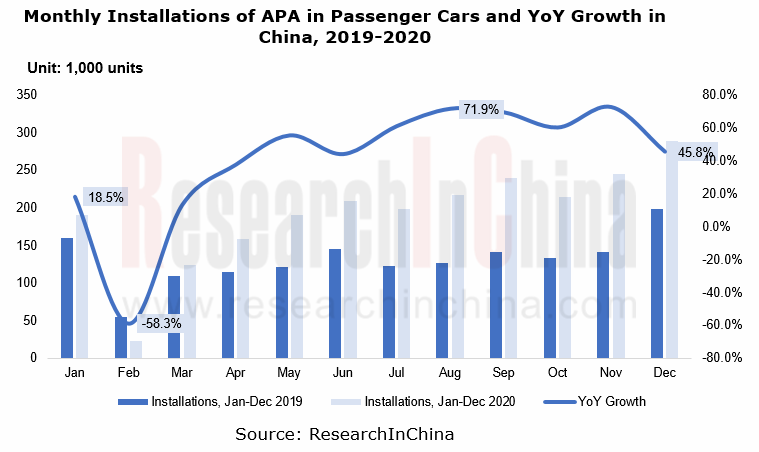
In 2020, the installation rate of APA reached 12.3%, 4.28 percentage points higher than a year ago.
According to ResearchInChina, in 2020, China had 2,308,000 passenger cars equipped with APA, an annualized upsurge of 46.4%, taking the installation rate of APA to 12.3%, up 4.28 percentage points versus 2019; in 2020, the installation rate of APA made a steady growth as a whole, but a decline in February due to the reduced passenger car sales caused by the COVID-19 pandemic.
? Wherein, among APA-enabled models that sell well, most are foreign brands like Mercedes-Benz, BMW and Buick.
? Fully automated parking assist (F-APA) and remote parking are major intelligent parking system solutions at present.
? In OEM market, L3 memory parking and L4 APA capabilities begin to become available to mid-to-high-end and luxury models.
For AVP single vehicle intelligence technologies, memory parking is firstly landed; at the parking lot end, AVP is firstly used in P3 and P4 parking lots.
Automated valet parking (AVP) allows a user who gets off at the designated drop-off point to send a parking instruction via the mobile APP to his/her car which will then drive itself to the parking spot without manual operation and monitoring; as the user gives a pick-up instruction on the APP, the car following the instruction will automatically go to the designated pick-up point; if several cars receive the parking instruction at the same time, they will wait to enter the parking space one after another automatically.
The study shows that AVP that renders vehicles more intelligent can promote vehicle sales, cut down 30% operating cost for parking lots, reduce 10% invalid traffic time in parking lots, and save 10-15 minutes in vehicle pick-up and returning.
The AVP market accommodates large numbers of players which mainly provide three technology solutions: single vehicle intelligence, parking lot intelligence, and vehicle-parking lot cooperation. Of them, single vehicle intelligence primarily supplied by Baidu and ZongMu Technology are most often used by OEMs. In September 2020, at Auto China, the full-size E-HS9 SUV BEV of New Hongqi started pre-sale. This model packs AVP system from ZongMu Technology.
Baidu is a typical provider of AVP single vehicle intelligence solutions. The firm has planned the implementation route for AVP system from short distance to long distance, from easy to difficult. The memory parking (Home-AVP) is the first one to be landed.
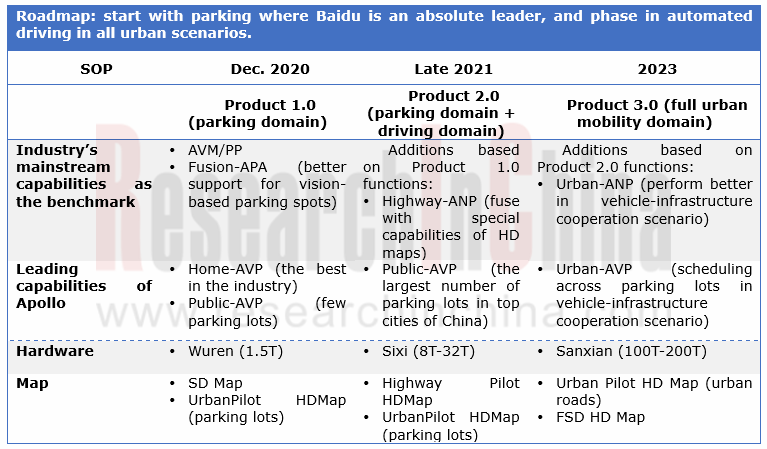
? Home-AVP: memory parking. From elevator to parking spot, learn one time; users summon or return cars outside using their mobile phones, and their cars can drive themselves;
? Public-AVP: from any pick-up or drop-off point in the parking lot, users park their cars anywhere in the parking lot, and the cars will automatically find a parking space; the summoned cars will drive themselves to the place designated by users;
? Urban-AVP: from pick-up or drop-off point at most 1km away from the parking space to the parking space, users can summon or return their cars at their will, and the cars will drive themselves.
Bosch is a typical parking lot intelligence solution provider. Together with Mercedes-Benz and the parking lot operator Apcoa, Bosch has deployed a set of AVP system for trial commercial operation at the car park P6 at Stuttgar Airport.
Vehicle-parking lot cooperation solution providers are led by Huawei. The solution is the hardest one to be commercialized for it is difficult to coordinate multiple stakeholders involved (e.g., property companies, independent parking solution providers, OEMs, and mobility platform operators).
The General Technical Requirements of Automated Valet Parking Systems firstly defines parking lot standards.
In current stage, AVP standards are mainly formulated by associations. To fill the gaps in AVP industry standards in China and deal with the challenge of AVP compatible with multiple solutions, China-SAE and China Communications Industry Association introduced the General Technical Requirements of Automated Valet Parking Systems (T/CSAE156-2020) in December 2020.
The standard covers the three technology routes: single vehicle intelligence, parking lot intelligence and vehicle-parking lot cooperation. It has four parts of content: system definition, security application scenarios, general technical requirements of the system, and general technical requirements of testing.
The General Technical Requirements of Automated Valet Parking Systems defines levels of intelligent parking lots: P0, P1, P2, P3, P4 and P5. . On this basis, we have extended interpretation of these levels, as follows:
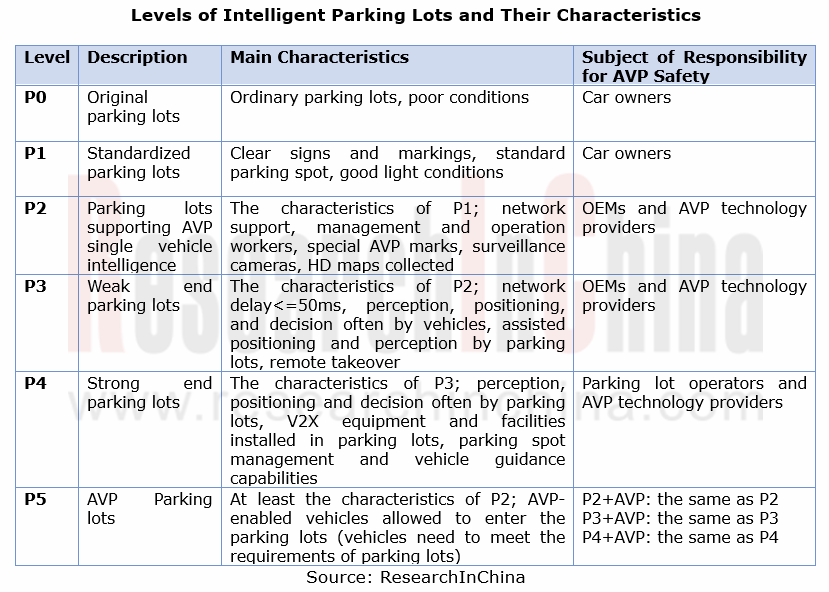
According to the table above, P2 parking lots meet the conditions needed by AVP single vehicle intelligence; P4 parking lots are basically qualified for being AVP parking lots at the strong end; P3 parking lots meet the conditions of AVP parking lots at the weak end, with most CVIS solutions deployed in P3 parking lots.
Most insiders argue that CVIS is the future of AVP. After exchanges with experts, we believe any technology roadmap needs a subject of responsibility for safety, that is, who takes charge of the safety of AVP system, vehicle end or parking lot end? We think the subject of responsibility at the strong end should be parking lot operators and AVP technology providers, and at the weak end, the OEMs and AVP technology providers.
Application of AVP in P2 parking lots needs L4 intelligent vehicles which are however unlikely to be mass-produced shortly (before 2025). Even if P2 parking lots are built, there will be few vehicles available. So before 2025, parking lots (P3/P4) that support CVIS solutions have plenty of room for growth.
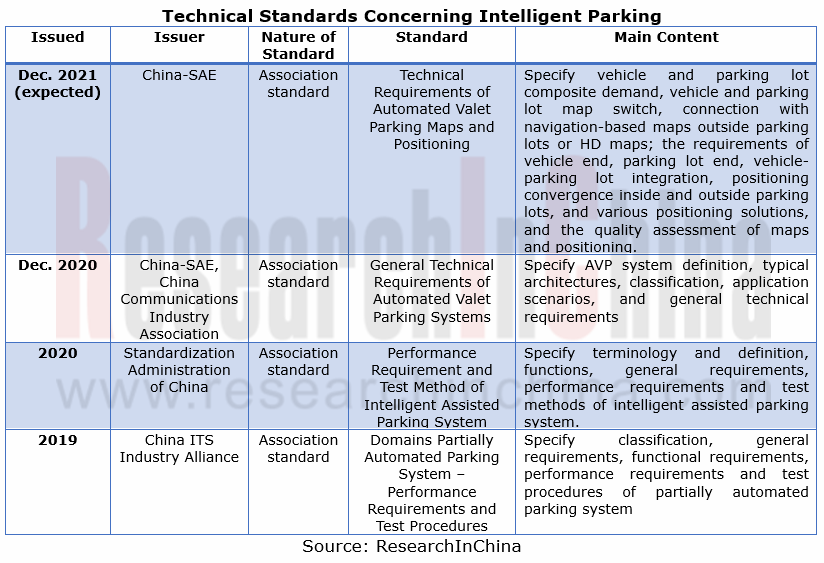
As a substandard of the General Technical Requirements of Automated Valet Parking Systems, the Technical Requirements of Automated Valet Parking Maps and Positioning is under discussion and expected to be drafted in December 2021. The study of other AVP substandards such as AVP parking lot communications, AVP test and memory parking is in the pipeline.
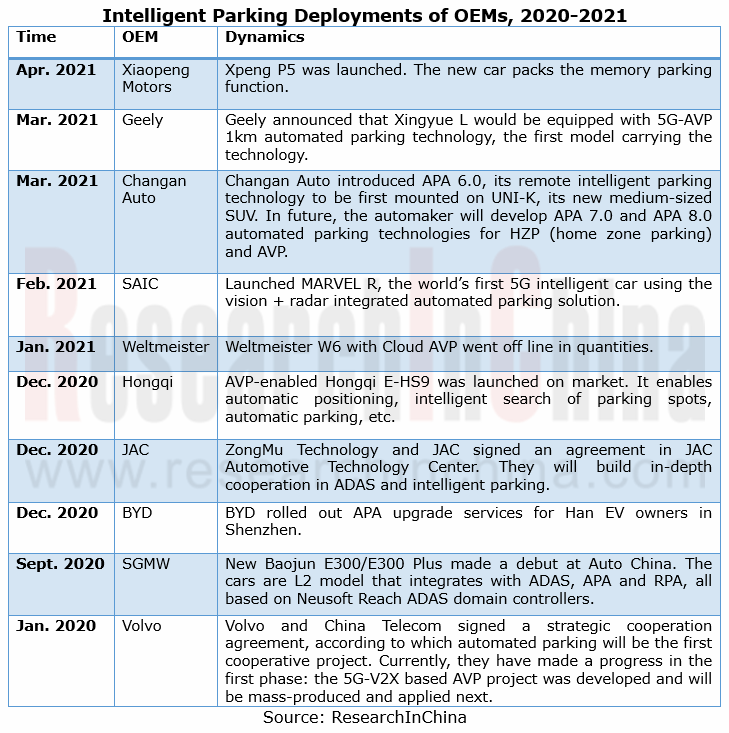
OEMs step up R&D of intelligent parking systems for mass production
OEMs are accelerating R&D of intelligent parking systems for mass production by way of independently developing or seeking external collaborations. Some OEMs like Weltmeister have achieved AVP for L4 automated driving in designated scenarios through working with Baidu; Geely with 5G-AVP technology enabling 1km autonomous parking will step into exploration of intelligent cloud based AVP; with a plan of trying to equip some of its models with memory parking function in late 2020, GAC has installed AVP function in some high-end and luxury models in 2021H1; Great Wall Motor and Baidu Apollo have worked together on mass production of AVP, and announced to spawn AVP-enabled vehicles in 2021.
There is a common belief that the pace of AVP system testing will quicken to gear up for use in vehicles between 2021 and 2022, and the mass adoption of AVP system will begin in 2023.
For parking business models, parking lot operators, OEMs and AVP solution providers make profits by charging AVP subscription fee or pay-per-use billing. Parking lot operators also make benefits with value-added services derived from intelligent parking systems. An example is Bosch which combines electric vehicle automatic charging, autonomous washing of vehicles and express delivery to provide complete solutions for parking lot operators.
AI-Defined Vehicle (AIDV) OEMs' Deployment Strategies Research Report, 2026
AIDV Research: Deployment Strategies of 22 OEMs
The AI-Defined Vehicle (AIDV) OEMs' Deployment Strategies Research Report, 2026, released by ResearchInChina, analyzes the AI deployment strategies of ...
OEMs’ Passenger Car Model Planning Research Report, 2026
Vehicle Model Planning Research: Chinese OEMs Launch Sub-Brands Intensively, While Multinational OEMs Apply the Brakes to Electrification Strategies
ResearchInChina released the OEMs’ Passenger Car M...
Autonomous Driving Simulation and World Model Research Report, 2026
Autonomous driving simulation research: "Simulation test + world model"-driven test system has become R&D infrastructure.
The "Autonomous Driving Simulation and World Model Research Report, 2026"...
Cockpit-Driving Integration Central Domain Controller SoC and AI Supercomputing Architecture Research Report, 2026
Cockpit-Driving integration and AI supercomputing research: The One Chip solution is rapidly installed in vehicles, and AI supercomputing architectures are moving towards full-domain integration.
AI ...
Intelligent Driving End-to-End Large Model Research Report, 2026
Research on Intelligent Driving Large Models: A Critical Period for Technological Competition and Paradigm Integration
As autonomous driving technology rapidly iterates from L2 to L3?L4, intelligent...
Automotive Digital Key Industry Trend Report, 2026
Digital Key Research: Automotive BLE, UWB and SLE Hardware Layout
The Automotive Digital Key Industry Trend Report, 2026, released by ResearchInChina, analyzes and predicts the digital key market, co...
Monthly Report on Automotive New Technology (May 2026)
UHD gaze technology, full-color LiDAR, UWB, etc. promote the upgrade of intelligent driving perception capabilities
This report is published once a month and is available for annual subscription.The...
In-Cabin Monitoring Systems (DMS, OMS, etc.) Research Report, 2026
In-Cabin Monitoring System Research: DMS to Become Mandatory in 2027, Expected to be Installed in Over 14 Million Vehicles
ResearchInChina released the In-Cabin Monitoring Systems (DMS, OMS, etc.) Re...
Automotive Service-Oriented Architecture (SOA) and Cross-Domain Middleware Industry Report, 2026
Research on automotive SOA and cross-domain middleware: The era of AI atomic services and AI cross-domain fusion agents is coming.
Automotive SOA evolves towards AI + full SOA servitization Driv...
Automotive Display, Center Console and Cluster Industry Report, 2026
Automotive Display Research: Multi-Screen Application Slows Down, While OLED and MiniLED Are Introduced in Vehicles Quickly
In 2026, automotive displays will no longer excessively pursue the number a...
Global and China Intelligent Vehicle Standard System Construction and Certification Research Report, 2026
Intelligent Driving Standards and Certification: With the Maturing Standardization System, China Will Participate in Formulation of Global Standards
China's automotive industry is transforming from ...
Automotive Intelligent Diagnosis Industry Report, 2026
Automotive Intelligent Diagnosis Research: Powered by AI, Remote Diagnosis Is Being Upgraded towards Intelligence.
ResearchInChina released the Automotive Intelligent Diagnosis Industry Report, 2026....
Automotive Cloud Service Platform Research Report, 2026
Research on automotive cloud service platform: with architecture upgrade and computing power improvement, cloud services enter a new stage
In 2026, the Internet of Vehicles industry generates petaby...
Integrated Battery and Innovative Battery Technology Research Report, 2026
Power Battery Research: Sales of High-Capacity Vehicles Keep Rising, and Solid-State Batteries Begin to Be Installed in Vehicles
I. Sales of High-Capacity Vehicles Sustain Growth, and Those with A C...
Chinese Independent OEMs’ ADAS and Autonomous Driving Report, 2026
Research on OEMs' Intelligent Driving: Era of Physical AI, Standard Configuration of D2D, and Initial Exploration of L3 Commercial Pilot Projects
From 2023 to 2025, the intelligent driving installati...
Intelligent Vehicle New Technology Application Analysis Report, 2025-2026
New Technology Research: Innovative Products such as Bionic Cameras, Vision-LiDAR Fusion Sensors, Auditory Sensors Further Enhance Vehicle Perception Capabilities
ForewordResearchInChina released th...
Automotive Optical Fiber Communication (Optical Fiber Ethernet, PON) and Supply Chain Research Report, 2026
Research on Automotive Optical Fiber Communication: Introduction of Optical Fiber in Vehicles Accelerates, with Priority Deployment in High-Speed Communication Link (10+Gbps) Scenarios
Automotive opt...
Automotive Intelligent Cockpit SoC Research Report, 2026
Automotive Cockpit SoC Research: Passenger Cars in the Price Range of RMB100,000–200,000 Account for Nearly 50% of Total Sales, and New-Generation Cockpit SoC Products Largely Enter Mass Production
P...