Global and China Automotive Lighting Industry Report, 2021 combs through intelligence trends of automotive lighting, technology routes, laws and regulations for automotive lighting industry, competitive pattern of automotive lighting market, automotive lighting companies’ deployments in intelligence, and their intelligent lighting configurations for mid- and high-class vehicle models.
Global automotive lighting market is highly concentrated, and Koito is the champion.
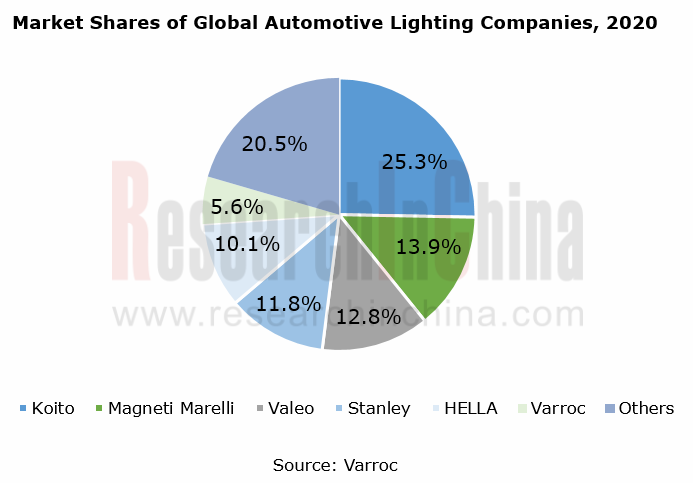
Automotive lighting is a highly concentrated market where bellwethers play a dominant role, that is, there are “one superpower and several powers”. In the global automotive lighting market, European, American and Japanese manufacturers are the main players. In 2020, Japan-based Koito was positioned first with market share of 25.3%, Italy’s Magneti Marelli (13.9%) and France-based Valeo (12.8%) followed, three together sweeping 52% of the global market.
Global automotive lighting leaders vie more fiercely for new technologies:
---In September 2019, Koito rolled out BladeScan?ADB headlamp system which has been mounted on 2019 Lexus RX and 2021 Lexus LS.
---At CES 2019, Magneti Marelli introduced its third-generation Smart Corner lighting technology which can integrate with all types of sensors including LiDAR, radar, camera and ultrasonic radar. The company also displayed advanced LED lighting functions such as digital light processing (DLP) and adaptive driving beam (ADB).
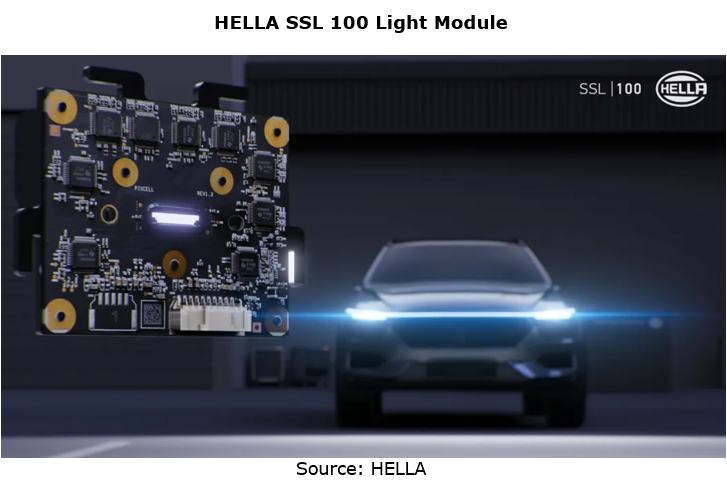
---In March 2020, Hella unveiled SSL 100 light module. The system offers up to 102 pixels, each of which can be activated independently, and controls light distribution via ECU to automatically turn on and turn off LED in a designated area. SSL 100 light module has been introduced into Chinese market and mass-produced at HELLA lamp plant in Jiaxing.
---In November 2020, the Human Centric Lighting (HCL) innovator Biological Innovations and Optimization Systems, LLC (BIOS), and Lumileds, joined forces to create a new SkyBlue? LED. BIOS SkyBlue Circadian rhythm technology used in the new product is a solution to technical challenges of HCL.
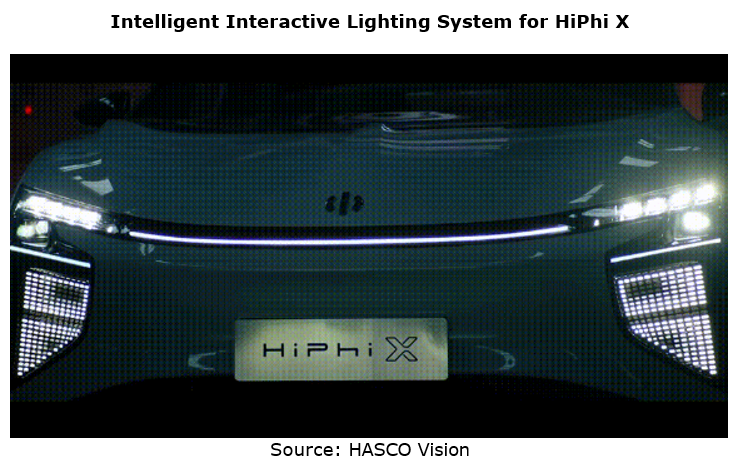
Not to be outdone, Chinese automotive lighting bellwethers have developed dynamically interactive lighting technology in the automotive CASE trend. For example, at Auto Shanghai 2021, HASCO Vision Technology displayed an intelligent interactive lighting system that consists of PML intelligent headlamps and ISD tail lights. The system can input user-defined texts, pictures and videos into the lighting domain controller which will then convert the content into elements and materials that the lamps can recognize to display the specific content and interact with the outside world. The system is mounted on Human Horizons HiPhi X. In 2020, Changzhou Xingyu Automotive Lighting Systems also managed to develop rhythmic taillights capable of welcoming, the second-generation ambient lights with public voice interaction function, gesture controlled indoor lamps, and pixel-type headlamp modules.
Demand for intelligent headlights increases, and six technology routes come to the forefront.
Intelligent headlights provide higher visibility for drivers in bad weathers to ensure driving safety. The data shows that the use of intelligent lamps helps to reduce 57%-74% traffic accidents at night. With the increasing demand, more and more intelligent headlights are installed in mid- and high-class cars. According to GMI Research and its public data, it is estimated that the global intelligent headlight market will be worth nearly USD6.84 billion in 2026 compared with USD4.83 billion in 2020.
There are six intelligent headlight technology routes: LED Matrix, μAFS, LCD, DLP, Blade Scan and MEMS.
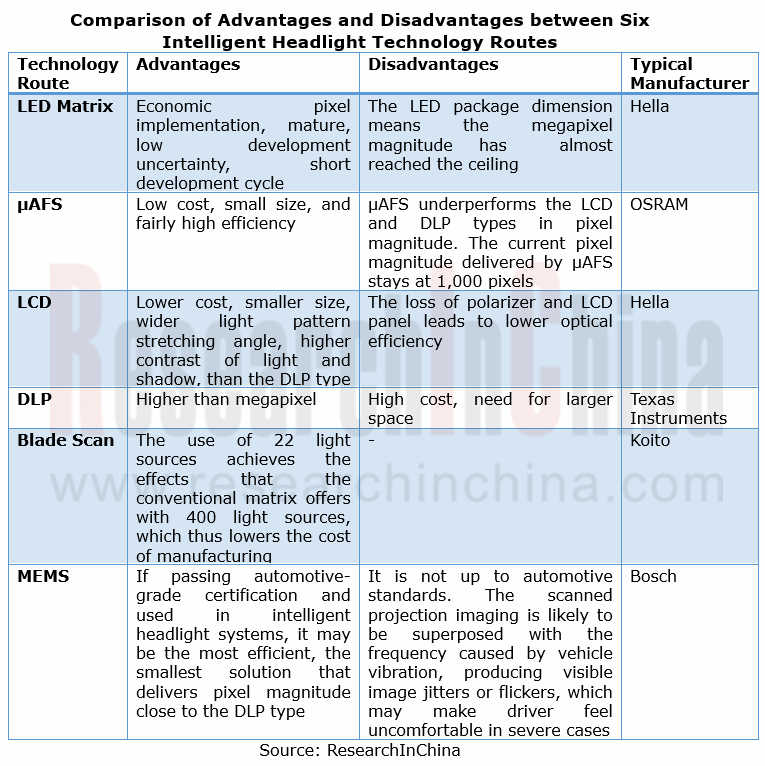
---As LED packaging technology matures and its cost falls, matrix ADB will still be the main implementation form of intelligent headlights which tend to sink from high-class car models to the lower-class.
OSRAM has introduced EVIYOS 1.0, the world’s first μAFS delivering 1,024 pixels on 4mm x 4mm SoC. OSRAM EVIYOS 2.0 offering 25,600 pixels is under development and will be rolled out in 2023.
DLP technology based on digital mirror device (DMD) is monopolized by TI. According to our statistics, there are a total of six DMD-enabled models including New Mercedes-Benz S Class, Great Wall VV6/VV7, and IM Zhiji. The more frequent interactions of vehicles with the outside world come with the development of intelligent connected vehicles. Automotive DLP technology allows light projections on ground to form various light patterns and icons so as to build a bridge to communicate with the outside world, and its high resolution helps to enable ADAS functions, for example, traffic sign lighting for recognizing traffic signs. Hence DLP technology will find broad application in intelligent connected vehicles.
Automakers play as “lighting factory” to accelerate the layout of intelligent lighting.
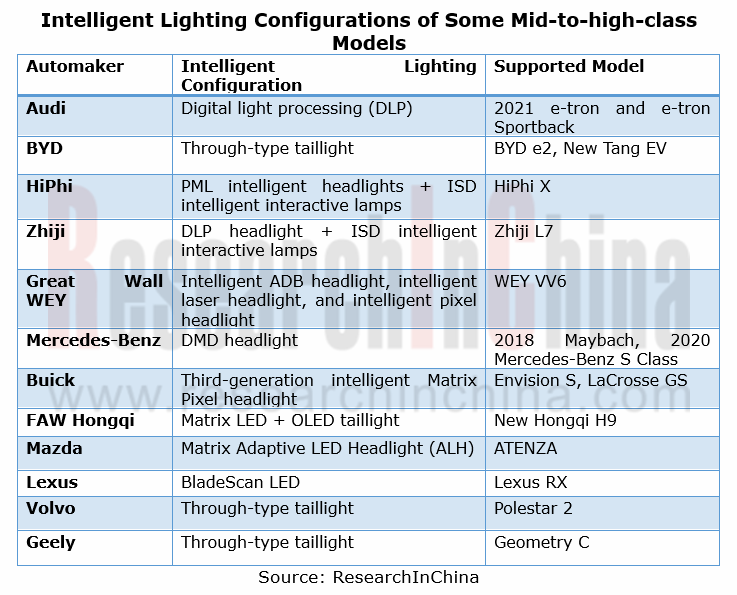
To meet market demand, automakers also step up their efforts to deploy intelligent lighting. Audi has made long and frequent deployments in automotive lighting. In June 2020, Audi released New Q5, a new model carrying Audi’s latest intelligent OLED lighting technology, which makes Audi the first automaker digitalizing taillights into a display. Audi is working to develop flexible digital OLED.
Among Chinese automakers, BYD has developed automotive lighting independently since 2003. FinDreams Vision Co., Ltd. BYD established in 2019 is devoted to developing vision technology, motor vehicle lighting and signal system. Having been the first automaker to integrate automotive lighting vertically, BYD is working toward development of new technologies in automotive lighting and environment interconnection.
In addition, Mazda has also developed its adaptive LED headlight (ALH) technology.
As the technology advances, automotive lighting is no longer a simple lighting tool but will integrate with driving assistance functions, for example, combined with cameras to enable safer driving through high and low beam switch according to the objects ahead. In future, more intelligent, more interactive and safer automotive lighting will be demanded in a new age.
AI-Defined Vehicle (AIDV) OEMs' Deployment Strategies Research Report, 2026
AIDV Research: Deployment Strategies of 22 OEMs
The AI-Defined Vehicle (AIDV) OEMs' Deployment Strategies Research Report, 2026, released by ResearchInChina, analyzes the AI deployment strategies of ...
OEMs’ Passenger Car Model Planning Research Report, 2026
Vehicle Model Planning Research: Chinese OEMs Launch Sub-Brands Intensively, While Multinational OEMs Apply the Brakes to Electrification Strategies
ResearchInChina released the OEMs’ Passenger Car M...
Autonomous Driving Simulation and World Model Research Report, 2026
Autonomous driving simulation research: "Simulation test + world model"-driven test system has become R&D infrastructure.
The "Autonomous Driving Simulation and World Model Research Report, 2026"...
Cockpit-Driving Integration Central Domain Controller SoC and AI Supercomputing Architecture Research Report, 2026
Cockpit-Driving integration and AI supercomputing research: The One Chip solution is rapidly installed in vehicles, and AI supercomputing architectures are moving towards full-domain integration.
AI ...
Intelligent Driving End-to-End Large Model Research Report, 2026
Research on Intelligent Driving Large Models: A Critical Period for Technological Competition and Paradigm Integration
As autonomous driving technology rapidly iterates from L2 to L3?L4, intelligent...
Automotive Digital Key Industry Trend Report, 2026
Digital Key Research: Automotive BLE, UWB and SLE Hardware Layout
The Automotive Digital Key Industry Trend Report, 2026, released by ResearchInChina, analyzes and predicts the digital key market, co...
Monthly Report on Automotive New Technology (May 2026)
UHD gaze technology, full-color LiDAR, UWB, etc. promote the upgrade of intelligent driving perception capabilities
This report is published once a month and is available for annual subscription.The...
In-Cabin Monitoring Systems (DMS, OMS, etc.) Research Report, 2026
In-Cabin Monitoring System Research: DMS to Become Mandatory in 2027, Expected to be Installed in Over 14 Million Vehicles
ResearchInChina released the In-Cabin Monitoring Systems (DMS, OMS, etc.) Re...
Automotive Service-Oriented Architecture (SOA) and Cross-Domain Middleware Industry Report, 2026
Research on automotive SOA and cross-domain middleware: The era of AI atomic services and AI cross-domain fusion agents is coming.
Automotive SOA evolves towards AI + full SOA servitization Driv...
Automotive Display, Center Console and Cluster Industry Report, 2026
Automotive Display Research: Multi-Screen Application Slows Down, While OLED and MiniLED Are Introduced in Vehicles Quickly
In 2026, automotive displays will no longer excessively pursue the number a...
Global and China Intelligent Vehicle Standard System Construction and Certification Research Report, 2026
Intelligent Driving Standards and Certification: With the Maturing Standardization System, China Will Participate in Formulation of Global Standards
China's automotive industry is transforming from ...
Automotive Intelligent Diagnosis Industry Report, 2026
Automotive Intelligent Diagnosis Research: Powered by AI, Remote Diagnosis Is Being Upgraded towards Intelligence.
ResearchInChina released the Automotive Intelligent Diagnosis Industry Report, 2026....
Automotive Cloud Service Platform Research Report, 2026
Research on automotive cloud service platform: with architecture upgrade and computing power improvement, cloud services enter a new stage
In 2026, the Internet of Vehicles industry generates petaby...
Integrated Battery and Innovative Battery Technology Research Report, 2026
Power Battery Research: Sales of High-Capacity Vehicles Keep Rising, and Solid-State Batteries Begin to Be Installed in Vehicles
I. Sales of High-Capacity Vehicles Sustain Growth, and Those with A C...
Chinese Independent OEMs’ ADAS and Autonomous Driving Report, 2026
Research on OEMs' Intelligent Driving: Era of Physical AI, Standard Configuration of D2D, and Initial Exploration of L3 Commercial Pilot Projects
From 2023 to 2025, the intelligent driving installati...
Intelligent Vehicle New Technology Application Analysis Report, 2025-2026
New Technology Research: Innovative Products such as Bionic Cameras, Vision-LiDAR Fusion Sensors, Auditory Sensors Further Enhance Vehicle Perception Capabilities
ForewordResearchInChina released th...
Automotive Optical Fiber Communication (Optical Fiber Ethernet, PON) and Supply Chain Research Report, 2026
Research on Automotive Optical Fiber Communication: Introduction of Optical Fiber in Vehicles Accelerates, with Priority Deployment in High-Speed Communication Link (10+Gbps) Scenarios
Automotive opt...
Automotive Intelligent Cockpit SoC Research Report, 2026
Automotive Cockpit SoC Research: Passenger Cars in the Price Range of RMB100,000–200,000 Account for Nearly 50% of Total Sales, and New-Generation Cockpit SoC Products Largely Enter Mass Production
P...