Automotive steering system research: EPS dominates the market, SBW prepares for fully autonomous driving
After hundreds of years of development, automotive steering systems have derived HPS, EHPS, EPS, SBW and other types. At present, HPS (hydraulic power steering) and EHPS (electronic hydraulic power steering) have been widely used in commercial vehicles, while EPS (electric power steering) is mainly applied to passenger cars, and SBW (Steer-by-Wire) has the lowest penetration rate.
EPS occupies the passenger car market, while HPS and EHPS dominate the commercial vehicle market
In Chinese passenger car steering system market, the share of EPS has increased from 80.1% in 2016 to 96.4% in 2020; only a small number of passenger cars adopt HPS and EHPS solutions. Relatively speaking, the higher the price of cars, the higher the proportion of EPS solutions applied.
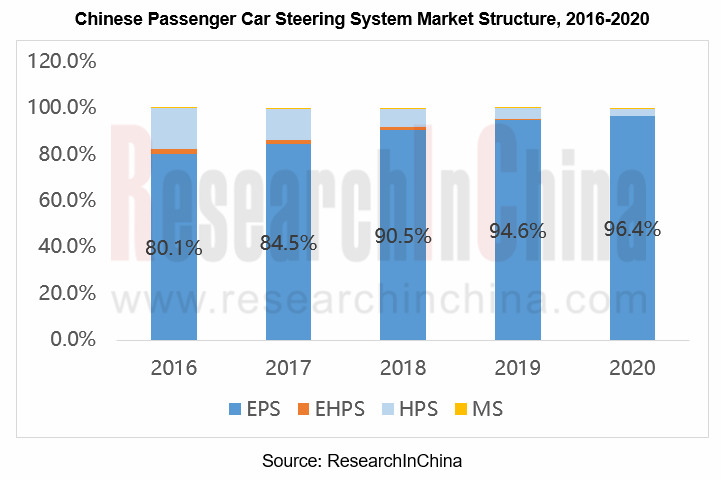
Due to its small size, low power consumption, light weight and flexibility, EPS is the first choice for new energy vehicles. EPS accounted for 99.91% of the new energy passenger car market in 2020, and this proportion is expected to reach 100% in the future.
HPS and EHPS are usually seen in most commercial vehicles, especially heavy-duty vehicles, thanks to their high power and low prices. In 2020, China's commercial vehicle steering systems were still dominated by HPS and EHPS, of which EHPS made up for 40.1%. However, the market shares of HPS and EHPS will gradually be grabbed by EPS in the future because they not only consume lots of power, but also cause hydraulic oil leakage, which do not meet environmental protection requirements.
The EPS penetration rate of local passenger car brands is gradually increasing
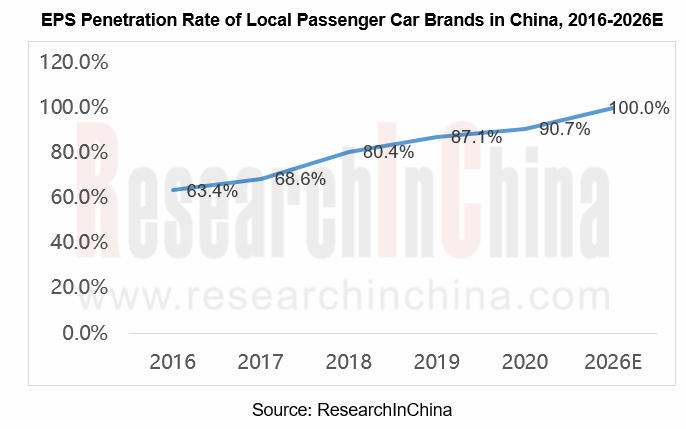
In the Chinese passenger car market, the EPS penetration rate of Chinese passenger car brands is much lower than that of foreign passenger car brands. In 2020, the former was 90.7%, while the latter hit as high as 100%. However, with the gradual tightening of environmental protection, local brands will gradually abandon the polluting steering systems such as HPS and EHPS. By 2026, the EPS penetration rate of Chinese passenger car brands is expected to reach 100%.
Multinational companies dominate the market, while local companies strive to survive
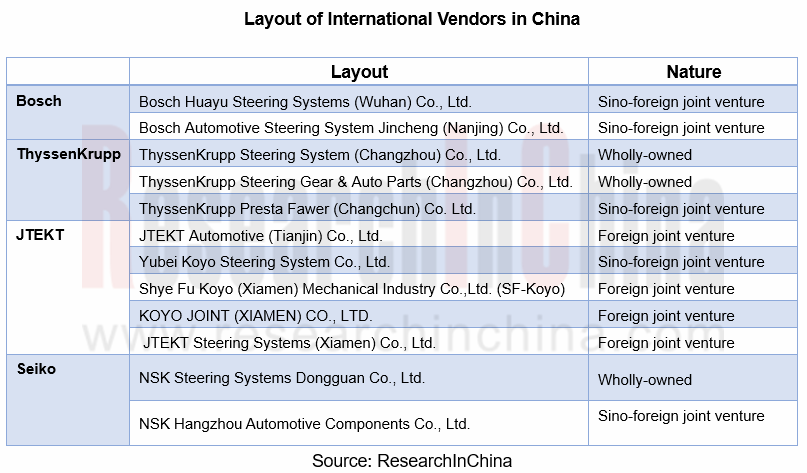
At present, the global automotive steering system market is mainly occupied by vendors such as JTEKT, Bosch, ZF, ThyssenKrupp, NSK, Mando, Hitachi Astemo. These multinational companies have deployed the Chinese market through sole proprietorship or joint ventures, firmly occupied the supply channels of luxury and joint venture brand automakers, and penetrated into the supply system of local automakers.
There are more than 100 local companies in China, but most of them are small companies targeting the aftermarket with weak competitiveness. Zhejiang Shibao, CAAS, Elite, Nexteer Automotive, etc. which have relatively strong competitiveness can compete with multinational giants. For example, Nexteer Automotive and Zhejiang Shibao have entered the supply systems of American, German and Japanese automakers by virtue of their robust strength, and have taken places in the siege of multinational companies.
Major vendors and automakers have deployed SBW which will be promising in the future
The biggest difference between SBW and EPS is that the former removes the mechanical connection between the steering wheel and the rack and uses ECU to transmit commands instead. SBW features fast response, flexible installation, lighter weight, and improved collision safety.
SBW technology was proposed as early as 1950. After decades of development, it has now been mass-produced on Infiniti’s several models. Although SBW still has problems such as high cost, immature technology, limited user acceptance, low penetration rate, etc., some automotive steering vendors and automakers are very optimistic about SBW technology and are making efforts herein. There will be a number of production models using SBW.
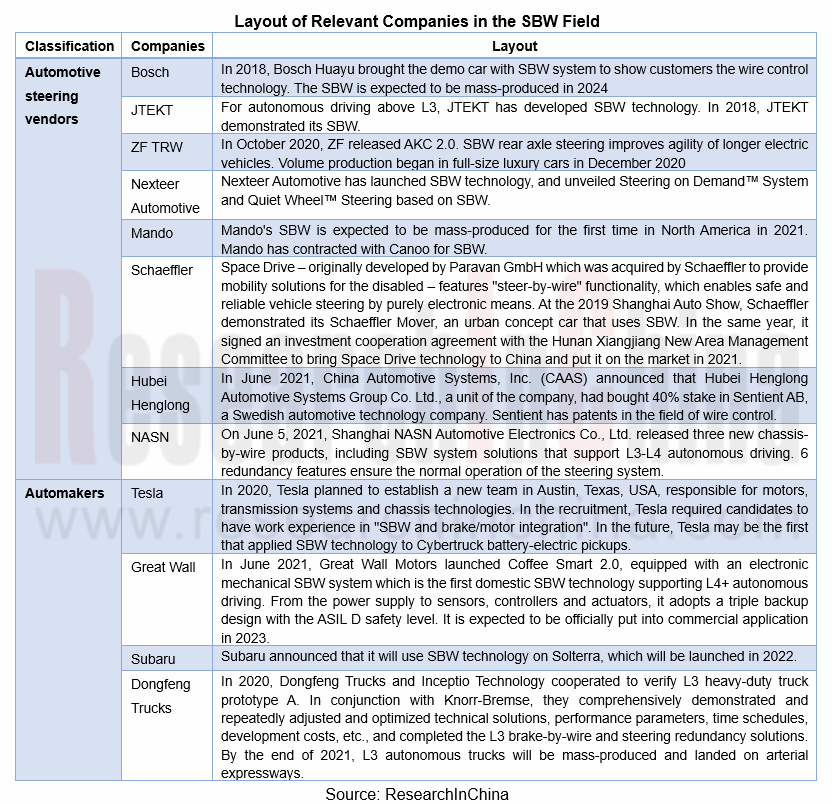
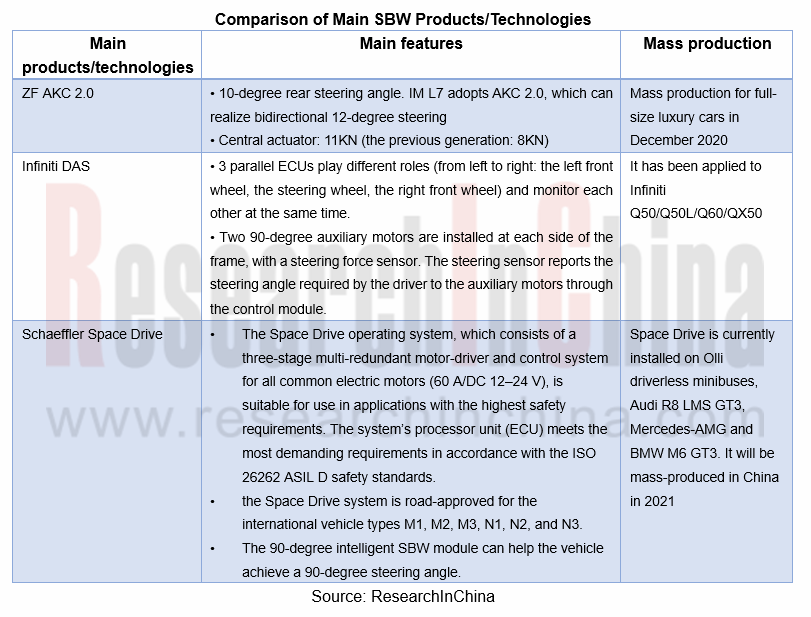
China Automotive Engineering Research Institute Co., Ltd. (CAERI) has worked with Huawei, Baidu, Schaeffler and many other companies to jointly compile SBW and Brake System Communication Protocol Requirements and Test Specifications, which is conducive to promoting the development of SBW technology and its application in intelligent vehicles.
At present, the penetration rate of SBW in China is extremely low, and was estimated at 0.1% in 2020. In the next few years, the penetration rate will jump rapidly, and it is expected to reach 15% by 2026. Meanwhile, the market scale will gradually expand to RMB12.16 billion, with lucrative development prospects.
EPS is the key to ADAS functions, while SBW is one of the key technologies for fully autonomous driving
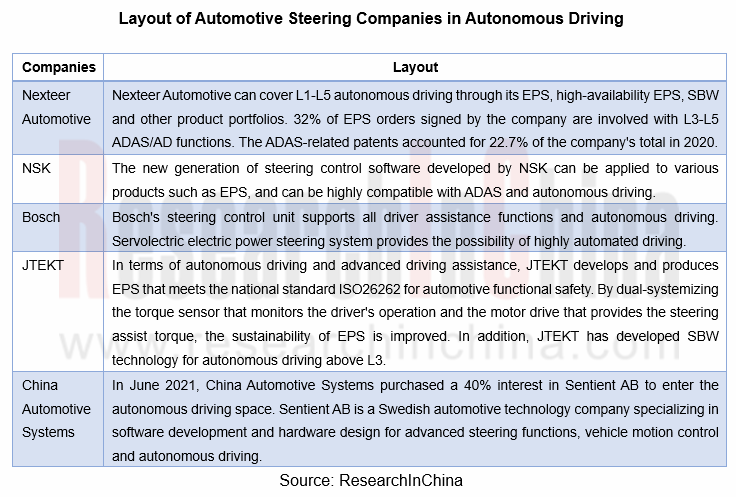
The automotive steering system is closely related to the development of autonomous driving. At present, EPS is the key to ADAS functions, serving different levels of autonomous driving with typical ADAS functions like APA, LDW&LKA and DSR. However, in essence, the steering signal of EPS still comes from the driver, while the steering signal of SBW stems from the algorithm. Therefore, SBW can be completely separated from the driver to control steering as one of the key technologies for fully automatic driving in the future.
At present, some automotive steering system companies have begun to deploy autonomous driving.
AI-Defined Vehicle (AIDV) OEMs' Deployment Strategies Research Report, 2026
AIDV Research: Deployment Strategies of 22 OEMs
The AI-Defined Vehicle (AIDV) OEMs' Deployment Strategies Research Report, 2026, released by ResearchInChina, analyzes the AI deployment strategies of ...
OEMs’ Passenger Car Model Planning Research Report, 2026
Vehicle Model Planning Research: Chinese OEMs Launch Sub-Brands Intensively, While Multinational OEMs Apply the Brakes to Electrification Strategies
ResearchInChina released the OEMs’ Passenger Car M...
Autonomous Driving Simulation and World Model Research Report, 2026
Autonomous driving simulation research: "Simulation test + world model"-driven test system has become R&D infrastructure.
The "Autonomous Driving Simulation and World Model Research Report, 2026"...
Cockpit-Driving Integration Central Domain Controller SoC and AI Supercomputing Architecture Research Report, 2026
Cockpit-Driving integration and AI supercomputing research: The One Chip solution is rapidly installed in vehicles, and AI supercomputing architectures are moving towards full-domain integration.
AI ...
Intelligent Driving End-to-End Large Model Research Report, 2026
Research on Intelligent Driving Large Models: A Critical Period for Technological Competition and Paradigm Integration
As autonomous driving technology rapidly iterates from L2 to L3?L4, intelligent...
Automotive Digital Key Industry Trend Report, 2026
Digital Key Research: Automotive BLE, UWB and SLE Hardware Layout
The Automotive Digital Key Industry Trend Report, 2026, released by ResearchInChina, analyzes and predicts the digital key market, co...
Monthly Report on Automotive New Technology (May 2026)
UHD gaze technology, full-color LiDAR, UWB, etc. promote the upgrade of intelligent driving perception capabilities
This report is published once a month and is available for annual subscription.The...
In-Cabin Monitoring Systems (DMS, OMS, etc.) Research Report, 2026
In-Cabin Monitoring System Research: DMS to Become Mandatory in 2027, Expected to be Installed in Over 14 Million Vehicles
ResearchInChina released the In-Cabin Monitoring Systems (DMS, OMS, etc.) Re...
Automotive Service-Oriented Architecture (SOA) and Cross-Domain Middleware Industry Report, 2026
Research on automotive SOA and cross-domain middleware: The era of AI atomic services and AI cross-domain fusion agents is coming.
Automotive SOA evolves towards AI + full SOA servitization Driv...
Automotive Display, Center Console and Cluster Industry Report, 2026
Automotive Display Research: Multi-Screen Application Slows Down, While OLED and MiniLED Are Introduced in Vehicles Quickly
In 2026, automotive displays will no longer excessively pursue the number a...
Global and China Intelligent Vehicle Standard System Construction and Certification Research Report, 2026
Intelligent Driving Standards and Certification: With the Maturing Standardization System, China Will Participate in Formulation of Global Standards
China's automotive industry is transforming from ...
Automotive Intelligent Diagnosis Industry Report, 2026
Automotive Intelligent Diagnosis Research: Powered by AI, Remote Diagnosis Is Being Upgraded towards Intelligence.
ResearchInChina released the Automotive Intelligent Diagnosis Industry Report, 2026....
Automotive Cloud Service Platform Research Report, 2026
Research on automotive cloud service platform: with architecture upgrade and computing power improvement, cloud services enter a new stage
In 2026, the Internet of Vehicles industry generates petaby...
Integrated Battery and Innovative Battery Technology Research Report, 2026
Power Battery Research: Sales of High-Capacity Vehicles Keep Rising, and Solid-State Batteries Begin to Be Installed in Vehicles
I. Sales of High-Capacity Vehicles Sustain Growth, and Those with A C...
Chinese Independent OEMs’ ADAS and Autonomous Driving Report, 2026
Research on OEMs' Intelligent Driving: Era of Physical AI, Standard Configuration of D2D, and Initial Exploration of L3 Commercial Pilot Projects
From 2023 to 2025, the intelligent driving installati...
Intelligent Vehicle New Technology Application Analysis Report, 2025-2026
New Technology Research: Innovative Products such as Bionic Cameras, Vision-LiDAR Fusion Sensors, Auditory Sensors Further Enhance Vehicle Perception Capabilities
ForewordResearchInChina released th...
Automotive Optical Fiber Communication (Optical Fiber Ethernet, PON) and Supply Chain Research Report, 2026
Research on Automotive Optical Fiber Communication: Introduction of Optical Fiber in Vehicles Accelerates, with Priority Deployment in High-Speed Communication Link (10+Gbps) Scenarios
Automotive opt...
Automotive Intelligent Cockpit SoC Research Report, 2026
Automotive Cockpit SoC Research: Passenger Cars in the Price Range of RMB100,000–200,000 Account for Nearly 50% of Total Sales, and New-Generation Cockpit SoC Products Largely Enter Mass Production
P...