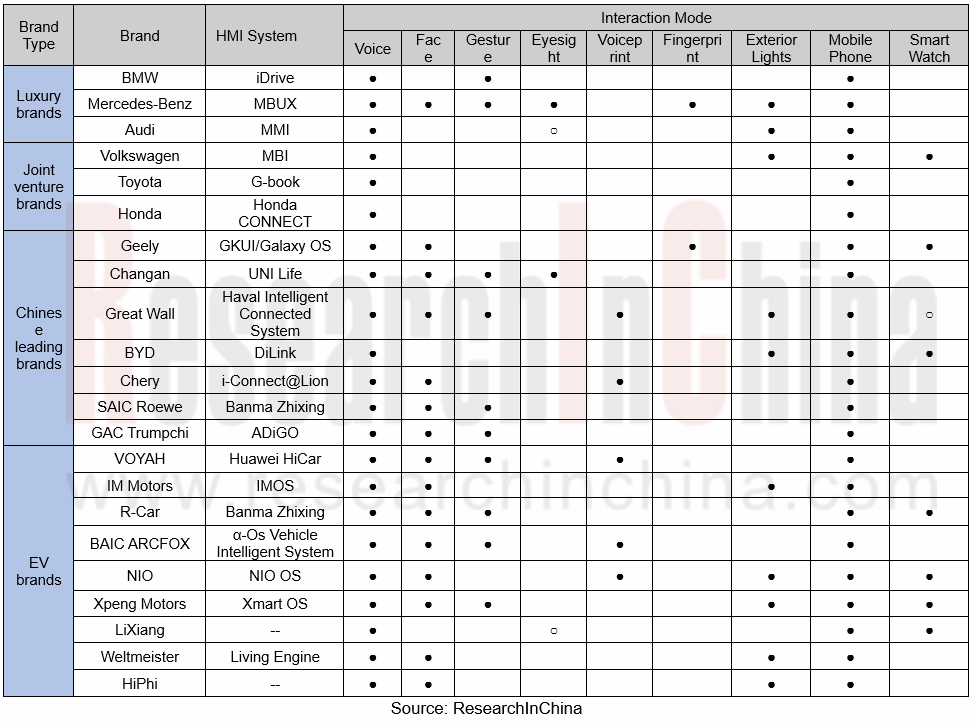
Our China Automotive Multimodal Interaction Development Research Report, 2021 combs through and summarizes the interaction modes of mainstream auto brands.
The current automotive human-computer interaction (HMI) is characterized by the following:
1. In terms of interaction modes, in addition to conventional interaction methods such as touch control, button and knob, voice and mobile phone have become favored options in automotive HMI. Moreover, face, gesture, and car lamp have also become popular interaction options. Some brands even have begun to try new interaction ways, such as eye tracking, voiceprint, and fingerprint.
2. As concerns layout, joint-venture brands remain conservative in interaction modes. They seldom use new interaction methods except for voice and mobile phone. Yet luxury brands are pioneers of multimodal interaction. One example is Mercedes-Benz which has equipped its new-generation MBUX system with multiple new interactions like face, gesture, eye, and fingerprint. By comparison, Chinese leading brands are more active in new interaction modes, for example, Changan Auto has eyesight wake-up and Great Wall Motor offers voiceprint recognition.
Some HMI modes of mainstream auto brands inside and outside China:
Voice as a conventional interaction mode offers improvements in functions.
Besides the original capabilities of voice interaction, features like continuous dialogue, voice area lock, tone switch, and user-defined voice have become next orientations of mainstream brands.
1. Continuous dialogue and voice area lock have been used by several brands.
After a wake-up, a voice interaction system with the continuous dialogue capability needs no repeated wake-up within a certain period of time, which makes the response to instructions more coherent; the voice area lock feature with the ability to locate the voice command issuer, executes commands like “open window” and “adjust air conditioning temperature” more accurately. The brands using the two features include Geely, Changan, Great Wall, Chery, SAIC Roewe, GAC Trumpchi, Xpeng, NIO and Lixiang.
Geely Xingyue L - the “driver geek mode” of Galaxy OS frees the driver of wake-up in 24 hours, and enables lock of four voice areas.

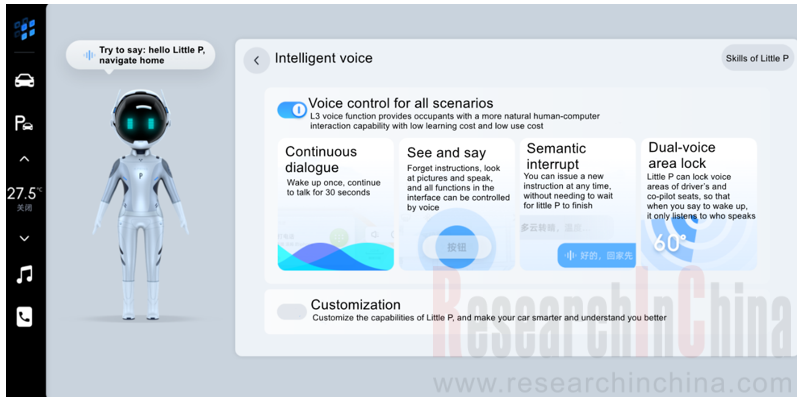
Xpeng Motors – the voice assistant Little P delivers voice functions in all scenarios and allows 30s continuous dialogue and dual-voice area lock.
2. Tone switch refers to the availability of other speech options the voice system provides for users in addition to default voices and sounds, such as, voices of celebrities and game characters. The brands with this feature include Geely, Changan, Great Wall, BYD and Roewe, as well as emerging carmakers like NIO, Xpeng and Lixiang. For instance, Banma Zhixing Venus System mounted on SAIC Roewe RX5 offers five tone options: affinity female voice, intellectual female voice, magnetic male voice, innocent child voice, and passionate female voice.
3. User-defined voice feature allows customization of voice tones and voice functions.
“Voice tone customization” means that the system applies the uploaded voices of the user’s own or his/her families’ in scenarios such as voice response and navigation broadcast. Models carrying this capability include Geely, Great Wall, SAIC Roewe, GAC Trumpchi and R Car.
“Voice function customization” means that users can define a voice command as well as corresponding operation, which brings the voice system into full play and meets the personalized needs of users. The typical brand using this capability is Xpeng Motors.
Geely Xingyue L - Galaxy OS allows users to define voice. The customized human voice is available to all scenarios including navigation and response.
Xpeng Motors - Little P Customization allows Xpeng car owners to define voice commands and corresponding operation via their smartphone APP.
Gesture has become the third new interaction mode behind voice and face.
Gesture interaction uses the in-car camera to judge a gesture and send the data to the vehicle system control unit which will then call out the function corresponding to the gesture. Gesture control is more accurate and quicker, and easier to operate than voice control.
Brands using gesture interaction include BMW, Mercedes-Benz, Changan, Great Wall, SAIC Roewe, GAC Trumpchi, VOYAH, R Car, BAIC ARCFOX, and Xpeng, of which Great Wall and Xpeng support gesture recognition outside car.
WEY Mocha – enable gesture control over ignition, forward/backward movement, suspension, and flameout outside the car.
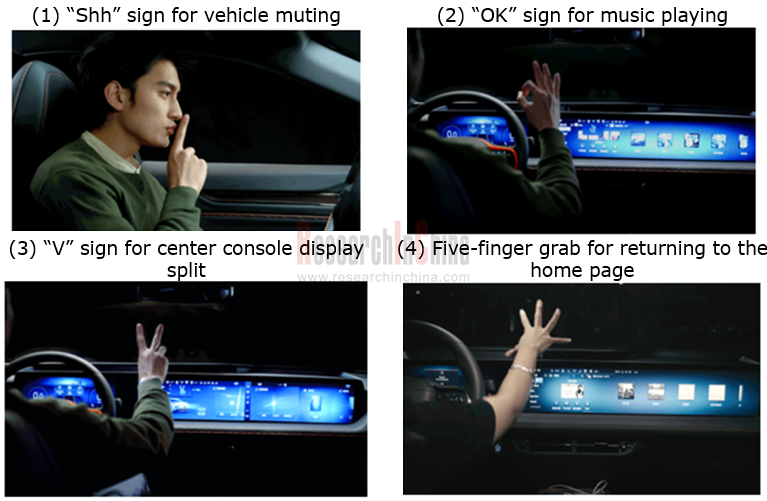
Changan Ford EVOS - the new-generation SYNC+ 2.0 allows gesture control over muting, music play, interface split, and back to the home interface, etc.
Light interaction is available to brands like Mercedes-Benz, HiPhi and IM Motors.
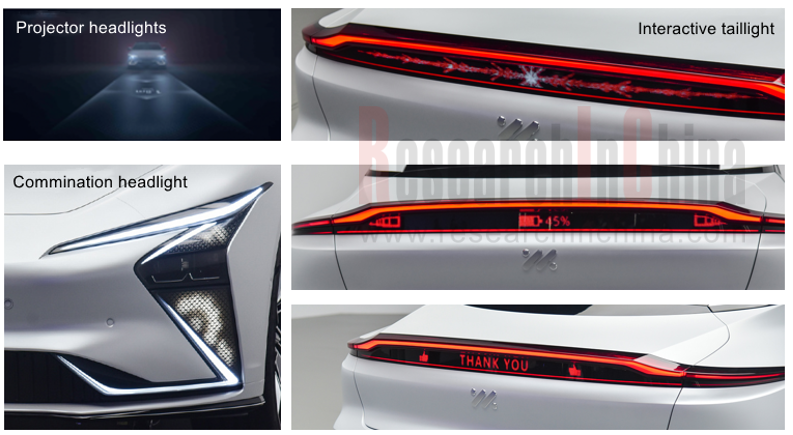
Light interaction sends a message out by way of flashing, light projection and combination headlight. Light interaction provides channels for communication with traffic participants outside the car, and enables autonomous vehicles to communicate with the surroundings at a time of implementing autonomous driving. Now brands including Mercedes-Benz, Audi, Volkswagen, Great Wall, BYD, HiPhi, IM and Xpeng have packed this interaction mode.
Mercedes-Benz - Projector headlights project warning signs, assisted markings and other information related to driving assistance systems onto the road ahead.
IM L7 - Projection headlights enable the projection of interactive alerts, navigation, vehicle information among others, offering lane-level guidance with HD maps.; combination headlights provide several patterns to show the status of users in the cockpit; interactive taillights enable display of words and emoticons, as well as information, for example, thanks, pedestrian warning and state of charge.
As well as combination headlights, some brands like BAIC and Samsung are trying to add displays at the front and rear of the body to send messages to pedestrians.
BAIC Lite 300 – LED displays at the front and rear of the body show words, emoticons, animations, state of charge and other content.
Multimodal fusion holds a future trend.
Single-modal interaction has a limited role to play in improvement of interaction experience. Multimodal fusion is obviously a feasible and efficient option for better interaction experience in future. Brands that are developing this feature are Mercedes-Benz, BMW, Huawei and Changan.
1. Voice + eye sight
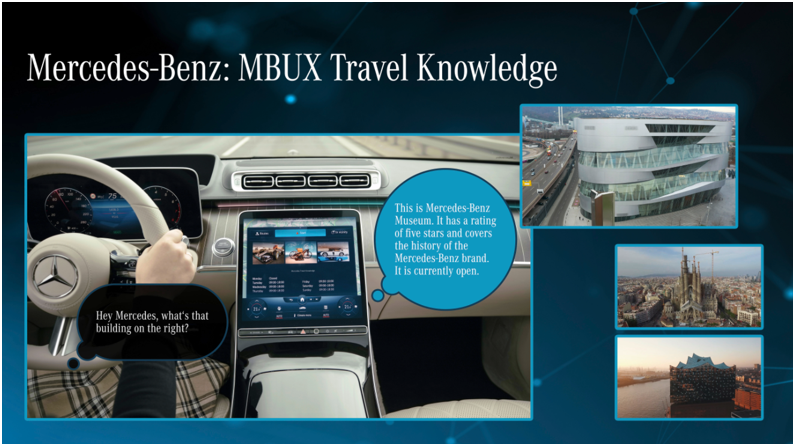
Voice interaction shows little ability to recognize fuzzy pronouns like “this” and “that”. In this case, the addition of eye tracking for locking direction, plus voice commands, can make the response to commands much quicker.
Mercedes-Benz MBUX Travel Knowledge – a driver who fixes his/her gaze on a building says “I want to know the purpose of this building”, and he/she will acquire related information. Cerence Look provides technical support.
2. Voice + lip movement recognition
Accurate acquisition of commands is a key step in the voice interaction process. Complex cockpit environment, noise and high personnel density make it harder to recognize voice. The new voice area lock feature added recently comes as a solution to the problem. Yet for its limitations, the single-model voice interaction technology has a limited effect in improving interaction experience.
The combination with lip movement recognition renders voice recognition far more accurate in voice interaction. Lip movements vary over language. In a noisy cockpit environment, combining lip movements, the system can ensure high voice recognition accuracy, even as the voice sounds low.
AI-Defined Vehicle (AIDV) OEMs' Deployment Strategies Research Report, 2026
AIDV Research: Deployment Strategies of 22 OEMs
The AI-Defined Vehicle (AIDV) OEMs' Deployment Strategies Research Report, 2026, released by ResearchInChina, analyzes the AI deployment strategies of ...
OEMs’ Passenger Car Model Planning Research Report, 2026
Vehicle Model Planning Research: Chinese OEMs Launch Sub-Brands Intensively, While Multinational OEMs Apply the Brakes to Electrification Strategies
ResearchInChina released the OEMs’ Passenger Car M...
Autonomous Driving Simulation and World Model Research Report, 2026
Autonomous driving simulation research: "Simulation test + world model"-driven test system has become R&D infrastructure.
The "Autonomous Driving Simulation and World Model Research Report, 2026"...
Cockpit-Driving Integration Central Domain Controller SoC and AI Supercomputing Architecture Research Report, 2026
Cockpit-Driving integration and AI supercomputing research: The One Chip solution is rapidly installed in vehicles, and AI supercomputing architectures are moving towards full-domain integration.
AI ...
Intelligent Driving End-to-End Large Model Research Report, 2026
Research on Intelligent Driving Large Models: A Critical Period for Technological Competition and Paradigm Integration
As autonomous driving technology rapidly iterates from L2 to L3?L4, intelligent...
Automotive Digital Key Industry Trend Report, 2026
Digital Key Research: Automotive BLE, UWB and SLE Hardware Layout
The Automotive Digital Key Industry Trend Report, 2026, released by ResearchInChina, analyzes and predicts the digital key market, co...
Monthly Report on Automotive New Technology (May 2026)
UHD gaze technology, full-color LiDAR, UWB, etc. promote the upgrade of intelligent driving perception capabilities
This report is published once a month and is available for annual subscription.The...
In-Cabin Monitoring Systems (DMS, OMS, etc.) Research Report, 2026
In-Cabin Monitoring System Research: DMS to Become Mandatory in 2027, Expected to be Installed in Over 14 Million Vehicles
ResearchInChina released the In-Cabin Monitoring Systems (DMS, OMS, etc.) Re...
Automotive Service-Oriented Architecture (SOA) and Cross-Domain Middleware Industry Report, 2026
Research on automotive SOA and cross-domain middleware: The era of AI atomic services and AI cross-domain fusion agents is coming.
Automotive SOA evolves towards AI + full SOA servitization Driv...
Automotive Display, Center Console and Cluster Industry Report, 2026
Automotive Display Research: Multi-Screen Application Slows Down, While OLED and MiniLED Are Introduced in Vehicles Quickly
In 2026, automotive displays will no longer excessively pursue the number a...
Global and China Intelligent Vehicle Standard System Construction and Certification Research Report, 2026
Intelligent Driving Standards and Certification: With the Maturing Standardization System, China Will Participate in Formulation of Global Standards
China's automotive industry is transforming from ...
Automotive Intelligent Diagnosis Industry Report, 2026
Automotive Intelligent Diagnosis Research: Powered by AI, Remote Diagnosis Is Being Upgraded towards Intelligence.
ResearchInChina released the Automotive Intelligent Diagnosis Industry Report, 2026....
Automotive Cloud Service Platform Research Report, 2026
Research on automotive cloud service platform: with architecture upgrade and computing power improvement, cloud services enter a new stage
In 2026, the Internet of Vehicles industry generates petaby...
Integrated Battery and Innovative Battery Technology Research Report, 2026
Power Battery Research: Sales of High-Capacity Vehicles Keep Rising, and Solid-State Batteries Begin to Be Installed in Vehicles
I. Sales of High-Capacity Vehicles Sustain Growth, and Those with A C...
Chinese Independent OEMs’ ADAS and Autonomous Driving Report, 2026
Research on OEMs' Intelligent Driving: Era of Physical AI, Standard Configuration of D2D, and Initial Exploration of L3 Commercial Pilot Projects
From 2023 to 2025, the intelligent driving installati...
Intelligent Vehicle New Technology Application Analysis Report, 2025-2026
New Technology Research: Innovative Products such as Bionic Cameras, Vision-LiDAR Fusion Sensors, Auditory Sensors Further Enhance Vehicle Perception Capabilities
ForewordResearchInChina released th...
Automotive Optical Fiber Communication (Optical Fiber Ethernet, PON) and Supply Chain Research Report, 2026
Research on Automotive Optical Fiber Communication: Introduction of Optical Fiber in Vehicles Accelerates, with Priority Deployment in High-Speed Communication Link (10+Gbps) Scenarios
Automotive opt...
Automotive Intelligent Cockpit SoC Research Report, 2026
Automotive Cockpit SoC Research: Passenger Cars in the Price Range of RMB100,000–200,000 Account for Nearly 50% of Total Sales, and New-Generation Cockpit SoC Products Largely Enter Mass Production
P...