|
 |
Joint Venture Passenger Car Brands’ ADAS and Autonomous Driving Research Report, 2021
|
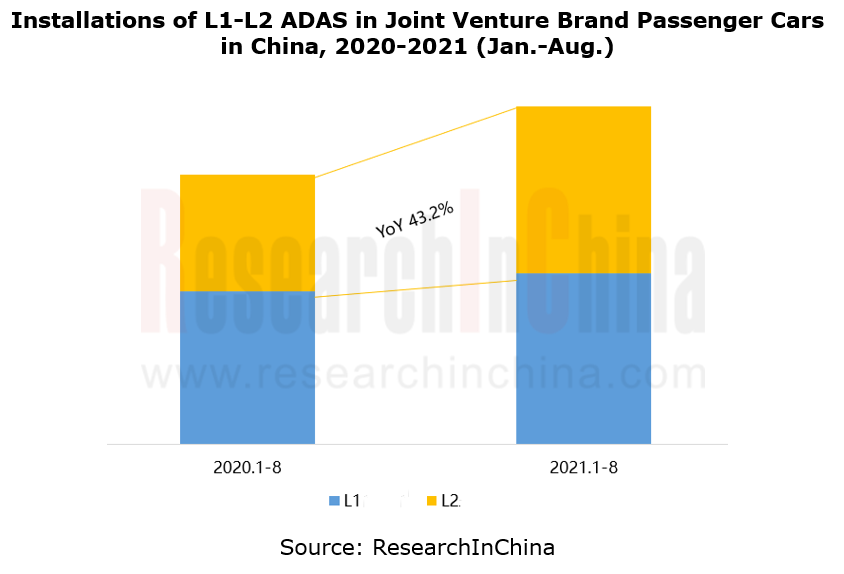
Joint venture brands’ ADAS research: the installations of L2 ADAS surged by 43.2% year on year.
In the first eight months of 2021, 3.87 million passenger cars of joint venture brands in China were equipped with ADAS, a like-on-like jump of 25.4%, with the installation rate up to 49.0%, up 4.9 percentage points. Wherein, the installations and installation rate of L2 ADAS increased by 43.2% and 5.1 percentage points from the same period of the previous year, separately.
Toyota leads L2 ADAS market.
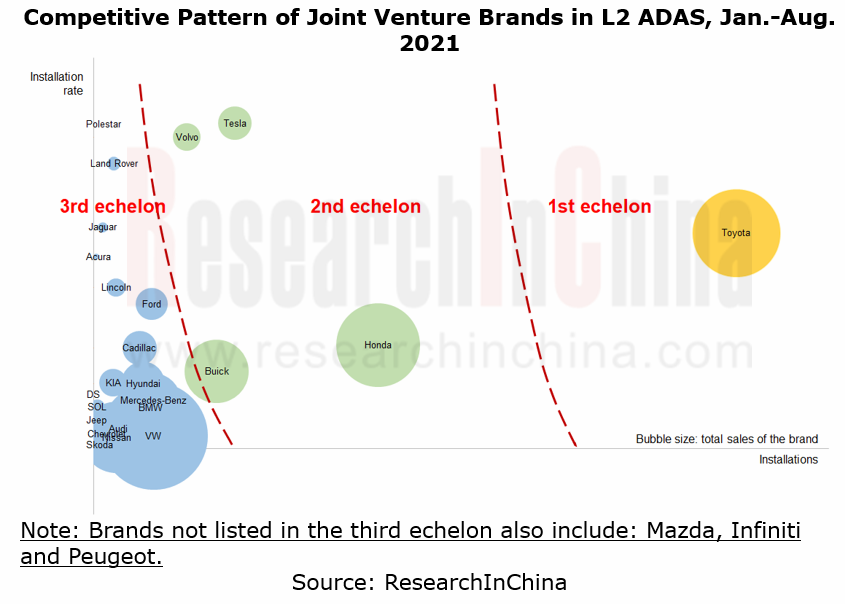
In the joint venture brands’ L2 ADAS market, Toyota is only first-echelon player, with the system installations far higher than its peers; Honda, Buick, Volvo and Tesla are in the second echelon.
- Toyota’s installations of L2 ADAS approached 700,000 units, driven by its hot-selling models like Corolla, Levin, RAV4 and Avalon, nearly 400,000 units more than the runner-up Honda. In terms of sensor solution, Toyota’s L2 ADAS adopted 1R1V and 3R1V solutions, over 90% of which were 1R1V;
- Volvo boasted a L2 ADAS installation of 95.6% and mainly used 1R1V and 3R1V solutions, of which 1R1V swept over 80%;
- The third-echelon players, Ford and Volkswagen have the potential to leap to the second echelon.
L3 ADAS of Honda and Mercedes-Benz has been approved for use in cars legally introduced on roads in their local markets.
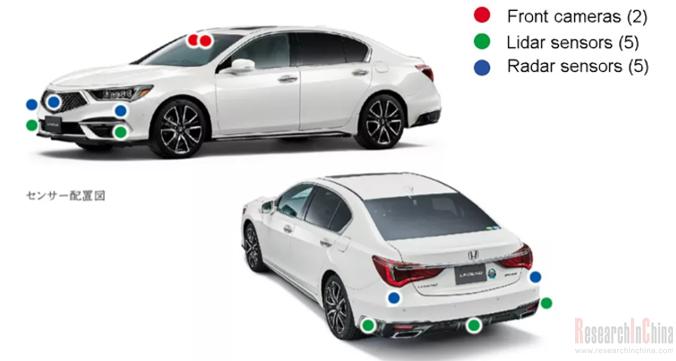
In March 2021, Honda introduced Honda SENSING Elite, a L3 automated driving system first mounted on Honda Legend, the world’s first L3 model legally introduced on roads. This L3 system employs the following sensor solution:
- 1 set of front view stereo cameras
- 4 surround view cameras
- 5 LiDARs (Valeo’s second-generation SCALA LiDARs, 16-channel)
- 5 radars
The sensor layout is shown below.
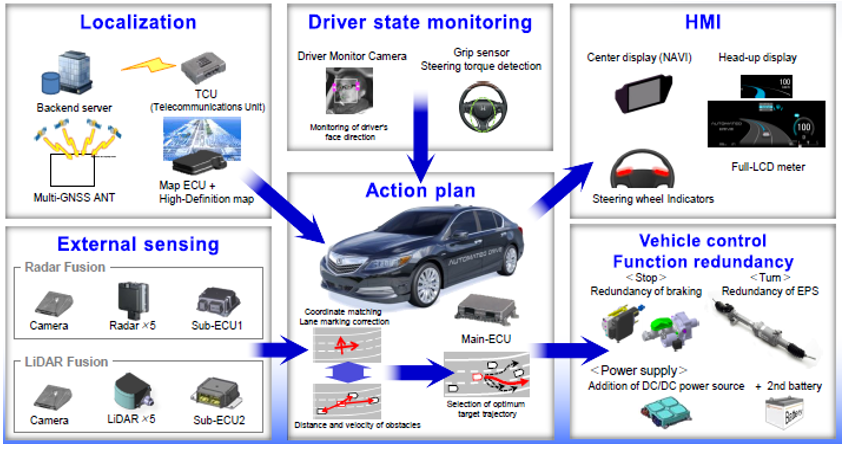
The composition of Honda SENSING Elite is as follows.
Honda Legend, the world’s first L3 autonomous model legally running on roads, is only available in Japan. Just 100 units have been launched on market for rental, not sold. The MRRP of JPY11 million (approximately RMB660,000) refers to only deposit. There is still no effective way for ordinary users to access L3 automated driving.
In December 2021, Mercedes-Benz DRIVE PILOT, a L3 autonomous driving system captured the approval for driving on roads from the German Federal Motor Transport Authority (KBA). This L3 system mounted on Mercedes-Benz EQS or S-Class will become available on market in 2022, which means ordinary users will use L3 autonomous driving function on 13,000km highways in Germany as early as the second half of 2022.
The sensor solution for Mercedes-Benz DRIVE PILOT is as follows:
- 1 LiDAR
- 4 angular radars
- 1 long-range forward radar
- 1 set of front view stereo cameras
- 4 surround view cameras
- 12 ultrasonic radars
- 1 wheel camera (working together with the rain sensor on the windshield to perceive whether it is rainy or not)
- 1 rear multi-purpose camera
- HD map
- Driver camera
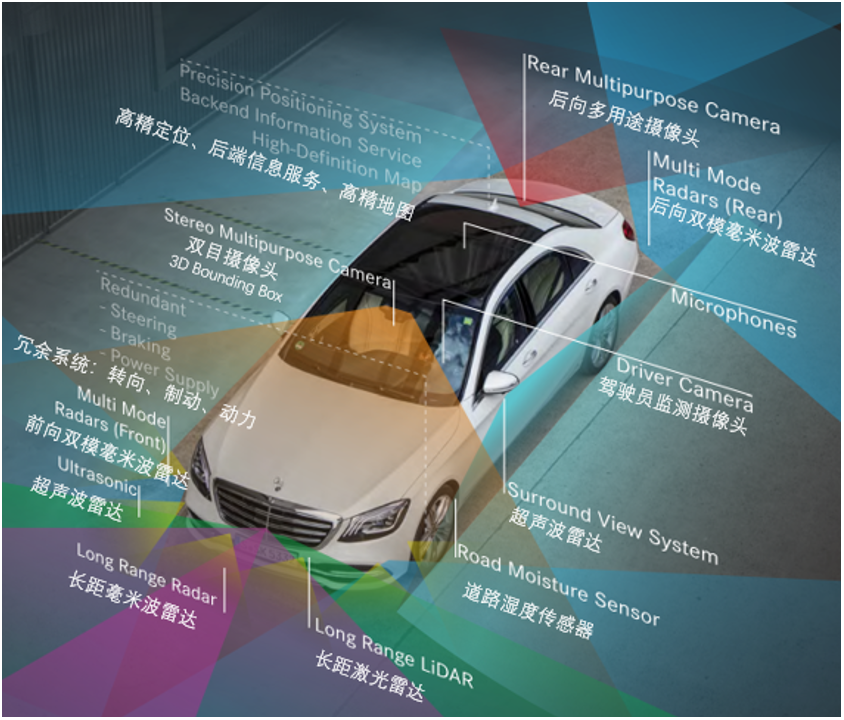
The KBA has granted approval for Mercedes-Benz’s mass-production and sales of L3 autonomous cars on the basis of the technical regulation UN-R157, a UN Regulation on uniform provisions concerning the approval of vehicles with Regards to Automated Lane Keeping Systems, which was passed at World Forum for Harmonization of Vehicle Regulations of United Nations Economic Commission for Europe.
UN-R157 defines ALKS:
 ALKS is a system than controls the lateral and longitudinal movement of the vehicle in the lane for extended periods without further driver command; ALKS is a system than controls the lateral and longitudinal movement of the vehicle in the lane for extended periods without further driver command;
Limit to passenger cars (M1 vehicles);
Limit to operational speed to 60 km/h maximum.
According to UN-R157 regulation, Mercedes-Benz DRIVE PILOT specifies that there is 10 seconds for the driver to disengage after sending the transition demand, a milestone in the history of “full disengagement of autonomous vehicle drivers”.
UN-R157, the world’s first binding international regulation on SAE L3 automation, has entered into force on January 22, 2021. Noticeably, the contracting states include states of the EU, UK, Japan, Korea and Australia. UN-R157 will provide reliable guidelines for automakers to develop L3 autonomous driving functions in major global markets.
GM and Ford among others will achieve L4 autonomous driving in 2022 at the earliest.
Volkswagen, GM, Ford and the likes develop L4 autonomous driving technologies by establishing subsidiaries or investing technology firms. They plan to first implement commercial L4 in online ride-hailing and logistics distribution.
Volkswagen will develop a new software platform in 2025 to support L4 autonomous driving, through its software subsidiary CARIAD (formerly known as Car.Software). In addition to CARIAD, Volkswagen and its investee Argo AI partnered and plan to achieve fully autonomous driving in 2025.
Cruise Origin, a fourth-generation L4 self-driving car co-launched by GM and its subsidiary Cruise, eliminates the steering wheel, accelerator and brake pedals and features layout of two bench seats that face inward. The car is projected to be spawned at Detroit-Hamtramck Assembly Plant starting in 2022.
In October 2020, Ford and Argo AI together unveiled a fourth-generation self-driving test vehicle refitted from Ford Escape Hybrid. They plan launch of the commercial autonomous service for online ride-hailing and logistics distribution in 2022.
1 Status Quo of Joint Venture Brands’ ADAS Market in China
1.1 Installations & Installation Rate of ADAS Functions of Joint Venture Brands
1.2 ADAS Installations and Installation Rate of Joint Venture Brands: Overall Situation
1.3 L2 ADAS Installations and Installation Rate of Joint Venture Brands: Overall Situation
1.4 L2 ADAS Installations and Installation Rate of Joint Venture Brands: By Brand
1.5 L2 ADAS Installations and Installation Rate of Joint Venture Brands: By Vehicle Model
1.6 L2 ADAS Installations and Installation Rate of Joint Venture Brands: By Price
2 ADAS and Autonomous Driving Layout of Joint Venture Brands in China
2.1 ADAS Development Timelines of Joint Venture Brands
2.2 Comparison of L2, L2+ and L3 ADAS Solutions
2.3 L2 ADAS Layout
2.4 L2+ ADAS Layout
2.5 L3 ADAS Layouts
2.6 L4 ADAS Layout
2.7 Partner Camps
3 Research on ADAS/Autonomous Driving of Joint Venture Brands in China
3.1 Mercedes-Benz
3.1.1 Latest Strategy
3.1.2 Layout of Sensors for L3 Autonomous Driving
3.1.3 ADAS
3.1.4 Autonomous Driving Development Path
3.1.5 ADAS Installation in China, 2021
3.1.6 ADAS/AD Systems
3.1.7 Autonomous Driving Test
3.1.8 Autonomous Driving Partners
3.1.9 Dynamic Deployments in Autonomous Driving
3.2 BMW
3.2.1 Latest Strategy
3.2.2 R&D Course of ADAS and Autonomous Driving
3.2.3 Autonomous Driving Development Path
3.2.4 ADAS Installation in China, 2021
3.2.5 ADAS
3.2.6 Autonomous Driving Test
3.2.7 Autonomous Driving Platform Architecture
3.2.8 Autonomous Driving Partners
3.2.9 Dynamic Deployments in Autonomous Driving
3.3 Audi
3.3.1 Latest Strategy
3.3.2 Autonomous Driving Roadmap
3.3.3 ADAS Installation in China, 2021
3.3.4 ADAS
3.3.5 Artemis Software Architecture
3.3.6 V2X
3.3.7 Autonomous Driving Test
3.3.8 Autonomous Driving Dataset
3.3.9 Autonomous Driving Partners
3.3.10 Dynamic Deployments in Autonomous Driving
3.4 Volkswagen
3.4.1 Latest Strategy (1)
3.4.2 Latest Strategy (2)
3.4.3 Autonomous Driving Development Path
3.4.4 ADAS Installation in China, 2021
3.4.5 ADAS
3.4.6 Shared Mobility
3.4.7 Autonomous Driving Test
3.4.8 E/E Architecture
3.4.9 ID.4E/E Architecture
3.4.10 ID.4 Network Architecture
3.4.11 Autonomous Driving Layout
3.4.12 Autonomous Driving Partners
3.4.13 Dynamic Deployments in Autonomous Driving
3.5 GM
3.5.1 Autonomous Driving Development Path
3.5.2 ADAS Installation in China, 2021
3.5.3 ADAS
3.5.4 Autonomous Driving Test
3.5.5 Evolution of E/E Architecture
3.5.6 Autonomous Driving Partners
3.5.7 Dynamic Deployments in Autonomous Driving
3.6 Volvo
3.6.1 Latest Strategy
3.6.2 Autonomous Driving Development Path
3.6.3 ADAS Installation in China, 2021
3.6.4 ADAS
3.6.5 E/E Architecture
3.6.6 Autonomous Driving Test
3.6.7 Zenseact
3.6.8 Autonomous Driving Partners
3.6.9 Dynamic Deployments in Autonomous Driving
3.7 Ford
3.7.1 Development Course of Autonomous Driving
3.7.2 ADAS Installation in China, 2021
3.7.3 ADAS
3.7.4 L4 Autonomous Driving
3.7.5 Autonomous Driving Layout
3.7.6 Volkswagen-Ford Alliance
3.7.7 Robotaxi Service
3.7.8 C-V2X Models
3.7.9 Autonomous Driving Partners
3.7.10 Dynamic Deployments in Autonomous Driving
3.8 Tesla
3.8.1 Product strategy
3.8.2 Development Characteristics of Autopilot
3.8.3 Autopilot Development Path
3.8.4 ADAS Installation in China, 2021
3.8.5 Autopilot System
3.8.6 FSD (1)
3.8.7 FSD (2)
3.8.8 FSD (3)
3.8.9 Autopilot System
3.8.10 E/E Architecture
3.8.11 Tesla China
3.8.12 ADAS Supply Relationship
3.8.13 Dynamic Deployments in Autonomous Driving
3.9 Hyundai
3.9.1 Latest Strategy
3.9.2 Autonomous Driving Evolution Roadmap
3.9.3 ADAS Installation in China, 2021
3.9.4 ADAS
3.9.5 Autonomous Driving Partners
3.9.6 Future Urban Mobility Vision
3.9.7 Autonomous Driving Supporting Technologies
3.9.8 Autonomous Driving Test
3.9.9 Dynamic Deployments in Autonomous Driving
3.10 Toyota
3.10.1 Development Plan for ADAS/AD
3.10.2 Autonomous Driving Development Path
3.10.3 ADAS Installation in China, 2021
3.10.4 ADAS
3.10.5 E/E Architecture
3.10.6 Autonomous Driving Partners
3.10.7 Investment in Autonomous Driving
3.10.8 Dynamic Deployments in Autonomous Driving
3.11 Honda
3.11.1 Autonomous Driving Development Path
3.11.2 ADAS Installation in China, 2021
3.11.3 ADAS
3.11.4 V2X
3.11.5 Driving Safety Measures
3.11.6 Smart Concept Car
3.11.7 Autonomous Driving Test
3.11.8 Autonomous Driving Partners
3.11.9 Dynamic Deployments in Autonomous Driving
3.12 Nissan
3.12.1 Latest Strategy
3.12.2 Development History of ADAS
3.12.3 Autonomous Driving Evolution Roadmap
3.12.4 ADAS Installation in China, 2021
3.12.5 ADAS
3.12.6 Autonomous Driving Test
3.12.7 Autonomous Driving Partners
3.12.8 Dynamic Deployments in Autonomous Driving
AI-Defined Vehicle (AIDV) OEMs' Deployment Strategies Research Report, 2026 AIDV Research: Deployment Strategies of 22 OEMs
The AI-Defined Vehicle (AIDV) OEMs' Deployment Strategies Research Report, 2026, released by ResearchInChina, analyzes the AI deployment strategies of ... OEMs’ Passenger Car Model Planning Research Report, 2026 Vehicle Model Planning Research: Chinese OEMs Launch Sub-Brands Intensively, While Multinational OEMs Apply the Brakes to Electrification Strategies
ResearchInChina released the OEMs’ Passenger Car M... Autonomous Driving Simulation and World Model Research Report, 2026 Autonomous driving simulation research: "Simulation test + world model"-driven test system has become R&D infrastructure.
The "Autonomous Driving Simulation and World Model Research Report, 2026"... Cockpit-Driving Integration Central Domain Controller SoC and AI Supercomputing Architecture Research Report, 2026 Cockpit-Driving integration and AI supercomputing research: The One Chip solution is rapidly installed in vehicles, and AI supercomputing architectures are moving towards full-domain integration.
AI ... Intelligent Driving End-to-End Large Model Research Report, 2026 Research on Intelligent Driving Large Models: A Critical Period for Technological Competition and Paradigm Integration
As autonomous driving technology rapidly iterates from L2 to L3?L4, intelligent... Automotive Digital Key Industry Trend Report, 2026 Digital Key Research: Automotive BLE, UWB and SLE Hardware Layout
The Automotive Digital Key Industry Trend Report, 2026, released by ResearchInChina, analyzes and predicts the digital key market, co... Monthly Report on Automotive New Technology (May 2026) UHD gaze technology, full-color LiDAR, UWB, etc. promote the upgrade of intelligent driving perception capabilities
This report is published once a month and is available for annual subscription.The... In-Cabin Monitoring Systems (DMS, OMS, etc.) Research Report, 2026 In-Cabin Monitoring System Research: DMS to Become Mandatory in 2027, Expected to be Installed in Over 14 Million Vehicles
ResearchInChina released the In-Cabin Monitoring Systems (DMS, OMS, etc.) Re... Automotive Service-Oriented Architecture (SOA) and Cross-Domain Middleware Industry Report, 2026 Research on automotive SOA and cross-domain middleware: The era of AI atomic services and AI cross-domain fusion agents is coming.
Automotive SOA evolves towards AI + full SOA servitization Driv... Automotive Display, Center Console and Cluster Industry Report, 2026 Automotive Display Research: Multi-Screen Application Slows Down, While OLED and MiniLED Are Introduced in Vehicles Quickly
In 2026, automotive displays will no longer excessively pursue the number a... Global and China Intelligent Vehicle Standard System Construction and Certification Research Report, 2026 Intelligent Driving Standards and Certification: With the Maturing Standardization System, China Will Participate in Formulation of Global Standards
China's automotive industry is transforming from ... Automotive Intelligent Diagnosis Industry Report, 2026 Automotive Intelligent Diagnosis Research: Powered by AI, Remote Diagnosis Is Being Upgraded towards Intelligence.
ResearchInChina released the Automotive Intelligent Diagnosis Industry Report, 2026.... Automotive Cloud Service Platform Research Report, 2026 Research on automotive cloud service platform: with architecture upgrade and computing power improvement, cloud services enter a new stage
In 2026, the Internet of Vehicles industry generates petaby... Integrated Battery and Innovative Battery Technology Research Report, 2026 Power Battery Research: Sales of High-Capacity Vehicles Keep Rising, and Solid-State Batteries Begin to Be Installed in Vehicles
I. Sales of High-Capacity Vehicles Sustain Growth, and Those with A C... Chinese Independent OEMs’ ADAS and Autonomous Driving Report, 2026 Research on OEMs' Intelligent Driving: Era of Physical AI, Standard Configuration of D2D, and Initial Exploration of L3 Commercial Pilot Projects
From 2023 to 2025, the intelligent driving installati... Intelligent Vehicle New Technology Application Analysis Report, 2025-2026 New Technology Research: Innovative Products such as Bionic Cameras, Vision-LiDAR Fusion Sensors, Auditory Sensors Further Enhance Vehicle Perception Capabilities
ForewordResearchInChina released th... Automotive Optical Fiber Communication (Optical Fiber Ethernet, PON) and Supply Chain Research Report, 2026 Research on Automotive Optical Fiber Communication: Introduction of Optical Fiber in Vehicles Accelerates, with Priority Deployment in High-Speed Communication Link (10+Gbps) Scenarios
Automotive opt... Automotive Intelligent Cockpit SoC Research Report, 2026 Automotive Cockpit SoC Research: Passenger Cars in the Price Range of RMB100,000–200,000 Account for Nearly 50% of Total Sales, and New-Generation Cockpit SoC Products Largely Enter Mass Production
P...
|