Smart car OTA research: With the arrival of OTA3.0 era, how can OEMs explore payment modes of SAAS?
Driven by the development of smart cars, China's OTA installation rate has been growing. According to ResearchInChina’s data, from January to May 2022, 3.12 million passenger cars in China were equipped with OTA; the installation rate hit 44.6%, a year-on-year increase of 16.2 percentage points. By 2026, the OTA installation rate of Chinese passenger cars is expected to reach 88%, that is, 21.937 million passenger cars will boast OTA.
OTA updates are mainly reflected in infotainment, and will gradually spread to ADAS, body & control, and power.
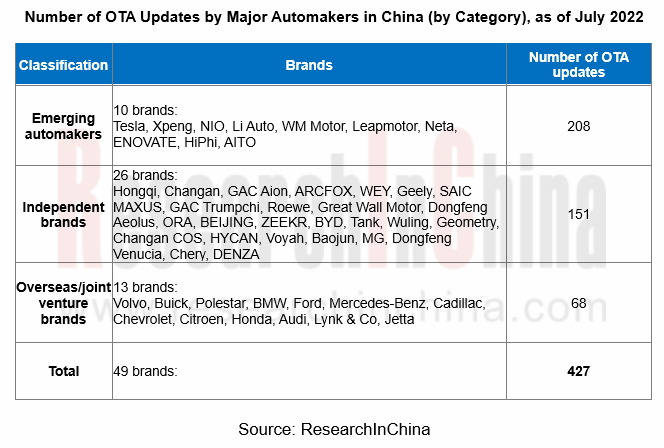
As of July 15, 2022, 49 auto brands (including brands of emerging automakers, independent companies, and joint ventures) had accomplished about 427 OTA updates. Among them, 10 emerging brands had implemented a total of 208 OTA updates, 26 independent brands had completed 151 OTA updates, and 12 joint venture brands had fulfilled 68 OTA updates.
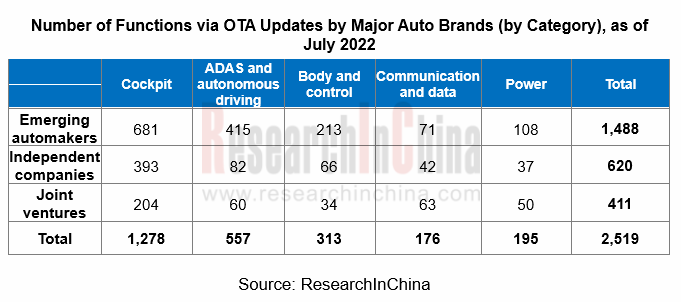
Regardless of emerging automakers, independent companies, or joint ventures, their OTA updates concentrate on cockpits (covering application entertainment, information display, etc.), reaching 1,278 updates; another 557 updates are about ADAS and autonomous driving.
In the era of OTA 3.0, OEMs explore SAAS (Software as a Service)
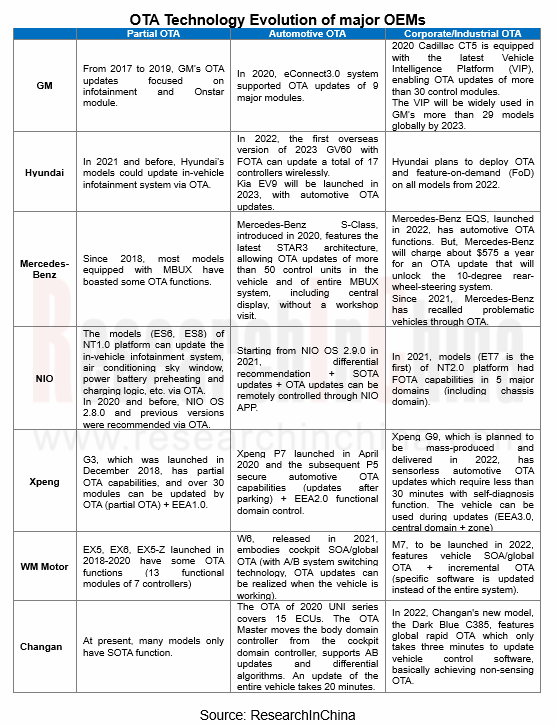
ABUP believes that automotive OTA industry should go through four development stages: component-level OTA, vehicle-level OTA, enterprise-level OTA, and industrial-level OTA. OTA has evolved from the 1.0 era (non-critical safety function updates) and the 2.0 era (automotive OTA) to the current 3.0 era (SAAS).
In the era of OTA 3.0, OTA functional services of OEMs are propelled by demand instead of R&D. OEMs guide users to purchase software OTA services. In the future, SAAS will become an important income source for major OEMs.
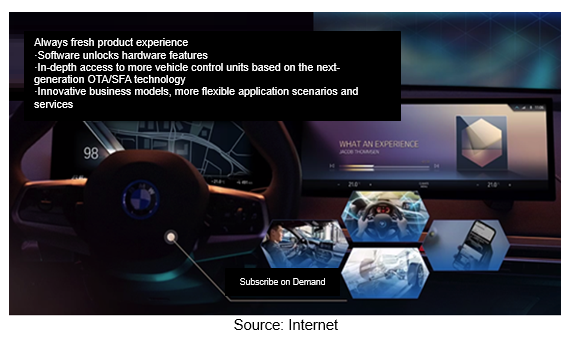
With deep involvement of automotive OTA, the business models of automakers are changing. The model of hardware "costization" + software "profit" continues to penetrate in the smart car market. Many automakers have pre-embed hardware in new models, and subsequently open functions through OTA software updates, so as to obtain commercial profits.
In the past two years, both emerging automakers and conventional car companies have been stepping up their exploration of SAAS model. In addition to offering paid OTA for new functions and services, many automakers have announced plans to launch "subscription on demand" services.
In addition to selling cars, Tesla makes money by selling software and services. Its software revenue comes from FSD (Full Self-Driving), OTA updates, and advanced Internet of Vehicles. The price of Tesla's FSD has been rising, hitting as high as $12,000. In addition, Tesla has introduced the Acceleration Boost upgrade for $2,000 that improved the 0-60 mph acceleration of Model 3 Dual Motor (Long Range) from 4.4 seconds to 3.9 seconds.
Hyundai announced to offer OTA and feature-on-demand (FoD) on all models from 2021. Users can not only update software and systems remotely, but also selectively purchase software systems.
In July 2021, BMW announced about its Functions on Demand system, in which customers can choose to pay monthly subscriptions for certain options. It unlocks the hardware modules pre-installed on the vehicle through software, remotely provides customers with new products and services, and helps customers enjoy the latest products in an innovative way.
In July 2022, BMW launched a number of subscription-based services for drivers in South Korea, including heated seats, a heated steering wheel, high-beam-assist headlights, simulated sound waves, wireless Apple CarPlay and other functions. Heated seats, for example, run for about RMB120 per month. per month or RMB1,180 per year.
At the same time, there have been some changes in the profit models of assisted driving systems of some OEMs. In the past, users had to pay for optional advance assisted driving systems which now tend to be included in the standard configuration, whereas the software cost is included in the car price for the purpose of suppressing the continuous price spike of battery-electric vehicles since 2022 and raising the activation rate of advanced assisted driving systems to collect real road data; in addition, the standard configuration of assisted driving systems improves the cost performance and value preservation rate of vehicles.
On May 6, 2022, Xpeng suddenly made major changes to users' rights and interests. It installed the intelligent assisted driving system software as standard, and canceled the lifetime free charging and free home charging piles. According to the data released by Xpeng in October 2021, the activation rate of XPILOT 3.0 with high-speed NPG is 59.29%, and it will continue to rise thanks to the standard configuration of assisted driving software;
In 2022, Tesla offers free Enhanced Autopilot as standard in China for a limited time, while it still charges FSD as an option;
Li Auto has always adhered to the standard autonomous driving system. The newly launched Li L9 is equipped with the Li AD Max full-stack intelligent driving system and hardware solution as standard;
NIO has altered its business strategy for ET7. It comes standard with LCC and ALC which are ready to use, so that users need not pay additional fees or buy the NIO Pilot Selected Package.
SAAS is paid separately or charged include the car price, and it has become a business strategy that major OEMs should consider and explore.
OTA supervision is becoming strict and standardized
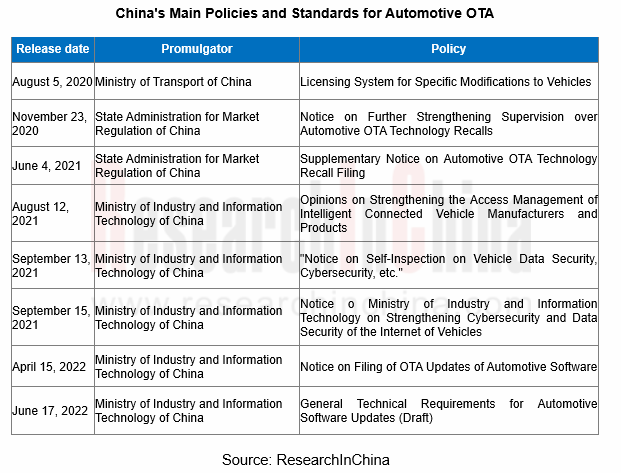
With the rapid growth of automotive OTA technology, China has issued a number of policies and standards about OTA updates in the past two years, clarifying requirements for ICV software updates.
On April 15, 2022, the Ministry of Industry and Information Technology Equipment Industry Development Center issued "Notice on Filing of OTA Updates of Automotive Software", which stipulates that automakers licensed to produce road motor vehicles should file for their vehicles equipped with OTA updates and every OTA update implemented. Authorities have attached great importance to OTA recalls, and have improved relevant procedures and specifications. A strict and effective regulatory mechanism will regulate the software updates of automakers. It will have a positive impact on the development of the entire industry while protecting the rights and interests of consumers.
AI-Defined Vehicle (AIDV) OEMs' Deployment Strategies Research Report, 2026
AIDV Research: Deployment Strategies of 22 OEMs
The AI-Defined Vehicle (AIDV) OEMs' Deployment Strategies Research Report, 2026, released by ResearchInChina, analyzes the AI deployment strategies of ...
OEMs’ Passenger Car Model Planning Research Report, 2026
Vehicle Model Planning Research: Chinese OEMs Launch Sub-Brands Intensively, While Multinational OEMs Apply the Brakes to Electrification Strategies
ResearchInChina released the OEMs’ Passenger Car M...
Autonomous Driving Simulation and World Model Research Report, 2026
Autonomous driving simulation research: "Simulation test + world model"-driven test system has become R&D infrastructure.
The "Autonomous Driving Simulation and World Model Research Report, 2026"...
Cockpit-Driving Integration Central Domain Controller SoC and AI Supercomputing Architecture Research Report, 2026
Cockpit-Driving integration and AI supercomputing research: The One Chip solution is rapidly installed in vehicles, and AI supercomputing architectures are moving towards full-domain integration.
AI ...
Intelligent Driving End-to-End Large Model Research Report, 2026
Research on Intelligent Driving Large Models: A Critical Period for Technological Competition and Paradigm Integration
As autonomous driving technology rapidly iterates from L2 to L3?L4, intelligent...
Automotive Digital Key Industry Trend Report, 2026
Digital Key Research: Automotive BLE, UWB and SLE Hardware Layout
The Automotive Digital Key Industry Trend Report, 2026, released by ResearchInChina, analyzes and predicts the digital key market, co...
Monthly Report on Automotive New Technology (May 2026)
UHD gaze technology, full-color LiDAR, UWB, etc. promote the upgrade of intelligent driving perception capabilities
This report is published once a month and is available for annual subscription.The...
In-Cabin Monitoring Systems (DMS, OMS, etc.) Research Report, 2026
In-Cabin Monitoring System Research: DMS to Become Mandatory in 2027, Expected to be Installed in Over 14 Million Vehicles
ResearchInChina released the In-Cabin Monitoring Systems (DMS, OMS, etc.) Re...
Automotive Service-Oriented Architecture (SOA) and Cross-Domain Middleware Industry Report, 2026
Research on automotive SOA and cross-domain middleware: The era of AI atomic services and AI cross-domain fusion agents is coming.
Automotive SOA evolves towards AI + full SOA servitization Driv...
Automotive Display, Center Console and Cluster Industry Report, 2026
Automotive Display Research: Multi-Screen Application Slows Down, While OLED and MiniLED Are Introduced in Vehicles Quickly
In 2026, automotive displays will no longer excessively pursue the number a...
Global and China Intelligent Vehicle Standard System Construction and Certification Research Report, 2026
Intelligent Driving Standards and Certification: With the Maturing Standardization System, China Will Participate in Formulation of Global Standards
China's automotive industry is transforming from ...
Automotive Intelligent Diagnosis Industry Report, 2026
Automotive Intelligent Diagnosis Research: Powered by AI, Remote Diagnosis Is Being Upgraded towards Intelligence.
ResearchInChina released the Automotive Intelligent Diagnosis Industry Report, 2026....
Automotive Cloud Service Platform Research Report, 2026
Research on automotive cloud service platform: with architecture upgrade and computing power improvement, cloud services enter a new stage
In 2026, the Internet of Vehicles industry generates petaby...
Integrated Battery and Innovative Battery Technology Research Report, 2026
Power Battery Research: Sales of High-Capacity Vehicles Keep Rising, and Solid-State Batteries Begin to Be Installed in Vehicles
I. Sales of High-Capacity Vehicles Sustain Growth, and Those with A C...
Chinese Independent OEMs’ ADAS and Autonomous Driving Report, 2026
Research on OEMs' Intelligent Driving: Era of Physical AI, Standard Configuration of D2D, and Initial Exploration of L3 Commercial Pilot Projects
From 2023 to 2025, the intelligent driving installati...
Intelligent Vehicle New Technology Application Analysis Report, 2025-2026
New Technology Research: Innovative Products such as Bionic Cameras, Vision-LiDAR Fusion Sensors, Auditory Sensors Further Enhance Vehicle Perception Capabilities
ForewordResearchInChina released th...
Automotive Optical Fiber Communication (Optical Fiber Ethernet, PON) and Supply Chain Research Report, 2026
Research on Automotive Optical Fiber Communication: Introduction of Optical Fiber in Vehicles Accelerates, with Priority Deployment in High-Speed Communication Link (10+Gbps) Scenarios
Automotive opt...
Automotive Intelligent Cockpit SoC Research Report, 2026
Automotive Cockpit SoC Research: Passenger Cars in the Price Range of RMB100,000–200,000 Account for Nearly 50% of Total Sales, and New-Generation Cockpit SoC Products Largely Enter Mass Production
P...