|
 |
Overseas LiDAR Industry Research Report, 2022
|
LiDAR Research: Perception Algorithms Become the Layout Focus of Foreign Vendors
Amid a variety of technology routes in parallel, rotating mirror and flash solutions are adopted most widely during OEM mass production.
LiDAR technology routes include mechanical, MEMS, rotating mirror/prism, OPA, flash, etc. On the whole, LiDAR evolves from mechanical type to solid-state type, with multiple technology routes existing in parallel (for example, Velodyne has developed mechanical and solid-state solutions simultaneously since Velarray debuted at the 2017 Frankfurt Auto Show). Flash is the most popular solution in the layout of foreign vendors, followed by FMCW and MEMS.
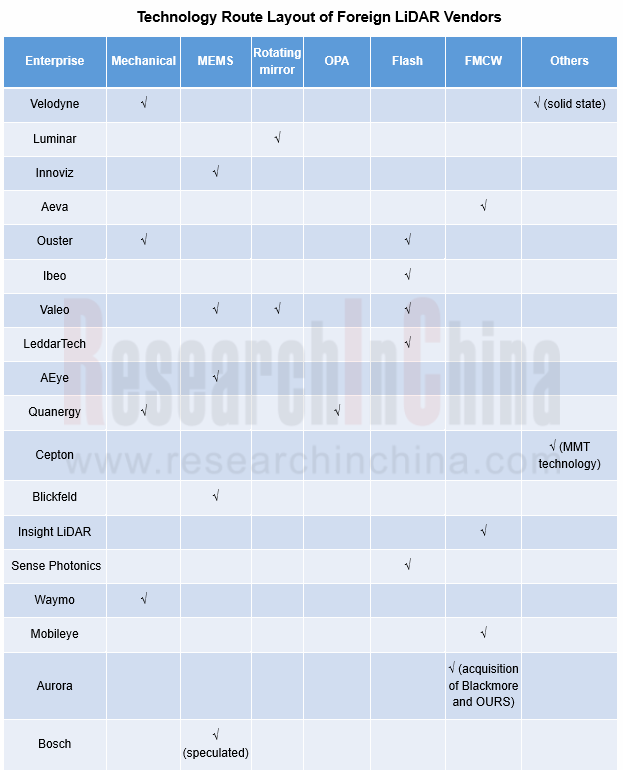
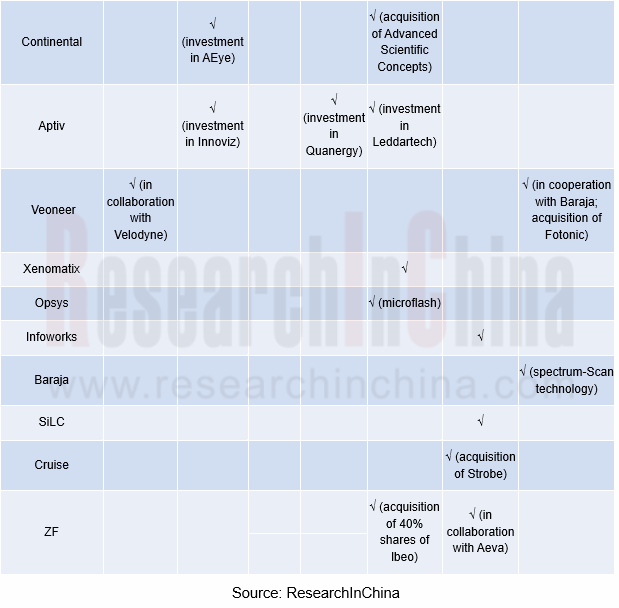
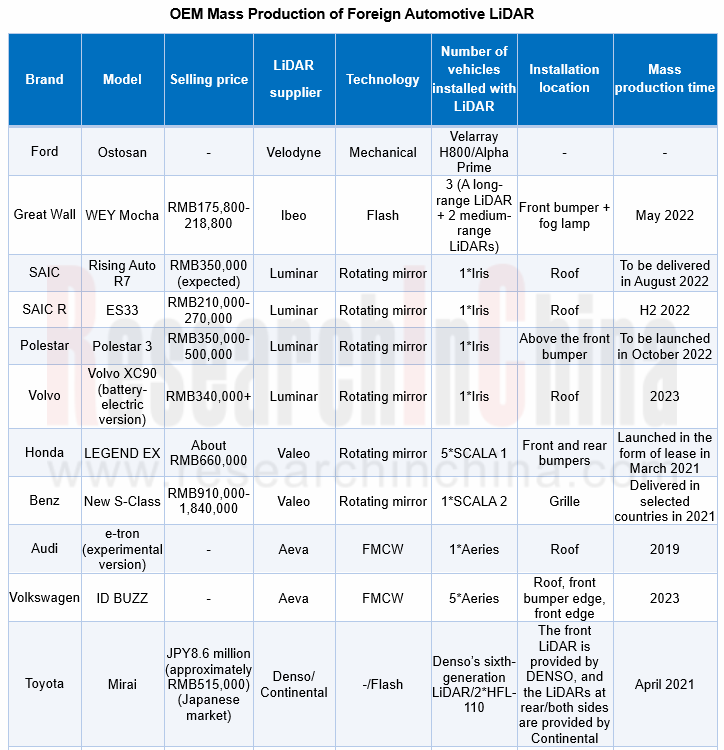
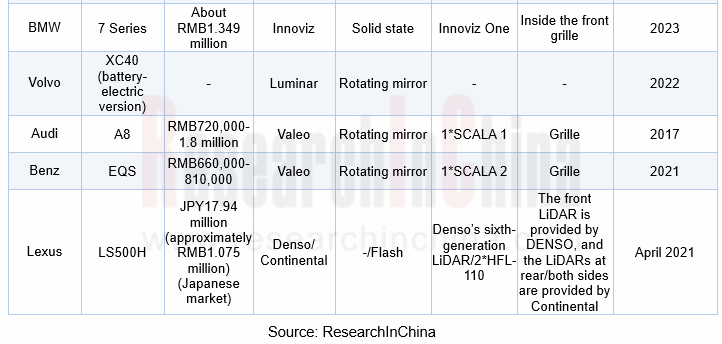
As per OEM mass production, rotating mirror and flash solutions are adopted most widely. Valeo is a typical vendor leveraging the rotating mirror solution, and it produces LiDAR at the Wemding factory in Bavaria, Germany. As of 2021, its Scala LiDAR shipments had exceeded 160,000 units, with a single unit costing less than $1,000. Ibeo is known for its flash LiDAR. The ibeoNEXT LiDAR system produced by ZF features the detection range of more than 250 meters, the horizontal angular resolution of 0.04°, and the vertical angular resolution of 0.07°. It can recognize guardrails, road signs, cars, bicycles and pedestrians, along with their respective positions and movement directions. It has been installed on Great Wall WEY Mocha.
Perception algorithms become the layout focus of foreign vendors
The quality of perception algorithm determines perception accuracy and distance. Therefore, LiDAR vendors not only upgrade their own hardware, but also develop perception software, so as to form the closed loop of perception fusion and system-level supply. Foreign LiDAR vendors mainly leverage self-research, acquisition and cooperation with software companies to deploy perception algorithms.
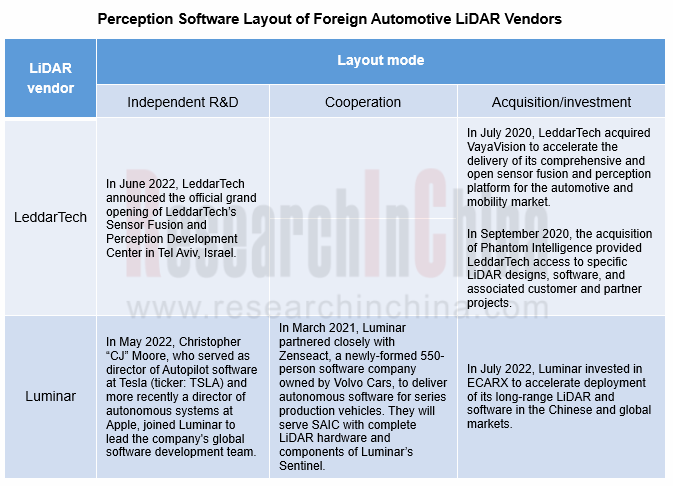
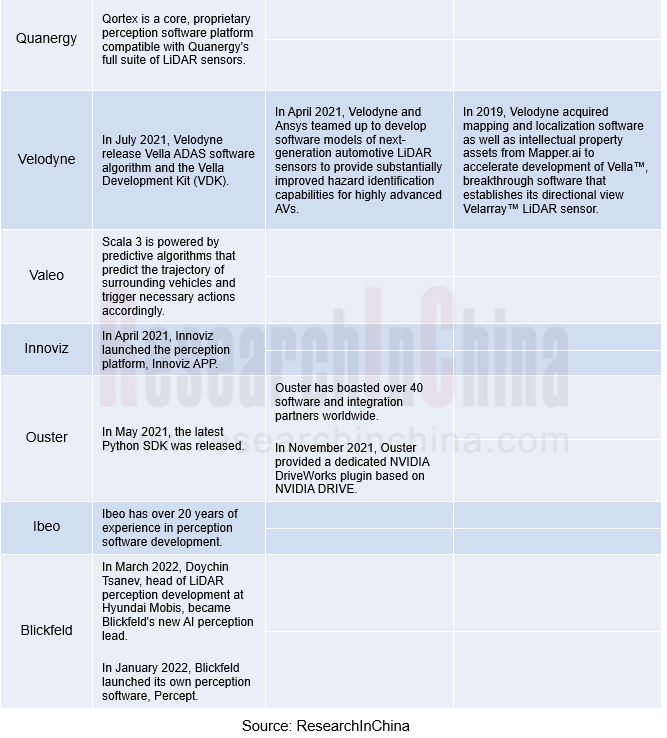
LeddarTech mainly makes its layout through acquisitions. LeddarTech acquired sensor fusion and perception software companies VayaVision and Phantom Intelligence in 2020. LeddarTech’s open platform based on its full-waveform digital signal processing technology combined with VayaVision’s raw data sensor fusion and perception software stack will deliver the most accurate environmental model, enabling the volume deployment of ADAS and AD applications. In September 2020, the acquisition of Phantom Intelligence provided LeddarTech access to specific LiDAR designs, software, and associated customer and partner projects.
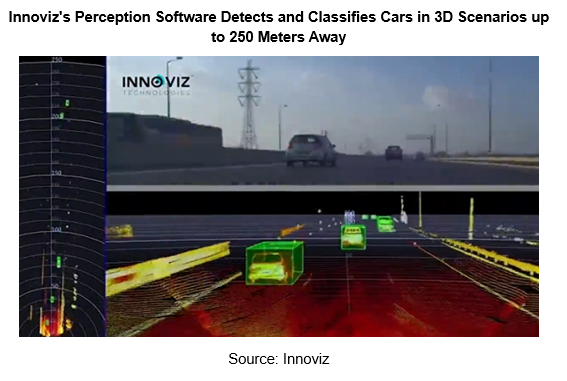
Innoviz mainly develops its own perception algorithm. In April 2021, Innoviz launched embedded automotive perception platform "Innoviz APP". Innoviz APP can accurately detect and classify objects in any 3D driving scenario up to 250 meters away, including cars, trucks, motorcycles, pedestrians, and more. It also executes perception algorithms in real time, detecting and classifying pixels as collision relevant or non-collision relevant. At the same time, it can also be integrated on chips as an embedded software IP. Innoviz's software leverages the massive data from LiDAR and proprietary AI algorithms to provide excellent scenario awareness as well as an automatically upgradable ASIL B(D) solution.
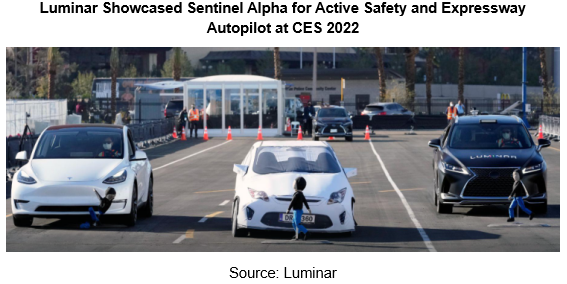
Luminar makes its layout through cooperation, investment and independent R&D. In March 2021, Luminar cooperated with Volvo’s self-driving software subsidiary Zenseact to create a “holistic autonomous vehicle stack” made for production vehicles. The stack is called Sentinel, which will integrate Zenseact’s OnePilot autonomous driving software solution alongside Luminar’s Iris LiDAR, perception software, and other components as a foundation. The system is designed to handle highway autonomy and a number of safety measures to proactively avoid collisions with evasive maneuvers, reducing accident rates by up to seven times. Luminar completed development of the alpha version of Sentinel in 2021 and plans to accomplish the beta version in 2022. In addition, Luminar will serve SAIC’s production vehicles with complete LiDAR hardware and components of Luminar’s Sentinel.
Chip-based LiDAR development is vital for mass production and cost reduction
Inside LiDAR, there are hundreds of discrete devices with high costs in materials and optical assembly, which pose a major obstacle to mass production. Chip-based LiDAR can integrate hundreds of discrete devices into one chip, effectively reducing the product size and costs while facilitating mass production.
For example, all of Ouster's digital LiDAR sensors share the same core architecture. The architecture consists of two chips and a patented micro-optical system, replacing hundreds of discrete components inside traditional analog LiDAR, improving reliability and reducing price (the ES2 debuts with an expected price of $600 for series production -- and Ouster’s digital LiDAR technology provides a clear roadmap that will allow future models to break the $100 price barrier).
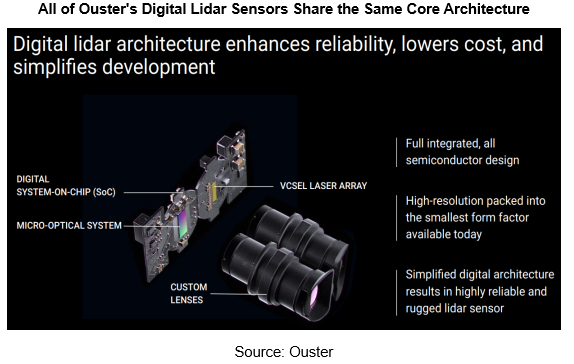
As shown above, in Ouster's LiDAR core architecture, a vertical cavity surface emitting laser (“VCSEL”) array integrates all lasers on a single chip. The custom SoC integrates single photon avalanche diode (“SPAD”) detectors and a proprietary digital signal processing system to handle all commands and control logic of LiDAR. The patented micro-optical system guides light through LiDAR to improve the detector efficiency exponentially.
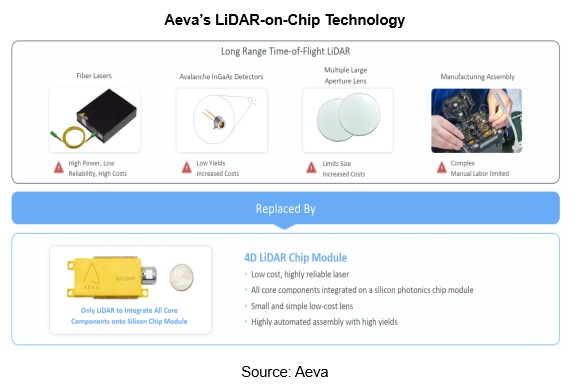
Aeva is also working on a chip-based layout. In February 2022, Aeva unveiled Aeries? II, a 4D LiDAR? sensor leveraging Aeva’s unique Frequency Modulated Continuous Wave (FMCW) technology and the world’s first LiDAR-on-chip module design which places all key components including transmitters, receivers and optics onto a silicon photonics chip in a compact module. The compact design is 75% smaller than the previous generation. Mass production is expected in 2023.
1 LiDAR Market and Trends
1.1 LiDAR Industry Chain
1.2 Technology Trends of Foreign Vendors
1.2.1 Core LiDAR Technology
1.2.2 Technical Solution Layout of Foreign Vendors
1.2.3 Progress of Foreign Vendors in Rotating Mirror Technology
1.2.4 Progress of Foreign Vendors in MEMS Technology
1.2.5 Progress of Foreign Vendors in Flash Technology
1.2.6 Progress of Foreign Vendors in FMCW Technology
1.3 Companies and Products
1.3.1 Market
1.3.2 Financing
1.3.3 Installation of LiDAR Products of Foreign Vendors
1.3.4 Comparison between Mechanical LiDAR Products of Foreign Vendors
1.3.5 Comparison between Semi-solid-state LiDAR Products of Foreign Vendors
1.3.6 Comparison between Solid-state LiDAR Products of Foreign Vendors
1.3.7 Comparison between FMCW LiDAR Products of Foreign Vendors
1.4 Development Trends
2. Overseas Foreign Enterprises Related to Automotive LiDAR Industry Chain
2.1 Lumentum
2.1.1 Profile
2.1.2 Revenue
2.1.3 Main VCSELs
2.1.4 Multi-junction Addressable VCSEL Arrays
2.1.5 Multi-junction VCSEL Array: M51-100
2.1.6 Dynamics in Cooperation
2.2 Sony
2.2.1 Profile
2.2.2 IMX459 SPAD Depth Sensor
2.2.3 Parameters of IMX459
2.2.4 Long-range SPAD dToF LiDAR
2.3 AMS Osram
2.3.1 Profile
2.3.2 Core Infrared Technology: EEL and VSCEL
2.3.3 Main VCSELs and EELs
2.3.4 PowerBoost Multi-junction VCSEL
2.3.5 Dynamics in Cooperation
3 Foreign Automotive LiDAR Suppliers
3.1 Summary and Analysis of Overseas LiDAR Suppliers
3.2 Velodyne
3.2.1 Profile
3.2.2 Revenue
3.2.3 Core Technology and Manufacturing Process
3.2.4 Product Lineup
3.2.5 Automotive LiDAR Product Matrix
3.2.6 Velarray M1600: The Latest Solid-state LiDAR for Autonomous Delivery
3.2.7 Velabit 2.0: The Latest Solid-state LiDAR
3.2.8 Intelligent Infrastructure Solution (IIS)
3.2.9 Development Strategy and Layout in the Field of Autonomous Driving
3.2.10 Layout and Cooperation Mode in China
3.2.11 Dynamics in Cooperation
3.3 Luminar
3.3.1 Profile
3.3.2 Revenue
3.3.3 Development History
3.3.4 Core Technology
3.3.5 Product Lineup
3.3.6 Introduction to Iris
3.3.7 Iris Mass Production Plan and Progress
3.3.8 Hydra
3.3.9 Blade
3.3.10 Development Strategy in the Field of Autonomous Driving and Layout in China
3.3.11 Partners
3.3.12 Dynamics in Cooperation
3.4 Innoviz
3.4.1 Profile
3.4.2 Development History
3.4.3 Core LiDAR Technology
3.4.4 Product Lineup
3.4.5 Comparison between LiDAR Products in Parameters
3.4.6 Introduction to InnovizTwo
3.4.7 Progress in Mass Production of InnovizTwo
3.4.8 Innoviz360
3.4.9 Innoviz APP
3.4.10 Layout and Cooperation Mode in China
3.4.11 Dynamics in Cooperation
3.5 Aeva
3.5.1 Profile
3.5.2 Development History
3.5.3 Core Technology
3.5.4 Product Lineup
3.5.5 Mass Production Plan
3.5.6 Introduction to Aeries II
3.5.7 Performance of Aeries II
3.5.8 The Third-generation 4D LiDAR Chip Module
3.5.9 Production Layout of 4D LiDAR Chip Module
3.5.10 Dynamics in Cooperation
3.6 Ouster
3.6.1 Profile
3.6.2 Development History
3.6.3 Revenue
3.6.4 Core Technology
3.6.5 Product Lineup
3.6.6 Comparison between LiDAR Products
3.6.7 Introduction to ES2
3.6.8 Introduction to DF Series LiDAR
3.6.9 Technical Advantages of DF Series LiDAR
3.6.10 Mass Production Roadmap of DF Series LiDAR
3.6.11 Iteration of LiDAR Chips
3.6.12 L2X LiDAR Chip
3.6.13 Chronos LiDAR Chip
3.6.14 Software Layout
3.6.15 Python SDK for LiDAR Development
3.6.16 DriveWorks Plug-in
3.6.17 Dynamics in Cooperation
3.7 Ibeo
3.7.1 Profile
3.7.2 Product Lineup
3.7.3 LUX Series LiDAR
3.7.4 ibeoNEXT 4D Solid-state LiDAR
3.7.5 Technical Highlights of ibeoNEXT
3.7.6 Application Scenarios of ibeoNEXT
3.7 Perception Software
3.7.8 Dynamics in Cooperation
3.8 Valeo
3.8.1 Profile
3.8.2 Revenue
3.8.3 LiDAR Shipments and Production Bases
3.8.4 Roadmap of LiDAR Products
3.8.5 Third-generation LiDAR
3.8.6 Technical Highlights of the Third-generation LiDAR
3.8.7 Near-field LiDAR
3.8.8 LiDAR Testing and Verification Capability
3.8.9 Mobile Kit with LiDAR
3.8.10 LiDAR Application: L3 Park4U
3.8.11 Dynamics in Cooperation
3.9 LeddarTech
3.9.1 Profile
3.9.2 Global Network
3.9.3 Roadmap of LiDAR Products
3.9.4 Introduction to Leddar Sight
3.9.5 Introduction to Leddar Engine Solution
3.9.6 Leddar Engine Provides Four Software Integration Solutions
3.9.7 3D Solid-state LiDAR Chip
3.9.8 PixSet Dataset
3.9.9 LeddarSteer? Solid-state Digital Beam Steering Solution
3.9.10 Leddar Vision Sensor Fusion and Perception Platform
3.9.11 Framework of Leddar Vision Environment Awareness Software
3.9.12 Cooperation Mode
3.9.13 Partners
3.9.14 Dynamics in Cooperation
3.10 AEye
3.10.1 Profile
3.10.2 Development History
3.10.3 Global Network
3.10.4 Revenue
3.10.5 Core Technology (1)
3.10.6 Core Technology (2)
3.10.7 Core Technology (3)
3.10.8 LiDAR Product Lineup
3.10.9 Introduction to 4Sight Solid-state LiDAR
3.10.10 Introduction to HRL131 Solid-state LiDAR
3.10.11 LiDAR Production, Verification and Testing
3.10.12 Business Model
3.10.13 Dynamics in Cooperation
3.11 Quanergy
3.11.1 Profile
3.11.2 Revenue
3.11.3 Core Technology
3.11.4 Evolution of Core Technology
3.11.5 Product Lineup
3.11.6 LiDAR Product Lineup
3.11.7 Introduction to S3 LiDAR
3.11.8 Performance Parameters and Principles of S3 LiDAR
3.11 QORTEX 3D Perception Software
3.11.10 Dynamics in Cooperation
3.12 Cepton
3.12.1 Profile
3.12.2 Development History
3.12.3 Revenue
3.12.4 Core Technology (1)
3.12.5 Core Technology (2)
3.12.6 Core Technology (3)
3.12.7 Product Lineup
3.12.8 Market Strategy
3.12.9 Vista Series LiDAR
3.12.10 Nova LiDAR
3.12.11 Cooperation Mode and Cooperation with Koito
3.12.12 Cooperation with GM
3.12.13 Mass Production Schedule in Cooperation with GM
3.12.14 Model Schedule in Cooperation with GM
3.12.15 Dynamics in Cooperation
3.13 Blickfeld
3.13.1 Profile
3.13.2 Core Technology
3.13.3 Main Products: Cube 1, Cube Range
3.13.4 Main Products: Vision Mini, Vision Plus
3.13.5 Main Products: MEMS scanning module 118
3.13.6 Percept: Perception Software
3.13.7 Dynamics in Cooperation
3.14 Insight LiDAR
3.14.1 Profile
3.14.2 Core Technology
3.14.3 Product Lineup
3.14.4 Main Products
3.15 Sense Photonics
3.15.1 Profile
3.15.2 Core Technology
3.15.3 LiDAR Platform
3.15.4 Partners and Dynamics
3.16 Waymo
3.16.1 Profile
3.16.2 LiDAR Technology
3.16.3 Development History and Products of LiDAR
3.16.4 Honeycomb Short-range LiDAR
3.16.5 LiDAR Solution
3.16.6 The Latest LiDAR Solution
3.16.7 Dynamics in LiDAR Solution Cooperation
3.16.8 LiDAR Development Planning
3.17 Mobileye
3.17.1 Profile
3.17.2 Main Business and Revenue
3.17.3 Product Lineup
3.17.4 Core Technology
3.17.5 LiDAR Layout and Planning
3.17.6 LiDAR Products
3.17.7 The First-generation Mobileye Drive? LiDAR Solution
3.17.8 Application of the First-generation Mobileye Drive? LiDAR Solution
3.17.9 The Second-generation Mobileye Drive? LiDAR Solution
3.17.10 Mobileye Chauffeur LiDAR Solution
3.18 Aurora
3.18.1 Profile
3.18.2 Core Technology
3.18.3 R&D Capability
3.18.4 Product Lineup
3.18.5 LiDAR Products
3.18.6 LiDAR Application: Aurora Driver Hardware Kit
3.18.7 Development Strategy in the Field of Autonomous Driving
3.18.8 Dynamics in Cooperation
3.19 Bosch
3.19.1 Profile
3.19.2 Product Lineup
3.19.3 Introduction to Long-range LiDAR
3.19.4 LiDAR Investment
3.20 Continental
3.20.1 Profile
3.20.2 Product Lineup
3.20.3 Development History of LiDAR
3.20.4 LiDAR Business Layout
3.20.5 Comparison between LiDAR Products
3.20.6 Short-range LiDAR
3.20.7 Layout in Long-range LiDAR
3.20.8 Dynamics in Cooperation
3.21 Aptiv
3.21.1 Profile
3.21.2 Development History
3.21.3 LiDAR Investment
3.21.4 RoboTaxi Sensor Configuration in cooperation with Hyundai
3.22 Veoneer
3.22.1 Profile
3.22.2 Revenue
3.22.3 Product Lineup
3.22.4 LiDAR Layout
3.23 Xenomatix
3.23.1 Profile
3.23.2 Introduction to XenoLiDAR-X Solid-state LiDAR
3.23.3 Generation Comparison of XenoTrack Solid-State LiDAR
3.23.4 Introduction to the Second-generation XenoTrack
3.23.5 Dynamics in Cooperation
3.24 Opsys
3.24.1 Profile
3.24.2 Core Technology
3.24.3 Comparison between Main Products
3.24.4 SP3.0 LiDAR
3.24.5 Dynamics in Cooperation
3.25 Infoworks
3.25.1 Profile
3.25.2 Main LiDAR Products
3.26 Baraja
3.26.1 Profile
3.26.2 Development History
3.26.3 Core Technology
3.26.4 Spectrum HD
3.26.5 Dynamics in Cooperation
3.27 SiLC Technologies
3.27.1 Profile
3.27.2 Core Technology
3.27.3 Main Products
3.28 Others
3.28.1 Cruise
3.28.2 ZF
4 Overseas Models Equipped with LiDAR
4.1 Honda Legend EX
4.2 BMW 7 Series
4.3 Mercedes-Benz EQS
4.4 Toyota Mirai
4.5 Volkswagen ID.BUZZ
AI-Defined Vehicle (AIDV) OEMs' Deployment Strategies Research Report, 2026 AIDV Research: Deployment Strategies of 22 OEMs
The AI-Defined Vehicle (AIDV) OEMs' Deployment Strategies Research Report, 2026, released by ResearchInChina, analyzes the AI deployment strategies of ... OEMs’ Passenger Car Model Planning Research Report, 2026 Vehicle Model Planning Research: Chinese OEMs Launch Sub-Brands Intensively, While Multinational OEMs Apply the Brakes to Electrification Strategies
ResearchInChina released the OEMs’ Passenger Car M... Autonomous Driving Simulation and World Model Research Report, 2026 Autonomous driving simulation research: "Simulation test + world model"-driven test system has become R&D infrastructure.
The "Autonomous Driving Simulation and World Model Research Report, 2026"... Cockpit-Driving Integration Central Domain Controller SoC and AI Supercomputing Architecture Research Report, 2026 Cockpit-Driving integration and AI supercomputing research: The One Chip solution is rapidly installed in vehicles, and AI supercomputing architectures are moving towards full-domain integration.
AI ... Intelligent Driving End-to-End Large Model Research Report, 2026 Research on Intelligent Driving Large Models: A Critical Period for Technological Competition and Paradigm Integration
As autonomous driving technology rapidly iterates from L2 to L3?L4, intelligent... Automotive Digital Key Industry Trend Report, 2026 Digital Key Research: Automotive BLE, UWB and SLE Hardware Layout
The Automotive Digital Key Industry Trend Report, 2026, released by ResearchInChina, analyzes and predicts the digital key market, co... Monthly Report on Automotive New Technology (May 2026) UHD gaze technology, full-color LiDAR, UWB, etc. promote the upgrade of intelligent driving perception capabilities
This report is published once a month and is available for annual subscription.The... In-Cabin Monitoring Systems (DMS, OMS, etc.) Research Report, 2026 In-Cabin Monitoring System Research: DMS to Become Mandatory in 2027, Expected to be Installed in Over 14 Million Vehicles
ResearchInChina released the In-Cabin Monitoring Systems (DMS, OMS, etc.) Re... Automotive Service-Oriented Architecture (SOA) and Cross-Domain Middleware Industry Report, 2026 Research on automotive SOA and cross-domain middleware: The era of AI atomic services and AI cross-domain fusion agents is coming.
Automotive SOA evolves towards AI + full SOA servitization Driv... Automotive Display, Center Console and Cluster Industry Report, 2026 Automotive Display Research: Multi-Screen Application Slows Down, While OLED and MiniLED Are Introduced in Vehicles Quickly
In 2026, automotive displays will no longer excessively pursue the number a... Global and China Intelligent Vehicle Standard System Construction and Certification Research Report, 2026 Intelligent Driving Standards and Certification: With the Maturing Standardization System, China Will Participate in Formulation of Global Standards
China's automotive industry is transforming from ... Automotive Intelligent Diagnosis Industry Report, 2026 Automotive Intelligent Diagnosis Research: Powered by AI, Remote Diagnosis Is Being Upgraded towards Intelligence.
ResearchInChina released the Automotive Intelligent Diagnosis Industry Report, 2026.... Automotive Cloud Service Platform Research Report, 2026 Research on automotive cloud service platform: with architecture upgrade and computing power improvement, cloud services enter a new stage
In 2026, the Internet of Vehicles industry generates petaby... Integrated Battery and Innovative Battery Technology Research Report, 2026 Power Battery Research: Sales of High-Capacity Vehicles Keep Rising, and Solid-State Batteries Begin to Be Installed in Vehicles
I. Sales of High-Capacity Vehicles Sustain Growth, and Those with A C... Chinese Independent OEMs’ ADAS and Autonomous Driving Report, 2026 Research on OEMs' Intelligent Driving: Era of Physical AI, Standard Configuration of D2D, and Initial Exploration of L3 Commercial Pilot Projects
From 2023 to 2025, the intelligent driving installati... Intelligent Vehicle New Technology Application Analysis Report, 2025-2026 New Technology Research: Innovative Products such as Bionic Cameras, Vision-LiDAR Fusion Sensors, Auditory Sensors Further Enhance Vehicle Perception Capabilities
ForewordResearchInChina released th... Automotive Optical Fiber Communication (Optical Fiber Ethernet, PON) and Supply Chain Research Report, 2026 Research on Automotive Optical Fiber Communication: Introduction of Optical Fiber in Vehicles Accelerates, with Priority Deployment in High-Speed Communication Link (10+Gbps) Scenarios
Automotive opt... Automotive Intelligent Cockpit SoC Research Report, 2026 Automotive Cockpit SoC Research: Passenger Cars in the Price Range of RMB100,000–200,000 Account for Nearly 50% of Total Sales, and New-Generation Cockpit SoC Products Largely Enter Mass Production
P...
|