Chassis domain controller research: full-stack independent development, or open ecosystem route?
Chassis domain consists of transmission, driving, steering and braking systems. Conventional vehicle chassis fail to fit in with the development of vehicle intelligence and autonomous driving, and need chassis-by-wire transformation. Vehicle chassis tend to be electronic, modular and intelligent. Mechanical decoupling is a prerequisite for chassis technology upgrade. Yet in conventional chassis, braking and steering are mechanically coupled, that is, their power source is the mechanical force from drivers who control terminals with the force amplified by hydraulic pressure. In the process of intelligent evolution, the key to chassis electronics however is to enable the decoupling of the mechanical force and replace it with motor drive, so as to improve the control accuracy and also realize better combination of human and systems.
In addition to mechanical decoupling, chassis also need software and hardware decoupling. Conventional electronic chassis systems are divided by components such as electronic stability control system (ESC), electric power steering system (EPS) and electronically controlled suspension system. Each subsystem is from different suppliers or different development departments of OEMs, and has an independent vehicle power control system and vehicle dynamic control model. In the development of chassis controllers, all of which triggers such problems as strong coupling relationship between software and hardware, repeated research and development and high development cost, and countervailing negative effect between subsystems, making optimal vehicle control unreachable.
To answer the current needs for new vehicle technologies and new functions, intelligent chassis domain controllers come into being. In the field of highly automated driving, chassis domain controller products are more needed to enable the centralized control of steering, braking, suspension and even power systems, and separation of software and hardware, as well as the transverse, longitudinal and vertical coordinated control of vehicles, better serving intelligent driving.
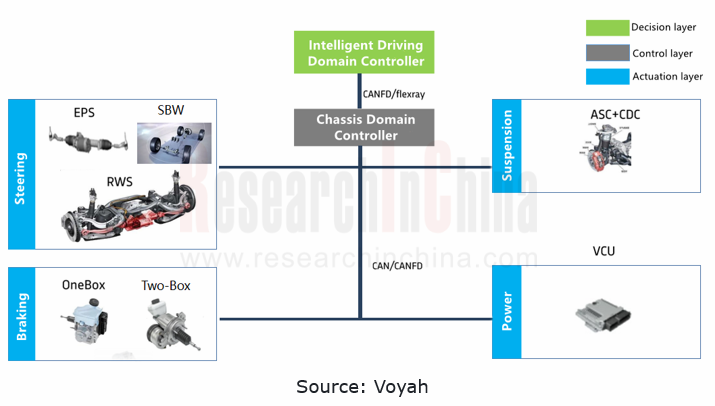
There are two chassis domain controller technology development routes: the full-stack self-development route of some OEMs, and open ecosystem route of represented by Tier 1 suppliers.
Volkswagen MEB platform uses three controllers to control the whole vehicle and enable functions. The ICAS1 vehicle control domain controller combines many functions including body control management, drive system management, driving system management, power system management, and comfort system management, and integrates body, power and chassis domains into one domain controller.
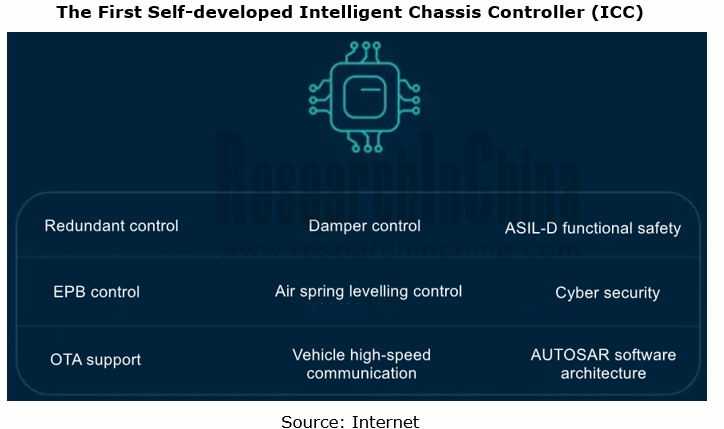
In 2022, NIO introduced its Intelligent Chassis Controller (ICC) when launching ET7. The ICC enables design and adjustment of chassis in all aspects of comfort, maneuverability and drivability and integrates control functions such as "redundant parking, air suspension and shock absorber". This controller also supports cross-domain integrated high-level automated driving scenarios. FOTA updates allow its flexible, quick iterations. The controller of NIO can uniformly adjust and control air spring leveling, shock absorber damping, electronic parking brake and other capabilities.
As concerns the open ecosystem route, chassis domain controllers pose high technical barriers, and there are few mass-produced solutions. At present, Tier 1 suppliers work on single/multi-subsystem development (domain) controllers for chassis subsystems. For example, Keboda Technology has shipped in batches its DCC (dynamic chassis control) that supports Xpeng Motors. This controller is designed to enable the dynamic control of suspensions. The two mainstream products of Suzhou Gates Electronics, i.e., continuous damping dynamic suspension electrically controlled system and air suspension electrically controlled system, are also used for suspension control.
In terms of integrated control of chassis systems, Chinese suppliers still need to learn from world-renowned Tier 1 suppliers.
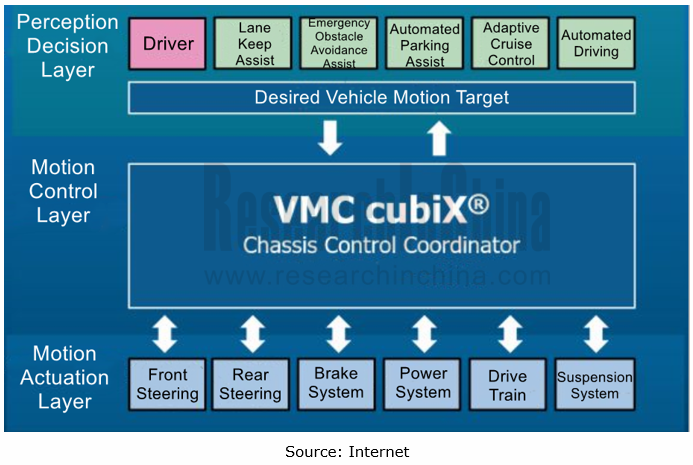
ZF's Integrated Brake Control (IBC), a brake-by-wire system, combines the brake-by-wire active rear axle steering Active Kinematics Control (AKC) and the active damping system (sMotion), bringing longitudinal, transverse and vertical safety and comfort experience. Recently, ZF’s front-axle steering, the most important component for vehicle steering systems, has also enabled drive-by-wire decoupling of software and hardware. All actuation systems are uniformly controlled by cubiX platform. cubiX is an integrated software suite for vehicle motion control, coordinating all the aforementioned actuators and sensors related to vehicle motion.
ZF's VMC cubiX gathers sensor information from the entire vehicle and environment, and prepares it for an optimized control of active systems in the chassis, steering, brakes and propulsion. Meanwhile, following a vendor-agnostic approach, cubiX can support both ZF and third-party components.
In the disruption of intelligent vehicle industry, the only constant is change. Either full-stack independent development or open ecosystem route has its own market space. There is still a wide gap between Chinese chassis (domain controller) Tier 1 suppliers and their foreign counterparts. Fortunately, chassis intelligence is bound up with vehicle electrification. Chinese OEMs have a leading edge in electrification, providing a golden opportunity for these Chinese players and drawing talents who serve Tier 1 suppliers at abroad back into domestic companies.
AI-Defined Vehicle (AIDV) OEMs' Deployment Strategies Research Report, 2026
AIDV Research: Deployment Strategies of 22 OEMs
The AI-Defined Vehicle (AIDV) OEMs' Deployment Strategies Research Report, 2026, released by ResearchInChina, analyzes the AI deployment strategies of ...
OEMs’ Passenger Car Model Planning Research Report, 2026
Vehicle Model Planning Research: Chinese OEMs Launch Sub-Brands Intensively, While Multinational OEMs Apply the Brakes to Electrification Strategies
ResearchInChina released the OEMs’ Passenger Car M...
Autonomous Driving Simulation and World Model Research Report, 2026
Autonomous driving simulation research: "Simulation test + world model"-driven test system has become R&D infrastructure.
The "Autonomous Driving Simulation and World Model Research Report, 2026"...
Cockpit-Driving Integration Central Domain Controller SoC and AI Supercomputing Architecture Research Report, 2026
Cockpit-Driving integration and AI supercomputing research: The One Chip solution is rapidly installed in vehicles, and AI supercomputing architectures are moving towards full-domain integration.
AI ...
Intelligent Driving End-to-End Large Model Research Report, 2026
Research on Intelligent Driving Large Models: A Critical Period for Technological Competition and Paradigm Integration
As autonomous driving technology rapidly iterates from L2 to L3?L4, intelligent...
Automotive Digital Key Industry Trend Report, 2026
Digital Key Research: Automotive BLE, UWB and SLE Hardware Layout
The Automotive Digital Key Industry Trend Report, 2026, released by ResearchInChina, analyzes and predicts the digital key market, co...
Monthly Report on Automotive New Technology (May 2026)
UHD gaze technology, full-color LiDAR, UWB, etc. promote the upgrade of intelligent driving perception capabilities
This report is published once a month and is available for annual subscription.The...
In-Cabin Monitoring Systems (DMS, OMS, etc.) Research Report, 2026
In-Cabin Monitoring System Research: DMS to Become Mandatory in 2027, Expected to be Installed in Over 14 Million Vehicles
ResearchInChina released the In-Cabin Monitoring Systems (DMS, OMS, etc.) Re...
Automotive Service-Oriented Architecture (SOA) and Cross-Domain Middleware Industry Report, 2026
Research on automotive SOA and cross-domain middleware: The era of AI atomic services and AI cross-domain fusion agents is coming.
Automotive SOA evolves towards AI + full SOA servitization Driv...
Automotive Display, Center Console and Cluster Industry Report, 2026
Automotive Display Research: Multi-Screen Application Slows Down, While OLED and MiniLED Are Introduced in Vehicles Quickly
In 2026, automotive displays will no longer excessively pursue the number a...
Global and China Intelligent Vehicle Standard System Construction and Certification Research Report, 2026
Intelligent Driving Standards and Certification: With the Maturing Standardization System, China Will Participate in Formulation of Global Standards
China's automotive industry is transforming from ...
Automotive Intelligent Diagnosis Industry Report, 2026
Automotive Intelligent Diagnosis Research: Powered by AI, Remote Diagnosis Is Being Upgraded towards Intelligence.
ResearchInChina released the Automotive Intelligent Diagnosis Industry Report, 2026....
Automotive Cloud Service Platform Research Report, 2026
Research on automotive cloud service platform: with architecture upgrade and computing power improvement, cloud services enter a new stage
In 2026, the Internet of Vehicles industry generates petaby...
Integrated Battery and Innovative Battery Technology Research Report, 2026
Power Battery Research: Sales of High-Capacity Vehicles Keep Rising, and Solid-State Batteries Begin to Be Installed in Vehicles
I. Sales of High-Capacity Vehicles Sustain Growth, and Those with A C...
Chinese Independent OEMs’ ADAS and Autonomous Driving Report, 2026
Research on OEMs' Intelligent Driving: Era of Physical AI, Standard Configuration of D2D, and Initial Exploration of L3 Commercial Pilot Projects
From 2023 to 2025, the intelligent driving installati...
Intelligent Vehicle New Technology Application Analysis Report, 2025-2026
New Technology Research: Innovative Products such as Bionic Cameras, Vision-LiDAR Fusion Sensors, Auditory Sensors Further Enhance Vehicle Perception Capabilities
ForewordResearchInChina released th...
Automotive Optical Fiber Communication (Optical Fiber Ethernet, PON) and Supply Chain Research Report, 2026
Research on Automotive Optical Fiber Communication: Introduction of Optical Fiber in Vehicles Accelerates, with Priority Deployment in High-Speed Communication Link (10+Gbps) Scenarios
Automotive opt...
Automotive Intelligent Cockpit SoC Research Report, 2026
Automotive Cockpit SoC Research: Passenger Cars in the Price Range of RMB100,000–200,000 Account for Nearly 50% of Total Sales, and New-Generation Cockpit SoC Products Largely Enter Mass Production
P...