Integrated Die Casting Research: Upstream, midstream and downstream companies are making plans and layouts in this booming field
Automotive integrated die casting is an automotive manufacturing process proposed and put into practice by Tesla. It redesigns and highly integrates multiple separate and scattered small parts in the original design, then uses a large die casting machine to perform high-pressure die casting at one time, and directly produces a complete large part without the welding process. Compared with traditional automotive manufacturing, automotive integrated die casting has advantages in manufacturing cost, production efficiency, labor cost, model development cycle, performance, materials recycling, etc.
Against the traditional concept that product and process design hinges on the existing conditions and capabilities, Tesla prefers reverse thinking. Taking automotive integrated die-casting as an example, Tesla determines how large the part can be to achieve the best effect, then deduces how much equipment, tooling and materials are needed. Afterwards, it cooperates with suppliers to develop new equipment, corresponding molds, materials and new processes. This kind of thinking has greatly inspired the innovation of the traditional industry and brought upheaval and the secondary innovation to the industry.
OEMs master the know-how of integrated die casting through independent research and development
After Tesla Model Y adopted the integrated die casting process for the first time, a new wave of integrated die casting has staged worldwide. A complete industrial chain layout has been formed between upstream die casting machine manufacturers, material manufacturers and mold manufacturers, as well as midstream die-casting companies and downstream automakers.
There are currently two main business modes:
 Independent research and development of OEMs: OEMs: directly purchase die casting machines, molds and materials, and then build their own factories to produce die casting parts. Tesla, Xpeng and Volvo adopt this mode.
Procurement: OEMs directly purchase die casting parts from die-casting manufacturers who buy relevant materials to produce die casting parts and deliver them to OEMs. HiPhi, NIO and Li Auto follow this mode.
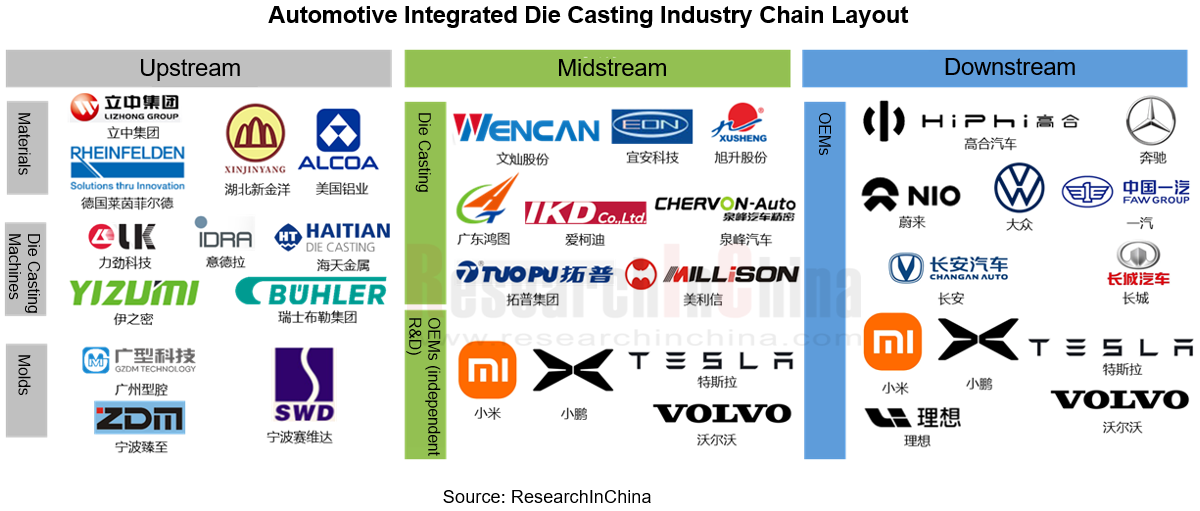
In the long run, automotive integrated die casting will gradually return to the procurement mode. OEMs have to invest heavily in building their own production lines, and they may be extremely concerned about the later operation and management. Tesla, the representative of the independent R&D mode, has cooperated with die casting manufacturers in order to add new capacity by outsourcing in the future. The main purpose of the OEM's self-research is to master the know-how of integrated die-casting, which is convenient for technical communication with suppliers in the future.
Upstream: Super-large die casting machines debuted, helping vehicle-level integrated die casting
Large die casting machines are the key to realizing automotive integrated die casting. At present, integrated die casting requires 6000T (or above) die casting machines. Globally, IDRA (a wholly-owned subsidiary of L.K. Technology), Bühler Group, as well as China-based L.K. Technology, Haitian Die Casting and Guangdong Yizumi can produce die casting machines over 6000T.
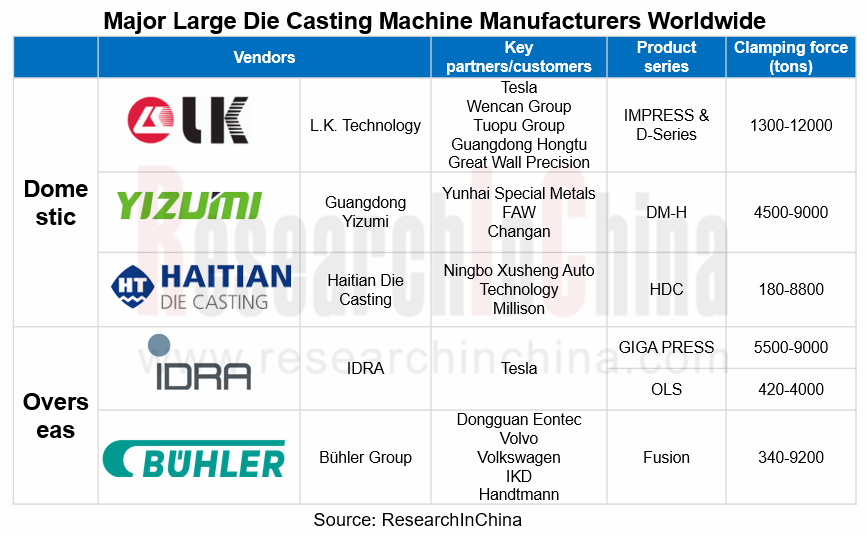
Higher-tonnage die casting machines can facilitate breakthroughs in die casting size and structure. Now, Tesla, L.K. Technology, Guangdong Hongtu, Haitian Die Casting and other companies have started research and development of die casting machines above 12,000T. In September 2022, L.K. Technology and Guangdong Hongtu successfully released a 12,000T super-large intelligent die casting unit jointly, marking the advent of world's highest-tonnage die casting machine. This is expected to boost vehicle-level integrated die-casting.
Midstream: Die casting leaders emerged
As midstream die-casting companies, Wencan Group, Tuopu Group, Guangdong Hongtu, Xusheng Auto Technology, Millison, etc., have deployed automotive integrated die casting by purchasing large die casting equipment and cooperating with automakers.
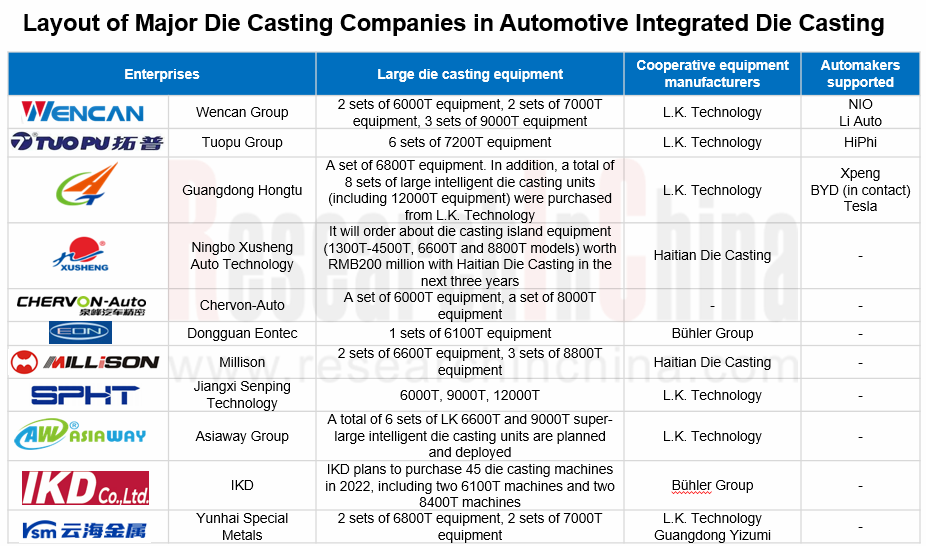
Currently, Wencan Group, Tuopu Group and Guangdong Hongtu have first-mover advantages in experience accumulation and order intake. All three have established cooperation with automakers and successfully completed the trial production of integrated die casting parts. Especially, Guangdong Hongtu is superior to others thanks to its heat-treatment-free aluminum alloy patent and the yield rate of 85%-90%. So far, it has not only obtained the designation from Xpeng, but also become Tesla's only die casting partner in integrated die casting.
Downstream: Automakers scramble to deploy integrated die casting in a bid to integrate the upper and lower car body
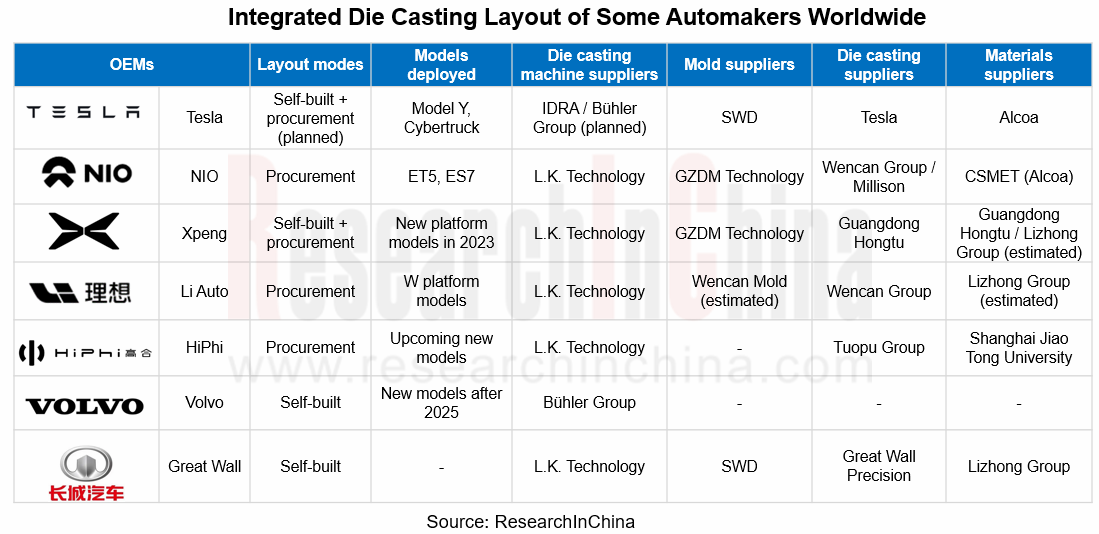
At present, Tesla, NIO, Xpeng, HiPhi, Volvo, Great Wall and other automakers have made layout in the field of automotive integrated die casting.
In terms of emerging automakers, Tesla has officially delivered Model Y with integrated die casting floors. NIO ET5 with an integrated die casting rear subframe is about to be delivered. In addition, Xpeng, Li Auto and HiPhi have put integrated die casting on the agenda, and they may apply it to vehicles in 2023.
As for traditional automakers, Volkswagen and Volvo have a long-term timetable for the layout of integrated die casting, and they expect to achieve mass production around 2025. Chinese automakers Changan and Great Wall have started bidding for integrated die casting projects, and they are likely to accomplish mass production in the next two to three years.
Now, major OEMs mainly apply integrated die casting to the rear floor, the front cockpit, etc. With the advent of higher-tonnage die casting machines, integrated die casting is expected to spread to lower body assembly, upper body integrated casting parts, and even body-in-white in the future.
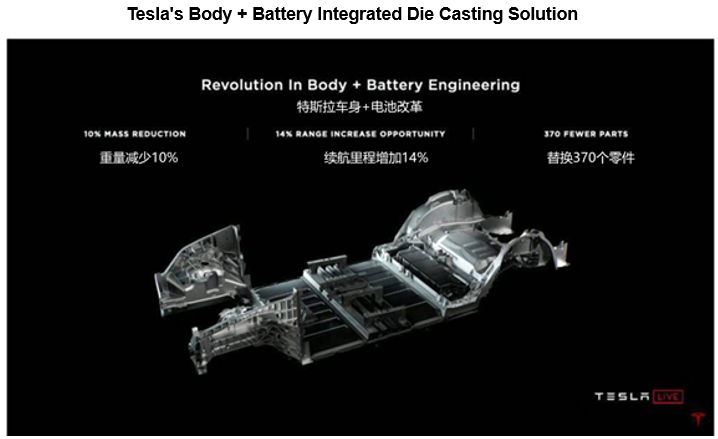
Tesla plans to replace the 370-part lower body assembly with 2-3 large die casting parts. Tesla has extended the integrated die casting to the front and rear floors. At the same time, the upper cover of the battery pack and the middle floor of the vehicle are combined into one for integrated die casting, which can reduce the vehicle weight by 10% and increase the cruising range by 14%.
In addition, Wencan Group has successfully trial-manufactured large integrated casting parts on the upper body, and it will deliver samples in small batches later.
AI-Defined Vehicle (AIDV) OEMs' Deployment Strategies Research Report, 2026
AIDV Research: Deployment Strategies of 22 OEMs
The AI-Defined Vehicle (AIDV) OEMs' Deployment Strategies Research Report, 2026, released by ResearchInChina, analyzes the AI deployment strategies of ...
OEMs’ Passenger Car Model Planning Research Report, 2026
Vehicle Model Planning Research: Chinese OEMs Launch Sub-Brands Intensively, While Multinational OEMs Apply the Brakes to Electrification Strategies
ResearchInChina released the OEMs’ Passenger Car M...
Autonomous Driving Simulation and World Model Research Report, 2026
Autonomous driving simulation research: "Simulation test + world model"-driven test system has become R&D infrastructure.
The "Autonomous Driving Simulation and World Model Research Report, 2026"...
Cockpit-Driving Integration Central Domain Controller SoC and AI Supercomputing Architecture Research Report, 2026
Cockpit-Driving integration and AI supercomputing research: The One Chip solution is rapidly installed in vehicles, and AI supercomputing architectures are moving towards full-domain integration.
AI ...
Intelligent Driving End-to-End Large Model Research Report, 2026
Research on Intelligent Driving Large Models: A Critical Period for Technological Competition and Paradigm Integration
As autonomous driving technology rapidly iterates from L2 to L3?L4, intelligent...
Automotive Digital Key Industry Trend Report, 2026
Digital Key Research: Automotive BLE, UWB and SLE Hardware Layout
The Automotive Digital Key Industry Trend Report, 2026, released by ResearchInChina, analyzes and predicts the digital key market, co...
Monthly Report on Automotive New Technology (May 2026)
UHD gaze technology, full-color LiDAR, UWB, etc. promote the upgrade of intelligent driving perception capabilities
This report is published once a month and is available for annual subscription.The...
In-Cabin Monitoring Systems (DMS, OMS, etc.) Research Report, 2026
In-Cabin Monitoring System Research: DMS to Become Mandatory in 2027, Expected to be Installed in Over 14 Million Vehicles
ResearchInChina released the In-Cabin Monitoring Systems (DMS, OMS, etc.) Re...
Automotive Service-Oriented Architecture (SOA) and Cross-Domain Middleware Industry Report, 2026
Research on automotive SOA and cross-domain middleware: The era of AI atomic services and AI cross-domain fusion agents is coming.
Automotive SOA evolves towards AI + full SOA servitization Driv...
Automotive Display, Center Console and Cluster Industry Report, 2026
Automotive Display Research: Multi-Screen Application Slows Down, While OLED and MiniLED Are Introduced in Vehicles Quickly
In 2026, automotive displays will no longer excessively pursue the number a...
Global and China Intelligent Vehicle Standard System Construction and Certification Research Report, 2026
Intelligent Driving Standards and Certification: With the Maturing Standardization System, China Will Participate in Formulation of Global Standards
China's automotive industry is transforming from ...
Automotive Intelligent Diagnosis Industry Report, 2026
Automotive Intelligent Diagnosis Research: Powered by AI, Remote Diagnosis Is Being Upgraded towards Intelligence.
ResearchInChina released the Automotive Intelligent Diagnosis Industry Report, 2026....
Automotive Cloud Service Platform Research Report, 2026
Research on automotive cloud service platform: with architecture upgrade and computing power improvement, cloud services enter a new stage
In 2026, the Internet of Vehicles industry generates petaby...
Integrated Battery and Innovative Battery Technology Research Report, 2026
Power Battery Research: Sales of High-Capacity Vehicles Keep Rising, and Solid-State Batteries Begin to Be Installed in Vehicles
I. Sales of High-Capacity Vehicles Sustain Growth, and Those with A C...
Chinese Independent OEMs’ ADAS and Autonomous Driving Report, 2026
Research on OEMs' Intelligent Driving: Era of Physical AI, Standard Configuration of D2D, and Initial Exploration of L3 Commercial Pilot Projects
From 2023 to 2025, the intelligent driving installati...
Intelligent Vehicle New Technology Application Analysis Report, 2025-2026
New Technology Research: Innovative Products such as Bionic Cameras, Vision-LiDAR Fusion Sensors, Auditory Sensors Further Enhance Vehicle Perception Capabilities
ForewordResearchInChina released th...
Automotive Optical Fiber Communication (Optical Fiber Ethernet, PON) and Supply Chain Research Report, 2026
Research on Automotive Optical Fiber Communication: Introduction of Optical Fiber in Vehicles Accelerates, with Priority Deployment in High-Speed Communication Link (10+Gbps) Scenarios
Automotive opt...
Automotive Intelligent Cockpit SoC Research Report, 2026
Automotive Cockpit SoC Research: Passenger Cars in the Price Range of RMB100,000–200,000 Account for Nearly 50% of Total Sales, and New-Generation Cockpit SoC Products Largely Enter Mass Production
P...