|
 |
Emerging Automaker Strategy Research Report, 2022 - Li Auto
|
Research on Emerging Automaker Strategy: the strategic layout of Li Auto in electric vehicles, cockpits and autonomous driving
Li Auto will shift from the single extended-range route to the “extended-range + high-voltage battery-electric” route of in 2023.
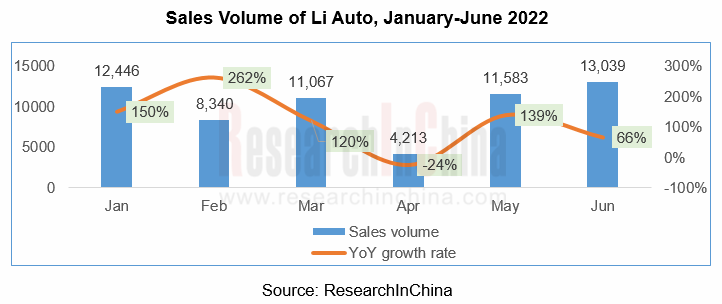
In the first half of 2022, Li Auto sold 60,801 vehicles, up 99.1% year-on-year. In terms of models, Li ONE still played a main role in the first half of the year. With the launch of L8 in September 2022, Li ONE will be gradually withdrawn from the production line, while L8, L7 and L9 will be the focus of production and marketing in the future.
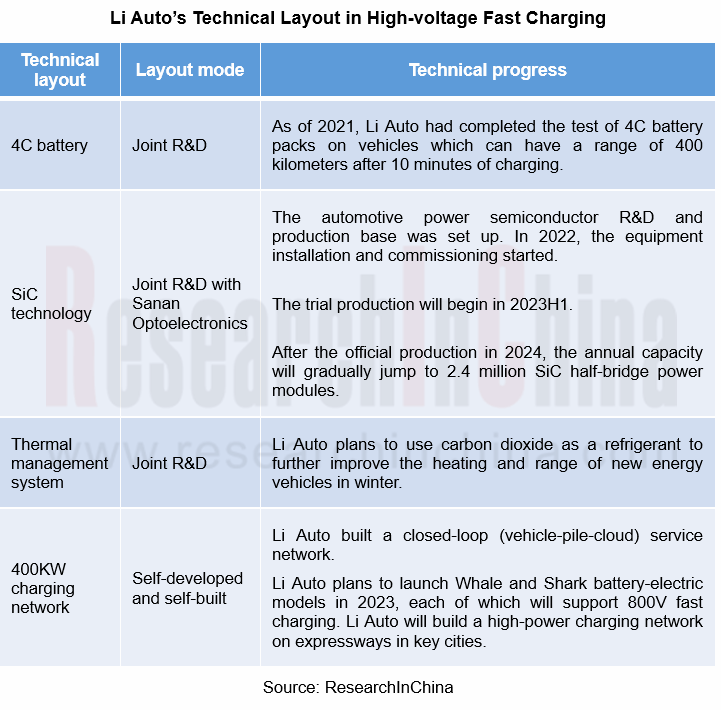
As for product planning, all the models currently being sold by Li Auto are extended-range electric vehicles. However, Li Auto plans to launch at least two high-voltage battery-electric vehicles every year from 2023 onward. For the purpose of high-voltage super-fast charging, Li Auto deploys the following four aspects: First, 4C batteries. Second, application of SiC technology. Third, thermal management system. Fourth, 400KW charging network.
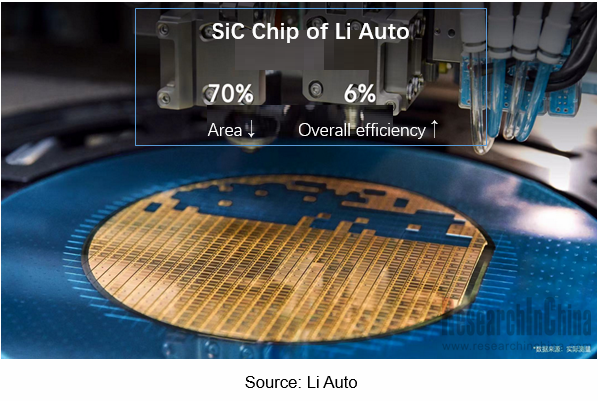
According to its plan, Li Auto will produce the third-generation semiconductor SiC power chip in 2024. At the same current of the high-voltage platform, this chip is 70% smaller than an IGBT chip, with the comprehensive efficiency being improved by 6%. The layout of Li Auto’s 800V high-voltage battery-electric technology reveals that one of the selling points of new cars in the future will be reflected in the charging speed.
Li Auto has self-developed AEB and NOA and laid out autonomous driving chips to progress on intelligent driving
As for the progress of intelligent driving, Li Auto has developed AEB system by itself as a "latecomer". In the future, Li Auto will provide all open source codes of its AEB system to improve traffic safety.
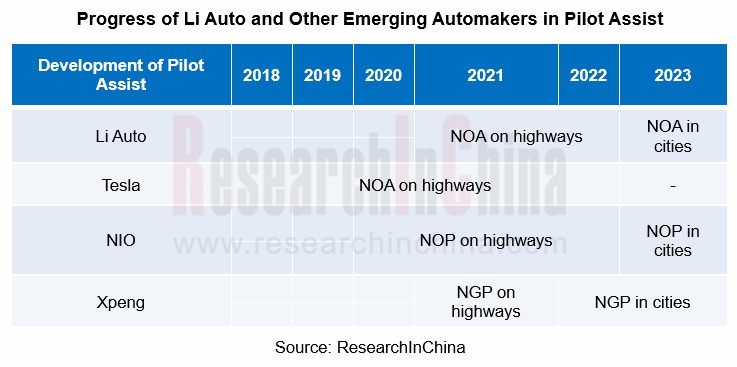
In addition, Li Auto added NOA to 2021 Li ONE in December 2021, improved the performance of AEB, and optimize the detection and fusion of cameras and radar. Since 2022, all new cars have been equipped with Li Auto’s self-developed hardware compatible with L4 autonomous driving as standard. Li Auto plans to make urban NGP functions available in Li L9 through OTA in 2023, and install L4 autonomous driving capability on production vehicles via OTA around 2024.
Regarding the core underlying technology layout of intelligent driving, Li Auto established Sichuan Lixiang Intelligent Technology Co., Ltd. in May 2022 to design chips. In August 2022, Xie Yan, the former vice president of Huawei Software, joined Li Auto as the head of system R&D division. The system R&D division is mainly responsible for R&D of some underlying intelligent technologies, including Li Auto's self-developed operating system and computing platform. Li Auto's computing platform business also includes its self-developed intelligent driving chip project.
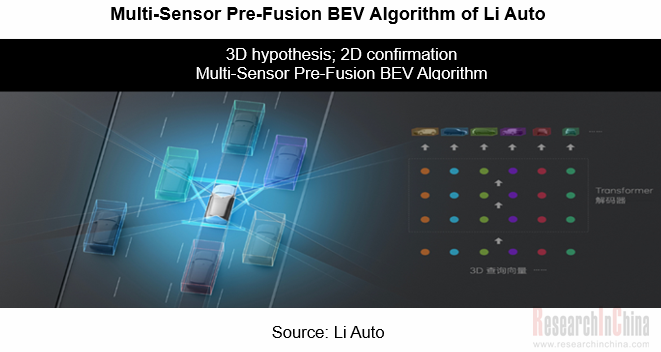
For the intelligent driving algorithm, Li Auto uses BEV framework similar to that of Tesla, that is, it utilizes pure vision for motion perception prediction. On the basis of BEV visual information, Li Auto exploits additional LiDAR and HD map information input to implement the BEV fusion algorithm, and adds a visual security module and a LiDAR security module which are redundant with BEV framework model for the sake of an extra layer of protection.
The cockpit of Li Auto upgrades from 2D interaction to 3D interaction.
The cockpit multi-modal interaction represents development trend of human-machine co-driving era. As per three new cars launched in 2022, Li Auto upgrades the past four-screen 2D interaction in Li ONE to current five-screen 3D interaction, and realizes “voice+gesture” multi-modal interaction.
For example, the five screens of Li L9 include a safe driving interactive screen, a W-HUD with a projected area of 13.35 inches, a 15.7-inch integrated center console screen and co-driver screen, and a 15.7-inch rear entertainment screen. The in-vehicle 3D ToF sensor perceives the cockpit environment in real time. Plus, 6 microphones, 7.3.4 panoramic sound layout, 5G dual-operator automotive communication network, and multi-modal spatial interaction technology developed by Li Auto based on deep learning enable the three-dimensional interaction in the cockpit.
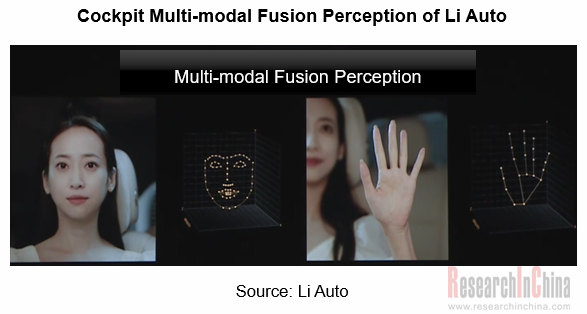
In terms of perception, Li AI, the intelligent cockpit space, imitates the coordination of human ears and eyes to attain the three-dimensional information perception inside the vehicle under the influence of multi-modal attention technology by a distributed hexasilicon microphone, an IR 3D ToF sensor, MIMO-Net six-vocal-range enhancement network and MVS-Net multinocular & multi-view visual fusion network.
As for understanding and expression, Li AI restores the multi-source heterogeneous data sensed by fusion perception to concrete events in the network, and fulfills further abstract understanding. Ultimately, knowledge linking, knowledge completion and logical reasoning form an event graph, allowing machines to have their own understanding and decision-making capabilities.
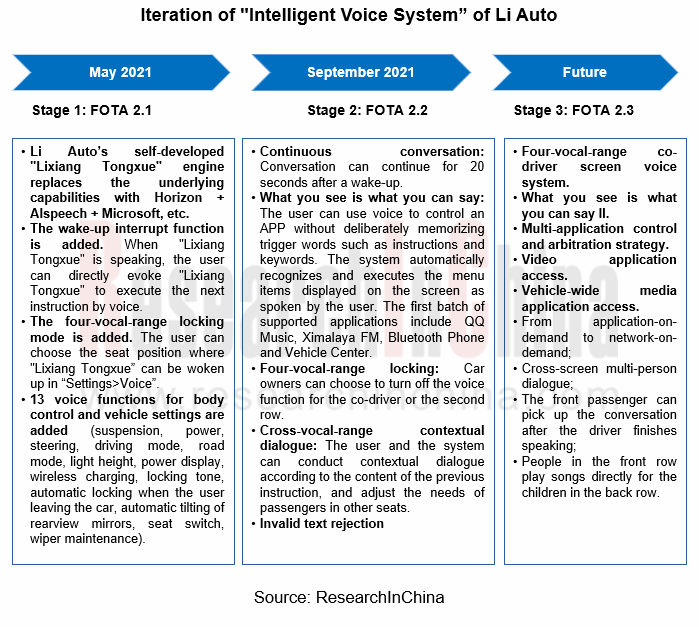
Regarding voice technology, Li Auto defines its voice assistant "Lixiang Tongxue" as the user's housekeeper (current stage) and family (future goal), and plans a three-stage product upgrade. At present, the goals of the first two stages have been achieved through OTA: The first stage: Li Auto’s self-developed "Lixiang Tongxue" engine replaces the underlying capabilities with Horizon + AIspeech + Microsoft, etc.
The second stage: "what you see is what you can say", four-vocal-range locking and other functions.
In the future, the voice system will offer functions such as "from application-on-demand to network-on-demand", cross-screen multi-person dialogue, and "the front passenger can pick up the conversation after the driver finishes speaking".
Top10 Emerging Automakers by Sales Volume in 2021
1 Profile of Li Auto
1.1 Basic Information
1.2 Development History
1.3 Revenue, Sales Volume and Planning
1.4 Carmaking Platform and Product Planning
1.5 Financing History
1.6 Investment History
1.7 R&D Investment and Direction
1.8 Production Layout
1.9 Marketing and Services
1.9.1 Sales Models
1.9.2 Distribution of Offline Service Outlets
1.9.3 Sales Channels
1.9.4 After-sales Services
1.9.5 Financial Solutions
2 User Operation of Li Auto APP
2.1 Version Iteration of Li Auto APP (1)
2.1 Version Iteration of Li Auto APP (2)
2.1 Version Iteration of Li Auto APP (3)
2.2 User Portrait and Homepage Analysis
2.3 Functional Plate Analysis - Community Plate and News Plate
2.4 Functional Plate Analysis - Vehicle Control Plate
2.5 Functional Plate Analysis - Commodity Categories and Characteristics of Li Auto Mall
2.6 Functional Plate Analysis - My Plate
2.7 Operation Strategy and User Growth System
2.8 User Growth System - Points Features and How to Obtain Them
2.9 User Growth System - Points Consumption Modes
2.10 User Growth System - Badges and Membership Levels
3 Electric Technology of Li Auto
3.1 Comparison between Models on Sale in Dynamic Performance Parameters
3.2 Electric Technology Layout
3.3 Features of Power System
3.4 The First-generation Extended-range Electric Solution for Vehicles
3.5 The Second-generation Extended-range Electric Solution for Vehicles
3.6 Thermal Management System Structure and Suppliers of Li ONE
3.7 Thermal Management System Strategy of Li ONE
3.8 Thermal Management System and Drive System Suppliers of Li L9
3.9 Energy Supplement Modes of Vehicles
3.10 Super Charging Network Planning
3.11 Electrification Dynamics
4 Electronic and Electrical Architecture of Li Auto
4.1 Evolution of EEA: LEEA 1.0–LEEA 3.0
4.2 LEEA 2.0 Hardware Architecture: AD Max
4.3 LEEA 2.0 Hardware Architecture: Autonomous Driving Algorithm
4.4 LEEA 2.0 Hardware Architecture: Intelligent Cockpit
4.5 LEEA 2.0 Hardware Architecture: Central Domain Controller (XCU)
4.6 LEEA 2.0 Hardware Architecture: Central Computing Platform +4 Zonal Controllers
4.7 LEEA 3.0 Hardware Architecture: Central Computer Unit (CCU) (1)
4.8 LEEA 3.0 Hardware Architecture: Central Computer Unit (CCU) (2)
4.9 LEEA 3.0 Hardware Architecture: Zonal Controller
4.10 LEEA 3.0 Communication Architecture: PCIe Switch and TSN Switch
4.11 LEEA 3.0 Software Architecture: Definition and Deployment of Multi-level Services
4.12 LEEA 3.0 Software Architecture: LiOS (Li Auto OS)
5 Intelligent Driving Technology of Li Auto
5.1 Autonomous Driving Development Roadmap
5.2 Autonomous Driving Chip Layout
5.3 Intelligent Driving R&D Model
5.4 Intelligent Driving Algorithm (1)
5.4 Intelligent Driving Algorithm (2)
5.5 Intelligent Driving Data Accumulation and Processing
5.6 AD System and Typical Models
5.7 AD MAX System
5.8 AD Pro System
5.9 Hardware Iteration and Suppliers of ADAS
5.10 ADAS Hardware - Comparison between NIO, Li Auto and Xpeng in LiDAR Solutions
5.11 Software Iteration of ADAS
5.12 ADAS - NOA Functions
5.13 ADAS - Comparison between NIO, Li Auto, Xpeng and Tesla in NOA Solutions
5.14 Development Roadmap of Autonomous Parking System
5.15 Functional Evolution of Automated Parking
5.16 Visual Parking at All Scenarios
5.17 Dynamics of Cooperation in Autonomous Driving
6 Intelligent Cockpit and IoV Technology of Li Auto
6.1 OTA Update Modes
6.2 OTA Update Analysis - by Frequency
6.3 OTA Update Analysis - by Year
6.4 OTA Update Analysis - by Category
6.5 Major Changes in OTA Updates (1)
6.5 Major Changes in OTA Updates (2)
6.6 OTA Update Plan
6.7 Intelligent Cockpit Configuration
6.8 Seating Configuration of L9, L8 and L7
6.9 Li AI
6.10 Li AI Interaction (1)
6.10 Li AI Interaction (2)
6.10 Li AI Interaction (3)
6.11 Example of Li AI Application: L9
6.12 Other Intelligent Cockpit Suppliers
6.13 Intelligent Cockpit R&D Planning
6.14 Intelligent Voice System
6.15 Automotive Application Ecology
6.16 Actual IoV Security
6.17 Dynamics of Cooperation in IoV
AI-Defined Vehicle (AIDV) OEMs' Deployment Strategies Research Report, 2026 AIDV Research: Deployment Strategies of 22 OEMs
The AI-Defined Vehicle (AIDV) OEMs' Deployment Strategies Research Report, 2026, released by ResearchInChina, analyzes the AI deployment strategies of ... OEMs’ Passenger Car Model Planning Research Report, 2026 Vehicle Model Planning Research: Chinese OEMs Launch Sub-Brands Intensively, While Multinational OEMs Apply the Brakes to Electrification Strategies
ResearchInChina released the OEMs’ Passenger Car M... Autonomous Driving Simulation and World Model Research Report, 2026 Autonomous driving simulation research: "Simulation test + world model"-driven test system has become R&D infrastructure.
The "Autonomous Driving Simulation and World Model Research Report, 2026"... Cockpit-Driving Integration Central Domain Controller SoC and AI Supercomputing Architecture Research Report, 2026 Cockpit-Driving integration and AI supercomputing research: The One Chip solution is rapidly installed in vehicles, and AI supercomputing architectures are moving towards full-domain integration.
AI ... Intelligent Driving End-to-End Large Model Research Report, 2026 Research on Intelligent Driving Large Models: A Critical Period for Technological Competition and Paradigm Integration
As autonomous driving technology rapidly iterates from L2 to L3?L4, intelligent... Automotive Digital Key Industry Trend Report, 2026 Digital Key Research: Automotive BLE, UWB and SLE Hardware Layout
The Automotive Digital Key Industry Trend Report, 2026, released by ResearchInChina, analyzes and predicts the digital key market, co... Monthly Report on Automotive New Technology (May 2026) UHD gaze technology, full-color LiDAR, UWB, etc. promote the upgrade of intelligent driving perception capabilities
This report is published once a month and is available for annual subscription.The... In-Cabin Monitoring Systems (DMS, OMS, etc.) Research Report, 2026 In-Cabin Monitoring System Research: DMS to Become Mandatory in 2027, Expected to be Installed in Over 14 Million Vehicles
ResearchInChina released the In-Cabin Monitoring Systems (DMS, OMS, etc.) Re... Automotive Service-Oriented Architecture (SOA) and Cross-Domain Middleware Industry Report, 2026 Research on automotive SOA and cross-domain middleware: The era of AI atomic services and AI cross-domain fusion agents is coming.
Automotive SOA evolves towards AI + full SOA servitization Driv... Automotive Display, Center Console and Cluster Industry Report, 2026 Automotive Display Research: Multi-Screen Application Slows Down, While OLED and MiniLED Are Introduced in Vehicles Quickly
In 2026, automotive displays will no longer excessively pursue the number a... Global and China Intelligent Vehicle Standard System Construction and Certification Research Report, 2026 Intelligent Driving Standards and Certification: With the Maturing Standardization System, China Will Participate in Formulation of Global Standards
China's automotive industry is transforming from ... Automotive Intelligent Diagnosis Industry Report, 2026 Automotive Intelligent Diagnosis Research: Powered by AI, Remote Diagnosis Is Being Upgraded towards Intelligence.
ResearchInChina released the Automotive Intelligent Diagnosis Industry Report, 2026.... Automotive Cloud Service Platform Research Report, 2026 Research on automotive cloud service platform: with architecture upgrade and computing power improvement, cloud services enter a new stage
In 2026, the Internet of Vehicles industry generates petaby... Integrated Battery and Innovative Battery Technology Research Report, 2026 Power Battery Research: Sales of High-Capacity Vehicles Keep Rising, and Solid-State Batteries Begin to Be Installed in Vehicles
I. Sales of High-Capacity Vehicles Sustain Growth, and Those with A C... Chinese Independent OEMs’ ADAS and Autonomous Driving Report, 2026 Research on OEMs' Intelligent Driving: Era of Physical AI, Standard Configuration of D2D, and Initial Exploration of L3 Commercial Pilot Projects
From 2023 to 2025, the intelligent driving installati... Intelligent Vehicle New Technology Application Analysis Report, 2025-2026 New Technology Research: Innovative Products such as Bionic Cameras, Vision-LiDAR Fusion Sensors, Auditory Sensors Further Enhance Vehicle Perception Capabilities
ForewordResearchInChina released th... Automotive Optical Fiber Communication (Optical Fiber Ethernet, PON) and Supply Chain Research Report, 2026 Research on Automotive Optical Fiber Communication: Introduction of Optical Fiber in Vehicles Accelerates, with Priority Deployment in High-Speed Communication Link (10+Gbps) Scenarios
Automotive opt... Automotive Intelligent Cockpit SoC Research Report, 2026 Automotive Cockpit SoC Research: Passenger Cars in the Price Range of RMB100,000–200,000 Account for Nearly 50% of Total Sales, and New-Generation Cockpit SoC Products Largely Enter Mass Production
P...
|