Autonomous Driving Algorithm Research: BEV Drives Algorithm Revolution, AI Large Model Promotes Algorithm Iteration
The core of the autonomous driving algorithm technical framework is divided into three parts: environment perception, decision planning, and control execution.
Environment perception: convert sensor data into machine language of the scenario where the vehicle is located, which can include object detection, recognition and tracking, environment modeling, motion estimation, etc.;
Decision planning: Based on the output results of perception algorithm, the final behavioral action instructions are given, including behavioral decisions (vehicle following, stopping and overtaking), action decisions (car steering, speed, etc.), path planning, etc.;
Control actuation: according to the output results of decision-making level, the underlying modules are mobilized to issue instructions to the core control components such as accelerator and brake, and promote vehicle to drive according to the planned route.
BEV drives algorithm revolution
In recent years, BEV perception has received extensive attention. BEV model mainly provides a unified space to facilitate the fusion of various tasks and sensors. It has following advantages:
BEV unifies the multimodal data processing dimension and makes multimodal fusion easier
The BEV perception system converts the information obtained from multiple cameras or radars to a bird's-eye view, and then do tasks such as object detection and instance segmentation, which can more intuitively display the dimension and direction of objects in BEV space.
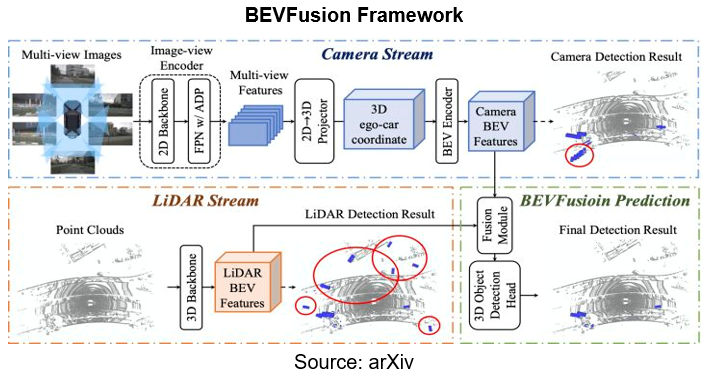
In 2022, Peking University & Ali proposed a fusion framework of LiDAR and vision - BEVFusion. The processing of radar point clouds and image processing are carried out independently, using neural networks to encode, project to a unified BEV space, and then merge the two in BEV space.
Realize timing information fusion and build 4D space
In the 4D space, the perception algorithm can better complete the perception tasks such as speed measurement, and can transmit the results of motion prediction to the decision and control module.
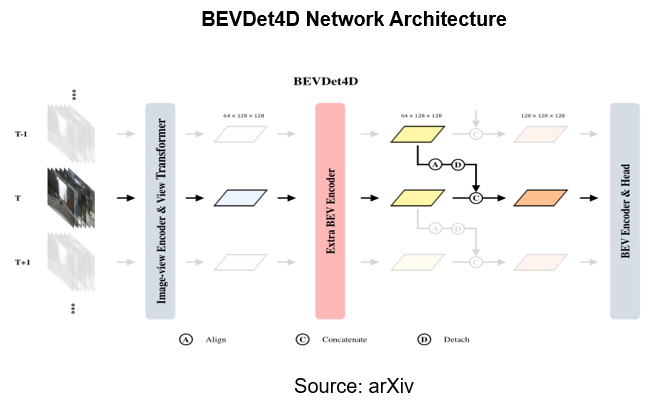
PhiGent Robotics proposed BEVDet4D in 2022, which is a version based on BEVDet to increase timing fusion. BEVDet4D extends BEVDet by retaining intermediate BEV features of past frames, and then fuses features by aligning and splicing with the current frame, so that time clues can be obtained by querying two candidate features.
Imagine occluded objects to realize object prediction
In the BEV space, the algorithm can predict the occluded area based on prior knowledge, and imagine whether there are objects in the occluded area.
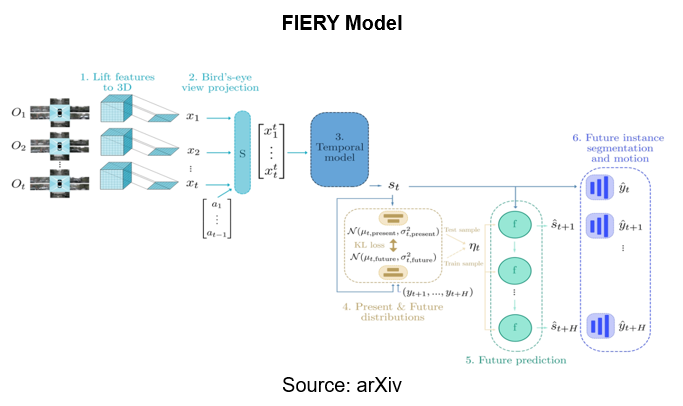
FIERY, proposed by Wayve in cooperation with the University of Cambridge in 2021, is an end-to-end road dynamic object instance prediction algorithm that does not rely on high-precision maps and is only based on aerial views of monocular cameras.
Promoting development of an end-to-end autonomous driving framework
In the BEV space, perception and prediction can be directly optimized end-to-end through neural networks in a unified space, and the results can be obtained at the same time. Not only the perception module, but also the BEV-based planning decision-making module is also the direction of academic research.
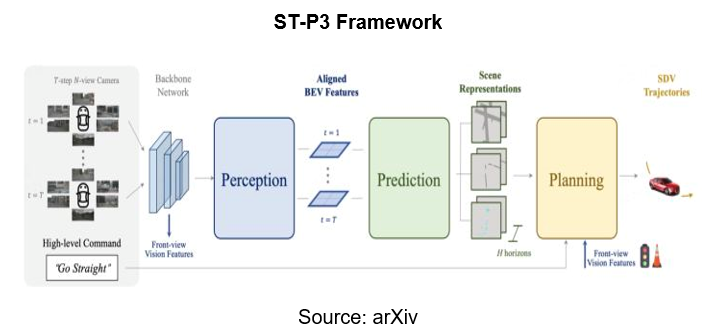
In 2022, autonomous driving team of Shanghai Artificial Intelligence Laboratory and the team of associate professor Yan Junchi of Shanghai Jiao Tong University collaborated on paper ST-P3 to propose a spatiotemporal feature learning solution that can simultaneously provide a set of more representative features for perception, prediction and planning tasks.
AI large model drives algorithm iteration
After 2012, deep learning algorithms are widely applied in autonomous driving field. In order to support larger and more complex AI computing needs, AI large models with the characteristics of "huge data, huge computing power, and huge algorithms" were born, which accelerated the iteration speed of algorithms.
Large Model and Intelligent Computing Center
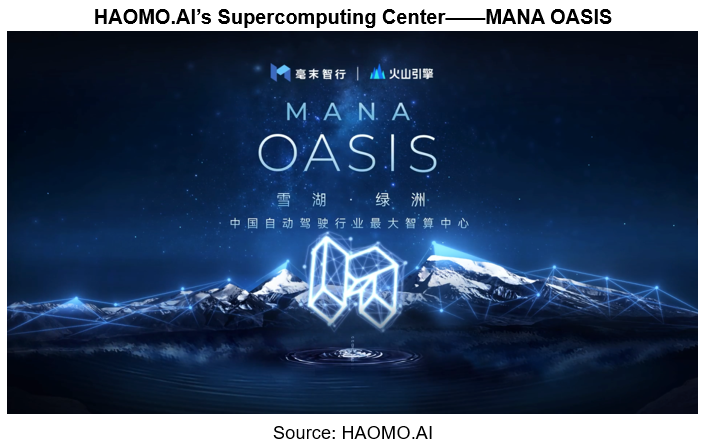
In 2021, HAOMO.AI launched research and landing attempts on large-scale Transformer model, and then gradually applied it on a large scale in projects including multi-modal perception data fusion and cognitive model training. In December 2021, HAOMO.AI released autonomous driving data intelligence system MANA (Chinese name "Snow Lake"), which integrates perception, cognition, labeling, simulation, computing and other aspects. In January 2023, HAOMO.AI together with Volcano Engine unveiled MANA OASIS, a supercomputing center with a total computing power of 670 PFLOPS. After deploying HAOMO.AI's training platform, OASIS can run various applications including cloud large-scale model training, vehicle-side model training, annotation, and simulation. With the help of MANA OASIS, the five major models of HAOMO.AI have ushered in a new appearance and upgrade.
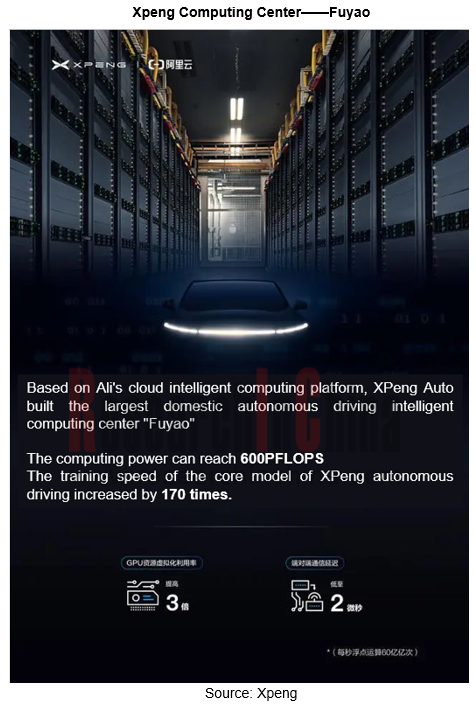
In August 2022, based on Alibaba Cloud intelligent computing platform, Xpeng Motors built an autonomous driving intelligent computing center "Fuyao", which is dedicated to training of autonomous driving models. In October 2022, Xpeng also announced the introduction of Transformer large model.
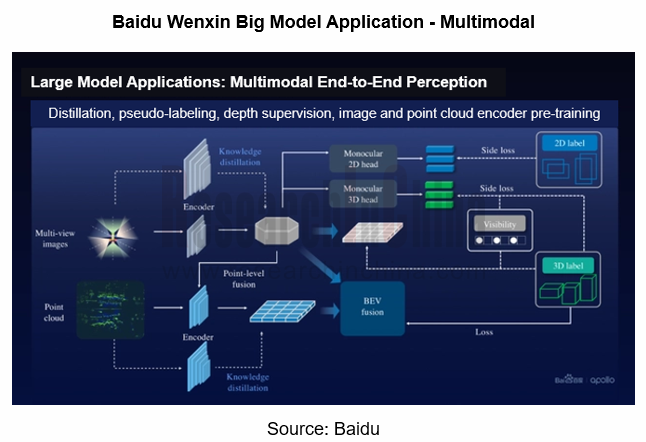
In November 2022, Baidu released Wenxin Big Model. Leveraging more than 1 billion parameters, it recognizes thousands of objects, helping to enlarge the scope of semantic recognition. At present, it is mainly used in three aspects: distance vision, multimodality and data mining.
AI-Defined Vehicle (AIDV) OEMs' Deployment Strategies Research Report, 2026
AIDV Research: Deployment Strategies of 22 OEMs
The AI-Defined Vehicle (AIDV) OEMs' Deployment Strategies Research Report, 2026, released by ResearchInChina, analyzes the AI deployment strategies of ...
OEMs’ Passenger Car Model Planning Research Report, 2026
Vehicle Model Planning Research: Chinese OEMs Launch Sub-Brands Intensively, While Multinational OEMs Apply the Brakes to Electrification Strategies
ResearchInChina released the OEMs’ Passenger Car M...
Autonomous Driving Simulation and World Model Research Report, 2026
Autonomous driving simulation research: "Simulation test + world model"-driven test system has become R&D infrastructure.
The "Autonomous Driving Simulation and World Model Research Report, 2026"...
Cockpit-Driving Integration Central Domain Controller SoC and AI Supercomputing Architecture Research Report, 2026
Cockpit-Driving integration and AI supercomputing research: The One Chip solution is rapidly installed in vehicles, and AI supercomputing architectures are moving towards full-domain integration.
AI ...
Intelligent Driving End-to-End Large Model Research Report, 2026
Research on Intelligent Driving Large Models: A Critical Period for Technological Competition and Paradigm Integration
As autonomous driving technology rapidly iterates from L2 to L3?L4, intelligent...
Automotive Digital Key Industry Trend Report, 2026
Digital Key Research: Automotive BLE, UWB and SLE Hardware Layout
The Automotive Digital Key Industry Trend Report, 2026, released by ResearchInChina, analyzes and predicts the digital key market, co...
Monthly Report on Automotive New Technology (May 2026)
UHD gaze technology, full-color LiDAR, UWB, etc. promote the upgrade of intelligent driving perception capabilities
This report is published once a month and is available for annual subscription.The...
In-Cabin Monitoring Systems (DMS, OMS, etc.) Research Report, 2026
In-Cabin Monitoring System Research: DMS to Become Mandatory in 2027, Expected to be Installed in Over 14 Million Vehicles
ResearchInChina released the In-Cabin Monitoring Systems (DMS, OMS, etc.) Re...
Automotive Service-Oriented Architecture (SOA) and Cross-Domain Middleware Industry Report, 2026
Research on automotive SOA and cross-domain middleware: The era of AI atomic services and AI cross-domain fusion agents is coming.
Automotive SOA evolves towards AI + full SOA servitization Driv...
Automotive Display, Center Console and Cluster Industry Report, 2026
Automotive Display Research: Multi-Screen Application Slows Down, While OLED and MiniLED Are Introduced in Vehicles Quickly
In 2026, automotive displays will no longer excessively pursue the number a...
Global and China Intelligent Vehicle Standard System Construction and Certification Research Report, 2026
Intelligent Driving Standards and Certification: With the Maturing Standardization System, China Will Participate in Formulation of Global Standards
China's automotive industry is transforming from ...
Automotive Intelligent Diagnosis Industry Report, 2026
Automotive Intelligent Diagnosis Research: Powered by AI, Remote Diagnosis Is Being Upgraded towards Intelligence.
ResearchInChina released the Automotive Intelligent Diagnosis Industry Report, 2026....
Automotive Cloud Service Platform Research Report, 2026
Research on automotive cloud service platform: with architecture upgrade and computing power improvement, cloud services enter a new stage
In 2026, the Internet of Vehicles industry generates petaby...
Integrated Battery and Innovative Battery Technology Research Report, 2026
Power Battery Research: Sales of High-Capacity Vehicles Keep Rising, and Solid-State Batteries Begin to Be Installed in Vehicles
I. Sales of High-Capacity Vehicles Sustain Growth, and Those with A C...
Chinese Independent OEMs’ ADAS and Autonomous Driving Report, 2026
Research on OEMs' Intelligent Driving: Era of Physical AI, Standard Configuration of D2D, and Initial Exploration of L3 Commercial Pilot Projects
From 2023 to 2025, the intelligent driving installati...
Intelligent Vehicle New Technology Application Analysis Report, 2025-2026
New Technology Research: Innovative Products such as Bionic Cameras, Vision-LiDAR Fusion Sensors, Auditory Sensors Further Enhance Vehicle Perception Capabilities
ForewordResearchInChina released th...
Automotive Optical Fiber Communication (Optical Fiber Ethernet, PON) and Supply Chain Research Report, 2026
Research on Automotive Optical Fiber Communication: Introduction of Optical Fiber in Vehicles Accelerates, with Priority Deployment in High-Speed Communication Link (10+Gbps) Scenarios
Automotive opt...
Automotive Intelligent Cockpit SoC Research Report, 2026
Automotive Cockpit SoC Research: Passenger Cars in the Price Range of RMB100,000–200,000 Account for Nearly 50% of Total Sales, and New-Generation Cockpit SoC Products Largely Enter Mass Production
P...