Autonomous Shuttle Research: application scenarios further extend amidst policy promotion and continuous exploration
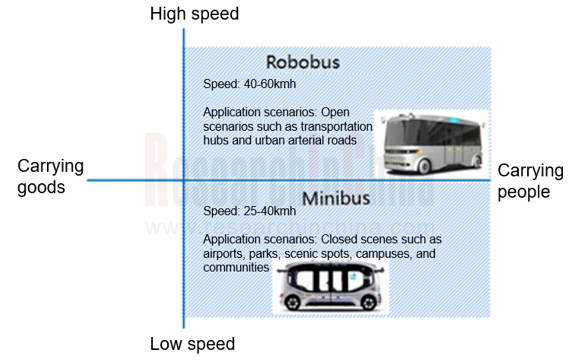
Autonomous shuttles are roughly categorized into minibuses and robobuses. Minibuses, namely micro-circulation shuttle buses, mostly work in airports, parks, scenic spots, campuses, communities and other scenarios at speeds of 25-45km/h. Typical minibuses are offered by FAW Hongqi, Baidu Apollo and UISEE.
Robobuses are autonomous minibuses running at 40-60 km/h under the control of software. They are often seen in open scenarios such as transportation hubs and urban trunk roads, and provide urban public transport services. Representative robobuses include Qcraft ONE and MOGO BUS M2.
I. Autonomous driving solution providers flood into the arena of shuttle buses.
In the arena of shuttle buses, main players embrace OEMs, auto parts companies and autonomous driving solution providers, among which L4 autonomous driving technology providers perform stunningly. For example, the robobus co-built by Shanghai Space and PIX Moving was delivered offline in March 2022, and officially began to provide short-distance shuttle services between Wangjiazhuang Subway Station and Xiantao Big Data Valley, Yubei District, Chongqing in June 2022. In July 2022, the driverless buses from Idriverplus landed in Beijing Dongsheng Science and Technology Park to start the normal operation and serve commuters in the park. In September 2022, MOGO officially released the autonomous OEM production buses - MOGO BUS M1 (autonomous minibus) and MOGO BUS M2 (autonomous bus), both equipped with the "vehicle-road-cloud integration" system.
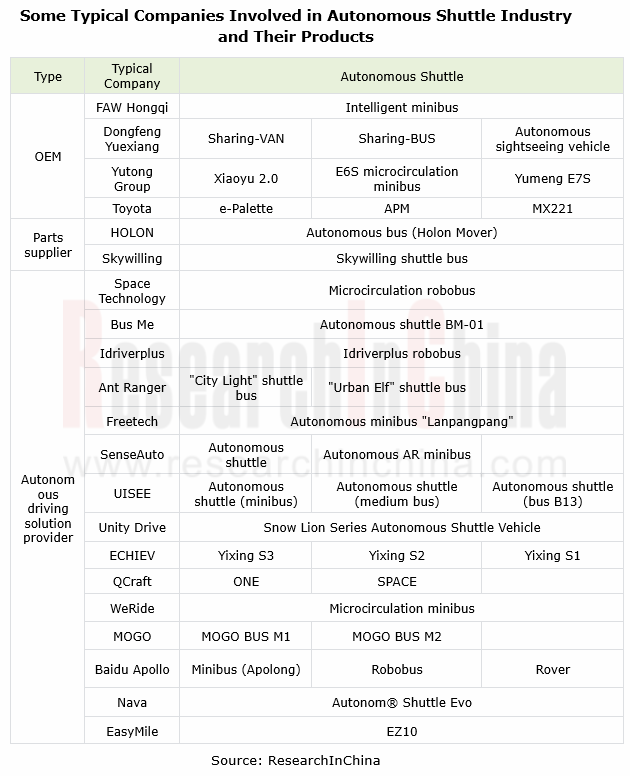
As well robotaxises that adopt L4 technology, autonomous shuttles boast sensors such as LiDAR, radar and cameras, and combine cloud software and sensors to enable vehicle positioning, environmental perception, path planning & decision, and vehicle control & actuation. At present, many L4 technical solution providers like QCraft, UISEE, MOGO, WeRide and Baidu Apollo have laid out technology routes for both robotaxis and robobuses.
II. The operation scenarios of autonomous shuttles are extending from designated areas and low-speed scenarios to open environments and complex scenarios.
At present, autonomous shuttles are running from closed and semi-closed designated areas (parks, scenic spots, factories, communities, campuses, airports, etc.) to urban public roads as subway shuttle buses, urban microcirculation buses, and autonomous buses for ride-hailing services.

III. The current growth of the autonomous shuttle market is mainly driven by policies and smart road upgrades.
1. China, the United States, Japan, and South Korea have issued favorable policies for autonomous buses.
Japan, the United States and South Korea among other foreign countries have introduced policies to encourage the commercial operation of autonomous vehicles like autonomous shuttles.
 On March 10, 2022, the National Highway Traffic Safety Administration (NHTSA) of the United States issued a first-of-its-kind final rule, the Occupant Protection Safety Standards for Vehicles Without Driving Controls, no longer requiring automated vehicle manufacturers to equip their ADS-enabled vehicles with traditional manual controls to meet crash standards.
Japan decided to allow for use of L4 autonomous vehicles (controlled by system) in transit and delivery services from April 1, 2023.
South Korea proposed a goal of commercializing L4 (highly automated) autonomous buses and shuttle buses by 2025 under its “Mobility Innovation Roadmap”. On November 25, 2022, Seoul, capital of South Korea, opened the first autonomous bus line with a total mileage of about 3.4 kilometers, marking South Korea’s first step to commercialize autonomous shuttles.
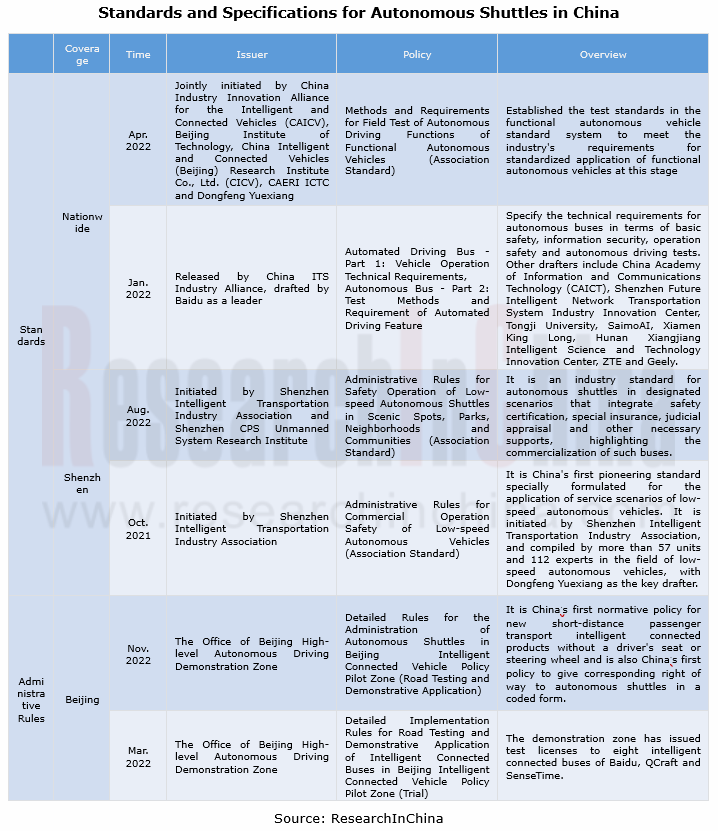
In China, Beijing, Shenzhen and other cities have standardized autonomous shuttles in terms of product standards and administration, setting an example for the development of the industry.
In January 2022, the "Automated Driving Bus” association standard jointly drafted by Baidu, China Academy of Information and Communications Technology (CAICT), ZTE and Geely was officially released. This standard covers two parts: Automated Driving Bus - Part 1: Vehicle Operation Technical Requirements, and Autonomous Bus - Part 2: Test Methods and Requirement of Automated Driving Feature. They specify the technical requirements for autonomous buses in terms of basic safety, information security, operation safety and autonomous driving tests.
In March 2022, Beijing High-level Autonomous Driving Demonstration Zone issued the Detailed Implementation Rules for Road Testing and Demonstrative Application of Intelligent Connected Buses in Beijing Intelligent Connected Vehicle Policy Pilot Zone (Trial), posing specific administrative requirements for in-vehicle management, vehicle operation, road test, insurance and technical parameters.
In November, 2022, Beijing High-level autonomous driving Demonstration Zone issued the "Detailed Rules for the Administration of Autonomous Shuttles in Beijing Intelligent Connected Vehicle Policy Pilot Zone (Road Testing and Demonstrative Application)". It is China’s first normative policy for new short-distance passenger transport intelligent connected products without a driver's seat or steering wheel and is also China’s first policy to give corresponding right of way to autonomous shuttles in a coded form.
2. The construction and upgrading of smart roads accelerate the large-scale application of autonomous shuttles.
The construction of smart roads is the premise for operating autonomous shuttles. In particular, the planning of smart bus lines in various urban demonstration areas has favored the application of robobuses. So far, Beijing, Xiong'an New Area, Guangzhou, Ezhou, Zibo, Changsha, Wuxi, Zhengzhou, Chongqing, Hainan and the like have taken the lead in introducing autonomous shuttles on the basis of smart roads.
As of September 2022, Wuhan Economic & Technological Development Zone had opened 321km test roads in total for intelligent connected vehicles, of which 106km is fully covered by 5G and CVIS. It had deployed more than 1,800 intelligent roadside units such as cameras, LiDARs, radars and edge computing servers at 96 smart intersections to support real-time information exchange between vehicles, between vehicles and roads, between vehicles and the Internet. Among the autonomous shuttles landing in Wuhan Economic & Technological Development Zone, more than 30 Sharing-VANs from Dongfeng Yuexiang have come into normal operation, travelling a total of over 209,000 kilometers.
Guangzhou has opened a total of 353 test sections for intelligent connected vehicles, with a cumulative one-way mileage of 654.451 kilometers and a two-way mileage of 1,308.902 kilometers. From August 2022 to December 2023, Guangzhou starts an autonomous driving pilot project for urban mobility, and introduces 50 autonomous buses from different companies on the loop lines around Canton Tower and Guangzhou International Bio Island, providing at least 1 million rides for passengers.
Accompanied by the construction and upgrading of smart roads as well as the promotion of seamless mobility services, autonomous shuttles and robotaxi will be integrated into intelligent city transportation systems together to offer diversified smart mobility services.
IV. Autonomous shuttle companies are exploring new business models such as PRT
Autonomous shuttles are a solution to “first-mile and last-mile" mobility. As autonomous shuttles penetrate into urban communities, subway stations, etc., how to activate the "peripheral nerves" of urban traffic on large scale is one of the issues that need urgent consideration in urban governance.
For seamless mobility services, some companies are exploring new business models.
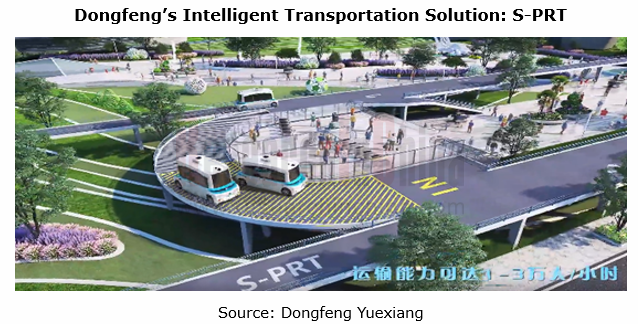
For example, Dongfeng Yuexiang's S-PRT (Sharing-Personal Rapid Transit) is a shared novel autonomous public transportation system composed of fully autonomous small vehicles and dedicated road networks. As a rapid nonstop public transportation tool with low construction cost (one-fifteenth of subways), it can transport an average of 10,000 to 30,000 people per hour at the average speed of 40-60km/h, and allows users to reserve without needing to wait. Dongfeng Yuexiang aims for test and demonstration of an operating mileage of more than 10 million kilometers in the Xiong'an New Area within three years, and promotes the "Xiong'an Solution" with partners in no less than 30 cities.
At the beginning of 2023, PIX Moving signed a strategic agreement with Common Rail (Hangzhou) Intelligent Industry Development Co., Ltd. on joint construction of a common rail project in Xiaoshan, Hangzhou. They will provide autonomous shuttles based on PIX’s chassis technology to solve the problems of large-scale commercialization of autonomous driving technology and urban traffic congestion.
AI-Defined Vehicle (AIDV) OEMs' Deployment Strategies Research Report, 2026
AIDV Research: Deployment Strategies of 22 OEMs
The AI-Defined Vehicle (AIDV) OEMs' Deployment Strategies Research Report, 2026, released by ResearchInChina, analyzes the AI deployment strategies of ...
OEMs’ Passenger Car Model Planning Research Report, 2026
Vehicle Model Planning Research: Chinese OEMs Launch Sub-Brands Intensively, While Multinational OEMs Apply the Brakes to Electrification Strategies
ResearchInChina released the OEMs’ Passenger Car M...
Autonomous Driving Simulation and World Model Research Report, 2026
Autonomous driving simulation research: "Simulation test + world model"-driven test system has become R&D infrastructure.
The "Autonomous Driving Simulation and World Model Research Report, 2026"...
Cockpit-Driving Integration Central Domain Controller SoC and AI Supercomputing Architecture Research Report, 2026
Cockpit-Driving integration and AI supercomputing research: The One Chip solution is rapidly installed in vehicles, and AI supercomputing architectures are moving towards full-domain integration.
AI ...
Intelligent Driving End-to-End Large Model Research Report, 2026
Research on Intelligent Driving Large Models: A Critical Period for Technological Competition and Paradigm Integration
As autonomous driving technology rapidly iterates from L2 to L3?L4, intelligent...
Automotive Digital Key Industry Trend Report, 2026
Digital Key Research: Automotive BLE, UWB and SLE Hardware Layout
The Automotive Digital Key Industry Trend Report, 2026, released by ResearchInChina, analyzes and predicts the digital key market, co...
Monthly Report on Automotive New Technology (May 2026)
UHD gaze technology, full-color LiDAR, UWB, etc. promote the upgrade of intelligent driving perception capabilities
This report is published once a month and is available for annual subscription.The...
In-Cabin Monitoring Systems (DMS, OMS, etc.) Research Report, 2026
In-Cabin Monitoring System Research: DMS to Become Mandatory in 2027, Expected to be Installed in Over 14 Million Vehicles
ResearchInChina released the In-Cabin Monitoring Systems (DMS, OMS, etc.) Re...
Automotive Service-Oriented Architecture (SOA) and Cross-Domain Middleware Industry Report, 2026
Research on automotive SOA and cross-domain middleware: The era of AI atomic services and AI cross-domain fusion agents is coming.
Automotive SOA evolves towards AI + full SOA servitization Driv...
Automotive Display, Center Console and Cluster Industry Report, 2026
Automotive Display Research: Multi-Screen Application Slows Down, While OLED and MiniLED Are Introduced in Vehicles Quickly
In 2026, automotive displays will no longer excessively pursue the number a...
Global and China Intelligent Vehicle Standard System Construction and Certification Research Report, 2026
Intelligent Driving Standards and Certification: With the Maturing Standardization System, China Will Participate in Formulation of Global Standards
China's automotive industry is transforming from ...
Automotive Intelligent Diagnosis Industry Report, 2026
Automotive Intelligent Diagnosis Research: Powered by AI, Remote Diagnosis Is Being Upgraded towards Intelligence.
ResearchInChina released the Automotive Intelligent Diagnosis Industry Report, 2026....
Automotive Cloud Service Platform Research Report, 2026
Research on automotive cloud service platform: with architecture upgrade and computing power improvement, cloud services enter a new stage
In 2026, the Internet of Vehicles industry generates petaby...
Integrated Battery and Innovative Battery Technology Research Report, 2026
Power Battery Research: Sales of High-Capacity Vehicles Keep Rising, and Solid-State Batteries Begin to Be Installed in Vehicles
I. Sales of High-Capacity Vehicles Sustain Growth, and Those with A C...
Chinese Independent OEMs’ ADAS and Autonomous Driving Report, 2026
Research on OEMs' Intelligent Driving: Era of Physical AI, Standard Configuration of D2D, and Initial Exploration of L3 Commercial Pilot Projects
From 2023 to 2025, the intelligent driving installati...
Intelligent Vehicle New Technology Application Analysis Report, 2025-2026
New Technology Research: Innovative Products such as Bionic Cameras, Vision-LiDAR Fusion Sensors, Auditory Sensors Further Enhance Vehicle Perception Capabilities
ForewordResearchInChina released th...
Automotive Optical Fiber Communication (Optical Fiber Ethernet, PON) and Supply Chain Research Report, 2026
Research on Automotive Optical Fiber Communication: Introduction of Optical Fiber in Vehicles Accelerates, with Priority Deployment in High-Speed Communication Link (10+Gbps) Scenarios
Automotive opt...
Automotive Intelligent Cockpit SoC Research Report, 2026
Automotive Cockpit SoC Research: Passenger Cars in the Price Range of RMB100,000–200,000 Account for Nearly 50% of Total Sales, and New-Generation Cockpit SoC Products Largely Enter Mass Production
P...