Nissan CASE research: two leverages for Dongfeng Nissan to turn the tables.
Introduction: since 2020, the declining sales of Dongfeng Nissan have exposed its problems in brand influence and product competitive edges. After de-stocking by "steep price cut" and "huge discount sale", how to find powerful leverages to turn the corner has posed a big challenge to the company. The Nissan CASE (Connectivity, Automation, Sharing and Electrification) Layout Research Report, 2022-2023 released by ResearchInChina analyzes and studies automation, connectivity, electrification, sharing and digitization.
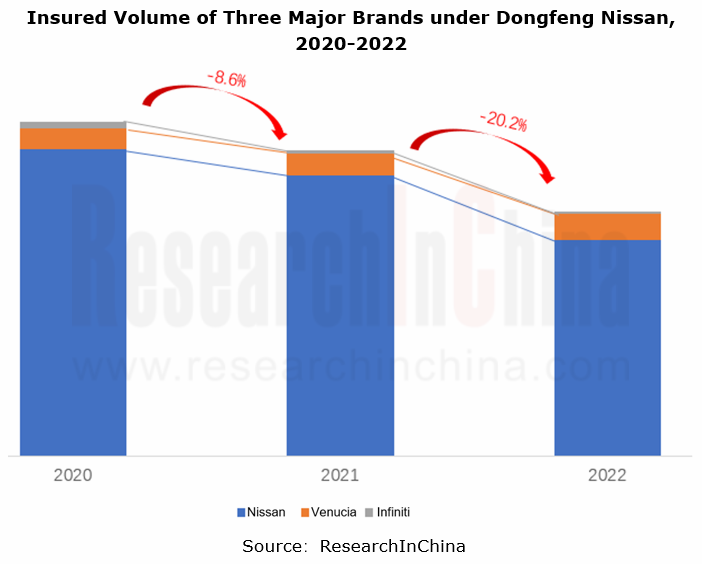
Dongfeng Nissan, a 50:50 joint venture between Nissan China and Dongfeng Motor Group, operates three brands: Nissan, Venucia and Infiniti. In recent three years, except for Venucia, both Nissan and Infiniti have suffered from declining sales.
1.Nissan’s intelligent connection functions are relatively conservative.
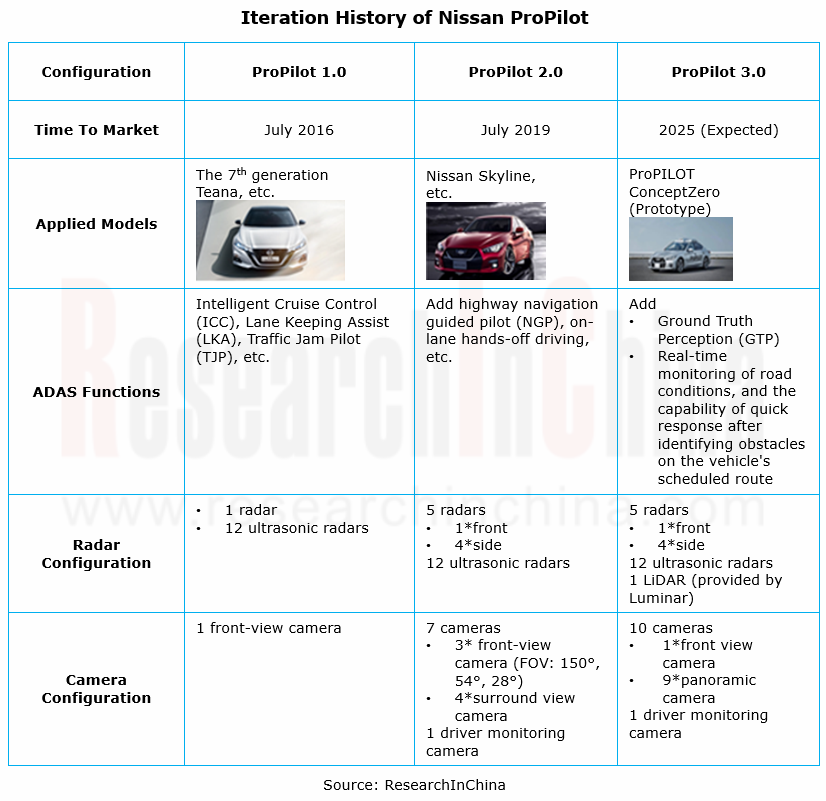
Nissan now implements a conservative strategy on ADAS and telematics functions, but keeps upgrading and iterating.
ProPilot 2.0, an ADAS system currently used by Nissan, was released as early as 2019 and was introduced to China in 2021. By the end of 2022, Dongfeng Nissan’s ADAS installation rate reached 32.1%, of which the installation of L2 ADAS was 9.3%, and L2.5 ADAS, 0.1%, much lower than the average of passenger cars in China.
Nissan's latest IVI system, Nissan Connect 2.0+, completed upgrade in September 2022. Based on the previous-generation system, it adds functions from 12.3-inch dual display, HUD, AR navigation, four-zone voice interaction and IVI theme mall, to voice control, online vehicle services, remote real-time monitoring, and online navigation.
The system was first installed in the ARIYA model. Its IVI chip is Renesas R-CAR H3, and the display combination is 12.3-inch dual display + 10.8-inch HUD. Its entertainment ecosystem covers Amap, Kugou Music, Ximalaya, iQIYI, LazyAudio, Nissan Intelligent Mobility Radio (integrating Kaola FM and Tingban), in-car KTV, and in-car audio books. Despite offering big improvements in intelligent connectivity, the automaker still lags far behind emerging carmakers like NIO, XPeng Motors and Li Auto.
2.Electrification will become Nissan's primary lever.
In September 2022, Nissan's first compact SUV BEV model ARIYA was launched on the Chinese market. ARIYA combines Nissan's 75-year all-electric techniques and more than 25-year experience in battery development and manufacture, enabling Nissan’s complete independent development chain of battery, motor and electric control unit (ECU). Adopting 9-layer protection architecture, the NISSAN ultra-safe battery on the car has undergone 111 items of industry high standard battery safety tests, and has enabled the car to travel a total of 21 billion kilometers without battery safety accidents. As concerns motor, Nissan creatively combines the merits of permanent magnet synchronous motor and AC asynchronous motor to complement their demerits, and develops an electrically excited synchronous motor with high performance and low energy consumption; the ECU uses 1/10000s ultra-high precision motors for torque control.
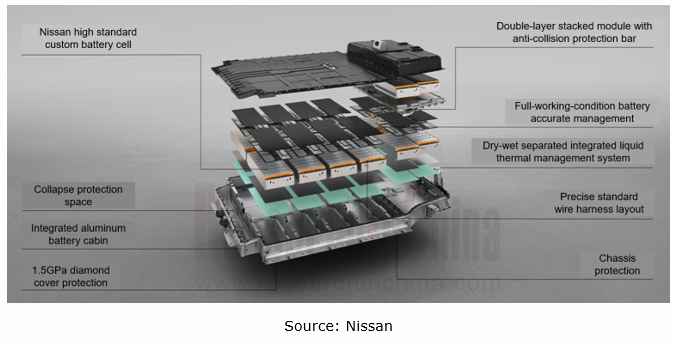
In terms of battery development, Nissan adheres to the parallel development route of lithium-ion batteries and all-solid-state batteries (ASSB). In February 2023, Nissan announced that it had successfully developed a new solid-state battery with halved cost. This ASSB has been successful in the laboratory and is expected to come into official production in 2025. A new ASSB-powered electric car will be manufactured in 2028. Meanwhile, Nissan also steps up its efforts to develop new lithium-ion battery technology, and plans to unveil a cobalt-free battery in 2028, favoring a slump in battery cost.
According to its plan, Nissan will introduce 9 battery electric models and Nissan e-POWER-enabled models (New Slyphy, New X-Trail, etc.) to the Chinese market by 2025; electric-driven models will account for more than 40% of the total model sales. In the future, electrification will become the primary weapon of Nissan to hold its ground in market.
3.Venucia is expected to open up a second front of new energy for Nissan.
From the sales of the three major brands under Dongfeng Nissan between 2020 and 2022, it can be seen that the Nissan brand still dominated but with a declining share in the sales, while the sales of Venucia ramped up, with its proportion rising from 6.3% (77,000 units) in 2020 to 7.0% (80,000 units) in 2021, and to 10.9% (98,000 units) in 2022. According to Nissan China’s latest sales data for February 2023, it sold 56,726 vehicles in the month, of which 6,003 units were Venucia (10.6% of the three brands), up 30.3% on a like-on-like basis, higher than the Nissan brand (23.5% MoM).
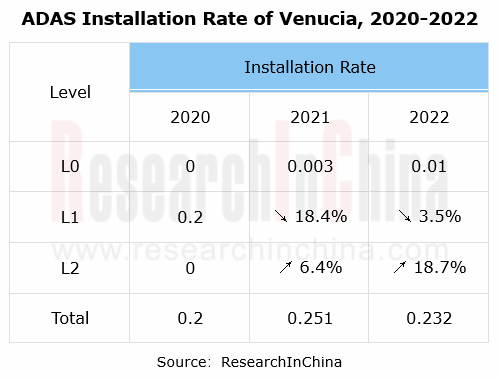
ADAS installation of Venucia in 2022:
?L1: the installations plunged by 76.4% on the previous year, and the installation rate slumped from 18.4% in 2021 to 3.5% in 2022.
?L2: the installations soared by 258.6% year on year in 2022, and the installation rate also showed a rapid upward trend, up to 18.7% in 2022.
From Venucia’s installation rates of L1 and L2, it can be seen that the surging installation of L2 ADAS undoubtedly reflects the rising level of intelligence.
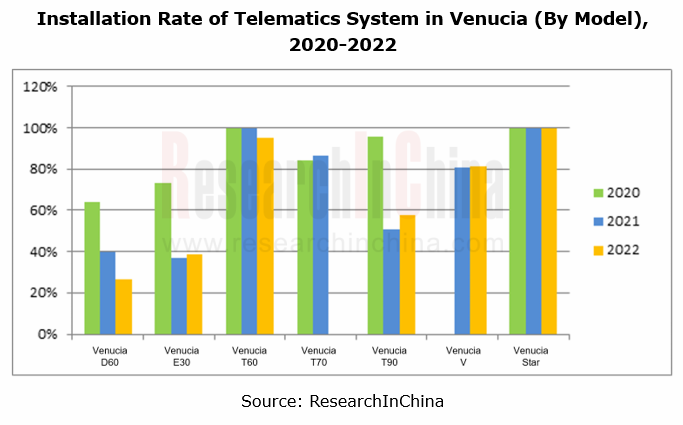
In terms of connectivity, in 2022, Venucia installed telematics systems in 52,758 of its vehicles, with installation rate up to 53.7%. By model, in 2022, the installation rate of telematics system in Venucia Star hit 100%, and both Venucia V and Venucia T60 boasted an installation rate of over 80%.
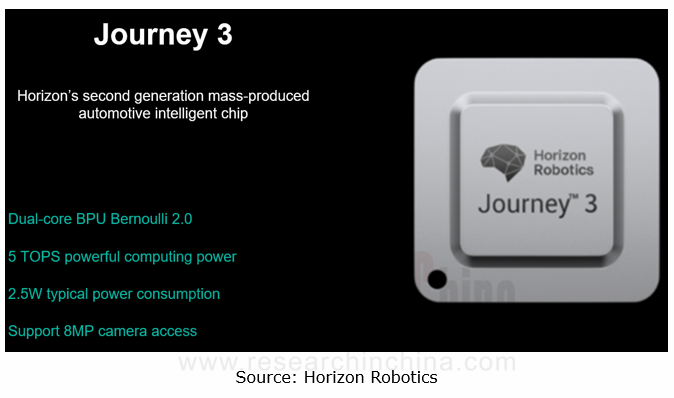
On December 30, 2022, Horizon Robotics and Venucia built cooperation on a new intelligent driving project. Venucia's new intelligent driving platform will bear Horizon Journey 3 chip and Horizon Matrix ? Mono 3 (8MP) visual perception solution to enable advanced driving assistance functions.
The intelligent driving platform will be first applied to several new energy models under Venucia, and the first model will be available in 2023. According to its plan, Venucia will launch at least two new energy models every year in the future. Moreover, Venucia also has the systematic ability to sell 300,000 units annually, and will gradually challenge the sales goal of 500,000 units per year. As for technology, Venucia sticks to developing multiple technology routes simultaneously, having built the Venucia V-π native all-electric platform and Venucia DD-i super hybrid technology. In Dongfeng Nissan's long-term plan and layout, Venucia will make continuous efforts on intelligence and electrification, and will become Dongfeng Nissan's second front of new energy.
AI-Defined Vehicle (AIDV) OEMs' Deployment Strategies Research Report, 2026
AIDV Research: Deployment Strategies of 22 OEMs
The AI-Defined Vehicle (AIDV) OEMs' Deployment Strategies Research Report, 2026, released by ResearchInChina, analyzes the AI deployment strategies of ...
OEMs’ Passenger Car Model Planning Research Report, 2026
Vehicle Model Planning Research: Chinese OEMs Launch Sub-Brands Intensively, While Multinational OEMs Apply the Brakes to Electrification Strategies
ResearchInChina released the OEMs’ Passenger Car M...
Autonomous Driving Simulation and World Model Research Report, 2026
Autonomous driving simulation research: "Simulation test + world model"-driven test system has become R&D infrastructure.
The "Autonomous Driving Simulation and World Model Research Report, 2026"...
Cockpit-Driving Integration Central Domain Controller SoC and AI Supercomputing Architecture Research Report, 2026
Cockpit-Driving integration and AI supercomputing research: The One Chip solution is rapidly installed in vehicles, and AI supercomputing architectures are moving towards full-domain integration.
AI ...
Intelligent Driving End-to-End Large Model Research Report, 2026
Research on Intelligent Driving Large Models: A Critical Period for Technological Competition and Paradigm Integration
As autonomous driving technology rapidly iterates from L2 to L3?L4, intelligent...
Automotive Digital Key Industry Trend Report, 2026
Digital Key Research: Automotive BLE, UWB and SLE Hardware Layout
The Automotive Digital Key Industry Trend Report, 2026, released by ResearchInChina, analyzes and predicts the digital key market, co...
Monthly Report on Automotive New Technology (May 2026)
UHD gaze technology, full-color LiDAR, UWB, etc. promote the upgrade of intelligent driving perception capabilities
This report is published once a month and is available for annual subscription.The...
In-Cabin Monitoring Systems (DMS, OMS, etc.) Research Report, 2026
In-Cabin Monitoring System Research: DMS to Become Mandatory in 2027, Expected to be Installed in Over 14 Million Vehicles
ResearchInChina released the In-Cabin Monitoring Systems (DMS, OMS, etc.) Re...
Automotive Service-Oriented Architecture (SOA) and Cross-Domain Middleware Industry Report, 2026
Research on automotive SOA and cross-domain middleware: The era of AI atomic services and AI cross-domain fusion agents is coming.
Automotive SOA evolves towards AI + full SOA servitization Driv...
Automotive Display, Center Console and Cluster Industry Report, 2026
Automotive Display Research: Multi-Screen Application Slows Down, While OLED and MiniLED Are Introduced in Vehicles Quickly
In 2026, automotive displays will no longer excessively pursue the number a...
Global and China Intelligent Vehicle Standard System Construction and Certification Research Report, 2026
Intelligent Driving Standards and Certification: With the Maturing Standardization System, China Will Participate in Formulation of Global Standards
China's automotive industry is transforming from ...
Automotive Intelligent Diagnosis Industry Report, 2026
Automotive Intelligent Diagnosis Research: Powered by AI, Remote Diagnosis Is Being Upgraded towards Intelligence.
ResearchInChina released the Automotive Intelligent Diagnosis Industry Report, 2026....
Automotive Cloud Service Platform Research Report, 2026
Research on automotive cloud service platform: with architecture upgrade and computing power improvement, cloud services enter a new stage
In 2026, the Internet of Vehicles industry generates petaby...
Integrated Battery and Innovative Battery Technology Research Report, 2026
Power Battery Research: Sales of High-Capacity Vehicles Keep Rising, and Solid-State Batteries Begin to Be Installed in Vehicles
I. Sales of High-Capacity Vehicles Sustain Growth, and Those with A C...
Chinese Independent OEMs’ ADAS and Autonomous Driving Report, 2026
Research on OEMs' Intelligent Driving: Era of Physical AI, Standard Configuration of D2D, and Initial Exploration of L3 Commercial Pilot Projects
From 2023 to 2025, the intelligent driving installati...
Intelligent Vehicle New Technology Application Analysis Report, 2025-2026
New Technology Research: Innovative Products such as Bionic Cameras, Vision-LiDAR Fusion Sensors, Auditory Sensors Further Enhance Vehicle Perception Capabilities
ForewordResearchInChina released th...
Automotive Optical Fiber Communication (Optical Fiber Ethernet, PON) and Supply Chain Research Report, 2026
Research on Automotive Optical Fiber Communication: Introduction of Optical Fiber in Vehicles Accelerates, with Priority Deployment in High-Speed Communication Link (10+Gbps) Scenarios
Automotive opt...
Automotive Intelligent Cockpit SoC Research Report, 2026
Automotive Cockpit SoC Research: Passenger Cars in the Price Range of RMB100,000–200,000 Account for Nearly 50% of Total Sales, and New-Generation Cockpit SoC Products Largely Enter Mass Production
P...