Automotive Wireless Charging Research: high-power charging solutions will lead the trend, with the installations to hit more than 10 million units in 2026.
Technology Trend: Qi2 Standard
The automotive mobile phone wireless charging module is an integrated device that uses wireless charging technology to charge a mobile phone in the vehicle. The mainstream wireless charging technologies include electromagnetic induction, electromagnetic resonance and electric field coupling. At present, mainstream mobile phone wireless charging solutions use electromagnetic induction technology to charge a mobile phone as per the Qi Standard created by the Wireless Power Consortium (WPC). Since 2017, electromagnetic resonance-based mobile phone wireless charging solutions have appeared on the market, but their application scope is far narrower than electromagnetic induction-based ones.
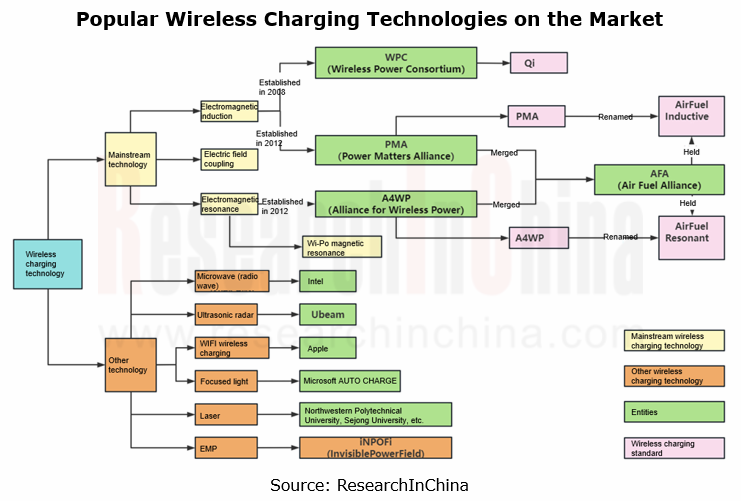
The automotive mobile phone wireless charging modules has been a standard configuration for most mid-to-high-end models. It is often installed near the center console in line with the Qi Standard, with the general charging power range of 5W-15W. To improve the charging efficiency, some models cooperate with mobile phone vendors (Xiaomi, Huawei, OPPO, Apple, etc.) and adopt private protocols with the charging power ranging at 40W-50W. In the future, more models will be equipped with high-power wireless charging modules, and wireless charging solutions for continuous and stable charging during driving.
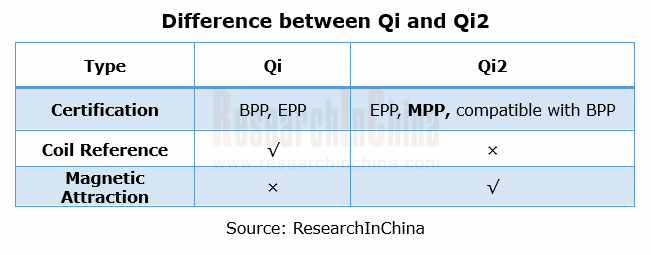
Following the launch of the logo of the Qi2 in January 2023, the WPC released the Qi2 Standard in April, with corresponding adjustments to the certification for mainstream automotive mobile phone wireless charging modules. The WPC developed Magnetic Power Profile (MPP), a magnetic attraction feature added to wireless charging modules.
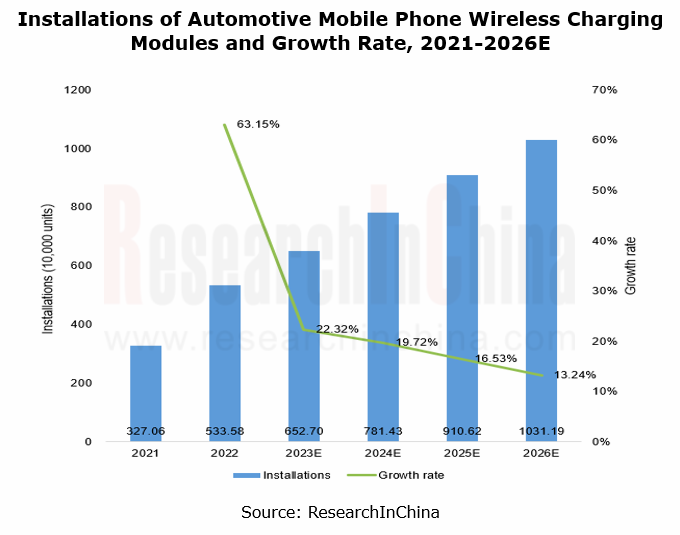
Market Size: the installations of automotive wireless charging modules are expected to hit more than 10 million units in 2026.
From 2021 to 2026, the installations of automotive mobile phone wireless charging modules will sustain steady growth, expected to exceed 10 million units in 2026.
Competitive landscape: there is still scope for localization.
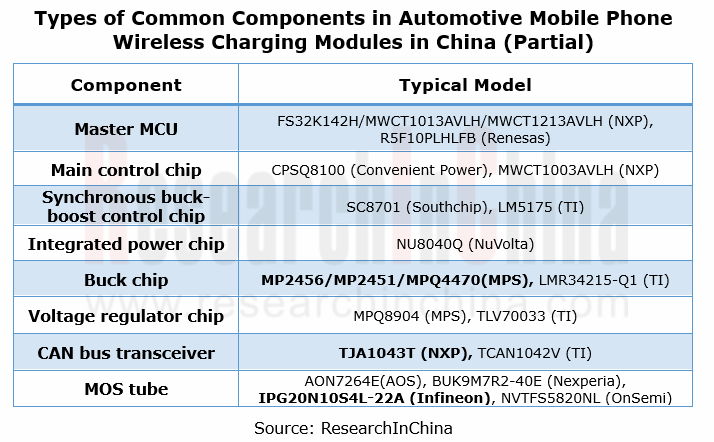
The main vendors in the automotive wireless charging industry chain are as follows:
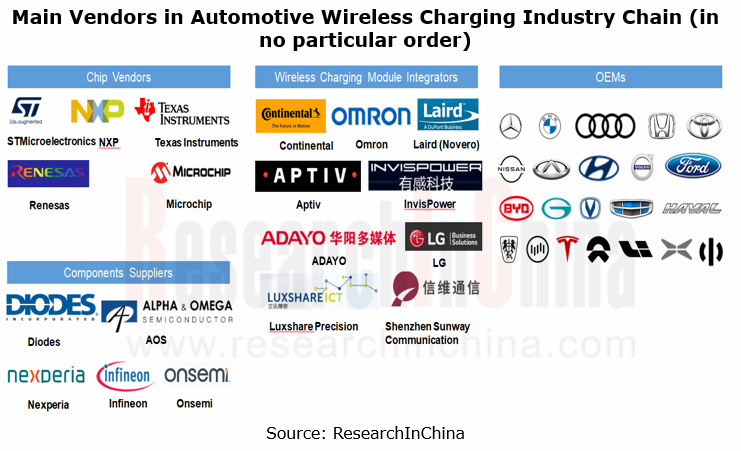
Foreign vendors like NXP and Renesas Electronics can design automotive mobile phone wireless charging solutions and provide chip products. Chinese vendors such as InvisPower, ADAYO and Sunway Communication can manufacture modules and provide automotive wireless charging solutions leveraging the key components from foreign vendors, such as NXP’s main control chip, TI’s voltage regulator chip, and AOS’ MOS tube. The widely used wireless charging chip solutions in China are those from ConvenientPower and Southchip.
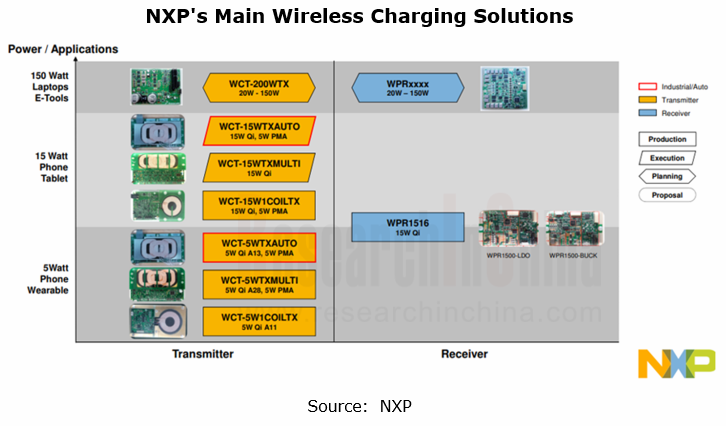
NXP
Among NXP's main wireless charging solutions, WCT-15WTXAUTO and WCT-5WTXAUTO are the most widely used, with respective power of 15W and 5W. The platforms are specially designed for AUTOSAR-compliant automotive wireless charging application. They use automotive-grade components, and AUTOSAR software and drivers, and conform to the latest Qi Standard.
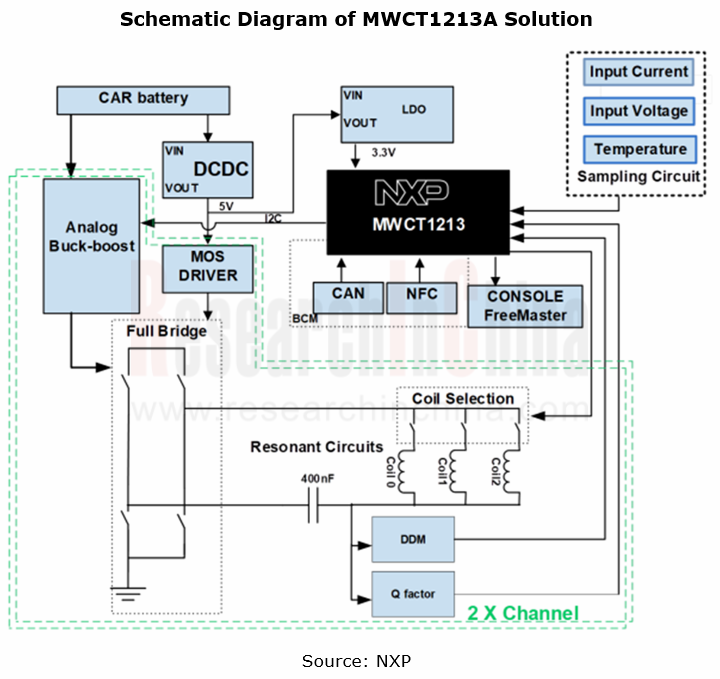
Among multiple MCUs, the MWCT1x1xA family is the most popular, for example, in the MWCT1213A solution, the system supports dual-channel transmitter control and manages overall system state, with the power of 15W.
Strategy of automakers: pursue high-power solutions and independently develop heat dissipation technology
At present, the Qi Standard-certified electromagnetic induction charging solutions are the mainstream automotive mobile phone wireless charging solutions. In terms of structure, SOC solutions with built-in full-bridge MCUs and built-in power tubes have a serious problem of heating.
The mainstream automotive mobile phone wireless charging solutions have the following three shortcomings: 1. Severe heating problem; 2. Slow charging and low module transmitting power; 3. Vulnerable to interference, e.g., metal and NFC key.
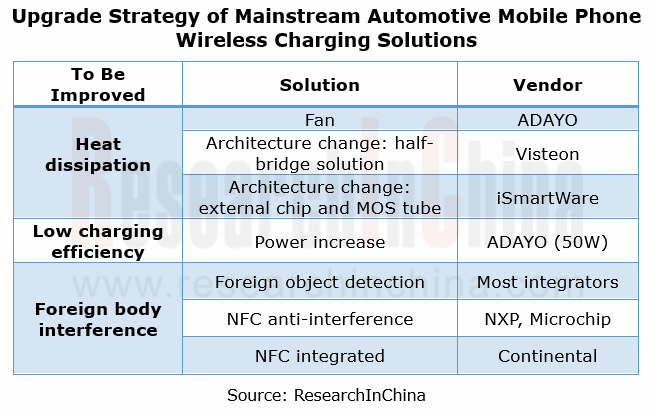
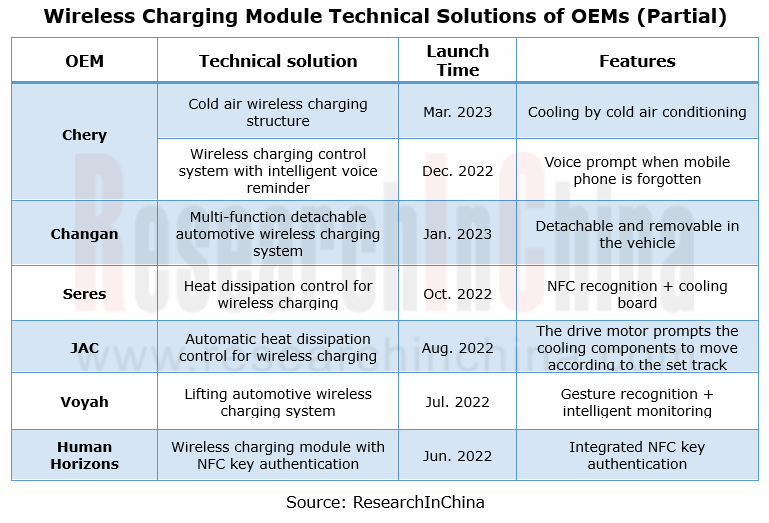
To solve the above problems, OEMs have begun to independently develop corresponding technical solutions. They have developed such technologies as air cooling, intelligent voice prompt, NFC integration, and detachable wireless charging modules.
The wireless charging board of Li L series models (L7-L9) lies in the center console, and is supplied by Luxshare Precision. It features slow charging, adopts the Qi Standard and supports both Android and Apple phones. The charging power of Android phones is 50W. In 2022, Li L series introduced the MFM-certified MagSafe wireless charging board, raising the charging power of Apple phones to 15W.
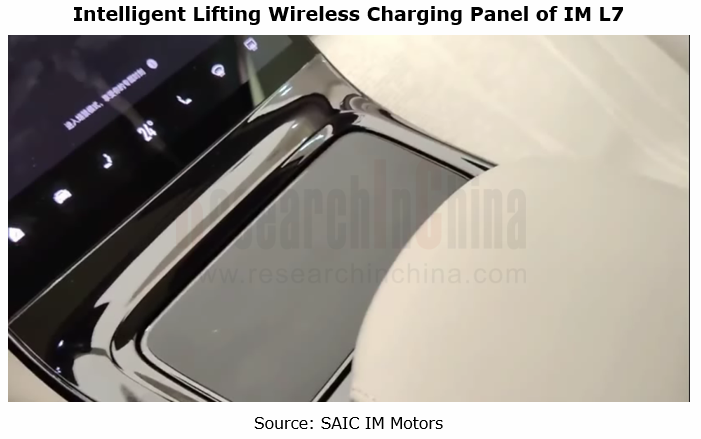
In the IM L7, the intelligent lifting wireless charging panel uses the gravity sensing function to detect the mobile phone completely placed on the module, then automatically tilts and sinks before the system starts charging; when a non-metallic device is placed on it, the panel will remain still.
AI-Defined Vehicle (AIDV) OEMs' Deployment Strategies Research Report, 2026
AIDV Research: Deployment Strategies of 22 OEMs
The AI-Defined Vehicle (AIDV) OEMs' Deployment Strategies Research Report, 2026, released by ResearchInChina, analyzes the AI deployment strategies of ...
OEMs’ Passenger Car Model Planning Research Report, 2026
Vehicle Model Planning Research: Chinese OEMs Launch Sub-Brands Intensively, While Multinational OEMs Apply the Brakes to Electrification Strategies
ResearchInChina released the OEMs’ Passenger Car M...
Autonomous Driving Simulation and World Model Research Report, 2026
Autonomous driving simulation research: "Simulation test + world model"-driven test system has become R&D infrastructure.
The "Autonomous Driving Simulation and World Model Research Report, 2026"...
Cockpit-Driving Integration Central Domain Controller SoC and AI Supercomputing Architecture Research Report, 2026
Cockpit-Driving integration and AI supercomputing research: The One Chip solution is rapidly installed in vehicles, and AI supercomputing architectures are moving towards full-domain integration.
AI ...
Intelligent Driving End-to-End Large Model Research Report, 2026
Research on Intelligent Driving Large Models: A Critical Period for Technological Competition and Paradigm Integration
As autonomous driving technology rapidly iterates from L2 to L3?L4, intelligent...
Automotive Digital Key Industry Trend Report, 2026
Digital Key Research: Automotive BLE, UWB and SLE Hardware Layout
The Automotive Digital Key Industry Trend Report, 2026, released by ResearchInChina, analyzes and predicts the digital key market, co...
Monthly Report on Automotive New Technology (May 2026)
UHD gaze technology, full-color LiDAR, UWB, etc. promote the upgrade of intelligent driving perception capabilities
This report is published once a month and is available for annual subscription.The...
In-Cabin Monitoring Systems (DMS, OMS, etc.) Research Report, 2026
In-Cabin Monitoring System Research: DMS to Become Mandatory in 2027, Expected to be Installed in Over 14 Million Vehicles
ResearchInChina released the In-Cabin Monitoring Systems (DMS, OMS, etc.) Re...
Automotive Service-Oriented Architecture (SOA) and Cross-Domain Middleware Industry Report, 2026
Research on automotive SOA and cross-domain middleware: The era of AI atomic services and AI cross-domain fusion agents is coming.
Automotive SOA evolves towards AI + full SOA servitization Driv...
Automotive Display, Center Console and Cluster Industry Report, 2026
Automotive Display Research: Multi-Screen Application Slows Down, While OLED and MiniLED Are Introduced in Vehicles Quickly
In 2026, automotive displays will no longer excessively pursue the number a...
Global and China Intelligent Vehicle Standard System Construction and Certification Research Report, 2026
Intelligent Driving Standards and Certification: With the Maturing Standardization System, China Will Participate in Formulation of Global Standards
China's automotive industry is transforming from ...
Automotive Intelligent Diagnosis Industry Report, 2026
Automotive Intelligent Diagnosis Research: Powered by AI, Remote Diagnosis Is Being Upgraded towards Intelligence.
ResearchInChina released the Automotive Intelligent Diagnosis Industry Report, 2026....
Automotive Cloud Service Platform Research Report, 2026
Research on automotive cloud service platform: with architecture upgrade and computing power improvement, cloud services enter a new stage
In 2026, the Internet of Vehicles industry generates petaby...
Integrated Battery and Innovative Battery Technology Research Report, 2026
Power Battery Research: Sales of High-Capacity Vehicles Keep Rising, and Solid-State Batteries Begin to Be Installed in Vehicles
I. Sales of High-Capacity Vehicles Sustain Growth, and Those with A C...
Chinese Independent OEMs’ ADAS and Autonomous Driving Report, 2026
Research on OEMs' Intelligent Driving: Era of Physical AI, Standard Configuration of D2D, and Initial Exploration of L3 Commercial Pilot Projects
From 2023 to 2025, the intelligent driving installati...
Intelligent Vehicle New Technology Application Analysis Report, 2025-2026
New Technology Research: Innovative Products such as Bionic Cameras, Vision-LiDAR Fusion Sensors, Auditory Sensors Further Enhance Vehicle Perception Capabilities
ForewordResearchInChina released th...
Automotive Optical Fiber Communication (Optical Fiber Ethernet, PON) and Supply Chain Research Report, 2026
Research on Automotive Optical Fiber Communication: Introduction of Optical Fiber in Vehicles Accelerates, with Priority Deployment in High-Speed Communication Link (10+Gbps) Scenarios
Automotive opt...
Automotive Intelligent Cockpit SoC Research Report, 2026
Automotive Cockpit SoC Research: Passenger Cars in the Price Range of RMB100,000–200,000 Account for Nearly 50% of Total Sales, and New-Generation Cockpit SoC Products Largely Enter Mass Production
P...