Research on Automotive Cloud Services: As Dedicated Automotive Cloud Platforms Are Launched, the Market Enters A Phase of Differentiated Competition
1. The exponentially increasing amount of vehicle data makes cloud migration an inevitable choice.
From the perspective of companies, the goals of digital transformation are to digitize all elements of the whole process throughout the full life cycle of vehicles, including R&D, production, sale, operation, and after-sales service; upload the data in the local servers and computer rooms of automakers to the cloud; connect the data channels of each link to gradually realize the integrated management of data in the whole industry chain, and the cloud-pipe-terminal integrated real-time interconnection; and build service operation models that span the full life cycle of users to enhance the connections between upstream and downstream partners in the industry and create greater value.
In terms of products, vehicle intelligence and connectivity are booming. For example, starting from L2, every time the autonomous driving functions evolve to a higher level, the consumption of cloud infrastructure platforms, applications, and services will rise by an order of magnitude. As high-level autonomous driving comes into mass production, the number of vehicle sensors and the amount of data multiply, making it difficult for local processing to meet the requirements. Cloud migration thus will be the best choice.
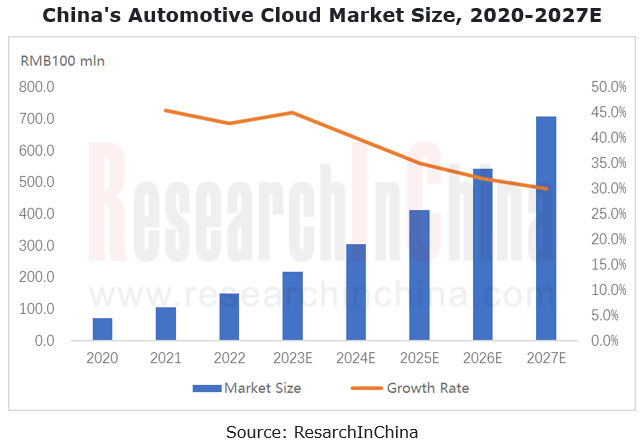
Automakers spend tens of millions of yuan every year building cloud services, which gives a big boost to the market. In 2022, China's automotive cloud service market was valued at over RMB15 billion, and it is expected to sustain the growth rate of 30-40% in the next five years.
2. As dedicated automotive cloud platforms are launched, differentiated competition becomes crucial.
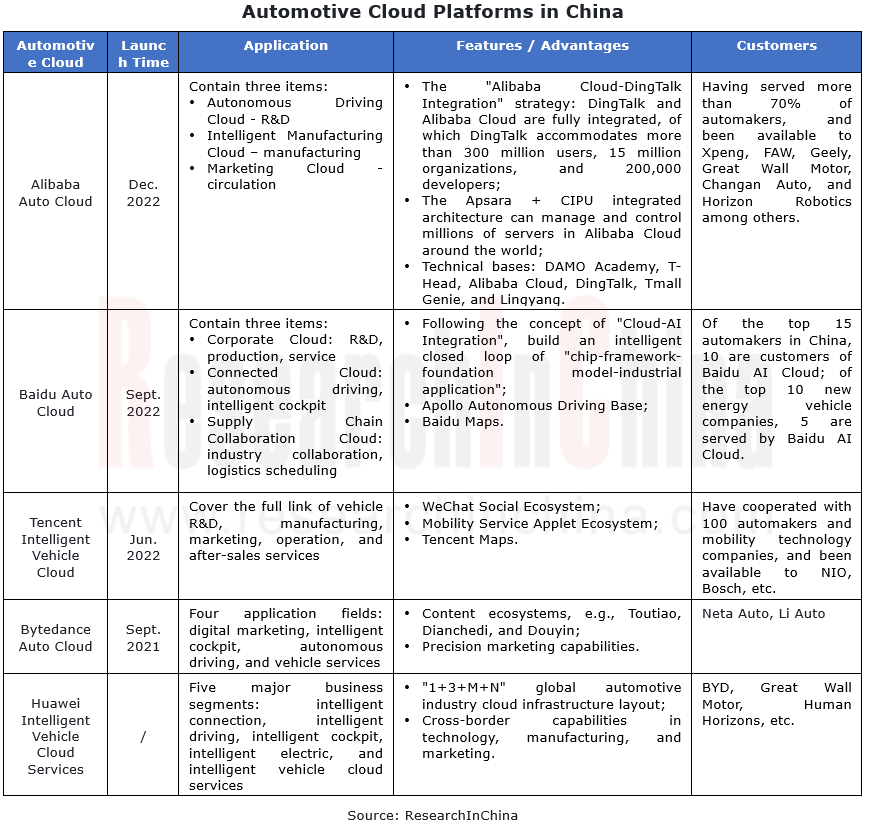
In 2021, ByteDance announced the "ByteDance Auto Cloud", which will provide cloud services in four segments: Digital Marketing, Intelligent Cockpit, Autonomous Driving, and Vehicle Services. In 2022, Tencent Intelligent Cloud Cloud, Baidu Auto Cloud, and Alibaba Auto Cloud became available. All the five giants (BATHD), i.e., Baidu, Alibaba, Tencent, Huawei and Douyin have stepped in the market, and the competition in automotive cloud services built on exclusive automotive cloud has become fiercer.
The service scope of each automotive cloud is much of a muchness, generally covering R&D, manufacture, marketing, and supply chain. The support for R&D is concentrated in the fields of autonomous driving, intelligent cockpit, telematics, and “three electrics” (battery, motor and ECU). How to gain differentiated competitive edges in the competition therefore has become the key to success for companies.
3. The differentiated competitive edges in cloud services are mainly built from two aspects: basic resource layer services and upper-layer R&D tool chains.
In terms of basic resource layer, supercomputing centers are an important indicator for assessing service capabilities, and Alibaba and Baidu are the first to deploy.
In August 2022, Alibaba Cloud launched the two intelligent supercomputing centers located in Zhangbei County and Ulanqab, with total compute of 15 EFLOPS (15 exascale floating-point operations per second). At the same time, Alibaba Cloud also introduced the "Apsara Intelligent Computing Platform", an intelligent computing solution which opens up intelligent computing capabilities by way of "platform + intelligent computing center".
Following the five intelligent computing centers in Yangquan, Jinan, Fuzhou, Yancheng, and Tianjin, Baidu Cloud started construction of the Baidu AI Cloud-Shenyang Intelligent Computing Center in May 2023, a project with a land area of about 2.4 hectares, floor areas of 42,000 square meters, and the total planned computing power of 500P, 200P for Phase I. In the future, Baidu Shenyang Intelligent Computing Center will not only involve physical data center construction capabilities and intelligent computing infrastructure capabilities, but also comprehensive solutions for AI software and hardware ecosystem capabilities such as foundation models, supporting the computing tasks of companies in different business scenarios and meeting the industrial application requirements of foundation models in the era of intelligent computing.
With regard to R&D tool chains, cloud service providers are committed to creating "fully furnished" service experiences for users by offering "full-process" and "fully closed-loop" services.
 In Tencent's autonomous driving cloud platform, virtual simulation has become a key link.
Huawei's autonomous driving cloud platform "Octopus" has built in a dataset with 20 million frame annotations, a library with 200,000 simulation scenes, a complete tool chain, and annotation algorithms, covering the full life cycle businesses such as autonomous driving data, models, training, simulation, and annotation, and helping automakers to build autonomous driving development capabilities on a "zero" basis.
Baidu makes a full-stack layout and enables a data closed loop by virtue of from chip (Kunlunxin), deep learning (PaddlePaddle) and training foundation model (ERNIE) to search (Baidu Search), cloud platform (Baidu AI Cloud), autonomous driving (Apollo) and intelligent connection (Xiaodu).
4. Under the multi-cloud strategy, the need of OEMs has changed from the pursuit of resources to efficiency.
With the in-depth migration to the cloud, the resource needs of OEMs for cloud migration have been overall met, and thus the underlying logic of the cloud strategy of companies has changed from the pursuit of resources to efficiency to finally improve their overall digitization capabilities in production and operation. In this process, OEMs are no longer tightly bound with some cloud platform, but implement a multi-cloud strategy where different business types are put on different cloud platforms.
Examples include:
Based on the "1+6+N" Geely Hybrid Cloud Platform co-built with Baidu, Geely works with Alibaba to build the Xingrui Intelligent Computing Center, and teams up with Tencent on telematics and security solutions.
FAW Group uses Huawei Cloud Stack to build hybrid cloud architecture, and also cooperates with Alibaba Cloud on intelligent manufacturing, digital marketing and other businesses.
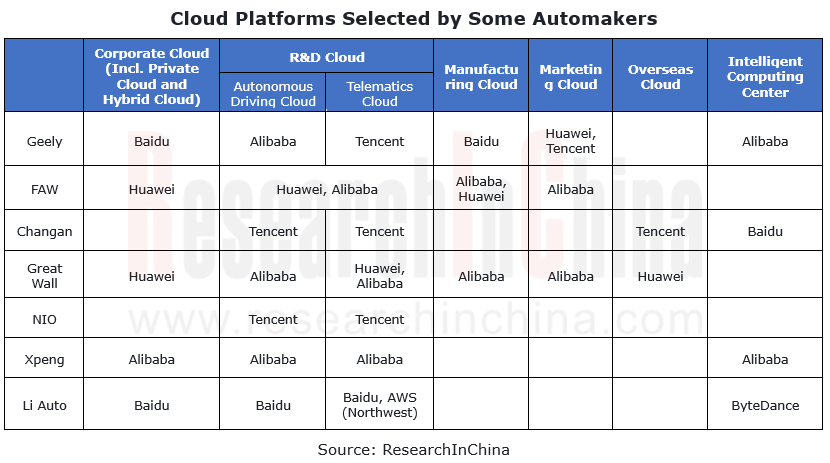
Without a doubt, the multi-cloud strategy offers benefits. It can integrate the advantages of various cloud platforms, enable refined business deployment, and reduce costs for companies, and also helps automakers to gain the core initiative in building cloud platforms and avoid being puzzled by the “soul” dispute. Yet the challenges of the multi-cloud strategy are also unavoidable. How to allocate storage/computing power among multiple clouds, cross-cloud data synchronization’s dependency on bandwidth, and whether costs and network delays will have an impact are all urgent problems to be solved. Hence how to formulate a multi-cloud strategy is a problem for OEMs.
AI-Defined Vehicle (AIDV) OEMs' Deployment Strategies Research Report, 2026
AIDV Research: Deployment Strategies of 22 OEMs
The AI-Defined Vehicle (AIDV) OEMs' Deployment Strategies Research Report, 2026, released by ResearchInChina, analyzes the AI deployment strategies of ...
OEMs’ Passenger Car Model Planning Research Report, 2026
Vehicle Model Planning Research: Chinese OEMs Launch Sub-Brands Intensively, While Multinational OEMs Apply the Brakes to Electrification Strategies
ResearchInChina released the OEMs’ Passenger Car M...
Autonomous Driving Simulation and World Model Research Report, 2026
Autonomous driving simulation research: "Simulation test + world model"-driven test system has become R&D infrastructure.
The "Autonomous Driving Simulation and World Model Research Report, 2026"...
Cockpit-Driving Integration Central Domain Controller SoC and AI Supercomputing Architecture Research Report, 2026
Cockpit-Driving integration and AI supercomputing research: The One Chip solution is rapidly installed in vehicles, and AI supercomputing architectures are moving towards full-domain integration.
AI ...
Intelligent Driving End-to-End Large Model Research Report, 2026
Research on Intelligent Driving Large Models: A Critical Period for Technological Competition and Paradigm Integration
As autonomous driving technology rapidly iterates from L2 to L3?L4, intelligent...
Automotive Digital Key Industry Trend Report, 2026
Digital Key Research: Automotive BLE, UWB and SLE Hardware Layout
The Automotive Digital Key Industry Trend Report, 2026, released by ResearchInChina, analyzes and predicts the digital key market, co...
Monthly Report on Automotive New Technology (May 2026)
UHD gaze technology, full-color LiDAR, UWB, etc. promote the upgrade of intelligent driving perception capabilities
This report is published once a month and is available for annual subscription.The...
In-Cabin Monitoring Systems (DMS, OMS, etc.) Research Report, 2026
In-Cabin Monitoring System Research: DMS to Become Mandatory in 2027, Expected to be Installed in Over 14 Million Vehicles
ResearchInChina released the In-Cabin Monitoring Systems (DMS, OMS, etc.) Re...
Automotive Service-Oriented Architecture (SOA) and Cross-Domain Middleware Industry Report, 2026
Research on automotive SOA and cross-domain middleware: The era of AI atomic services and AI cross-domain fusion agents is coming.
Automotive SOA evolves towards AI + full SOA servitization Driv...
Automotive Display, Center Console and Cluster Industry Report, 2026
Automotive Display Research: Multi-Screen Application Slows Down, While OLED and MiniLED Are Introduced in Vehicles Quickly
In 2026, automotive displays will no longer excessively pursue the number a...
Global and China Intelligent Vehicle Standard System Construction and Certification Research Report, 2026
Intelligent Driving Standards and Certification: With the Maturing Standardization System, China Will Participate in Formulation of Global Standards
China's automotive industry is transforming from ...
Automotive Intelligent Diagnosis Industry Report, 2026
Automotive Intelligent Diagnosis Research: Powered by AI, Remote Diagnosis Is Being Upgraded towards Intelligence.
ResearchInChina released the Automotive Intelligent Diagnosis Industry Report, 2026....
Automotive Cloud Service Platform Research Report, 2026
Research on automotive cloud service platform: with architecture upgrade and computing power improvement, cloud services enter a new stage
In 2026, the Internet of Vehicles industry generates petaby...
Integrated Battery and Innovative Battery Technology Research Report, 2026
Power Battery Research: Sales of High-Capacity Vehicles Keep Rising, and Solid-State Batteries Begin to Be Installed in Vehicles
I. Sales of High-Capacity Vehicles Sustain Growth, and Those with A C...
Chinese Independent OEMs’ ADAS and Autonomous Driving Report, 2026
Research on OEMs' Intelligent Driving: Era of Physical AI, Standard Configuration of D2D, and Initial Exploration of L3 Commercial Pilot Projects
From 2023 to 2025, the intelligent driving installati...
Intelligent Vehicle New Technology Application Analysis Report, 2025-2026
New Technology Research: Innovative Products such as Bionic Cameras, Vision-LiDAR Fusion Sensors, Auditory Sensors Further Enhance Vehicle Perception Capabilities
ForewordResearchInChina released th...
Automotive Optical Fiber Communication (Optical Fiber Ethernet, PON) and Supply Chain Research Report, 2026
Research on Automotive Optical Fiber Communication: Introduction of Optical Fiber in Vehicles Accelerates, with Priority Deployment in High-Speed Communication Link (10+Gbps) Scenarios
Automotive opt...
Automotive Intelligent Cockpit SoC Research Report, 2026
Automotive Cockpit SoC Research: Passenger Cars in the Price Range of RMB100,000–200,000 Account for Nearly 50% of Total Sales, and New-Generation Cockpit SoC Products Largely Enter Mass Production
P...