|
 |
Automotive Infrared Night Vision System Research Report, 2023
|
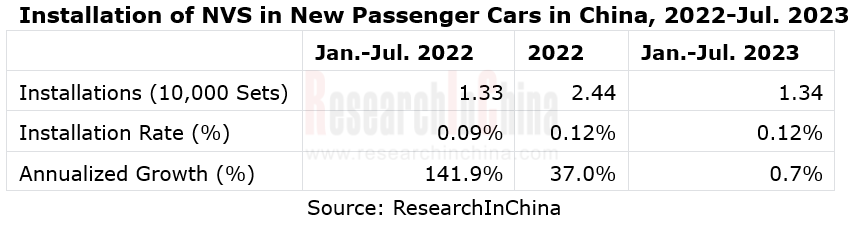
According to the data from ResearchInChina, during 2022-2023, the installations of NVS (night vision system) in new passenger cars in China went up at first and then down. From January to July 2022, the installations of NVS in new passenger cars in China was 13,300 sets, a like-on-like spurt of 141.9%; the full-year installations in 2022 reached up to 24,400 sets, jumping by 37.0% year on year; in the first seven months of 2023, the installations stood at 13,400 sets, up by 0.7% from the prior-year period, and the installation rate was 0.12%, on a par with 2022.
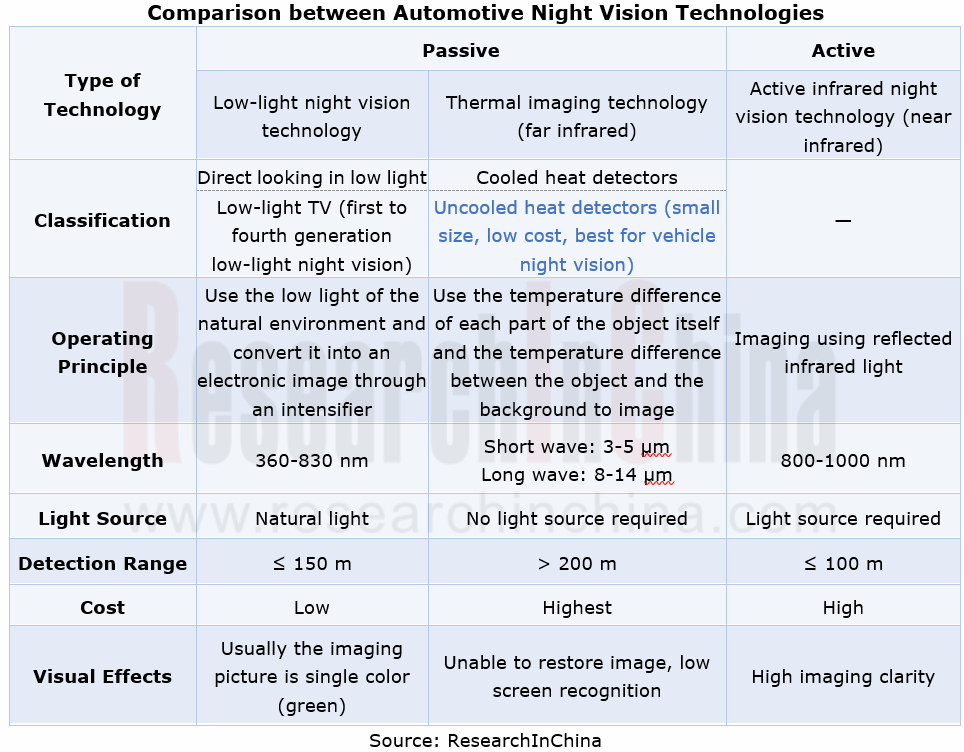
Automotive infrared night vision systems can be divided into active and passive types. Active infrared night vision is also called near-infrared night vision; passive infrared night vision falls into far-infrared night vision and low-light-level night vision.
Near-infrared night vision uses a powerful infrared emitter to illuminate the object during operation and images the object with the infrared rays reflected back from the object;
Low-light-level night vision amplifies a small amount of visible light received, and finally collects the image and projects it onto the corresponding display;
Far-infrared night vision mainly uses the infrared radiation emitted by the object itself for imaging. It is also called thermal imaging system, enabled by a thermal imager.
Infrared detector, an important upstream product in the industry chain, heads in the direction of small pixel size and low cost.
An infrared thermal imager is a product used to detect the infrared radiation from an object, and convert the temperature profile of the object into a video image after photoelectric conversion, electric signal processing and digital image processing.
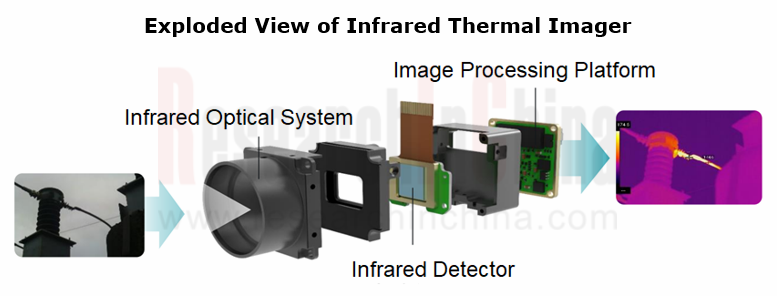
The core components of a thermal imager include lens, detector, following circuit and image processing software. Wherein, the infrared detector, also known as infrared focal plane detector, is an important part of a far-infrared night vision system, and is heading in the direction of small pixel size and low cost.
The pixel size of uncooled infrared chips in the industry has been reduced from the initial 35μm to the current mainstream 12μm, and even 10μm and 8μm products have been unveiled or developed. The pixel size tends to be smaller;
The advantage of small pixel size is that the smaller pixel size allows for chip size reduction, lowers chip cost, and further meets the requirements for miniaturization and integration of thermal imaging modules.
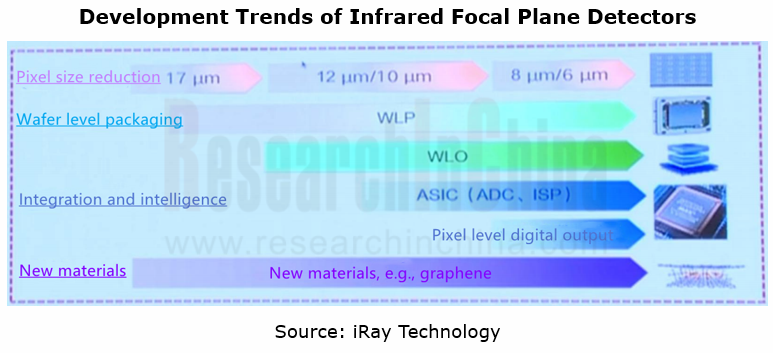
In terms of infrared technology, Raytron Technology, iRay Technology’s parent company, has expanded its 8μm product family, and has completed development of the prototype samples of the 1280×1024 new products; it has laid out the 10μm product family, and has trail-produced the 640×512 new products in small volume; in April 2023, it displayed IR-Pilot 1920X, its first automotive infrared thermal imager that packs an 8μm 1920×1080 infrared thermal imaging detector chip; in September 2023, it introduced an 8μm VGA (640×512) infrared thermal imaging detector chip. With these efforts, it promotes the development of global small-pixel infrared thermal imaging optics and image algorithms, facilitates the wide adoption of ultra-small pixel infrared focal plane detector chips in many new fields, and further cuts down the cost of automotive night vision systems.
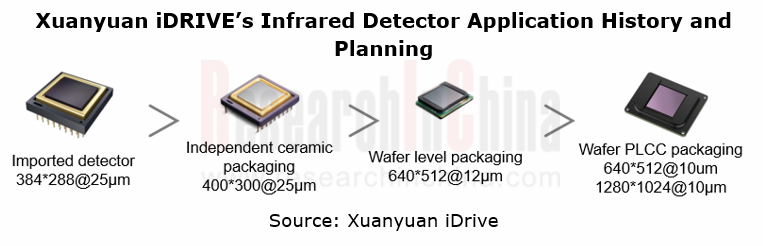
Xuanyuan iDRIVE’s infrared detector application history and planning: used imported 25μm detectors in 2015; used the self-developed 25μm detector in ceramic packaging in 2018, with little improvement in resolution; used 12μm detectors in wafer-level packaging in 2021, with the resolution increased to 640×512; plan to use 10μm wafer PLCC packaging in 2024, with two resolutions: VGA and SXGA. It shows that the size of detectors is getting smaller, the process is getting more mature, the resolution is getting higher and the cost is getting lower.
OEMs begin to integrate ADAS with infrared night vision technology.
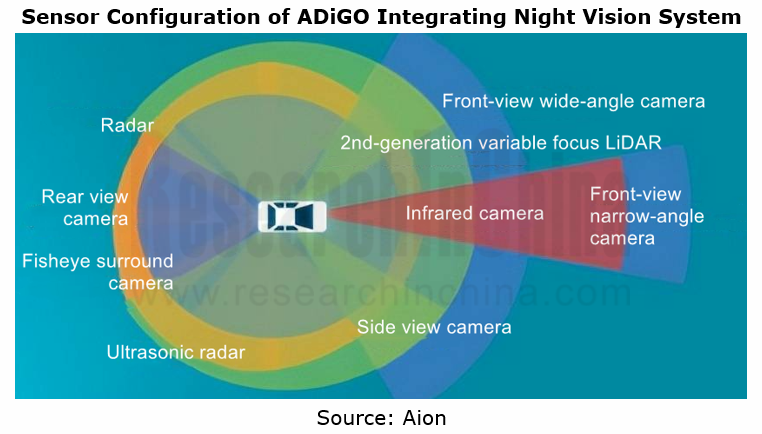
Automotive night vision has begun to be integrated with ADAS. GAC Aion has adopted infrared sensing technology in its ADAS for the first time. The ADiGO Intelligent Driving System that integrates intelligent driving infrared sensing technology strengthens video capture and recognition capabilities in dark night, haze, and heavy rain environments. Combined with the existing LiDAR, radar and visible light camera, this system acts as an active driving assistance safety strategy that integrates night vision/thermal imaging. The integration of night vision with ADAS allows thermal imaging to output video signals that have clear outlines and are easy to recognize, and helps to transmit the data to ADAS as a supplement to the uploaded perception data of other environments. The development history is as follows:
In March 2022, GAC Aion announced that ADiGO will be equipped with intelligent infrared sensing technology;
In September 2022, Aion notified Xuanyuan iDRIVE of developing and trial-producing components and undertaking the task of manufacturing night vision cameras;
In July 2023, Aion Hyper GT, an ADAS-enabled production model integrated with infrared night vision technology, was available on market.
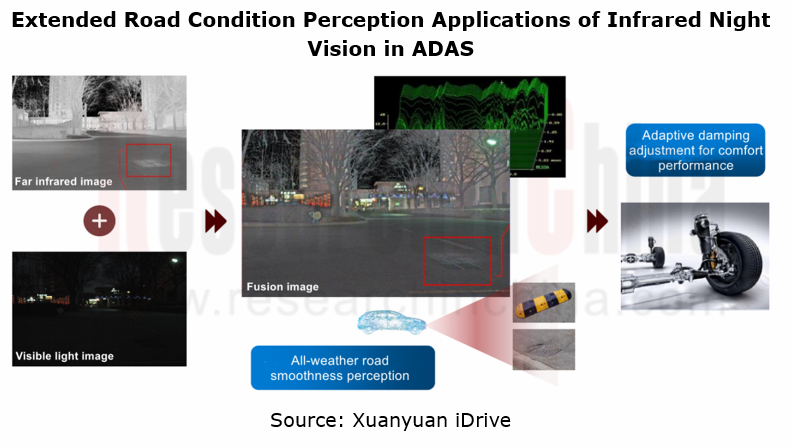
The subsequent extended applications of infrared night vision in ADAS also include intersection perception, multi-sensor data fusion, BEV spatial feature construction, image feature fusion perception, perceptual positioning and SLAM, stereo infrared, etc.
As concerns L4 autonomous driving, from Robotaxi nighttime road tests of Didi, AutoX, and WeRide, to DeepRoute.ai’s announcement of entering nighttime intra-city freight, it can be seen that there is great demand for night driving in the autonomous driving field. And driving safety at night makes infrared sensors an indispensable part.
Starting from January 3, 2023, Didi has increased its Robotaxi service hour to 24 hours. Didi's autonomous vehicles with the latest software and hardware are equipped with a variety of sensors including visible light, LiDAR and infrared thermal imaging, which can recognize traffic lights and traffic signs up to 300 meters away, and enable stable recognition in backlight and night scenarios and also accurate recognition of minor obstacles.
1 Automotive Infrared Night Vision Technologies
1.1 Definition and Working Principle of Infrared Thermal Imager
1.2 Definition, Classification and Packaging Forms of Infrared Detector
1.3 Infrared Night Vision Technology
1.3.1 Classification of Night Vision Technology
1.3.2 Active Infrared Night Vision Technology
1.3.3 Passive Infrared Night Vision Technology
1.4 Definition of Automotive Night Vision Driving Assistance System
1.4.1 Advantages of Automotive Night Vision Driving Assistance System
2 Automotive Infrared Night Vision System Industry Chain and Market
2.1 Automotive Infrared Night Vision Industry Chain
2.1.1 Infrared Night Vision System Industry Chain
2.1.2 Layout of Industry Chain Vendors
2.1.3 Product Comparison between Some Chinese and Foreign Night Vision System Suppliers
2.1.4 Technology Routes and Target Markets of Major Night Vision System Suppliers Inside and Outside China
2.1.5 Comparison of Products between Major Thermal Imager Suppliers Inside and Outside China (1)
2.1.5 Comparison of Products between Major Thermal Imager Suppliers Inside and Outside China (2)
2.1.5 Comparison of Products between Major Thermal Imager Suppliers Inside and Outside China (3)
2.2 Market and Technology Trends
2.2.1 Market Trend 1
2.2.2 Market Trend 2
2.2.3 Market Trend 3
2.2.4 Market Trend 4
2.2.5 Technology Trend 1
2.2.6 Technology Trend 2
2.3 Global Automotive Night Vision System Market Size
2.3.1 Global Night Vision System Market Size, 2018-2029E
2.4 Automotive Night Vision System Installation in China
2.4.1 Automotive Infrared Night Vision System Installation in China, 2021-2023
2.4.2 Sales of Vehicles Equipped with Night Vision Systems (by Price) in China, 2021-2023
2.4.3 Automotive Infrared Night Vision System Installation in China by Energy Source, 2021-2023
2.4.4 Automotive Infrared Night Vision System Installation in China by OEM, 2021-2023
2.4.5 Sales of Vehicles Equipped with Night Vision Systems (by Model) in China, 2021-2023
2.4.6 Sales of Vehicles Equipped with Night Vision Systems (by Region) in China, 2021-2023
2.5 Automotive Night Vision Camera Installation in China
2.5.1 Automotive Infrared Night Vision Camera Installation in China, 2021-2023
2.5.2 Automotive Infrared Night Vision Camera Installation in China by Price, 2021-2023
2.5.3 Automotive Infrared Night Vision Camera Installation in China by Energy Source, 2021-2023
2.5.4 Automotive Infrared Night Vision Camera Installation in China by OEM, 2021-2023
2.5.5 Automotive Infrared Night Vision Camera Installation in China by Model, 2021-2023
2.5.6 Automotive Infrared Night Vision Camera Installation in China by Province, 2021-2023
3 Night Vision System Application of OEMs
3.1 Overview of Night Vision System Application of OEMs
3.1.1 Status Quo of Application
3.1.2 Night Vision Technical Solutions and Supply Relationship of OEMs
3.2 BMW
3.2.1 Overview of BMW Night Vision
3.2.2 3rd-generation Night Vision System
3.2.3 Disassembly of BMW’s Third-generation Night Vision Camera
3.3 Benz
3.3.1 Overview of Night Vision System
3.3.2 Near Infrared Night Vision System
3.3.3 Far Infrared Night Vision System
3.3.4 Operation and Activation Conditions of Night Vision System
3.4 Audi
3.4.1 Overview of Night Vision System
3.4.2 Main Functions of Audi A8L Night Vision System
3.4.3 Camera and Control Unit of Audi A8L Night Vision System
3.4.4 Service Conditions and Operations Manual of Audi A8L Night Vision System
3.4.5 ECU Disassembly of Audi Night Vision System
3.5 Cadillac
3.5.1 Eagle Eye Night Vision System
3.5.2 Installation of Eagle Eye Night Vision System
3.6 VW
3.6.1 Infrared Night Vision System
3.6.2 Composition of Toureg Infrared Night Vision System
3.6.3 Installation of Phideon Night Vision System
3.7 BYD
3.7.1 Night Vision System
3.7.2 Yangwang U8
3.8 Voyah
3.8.1 Night Vision System
3.8.2 Voyah Dreamer Night Vision System
3.9 Other Cases
3.9.1 Rolls-Royce Night Vision System
3.9.2 Installation Cases of Bentley Night Vision System
3.9.3 Installation Cases of DS Night Vision System
3.9.4 Installation Cases of Peugeot Night Vision System
3.9.5 Installation Cases of Hongqi Night Vision System
3.9.6 Installation Cases of Porsche Night Vision System
3.9.7 Installation Cases of Aion Hyper Night Vision System
3.9.8 Installation Cases of Dongfeng Mengshi Night Vision System
3.9.9 Installation Cases of HiPhi Night Vision Camera
3.9.10 Installation Cases of DiDi Night Vision Camera
3.9.11 Installation Cases of Dayun Night Vision Camera
4 Automotive Infrared Night Vision System Suppliers
4.1 Magna
4.1.1 Profile
4.1.2 R&D History and Application of Automotive Night Vision System
4.1.3 Product Roadmap
4.1.4 Evolution of Automotive Infrared Night Vision System Technology
4.1.5 4th-Gen Automotive Night Vision System
4.2 Xuanyuan iDrive
4.2.1 Profile of Parent Company Guide Infrared
4.2.2 Profile of Xuanyuan iDrive
4.2.3 Development History and Planning of Infrared Night Vision Products
4.2.4 Vehicle Thermal Imaging Obstacle Avoidance System
4.2.5 Far Infrared Night Vision Obstacle Avoidance System and Application
4.2.6 Infrared Camera Component for Secondary Development - COIN612 Uncooled Thermal Module
4.2.7 Perception Algorithm
4.2.8 Perception Algorithm Indicator
4.2.9 Application Cases in Vehicles
4.2.10 Dynamics
4.3 Guangzhou SAT Infrared Technology
4.3.1 Profile
4.3.2 Features and Parameters of Vehicle Built-in Night Vision System NV628
4.3.3 NV628 Vehicle Interior Night Vision System: Functions and Application
4.3.4 NV618S Vehicle Integrated Dual-channel Night Vision System: Features and Parameters
4.3.5 NV618S Vehicle Integrated Dual-channel Night Vision System: Functions
4.3.6 Features and Parameters of Vehicle External Night Vision System NV618W
4.3.7 Partners
4.4 Shenzhen Tianzhi Automotive Electronic Technology
4.4.1 Profile
4.4.2 Duovox V9 Full Color Vehicle Night Vision Assist System
4.4.3 Specification & Installations of Duovox V9 Full Color Vehicle Night Vision Assist System
4.5 Bright Way Vision
4.5.1 Profile
4.5.2 Night Vision System
4.5.2 Night Vision System
4.5.3 Night Vision Technology: Gated Image Sensor
4.6 Baolong Technology
4.6.1 Profile
4.6.2 Infrared Camera
4.6.3 Intelligent Driving Solutions: V-SEE 2.0
4.6.4 Intelligent Driving Solutions: V-SEE 3.0
4.7 KYOCERA
4.7.1 Profile
4.7.2 Night Vision System
4.8 Lambda Night Vision
4.8.1 Profile
4.8.2 Night Vision All-in-one and Aftermarket Products
5 Automotive Infrared Night Vision Device Suppliers
5.1 Teledyne FLIR
5.1.1 Profile
5.1.2 Tau? 2 Thermal Imaging Cameras
5.1.3 Boson? Thermal Camera Modules
5.1.4 FLIR Thermal Imaging Automotive Development Kit (ADK)
5.1.5 FLIR Night Vision Dataset
5.1.6 FLIR Integrates Thermal Cameras with Prism AI Faster
5.1.7 "Thermal by FLIR" Partner Program
5.1.8 Application of FLIR Thermal Imager in Autonomous Vehicles
5.1.9 FLIR Cooperated with VSI Labs to Integrate Thermal Sensors in AEB System
5.2 AdaSky
5.2.1 Profile
5.2.2 Far Infrared Solid State Camera-Viper
5.2.3 Working Principle of Viper
5.2.4 System Effects of Thermal Camera
5.3 Ophir
5.3.1 Profile
5.3.2 Vehicle Night Vision Camera Products (I)
5.3.3 Vehicle Night Vision Camera Products (I)
5.4 Stoneridge -Orlaco
5.4.1 Profile
5.4.2 Vehicle Night Vision Cameras (I)
5.4.3 Vehicle Night Vision Cameras (II)
5.5 Lynred
5.5.1 Profile
5.5.2 Development Directions and Planning of Vehicle Infrared Products
5.5.3 Lynred and UMICORE Jointly Develop the Next-generation Thermal Sensing Solutions for PAEB
5.5.4 New Infrared Sensor Production Base
5.6 IRay Technology
5.6.1 Profile of Parent Company Raytron Technology
5.6.3 Profile of IRay Technology
5.6.4 Layout in the Field of Automotive Infrared Night Vision
5.6.5 Parameters of Xsafe-II Vehicle Infrared Night Vision System
5.6.6 Automotive Thermal Imager
5.6.7 IR-Pilot Series Automotive Infrared Night Vision Device and Its Parameters
5.6.8 IR-Pilot 640T Automotive Infrared Night Vision Device and Its Parameters
5.6.9 IR-Pilot 640M Automotive Infrared Night Vision Device and Its Parameters
5.6.10 IR-Pilot 640DS Intelligent Dual-light Vehicle-assisted Thermal Imaging Night Vision Device and Its Parameters
5.6.11 Xsafe A Series Automotive Infrared Thermal Imaging Night Vision Device and its Parameters
5.6.12 Asens FV Series Dual-light Fusion Automotive Thermal Imaging Night Vision Device and Its Parameters
5.6.13 Asens E Series Automotive Infrared Thermal Imaging Night Vision Device and its Parameters
5.6.14 Asens M Series Automotive Infrared Thermal Imaging Night Vision Device and its Parameters
5.6.15 180° Ultra Wide FOV Automotive Grade Thermal Imager
5.6.16 Horus Series Uncooled Infrared Thermal Imaging Modules
5.6.17 Aftermarket Automotive Night Vision System NV2
5.6.18 Cooperation Dynamics
5.7 Zhejiang Dali Technology
5.7.1 Profile
5.7.2 EX-25N Vehicle Infrared Thermal Imager
5.7.3 Automotive Thermal Imager EX-VI Series
5.7.4 Applied Models
5.8 SEEK Thermal
5.8.1 Profile
5.8.2 Automotive Infrared Camera Mosaic Core C1 Series
5.8.3 Automotive Infrared Camera Mosaic Core C3 and C2 Product Features and Categories
5.8.4 Automotive Infrared Camera Mosaic Core C3 and C2 Series Parameters
5.8.5 Automotive Infrared Camera Mosaic Core C3 and C2 Starter Kit
AI-Defined Vehicle (AIDV) OEMs' Deployment Strategies Research Report, 2026 AIDV Research: Deployment Strategies of 22 OEMs
The AI-Defined Vehicle (AIDV) OEMs' Deployment Strategies Research Report, 2026, released by ResearchInChina, analyzes the AI deployment strategies of ... OEMs’ Passenger Car Model Planning Research Report, 2026 Vehicle Model Planning Research: Chinese OEMs Launch Sub-Brands Intensively, While Multinational OEMs Apply the Brakes to Electrification Strategies
ResearchInChina released the OEMs’ Passenger Car M... Autonomous Driving Simulation and World Model Research Report, 2026 Autonomous driving simulation research: "Simulation test + world model"-driven test system has become R&D infrastructure.
The "Autonomous Driving Simulation and World Model Research Report, 2026"... Cockpit-Driving Integration Central Domain Controller SoC and AI Supercomputing Architecture Research Report, 2026 Cockpit-Driving integration and AI supercomputing research: The One Chip solution is rapidly installed in vehicles, and AI supercomputing architectures are moving towards full-domain integration.
AI ... Intelligent Driving End-to-End Large Model Research Report, 2026 Research on Intelligent Driving Large Models: A Critical Period for Technological Competition and Paradigm Integration
As autonomous driving technology rapidly iterates from L2 to L3?L4, intelligent... Automotive Digital Key Industry Trend Report, 2026 Digital Key Research: Automotive BLE, UWB and SLE Hardware Layout
The Automotive Digital Key Industry Trend Report, 2026, released by ResearchInChina, analyzes and predicts the digital key market, co... Monthly Report on Automotive New Technology (May 2026) UHD gaze technology, full-color LiDAR, UWB, etc. promote the upgrade of intelligent driving perception capabilities
This report is published once a month and is available for annual subscription.The... In-Cabin Monitoring Systems (DMS, OMS, etc.) Research Report, 2026 In-Cabin Monitoring System Research: DMS to Become Mandatory in 2027, Expected to be Installed in Over 14 Million Vehicles
ResearchInChina released the In-Cabin Monitoring Systems (DMS, OMS, etc.) Re... Automotive Service-Oriented Architecture (SOA) and Cross-Domain Middleware Industry Report, 2026 Research on automotive SOA and cross-domain middleware: The era of AI atomic services and AI cross-domain fusion agents is coming.
Automotive SOA evolves towards AI + full SOA servitization Driv... Automotive Display, Center Console and Cluster Industry Report, 2026 Automotive Display Research: Multi-Screen Application Slows Down, While OLED and MiniLED Are Introduced in Vehicles Quickly
In 2026, automotive displays will no longer excessively pursue the number a... Global and China Intelligent Vehicle Standard System Construction and Certification Research Report, 2026 Intelligent Driving Standards and Certification: With the Maturing Standardization System, China Will Participate in Formulation of Global Standards
China's automotive industry is transforming from ... Automotive Intelligent Diagnosis Industry Report, 2026 Automotive Intelligent Diagnosis Research: Powered by AI, Remote Diagnosis Is Being Upgraded towards Intelligence.
ResearchInChina released the Automotive Intelligent Diagnosis Industry Report, 2026.... Automotive Cloud Service Platform Research Report, 2026 Research on automotive cloud service platform: with architecture upgrade and computing power improvement, cloud services enter a new stage
In 2026, the Internet of Vehicles industry generates petaby... Integrated Battery and Innovative Battery Technology Research Report, 2026 Power Battery Research: Sales of High-Capacity Vehicles Keep Rising, and Solid-State Batteries Begin to Be Installed in Vehicles
I. Sales of High-Capacity Vehicles Sustain Growth, and Those with A C... Chinese Independent OEMs’ ADAS and Autonomous Driving Report, 2026 Research on OEMs' Intelligent Driving: Era of Physical AI, Standard Configuration of D2D, and Initial Exploration of L3 Commercial Pilot Projects
From 2023 to 2025, the intelligent driving installati... Intelligent Vehicle New Technology Application Analysis Report, 2025-2026 New Technology Research: Innovative Products such as Bionic Cameras, Vision-LiDAR Fusion Sensors, Auditory Sensors Further Enhance Vehicle Perception Capabilities
ForewordResearchInChina released th... Automotive Optical Fiber Communication (Optical Fiber Ethernet, PON) and Supply Chain Research Report, 2026 Research on Automotive Optical Fiber Communication: Introduction of Optical Fiber in Vehicles Accelerates, with Priority Deployment in High-Speed Communication Link (10+Gbps) Scenarios
Automotive opt... Automotive Intelligent Cockpit SoC Research Report, 2026 Automotive Cockpit SoC Research: Passenger Cars in the Price Range of RMB100,000–200,000 Account for Nearly 50% of Total Sales, and New-Generation Cockpit SoC Products Largely Enter Mass Production
P...
|