From January to September 2023, the penetration of telematics in passenger cars in China hit 77.6%, up 12.8 percentage points from the prior-year period. The rising penetration of telematics provides a market foundation for intelligent connected services, and consumers’ connection needs and usage habits take shape. Next how to provide diversified, personalized and intelligent application services using telematics big data will become the focus of major OEMs forging brand differentiation.
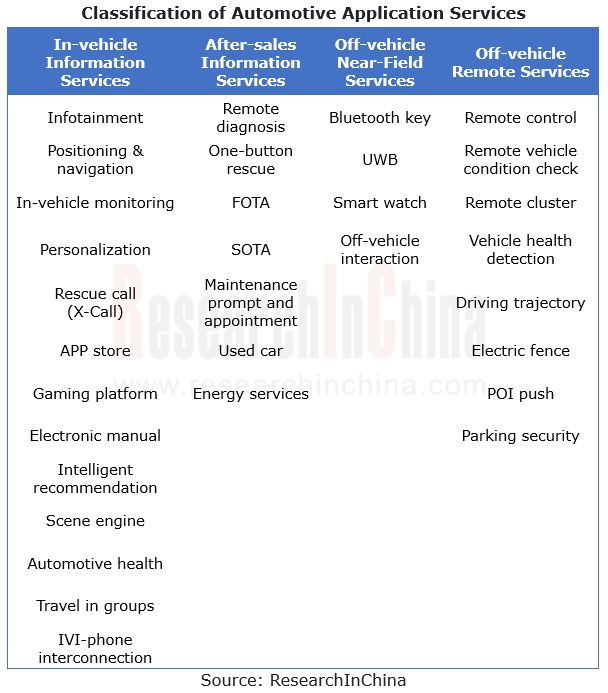
At present, China’s intelligent connected vehicle application services are mainly four scenario services: in-vehicle information services, after-sales information services, off-vehicle near-field services and off-vehicle remote services.
In-vehicle information services are mainly based on intelligent cockpit applications. In addition to conventional services such as infotainment, positioning, navigation, in-vehicle monitoring and rescue call, personalization, APP stores, vehicle gaming platforms, intelligent recommendations, scene engines, etc. have become hotspots of application services, which is accompanied by increasing big data applications in vehicles.
Centering on users’ needs for car usage and maintenance, after-sales information services provide remote diagnosis, one-button rescue, OTA updates, maintenance prompts and reservations, energy services for used cars and new energy vehicles, etc.
Off-vehicle near-field services are mainly enabled by near-field communications, such as digital keys like Bluetooth /UWB, smart watches, and off-vehicle interaction.
Off-vehicle remote services mainly use mobile phone APPs to remotely control vehicles, check vehicle conditions, detect vehicle status, etc.
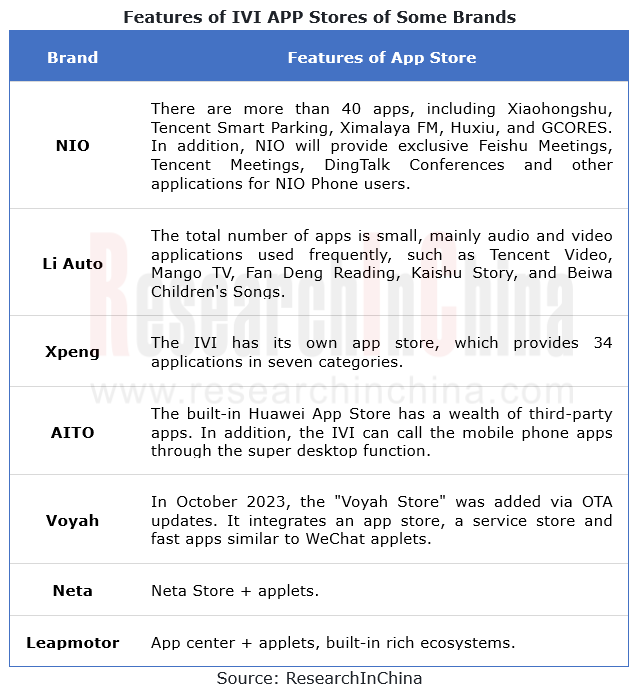
First, IVI APP stores enhance the personalization and scalability of in-vehicle services.
With rich ecological applications, APP stores can not only enhance the personalized and entertaining experience for users, but also enables the scalability of the application ecosystem, for example, users can work in the vehicle using office and conference software. At this stage, Chinese brands like BYD, NIO, Xpeng and Li Auto are the first to install APP stores in their IVI systems. Their foreign peers are following suit.
In February 2023, The Driven, an Australian electric vehicle website, issued an article saying that Tesla may already be working on its own Apple-like app store that would enable car owners to download and install applications to their electric cars.
In March 2023, Volkswagen Group officially announced that it would bring a new app store to its multiple auto brands and car models. Users can enjoy a mass of third-party applications via the update.
Second, the deep integration of mobile phones and IVI will spur more application services.
Mobile phones offer the most contact points and the longest contact time in automotive application services, and have become a bridge connecting people with cars and other devices. Mobile phone APPs can not only be used for remote car control, but also provide social contact, test drive/car purchase services, financial services, valet services, and even customized scenes, car manual guide and user evaluation, becoming a carrier for OEMs to create full life cycle services for users.
APP Functions of Some Mobile Phone Brands
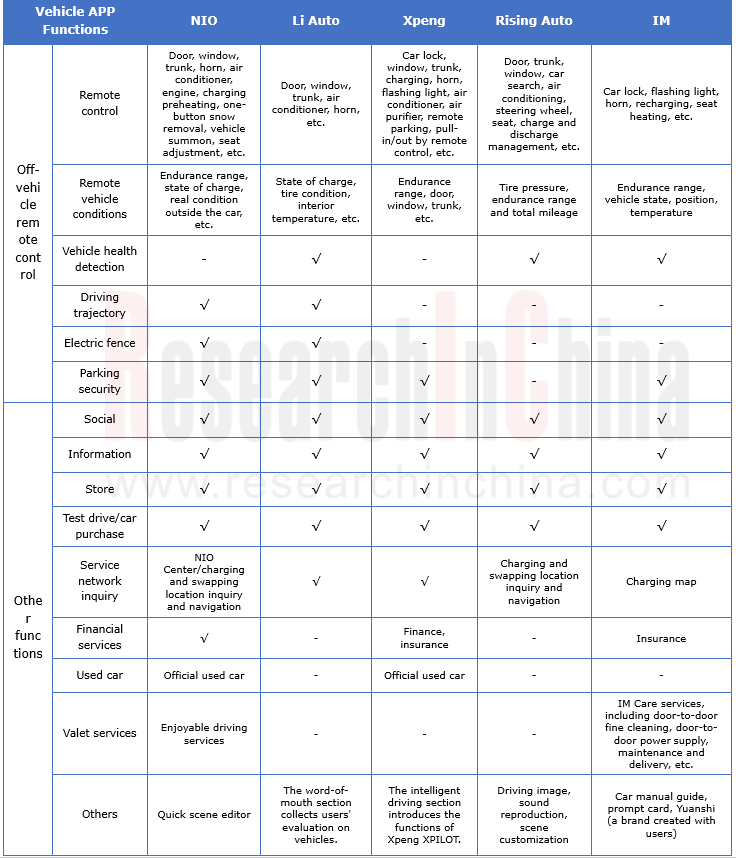
Note: √ means confirmed installation;
- means uninstallation or uncertain installation.
Source: ResearchInChina
At this stage, the special services offered by OEMs through mobile phone APPs mainly include:
1.Valet services
The enjoyable driving services of NIO are 7*24h customized services directly provided by NIO’s road service team according to users' demand. Using NIO APP, users can enjoy various valet services such as valet driving and accompanying, for example, accompanying the elderly to see a doctor and sending them to the hospital for physical examination, and accompanying children to do homework.
IM Care provides users with such services as door-to-door fine cleaning, door-to-door power supply, maintenance, and pick-up and delivery.
2. Feedback
Li Auto has set up a "word-of-mouth" section on its mobile phone APP, which enables users to evaluate vehicles in three dimensions: functions (appearance design, riding space, extended-range electric mode, chassis suspension, smart space and intelligent driving), services (after-sales service) and others (reasons for buying a car, satisfaction and expected improvements), thus creating a feedback channel for users.
3. Function introduction
Xpeng introduces the functions of Xpeng XPILOT to users via the intelligent driving section of the mobile phone APP. IM provides the manual guide for users via on the mobile phone APP.
4.Custom scenarios
NIO and Rising Auto set up scenario editors on their mobile phone APPs to enable users to add custom scenarios according to their preferences.
5. Brand co-creation
The Yuanshi Plan launched by IM encourages users to share mileage data, participate in interaction tasks and official co-creation activities on the APP, so as to enhance users' brand loyalty and achieve the effect of brand co-creation by way of issuing "original stones" (Yuanshi) and product redemption.
In addition, cross-terminal system applications such as HarmonyOS, and mobile phone vendors like OPPO, VIVO, Meizu and NIO Phone have entered IVI, bringing deeper integration of mobile phones and IVI. Cross-terminal data flow applications offer a bigger imaginable space to OEMs and suppliers, which may help to create more new services.
Third, the next-generation application service platform will build all-scenario service capabilities covering intelligent driving, cockpit and connectivity.
As E/E architectures tend to be centralized, automotive operating systems develop along the path of "IVI → cockpit → vehicle". In the era of vehicle operating systems, OEMs need to be based on SOA to realize cross-domain scheduling and functional integration among communication domain, cockpit domain and intelligent driving domain. There are two paths for OEMs to achieve cross-domain software integration: self-developing operating system platforms and application service platforms, represented by NIO, Xpeng and Li Auto; self-developing application service platforms but outsourcing operating system platforms to Neusoft, ThunderSoft and the like, represented by coventional automakers.
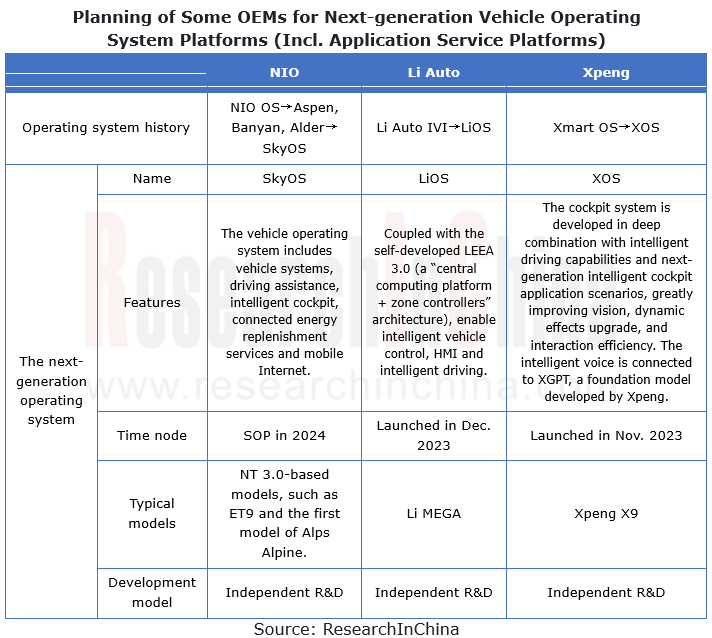
Therefore, emerging automakers such as NIO, Xpeng and Li Auto integrate the next-generation application service platforms with vehicle operating systems.
SkyOS, NIO’s next-generation operating system platform (including an application service platform), is an all-domain vehicle operating system, involving vehicle systems, driving assistance, intelligent cockpit, connected energy replenishment services and mobile Internet. It is applied to telematics, vehicle control, autonomous driving and digital cockpits.
LiOS, Li Auto’s next-generation operating system platform (including an application service platform), coupled with the self-developed LEEA 3.0 (a “central computing platform + zone controllers” architecture), combines intelligent driving domain, intelligent cockpit domain and vehicle control domain as a complete central domain.
AI-Defined Vehicle (AIDV) OEMs' Deployment Strategies Research Report, 2026
AIDV Research: Deployment Strategies of 22 OEMs
The AI-Defined Vehicle (AIDV) OEMs' Deployment Strategies Research Report, 2026, released by ResearchInChina, analyzes the AI deployment strategies of ...
OEMs’ Passenger Car Model Planning Research Report, 2026
Vehicle Model Planning Research: Chinese OEMs Launch Sub-Brands Intensively, While Multinational OEMs Apply the Brakes to Electrification Strategies
ResearchInChina released the OEMs’ Passenger Car M...
Autonomous Driving Simulation and World Model Research Report, 2026
Autonomous driving simulation research: "Simulation test + world model"-driven test system has become R&D infrastructure.
The "Autonomous Driving Simulation and World Model Research Report, 2026"...
Cockpit-Driving Integration Central Domain Controller SoC and AI Supercomputing Architecture Research Report, 2026
Cockpit-Driving integration and AI supercomputing research: The One Chip solution is rapidly installed in vehicles, and AI supercomputing architectures are moving towards full-domain integration.
AI ...
Intelligent Driving End-to-End Large Model Research Report, 2026
Research on Intelligent Driving Large Models: A Critical Period for Technological Competition and Paradigm Integration
As autonomous driving technology rapidly iterates from L2 to L3?L4, intelligent...
Automotive Digital Key Industry Trend Report, 2026
Digital Key Research: Automotive BLE, UWB and SLE Hardware Layout
The Automotive Digital Key Industry Trend Report, 2026, released by ResearchInChina, analyzes and predicts the digital key market, co...
Monthly Report on Automotive New Technology (May 2026)
UHD gaze technology, full-color LiDAR, UWB, etc. promote the upgrade of intelligent driving perception capabilities
This report is published once a month and is available for annual subscription.The...
In-Cabin Monitoring Systems (DMS, OMS, etc.) Research Report, 2026
In-Cabin Monitoring System Research: DMS to Become Mandatory in 2027, Expected to be Installed in Over 14 Million Vehicles
ResearchInChina released the In-Cabin Monitoring Systems (DMS, OMS, etc.) Re...
Automotive Service-Oriented Architecture (SOA) and Cross-Domain Middleware Industry Report, 2026
Research on automotive SOA and cross-domain middleware: The era of AI atomic services and AI cross-domain fusion agents is coming.
Automotive SOA evolves towards AI + full SOA servitization Driv...
Automotive Display, Center Console and Cluster Industry Report, 2026
Automotive Display Research: Multi-Screen Application Slows Down, While OLED and MiniLED Are Introduced in Vehicles Quickly
In 2026, automotive displays will no longer excessively pursue the number a...
Global and China Intelligent Vehicle Standard System Construction and Certification Research Report, 2026
Intelligent Driving Standards and Certification: With the Maturing Standardization System, China Will Participate in Formulation of Global Standards
China's automotive industry is transforming from ...
Automotive Intelligent Diagnosis Industry Report, 2026
Automotive Intelligent Diagnosis Research: Powered by AI, Remote Diagnosis Is Being Upgraded towards Intelligence.
ResearchInChina released the Automotive Intelligent Diagnosis Industry Report, 2026....
Automotive Cloud Service Platform Research Report, 2026
Research on automotive cloud service platform: with architecture upgrade and computing power improvement, cloud services enter a new stage
In 2026, the Internet of Vehicles industry generates petaby...
Integrated Battery and Innovative Battery Technology Research Report, 2026
Power Battery Research: Sales of High-Capacity Vehicles Keep Rising, and Solid-State Batteries Begin to Be Installed in Vehicles
I. Sales of High-Capacity Vehicles Sustain Growth, and Those with A C...
Chinese Independent OEMs’ ADAS and Autonomous Driving Report, 2026
Research on OEMs' Intelligent Driving: Era of Physical AI, Standard Configuration of D2D, and Initial Exploration of L3 Commercial Pilot Projects
From 2023 to 2025, the intelligent driving installati...
Intelligent Vehicle New Technology Application Analysis Report, 2025-2026
New Technology Research: Innovative Products such as Bionic Cameras, Vision-LiDAR Fusion Sensors, Auditory Sensors Further Enhance Vehicle Perception Capabilities
ForewordResearchInChina released th...
Automotive Optical Fiber Communication (Optical Fiber Ethernet, PON) and Supply Chain Research Report, 2026
Research on Automotive Optical Fiber Communication: Introduction of Optical Fiber in Vehicles Accelerates, with Priority Deployment in High-Speed Communication Link (10+Gbps) Scenarios
Automotive opt...
Automotive Intelligent Cockpit SoC Research Report, 2026
Automotive Cockpit SoC Research: Passenger Cars in the Price Range of RMB100,000–200,000 Account for Nearly 50% of Total Sales, and New-Generation Cockpit SoC Products Largely Enter Mass Production
P...