|
 |
Automotive XR (VR/AR/MR) Industry Report, 2024
|
Automotive XR (Extended Reality) is an innovative technology that integrates VR (Virtual Reality), AR (Augmented Reality) and MR (Mixed Reality) technologies into vehicle systems. It can bring drivers and passengers richer and more intuitive information interaction experiences. It is an important embodiment of differentiation between intelligent cockpits of the future.???
XR is integrated with IVI and smartphones to create multi-terminal integration experience.
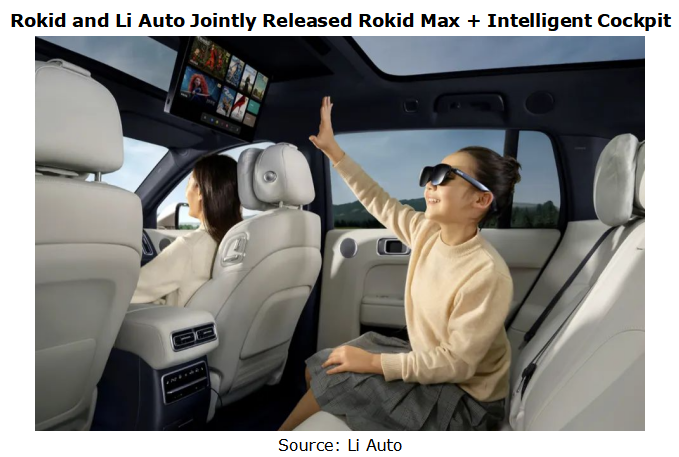
In March 2023, Rokid and Li Auto announced Rokid Max, their cooperative AR glasses which support L series models. Li Auto’s IVI APP can be projected onto VR glasses for viewing, gaming, online office, etc. In addition, it allows handheld game consoles to be projected onto the center console screen and then to the glasses, so that users can control IVI and play games through gesture interaction.???
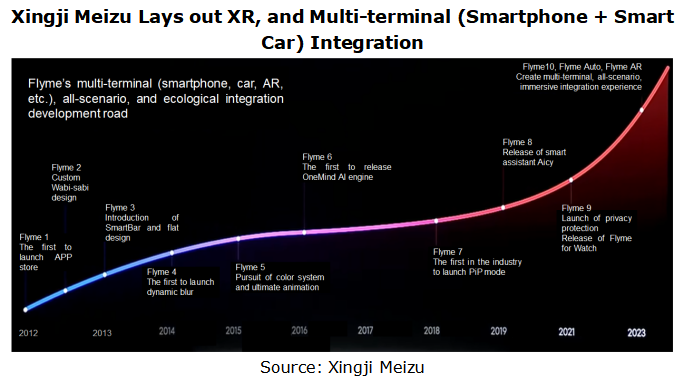
In November 2023, Xingji Meizu released MYVU intelligent AR glasses based on Flyme AR OS. The integration with Meizu smartphones via Flyme Link (a smartphone-IVI integration solution) not only allows for circulation of phone calls, music, videos, navigation, important application notifications and more to the AR glasses, but also makes it share computing power and network with the smartphone, thereby reducing the power consumption of the glasses and enabling a long cruising range. In the future, MYVU AR glasses will be integrated with cars and smartphones to create multi-terminal integration experience through seamless flow of applications and data.??
?
Therefore, at the “Meizu Flyme Ecosystem Launch”, Xingji Meizu upgraded the operating system Flyme to FlymeOS. Composed of Flyme 10 (smartphone OS), Flyme Auto (Meizu IVI system), and Flyme AR (AR glasses OS), FlymeOS covers three major areas: smartphone, XR and intelligent vehicle. FlymeOS features "Internet of Everything, Boundless and Infinite", and becomes the base for connecting all terminals.?????
AI+AR to enhance voice interaction experience
?
At CES 2024, Rayneo unveiled Rayneo X2 Lite, a stereo full-color MicroLED optical waveguide AR glasses that introduce Rayneo AI (released in December 2023), a foundation model voice assistant. With Rayneo AI, Rayneo X2 Lite enables multiple capabilities including multi-round natural language conversations, trip planning, easy encyclopedic Q&A and brainstorming, and supports AI-assisted translation, 3D spatial navigation, and first-person perspective video creation. In March 2024, Rayneo Technology closed a new funding round and raised RMB100 million which will be used to develop and spawn next-generation AR glasses and expedite the construction of the AI+AR glasses ecosystem.????
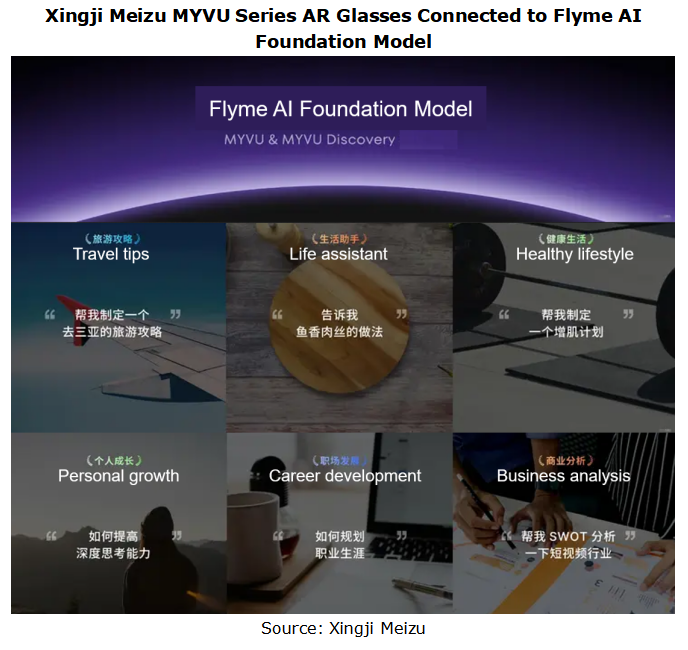
Xingji Meizu is also laying out AI+AR. In November 2023, Xingji Meizu released two MYVU series AR glasses, connected to the Flyme AI foundation model. Based on AI, AI assistant can be awakened in real time to provide travel tips, study plans, business analysis, and other daily life and work collaboration. At the same time, AR glasses can realize scenario functions such as teleprompter, real-time translation (in Chinese and English), and cycling navigation.
Automotive XR scenarios expand from entertainment to driving assistance and vehicle control.
Currently, XR mainly caters to users’ needs for cockpit entertainment, for example, viewing and gaming. Moreover suppliers are also exploring other application scenarios such as driving assistance and vehicle control.?
?
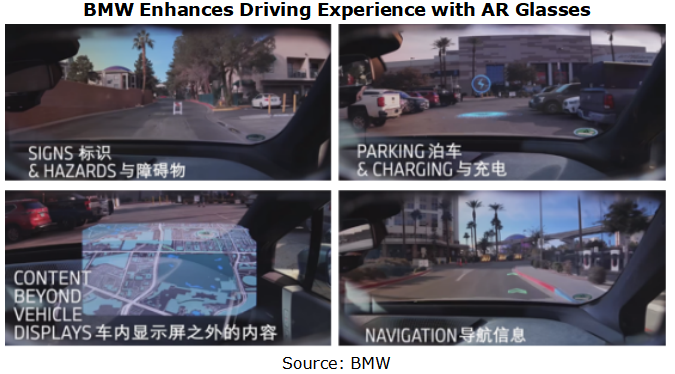
At CES 2024, BMW and XREAL together demonstrated XREAL Air 2 AR glasses, a device which integrates vehicle information, infotainment, vehicle electronic and electrical information, BMW cloud information and other data. Wearing the glasses, users can see how navigation instructions, hazard warnings, entertainment content, information on charging stations and supporting visualizations in parking situations are embedded perfectly into the real-world environment by the “XREAL Air 2”.???
?
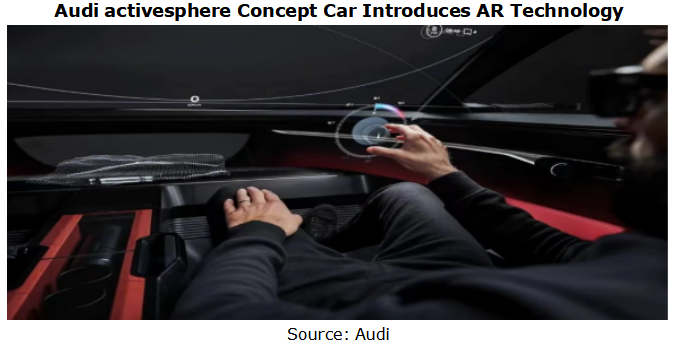
At CES 2023, Audi presented activesphere, a concept car which is equipped with four AR headsets. Wearing Magic Leap 2 AR glasses, the driver can view trip data, road conditions, location and navigation information in real time the MR visual interface with a 70° FOV; the passengers can control air conditioning temperature, airflow, and audio system next to their seats via gestures.??
?
Furthermore, AR technology can be available beyond the cockpit. In off-road scenarios, the topographic map can be projected into the surroundings; in commuting, traffic information, routes and safety warnings can be projected in layers into the driver's view.????
 ? ?
?
1 Overview and Market Trends of Automotive XR
1.1 Definition of Automotive XR (VR/AR/MR)
1.2 Comparison between Automotive XR Technologies
1.3 Main Application Scenarios of Automotive XR - Corporate-grade
1.4 Main Application Scenarios of Automotive XR - Consumer-grade
1.5 Advantages and Disadvantages of AR Glasses in Cars
1.5.1 Challenges in Adaptation of Existing VR Technologies to In-vehicle Scenarios
1.6 Automotive XR Business Models
1.7 XR Industry Chain
1.7.1 XR Industry Chain Companies
1.7.2 Comparison between Main VR Optical Solutions
1.7.3 Development Direction of VR Optical Solutions
1.7.4 Main VR Display Technologies
1.7.5 Comparison between Main AR Optical Solutions
1.7.6 Development Direction of AR Optical Solutions
1.7.7 Main AR Display Technologies
1.7.8 XR See-through Technology Route
1.7.8.1 VST (Video See-through) Application Cases
1.7.8.2 OST (Optical See-through) Application Cases
1.8 Development Trends of Automotive XR
1.8.1 Trend 1
1.8.2 Trend 2
1.8.3 Trend 3
1.8.3.1 Cases
2 Major Automotive XR Device and Software Solution Suppliers
2.1 Summary of Major Automotive XR Device and Solution Suppliers
2.1.1 Summary of Iteration Directions of Main Automotive XR Products
2.2 Rokid
2.2.1 Profile and Financing History
2.2.2 Latest Consumer-grade AR Glasses: Rokid Max
2.2.3 Rokid AR Space Operating System
2.2.4 Rokid AR Software Ecosystem Cooperation
2.2.5 Rokid AR In-vehicle Scenario Cooperation Layout
2.3 Meta
2.3.1 Profile
2.3.2 Latest VR Device: Quest 3
2.4 Rayneo Technology
2.4.1 Profile
2.4.2 AR Glasses: Rayneo X2
2.4.3 AR Glasses: Rayneo X2 Lite
2.4.4 AR Glasses: Rayneo Air 2
2.5 Xingji Meizu
2.5.1 "Smartphone + XR + Intelligent Vehicle" Strategic Map
2.5.2 Building Multi-terminal (Smartphone, Car, AR, etc.) Ecosystem Integration
2.5.3 Comparison between MYVU Series AR Glasses
2.5.4 MYVU Series AR Glasses: Xingji Meizu MYVU Discovery Edition
2.5.5 AR Glasses Highlight 1
2.5.6 AR Glasses Highlight 2
2.5.7 AR Glasses Highlight 3
2.5.8 Latest Upgrade of AR Glasses OS
2.6 XREAL
2.6.1 Profile and Financing History
2.6.2 Latest In-vehicle AR Glasses: XREAL Air 2
2.6.3 Iteration of AR Glasses Software Algorithms and Optical Engines
2.6.4 Automotive XR Cooperation Dynamics
2.7 Holoride
2.7.1 Profile
2.7.2 Eco-Architecture Map
2.7.3 Latest Automotive XR Hardware Solutions
2.7.4 Latest Automotive XR Software Solutions
2.7.5 Automotive XR Cooperation Dynamics
2.8 ELEJO
2.8.1 Profile and Key Automotive XR Technologies
2.8.2 Automotive XR Intelligent Cockpit ELEJO Technology Architecture
2.8.3 Automotive XR Intelligent Cockpit ELEJO Algorithm & Engine
2.8.4 Automotive XR Eco-Cooperation and Business Model
2.9 CATARC
2.9.1 Intelligent Automotive XR Technology Application Solution
2.9.2 Intelligent Automotive XR Virtual Simulation Experiment Platform
2.9.3 Intelligent Automotive XR Virtual Simulation Verification Software System
2.10 MOTREX: In-cabin XR BOX
3 AR/XR Layout of OEMs
3.1 Comparison of Cockpit XR Technology Layout between OEMs
3.1.1 Comparison of Automotive VR Headset Parameters between OEMs
3.1.2 Comparison of Automotive AR Glasses Parameters between OEMs
3.1.3 Optical and Display Solutions of AR Glasses for In-car Applications
3.2 BMW
3.2.1 Automotive XR Layout (1)
3.2.2 Automotive XR Layout (2)
3.3 Ford
3.3.1 Automotive XR Layout (1)
3.3.2 Automotive XR Layout (2)
3.4 Audi
3.4.1 Automotive XR Layout (1)
3.4.2 Automotive XR Layout (2)
3.5 Porsche Automotive XR Layout
3.6 Li Auto
3.6.1 Automotive XR Layout
3.6.2 Features of Rayneo Air AR Glasses
3.6.3 Features of Latest Rokid Max AR Glasses
3.7 NIO
3.7.1 AR Glasses
3.7.2 VR Headset
3.8 Skyworth
3.8.1 Launched Sleep-aid VR Headset Together with Skyworth XR
3.8.2 VR Headset Series Comparison
3.8.3 Main Features of VR Headset
3.8.4 VR Headset Software Algorithm
3.8.5 VR Headset Software Platform SkyOS
3.9 BYD
3.10 Chery’s Automotive XR Layout
3.11 GAC’s Automotive XR Layout
AI-Defined Vehicle (AIDV) OEMs' Deployment Strategies Research Report, 2026 AIDV Research: Deployment Strategies of 22 OEMs
The AI-Defined Vehicle (AIDV) OEMs' Deployment Strategies Research Report, 2026, released by ResearchInChina, analyzes the AI deployment strategies of ... OEMs’ Passenger Car Model Planning Research Report, 2026 Vehicle Model Planning Research: Chinese OEMs Launch Sub-Brands Intensively, While Multinational OEMs Apply the Brakes to Electrification Strategies
ResearchInChina released the OEMs’ Passenger Car M... Autonomous Driving Simulation and World Model Research Report, 2026 Autonomous driving simulation research: "Simulation test + world model"-driven test system has become R&D infrastructure.
The "Autonomous Driving Simulation and World Model Research Report, 2026"... Cockpit-Driving Integration Central Domain Controller SoC and AI Supercomputing Architecture Research Report, 2026 Cockpit-Driving integration and AI supercomputing research: The One Chip solution is rapidly installed in vehicles, and AI supercomputing architectures are moving towards full-domain integration.
AI ... Intelligent Driving End-to-End Large Model Research Report, 2026 Research on Intelligent Driving Large Models: A Critical Period for Technological Competition and Paradigm Integration
As autonomous driving technology rapidly iterates from L2 to L3?L4, intelligent... Automotive Digital Key Industry Trend Report, 2026 Digital Key Research: Automotive BLE, UWB and SLE Hardware Layout
The Automotive Digital Key Industry Trend Report, 2026, released by ResearchInChina, analyzes and predicts the digital key market, co... Monthly Report on Automotive New Technology (May 2026) UHD gaze technology, full-color LiDAR, UWB, etc. promote the upgrade of intelligent driving perception capabilities
This report is published once a month and is available for annual subscription.The... In-Cabin Monitoring Systems (DMS, OMS, etc.) Research Report, 2026 In-Cabin Monitoring System Research: DMS to Become Mandatory in 2027, Expected to be Installed in Over 14 Million Vehicles
ResearchInChina released the In-Cabin Monitoring Systems (DMS, OMS, etc.) Re... Automotive Service-Oriented Architecture (SOA) and Cross-Domain Middleware Industry Report, 2026 Research on automotive SOA and cross-domain middleware: The era of AI atomic services and AI cross-domain fusion agents is coming.
Automotive SOA evolves towards AI + full SOA servitization Driv... Automotive Display, Center Console and Cluster Industry Report, 2026 Automotive Display Research: Multi-Screen Application Slows Down, While OLED and MiniLED Are Introduced in Vehicles Quickly
In 2026, automotive displays will no longer excessively pursue the number a... Global and China Intelligent Vehicle Standard System Construction and Certification Research Report, 2026 Intelligent Driving Standards and Certification: With the Maturing Standardization System, China Will Participate in Formulation of Global Standards
China's automotive industry is transforming from ... Automotive Intelligent Diagnosis Industry Report, 2026 Automotive Intelligent Diagnosis Research: Powered by AI, Remote Diagnosis Is Being Upgraded towards Intelligence.
ResearchInChina released the Automotive Intelligent Diagnosis Industry Report, 2026.... Automotive Cloud Service Platform Research Report, 2026 Research on automotive cloud service platform: with architecture upgrade and computing power improvement, cloud services enter a new stage
In 2026, the Internet of Vehicles industry generates petaby... Integrated Battery and Innovative Battery Technology Research Report, 2026 Power Battery Research: Sales of High-Capacity Vehicles Keep Rising, and Solid-State Batteries Begin to Be Installed in Vehicles
I. Sales of High-Capacity Vehicles Sustain Growth, and Those with A C... Chinese Independent OEMs’ ADAS and Autonomous Driving Report, 2026 Research on OEMs' Intelligent Driving: Era of Physical AI, Standard Configuration of D2D, and Initial Exploration of L3 Commercial Pilot Projects
From 2023 to 2025, the intelligent driving installati... Intelligent Vehicle New Technology Application Analysis Report, 2025-2026 New Technology Research: Innovative Products such as Bionic Cameras, Vision-LiDAR Fusion Sensors, Auditory Sensors Further Enhance Vehicle Perception Capabilities
ForewordResearchInChina released th... Automotive Optical Fiber Communication (Optical Fiber Ethernet, PON) and Supply Chain Research Report, 2026 Research on Automotive Optical Fiber Communication: Introduction of Optical Fiber in Vehicles Accelerates, with Priority Deployment in High-Speed Communication Link (10+Gbps) Scenarios
Automotive opt... Automotive Intelligent Cockpit SoC Research Report, 2026 Automotive Cockpit SoC Research: Passenger Cars in the Price Range of RMB100,000–200,000 Account for Nearly 50% of Total Sales, and New-Generation Cockpit SoC Products Largely Enter Mass Production
P...
|