End-to-end Autonomous Driving Research: status quo of End-to-end (E2E) autonomous driving
1. Status quo of end-to-end solutions in China
An end-to-end autonomous driving system refers to direct mapping from sensor data inputs (camera images, LiDAR, etc.) to control command outputs (steering, acceleration/deceleration, etc.). It first appeared in the ALVINN project in 1988. It uses cameras and laser rangefinders as input and a simple neural network to generate steering as output.
In early 2024, Tesla rolled out FSD V12.3, featuring an amazing intelligent driving level. The end-to-end autonomous driving solution garners widespread attention from OEMs and autonomous driving solution companies in China.?
Compared with conventional multi-module solutions, the end-to-end autonomous driving solution integrates perception, prediction and planning into a single model, simplifying the solution structure. It can simulate human drivers making driving decisions directly according to visual inputs, effectively cope with long tail scenarios of modular solutions and improve the training efficiency and performance of models.


Li Auto's end-to-end solution
Li Auto believes that a complete end-to-end model should cover the whole process of perception, tracking, prediction, decision and planning, and it is the optimal solution to achieve L3 autonomous driving. In 2023, Li Auto pushed AD Max3.0, with overall framework reflecting the end-to-end concept but still a gap with a complete end-to-end solution. In 2024, Li Auto is expected to promote the system to become a complete end-to-end solution.?
Li Auto's autonomous driving framework is shown below, consisting of two systems:
Fast system: System 1, Li Auto’s existing end-to-end solution which is directly executed after perceiving the surroundings.
Slow system: System 2, a multimodal large language model that logically thinks and explores unknown environments to solve problems in unknown L4 scenarios.

In the process of promoting the end-to-end solution, Li Auto plans to unify the planning/forecast model and the perception model, and accomplish the end-to-end Temporal Planner on the original basis to integrate parking with driving.
2. Data becomes the key to the implementation of end-to-end solutions.
The implementation of an end-to-end solution requires processes covering R&D team building, hardware facilities, data collection and processing, algorithm training and strategy customization, verification and evaluation, promotion and mass production. Some of the sore points in scenarios are as shown in the table:

The integrated training in end-to-end autonomous driving solutions requires massive data, so one of the difficulties it faces lies in data collection and processing.
First of all, it needs a long time and may channels to collect data, including driving data and scenario data such as roads, weather and traffic conditions. In actual driving, the data within the driver's front view is relatively easy to collect, but the surrounding information is hard to say.
During data processing, it is necessary to design data extraction dimensions, extract effective features from massive video clips, make statistics of data distribution, etc. to support large-scale data training.
DeepRoute
As of March 2024, DeepRoute.ai's end-to-end autonomous driving solution has been designated by Great Wall Motor and involved in the cooperation with NVIDIA. It is expected to adapt to NVIDIA Thor in 2025. In the planning of DeepRoute.ai, the transition from the conventional solution to the "end-to-end" autonomous driving solution will go through sensor pre-fusion, HD map removal, and integration of perception, decision and control.

GigaStudio
DriveDreamer, an autonomous driving model of GigaStudio, is capable of scenario generation, data generation, driving action prediction and so forth. In the scenario/data generation, it has two steps:
When involving single-frame structural conditions, guide DriveDreamer to generate driving scenario images, so that it can understand structural traffic constraints easily.
Extend its understanding to video generation. Using continuous traffic structure conditions, DriveDreamer outputs driving scene videos to further enhance its understanding of motion transformation.

3. End-to-end solutions accelerate the application of embodied robots.
In addition to autonomous vehicles, embodied robots are another mainstream scenario of end-to-end solutions. From end-to-end autonomous driving to robots, it is necessary to build a more universal world model to adapt to more complex and diverse real application scenarios. The development framework of mainstream AGI (General Artificial Intelligence) is divided into two stages:
Stage 1: the understanding and generation of basic foundation models are unified, and further combined with embodied artificial intelligence (embodied AI) to form a unified world model;
Stage 2: capabilities of world model + complex task planning and control, and abstract concept induction gradually evolve into the era of the interactive AGI 1.0.
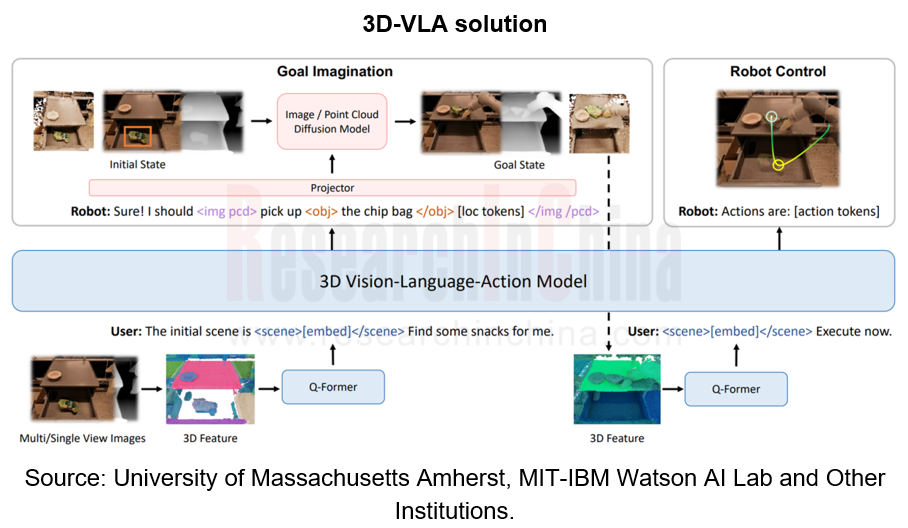
In the landing process of the world model, the construction of an end-to-end VLA (Vision-Language-Action) autonomous system has become a crucial link. VLA, as the basic foundation model of embodied AI, can seamlessly link 3D perception, reasoning and action to form a generative world model, which is built on the 3D-based large language model (LLM) and introduces a set of interactive markers to interact with the environment.
As of April 2024, some manufacturers of humanoid robots adopting end-to-end solutions are as follows:

For example, Udeer·AI's Large Physical Language Model (LPLM) is an end-to-end embodied AI solution that uses a self-labeling mechanism to improve the learning efficiency and quality of the model from unlabeled data, thereby deepening the understanding of the world and enhancing the robot's generalization capabilities and environmental adaptability in cross-modal, cross-scene, and cross-industry scenarios.

LPLM abstracts the physical world and ensures that this kind of information is aligned with the abstract level of features in LLM. It explicitly models each entity in the physical world as a token, and encodes geometric, semantic, kinematic and intentional information.
In addition, LPLM adds 3D grounding to the encoding of natural language instructions, improving the accuracy of natural language to some extent. Its decoder can learn by constantly predicting the future, thus strengthening the ability of the model to learn from massive unlabeled data.
AI-Defined Vehicle (AIDV) OEMs' Deployment Strategies Research Report, 2026
AIDV Research: Deployment Strategies of 22 OEMs
The AI-Defined Vehicle (AIDV) OEMs' Deployment Strategies Research Report, 2026, released by ResearchInChina, analyzes the AI deployment strategies of ...
OEMs’ Passenger Car Model Planning Research Report, 2026
Vehicle Model Planning Research: Chinese OEMs Launch Sub-Brands Intensively, While Multinational OEMs Apply the Brakes to Electrification Strategies
ResearchInChina released the OEMs’ Passenger Car M...
Autonomous Driving Simulation and World Model Research Report, 2026
Autonomous driving simulation research: "Simulation test + world model"-driven test system has become R&D infrastructure.
The "Autonomous Driving Simulation and World Model Research Report, 2026"...
Cockpit-Driving Integration Central Domain Controller SoC and AI Supercomputing Architecture Research Report, 2026
Cockpit-Driving integration and AI supercomputing research: The One Chip solution is rapidly installed in vehicles, and AI supercomputing architectures are moving towards full-domain integration.
AI ...
Intelligent Driving End-to-End Large Model Research Report, 2026
Research on Intelligent Driving Large Models: A Critical Period for Technological Competition and Paradigm Integration
As autonomous driving technology rapidly iterates from L2 to L3?L4, intelligent...
Automotive Digital Key Industry Trend Report, 2026
Digital Key Research: Automotive BLE, UWB and SLE Hardware Layout
The Automotive Digital Key Industry Trend Report, 2026, released by ResearchInChina, analyzes and predicts the digital key market, co...
Monthly Report on Automotive New Technology (May 2026)
UHD gaze technology, full-color LiDAR, UWB, etc. promote the upgrade of intelligent driving perception capabilities
This report is published once a month and is available for annual subscription.The...
In-Cabin Monitoring Systems (DMS, OMS, etc.) Research Report, 2026
In-Cabin Monitoring System Research: DMS to Become Mandatory in 2027, Expected to be Installed in Over 14 Million Vehicles
ResearchInChina released the In-Cabin Monitoring Systems (DMS, OMS, etc.) Re...
Automotive Service-Oriented Architecture (SOA) and Cross-Domain Middleware Industry Report, 2026
Research on automotive SOA and cross-domain middleware: The era of AI atomic services and AI cross-domain fusion agents is coming.
Automotive SOA evolves towards AI + full SOA servitization Driv...
Automotive Display, Center Console and Cluster Industry Report, 2026
Automotive Display Research: Multi-Screen Application Slows Down, While OLED and MiniLED Are Introduced in Vehicles Quickly
In 2026, automotive displays will no longer excessively pursue the number a...
Global and China Intelligent Vehicle Standard System Construction and Certification Research Report, 2026
Intelligent Driving Standards and Certification: With the Maturing Standardization System, China Will Participate in Formulation of Global Standards
China's automotive industry is transforming from ...
Automotive Intelligent Diagnosis Industry Report, 2026
Automotive Intelligent Diagnosis Research: Powered by AI, Remote Diagnosis Is Being Upgraded towards Intelligence.
ResearchInChina released the Automotive Intelligent Diagnosis Industry Report, 2026....
Automotive Cloud Service Platform Research Report, 2026
Research on automotive cloud service platform: with architecture upgrade and computing power improvement, cloud services enter a new stage
In 2026, the Internet of Vehicles industry generates petaby...
Integrated Battery and Innovative Battery Technology Research Report, 2026
Power Battery Research: Sales of High-Capacity Vehicles Keep Rising, and Solid-State Batteries Begin to Be Installed in Vehicles
I. Sales of High-Capacity Vehicles Sustain Growth, and Those with A C...
Chinese Independent OEMs’ ADAS and Autonomous Driving Report, 2026
Research on OEMs' Intelligent Driving: Era of Physical AI, Standard Configuration of D2D, and Initial Exploration of L3 Commercial Pilot Projects
From 2023 to 2025, the intelligent driving installati...
Intelligent Vehicle New Technology Application Analysis Report, 2025-2026
New Technology Research: Innovative Products such as Bionic Cameras, Vision-LiDAR Fusion Sensors, Auditory Sensors Further Enhance Vehicle Perception Capabilities
ForewordResearchInChina released th...
Automotive Optical Fiber Communication (Optical Fiber Ethernet, PON) and Supply Chain Research Report, 2026
Research on Automotive Optical Fiber Communication: Introduction of Optical Fiber in Vehicles Accelerates, with Priority Deployment in High-Speed Communication Link (10+Gbps) Scenarios
Automotive opt...
Automotive Intelligent Cockpit SoC Research Report, 2026
Automotive Cockpit SoC Research: Passenger Cars in the Price Range of RMB100,000–200,000 Account for Nearly 50% of Total Sales, and New-Generation Cockpit SoC Products Largely Enter Mass Production
P...