Research on DJI Automotive: lead the NOA market by virtue of unique technology route.
In 2016, DJI Automotive’s internal technicians installed a set of stereo sensors + vision fusion positioning system into a car and made it run successfully. DJI Automotive's technologies such as perception, positioning, decision and planning accumulated in the drone field have been successfully transferred to intelligent driving field.?
Almost all founding and management team members of DJI Automotive came from DJI’s drone projects. DJI Automotive had only about 10 members at the beginning, mainly composed of representatives temporarily transferred from the Flight Control Department and Vision Department of DJI at that time.?
?
DJI claims that it is a company specializing in the research of intelligent robots, and drones and autonomous vehicles are different forms of intelligent robots. Relying on its unique technology route, DJI holds lead in the mass production and application of NOA. By DJI Automotive’s estimates, around 2 million passenger cars taking to road will be equipped with DJI Automotive’s intelligent driving systems in 2025.?
Continuously optimize stereo vision sensors
One of the core technologies of DJI Automotive is stereo vision. Even when other sensors like GPS fail, based on visual perception of the stereo camera, drones can still enable hovering, obstacle avoidance, and speed measurement among others.?
After applying stereo vision technology to autonomous vehicles, DJI Automotive continues to optimize stereo vision sensors according to requirements of different autonomous driving levels.
In 2023, to meet the needs of NOA, DJI Automotive launched the second-generation inertial navigation stereo vision system, which eliminates the overall lens hood by adding a customized optical polarizer and cancels the rigid connecting rod using a better self-calibration algorithm. This makes it easier to install the sensor, and the distance between two cameras can be flexibly configured from 180 mm to 400 mm. Elimination of the rigid connecting rod is a huge progress in stereo vision sensors, allowing stereo cameras to be applied in much more scenarios.
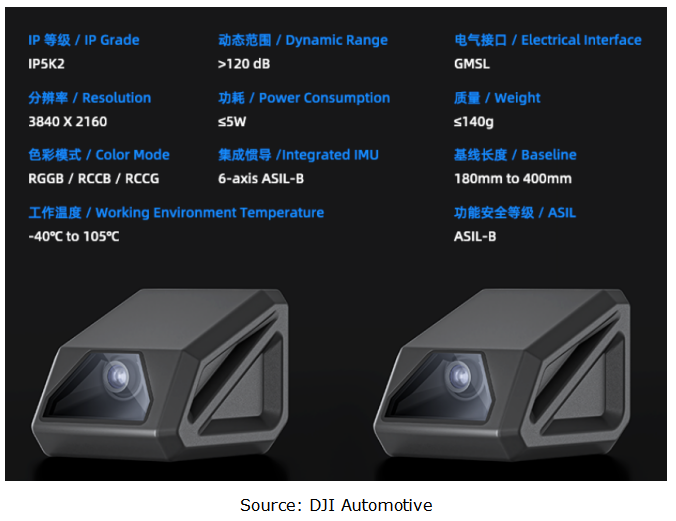
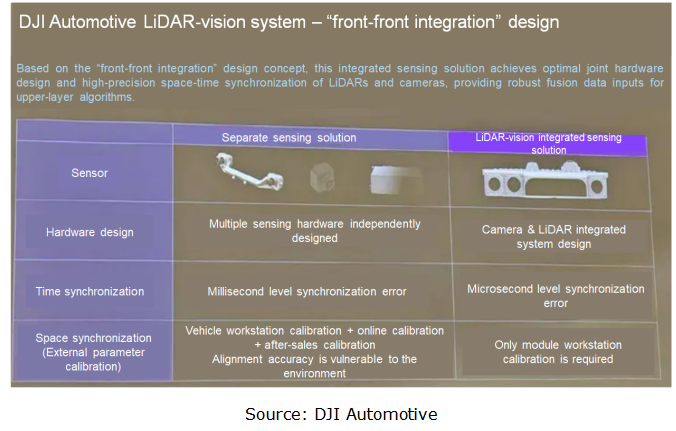
Based on the needs of L3 autonomous driving, in 2024 DJI Automotive introduced a LiDAR-vision system, which combines LiDAR, stereo sensor, long-focus mono camera and inertial navigation. Compared with the currently common "LiDAR + front camera" solution on the market, the system can reduce the costs by 30% to 40%, while enabling 100% performance and replacing all the functions. Thanks to the integrated design, the "LiDAR-vision" solution can also be built into the cabin as a whole, reducing the overall installation costs.????
 ???
???
The "LiDAR-vision" solution can further enhance safety in vehicle longitudinal control. Thanks to LiDAR's precise ranging capabilities and robustness to illumination, the "LiDAR-vision" solution can further improve safety and comfort of intelligent driving system in such scenarios as cut-in at close range, complex traffic flow in urban areas, response to vulnerable road users (VRU), arbitrary obstacle avoidance, detour, and VRU at night.
Use drone technologies for data acquisition and simulation
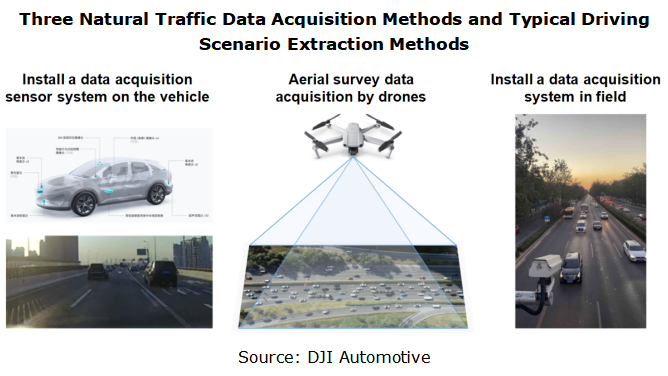
Among the three autonomous driving data acquisition methods, acquisition by vehicles is the most common, but the proportion of effective data is low, and it is easy to interfere with real behaviors of surrounding vehicles, and it is unable to record data in blind spots of sensors. Another method is acquisition in field, with low flexibility and insufficient reliability, a result of angle skew and low image accuracy.????
 ?
?
According to the in-depth research by fka, the automotive technology research institute of RWTH Aachen University, and DJI Automotive's own practices in the past two years, aerial survey data acquisition by drones has obvious advantages. Drones can collect richer and more complete scenario data, and can directly collect aerial objective shots of all vehicles in blind spots of the target vehicle without obstruction, reflecting more realistic and interference-free human driving behaviors, and more efficiently collecting data in specific road sections and special driving scenarios, for example, on/off-ramps and frequent cut-ins.???
Why does the implementation of vision-only autonomous driving suddenly accelerate?
Why has the pace of implementing vision-only technology solutions suddenly quicken since 2024? The answer is foundation models. The research shows that a truly autonomous driving system needs at least about 17 billion kilometers of road verification before being production-ready. The reason is that even if the existing technology can handle more than 95% of common driving scenarios, problems may still occur in the remaining 5% corner cases.??
Generally, learning a new corner case requires collecting more than 10,000 samples, and the entire cycle is more than 2 weeks. Even if a team has 100 autonomous vehicles conducting road tests 24 hours a day, the time required to accumulate data is measured in "hundred years" - which is obviously unrealistic.
Foundation models are used to quickly restore real scenarios and generate corner cases in various complex scenarios for model training. Foundation models (such as Pangu model) can shorten the closed-loop cycle of autonomous driving corner cases from more than two weeks to two days.
Currently, DJI Automotive, Baidu, PhiGent Robotics, GAC, Tesla and Megvii among others have launched their vision-only autonomous driving solutions. This weekly report summarizes and analyzes vision-only autonomous driving routes.
AI-Defined Vehicle (AIDV) OEMs' Deployment Strategies Research Report, 2026
AIDV Research: Deployment Strategies of 22 OEMs
The AI-Defined Vehicle (AIDV) OEMs' Deployment Strategies Research Report, 2026, released by ResearchInChina, analyzes the AI deployment strategies of ...
OEMs’ Passenger Car Model Planning Research Report, 2026
Vehicle Model Planning Research: Chinese OEMs Launch Sub-Brands Intensively, While Multinational OEMs Apply the Brakes to Electrification Strategies
ResearchInChina released the OEMs’ Passenger Car M...
Autonomous Driving Simulation and World Model Research Report, 2026
Autonomous driving simulation research: "Simulation test + world model"-driven test system has become R&D infrastructure.
The "Autonomous Driving Simulation and World Model Research Report, 2026"...
Cockpit-Driving Integration Central Domain Controller SoC and AI Supercomputing Architecture Research Report, 2026
Cockpit-Driving integration and AI supercomputing research: The One Chip solution is rapidly installed in vehicles, and AI supercomputing architectures are moving towards full-domain integration.
AI ...
Intelligent Driving End-to-End Large Model Research Report, 2026
Research on Intelligent Driving Large Models: A Critical Period for Technological Competition and Paradigm Integration
As autonomous driving technology rapidly iterates from L2 to L3?L4, intelligent...
Automotive Digital Key Industry Trend Report, 2026
Digital Key Research: Automotive BLE, UWB and SLE Hardware Layout
The Automotive Digital Key Industry Trend Report, 2026, released by ResearchInChina, analyzes and predicts the digital key market, co...
Monthly Report on Automotive New Technology (May 2026)
UHD gaze technology, full-color LiDAR, UWB, etc. promote the upgrade of intelligent driving perception capabilities
This report is published once a month and is available for annual subscription.The...
In-Cabin Monitoring Systems (DMS, OMS, etc.) Research Report, 2026
In-Cabin Monitoring System Research: DMS to Become Mandatory in 2027, Expected to be Installed in Over 14 Million Vehicles
ResearchInChina released the In-Cabin Monitoring Systems (DMS, OMS, etc.) Re...
Automotive Service-Oriented Architecture (SOA) and Cross-Domain Middleware Industry Report, 2026
Research on automotive SOA and cross-domain middleware: The era of AI atomic services and AI cross-domain fusion agents is coming.
Automotive SOA evolves towards AI + full SOA servitization Driv...
Automotive Display, Center Console and Cluster Industry Report, 2026
Automotive Display Research: Multi-Screen Application Slows Down, While OLED and MiniLED Are Introduced in Vehicles Quickly
In 2026, automotive displays will no longer excessively pursue the number a...
Global and China Intelligent Vehicle Standard System Construction and Certification Research Report, 2026
Intelligent Driving Standards and Certification: With the Maturing Standardization System, China Will Participate in Formulation of Global Standards
China's automotive industry is transforming from ...
Automotive Intelligent Diagnosis Industry Report, 2026
Automotive Intelligent Diagnosis Research: Powered by AI, Remote Diagnosis Is Being Upgraded towards Intelligence.
ResearchInChina released the Automotive Intelligent Diagnosis Industry Report, 2026....
Automotive Cloud Service Platform Research Report, 2026
Research on automotive cloud service platform: with architecture upgrade and computing power improvement, cloud services enter a new stage
In 2026, the Internet of Vehicles industry generates petaby...
Integrated Battery and Innovative Battery Technology Research Report, 2026
Power Battery Research: Sales of High-Capacity Vehicles Keep Rising, and Solid-State Batteries Begin to Be Installed in Vehicles
I. Sales of High-Capacity Vehicles Sustain Growth, and Those with A C...
Chinese Independent OEMs’ ADAS and Autonomous Driving Report, 2026
Research on OEMs' Intelligent Driving: Era of Physical AI, Standard Configuration of D2D, and Initial Exploration of L3 Commercial Pilot Projects
From 2023 to 2025, the intelligent driving installati...
Intelligent Vehicle New Technology Application Analysis Report, 2025-2026
New Technology Research: Innovative Products such as Bionic Cameras, Vision-LiDAR Fusion Sensors, Auditory Sensors Further Enhance Vehicle Perception Capabilities
ForewordResearchInChina released th...
Automotive Optical Fiber Communication (Optical Fiber Ethernet, PON) and Supply Chain Research Report, 2026
Research on Automotive Optical Fiber Communication: Introduction of Optical Fiber in Vehicles Accelerates, with Priority Deployment in High-Speed Communication Link (10+Gbps) Scenarios
Automotive opt...
Automotive Intelligent Cockpit SoC Research Report, 2026
Automotive Cockpit SoC Research: Passenger Cars in the Price Range of RMB100,000–200,000 Account for Nearly 50% of Total Sales, and New-Generation Cockpit SoC Products Largely Enter Mass Production
P...