Redundant system strategy research: develop towards integrated redundant design
ADAS redundant system definition framework
For autonomous vehicles, safety is the primary premise. Only when ADAS is fully redundant can real safety be ensured. Currently, the redundant design of most OEMs, Tier 1 suppliers and L4 autonomous driving companies is mainly software and hardware backup:
Software: algorithm redundancy, for example, GAC Group’s latest ADiGO PILOT intelligent driving system adopts the AEB function algorithm, the vision + radar fusion algorithm and the vision algorithm real-time redundant verification strategy to maximize the reliability of AEB.
Hardware: reflected in different functional positions. The perception end, decision end, execution end, power supply end, etc. all adopt dual-redundant or multi-redundant design to ensure that when one of the systems fails, another system with the same function can work normally.
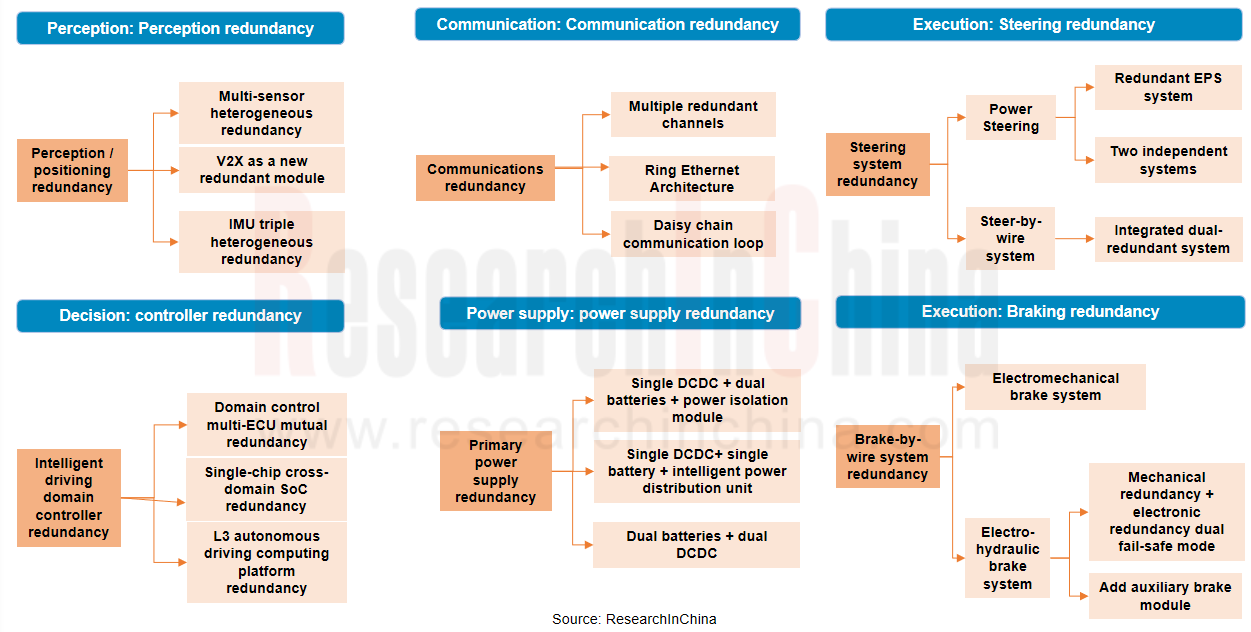
Execution redundancy: Fully redundant design of braking and steering systems
Execution redundancy and decision redundancy are the core parts, directly determining whether the vehicle can make correct response at a critical moment. Execution redundancy is often placed in braking and steering systems, and is generally designed as two independent systems with same functions. Decision redundancy is on the brain side. In vehicle EEA, the central computing platform is equipped with two sets of core computing units, and the redundant architecture design concept is adopted at vehicle architecture level, function definition level, system level, etc.
From the perspective of braking redundancy, its characteristics and trends are as follows:
At present, the key product is electro-hydraulic brake system (EHB), and the common redundancy schemes are the mechanical redundancy + electronic redundancy dual fail-safe mode, and adding auxiliary brake modules;
Brake-by-wire system is the future trend, because the electromechanical brake system (EMB) completely abandons brake fluid, hydraulic pipelines and other components of traditional braking systems, and generates braking force by electric motor drive, which improves the response speed, simplifies the structural layout, and enables inherent redundancy capabilities. However, it has extremely high reliability requirements and is difficult to mass-produce and install on vehicles in the short term.
In terms of steering redundancy, its characteristics and trends are as follows:
Currently the electric power steering system (EPS) mainly adopts the dual EPS steering redundancy scheme with two motors, two power supplies and two windings, which is equivalent to two sets of completely independent EPS hardware, which are independent of and backed up by each other, and the overall cost is relatively high;
The steering system is developing from electric power mode to wired-control mode. Steer-by-wire (SBW) system is composed of three main parts, i.e., steering wheel assembly, steering actuator assembly and ECU, as well as auxiliary systems such as automatic fail-safe system and power supply. It offers benefits of quick response, flexible installation method, light weight and high collision safety. SBW system therefore needs to have redundant backup of core components.
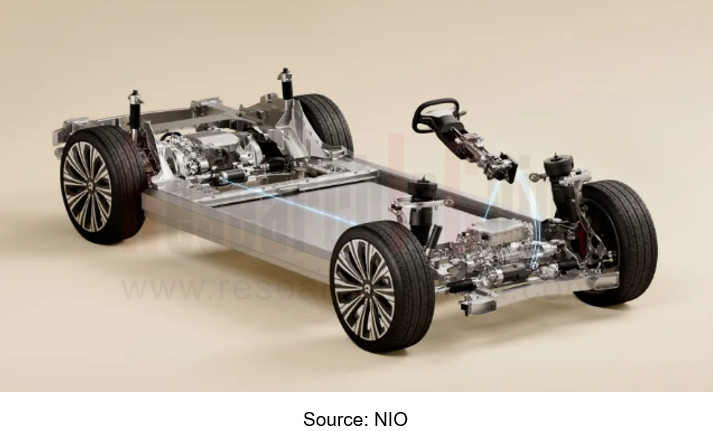
Redundant design of steer-by-wire system of NIO NT 3.0 Platform
The steer-by-wire system is used for transmission and control of electrical signals between the steering wheel and wheels. The angle and resistance torque of the steering wheel can be freely designed, with lower delay, more precise control, higher transmission efficiency and more flexible layout.
Fully redundant design with dual power supply, dual communication, dual hardware and dual software. Although there are no mechanical steering columns to connect the steering wheel and wheels, its reliability is 2.2 times higher than common electric power steering systems.
In December 2024, NIO ET9, the first model based on NT 3.0 Platform, acquired the mass production license for steer-by-wire technology from the Ministry of Industry and Information Technology, becoming China's first model carrying steer-by-wire technology.
Integrated redundant design for central computing architecture
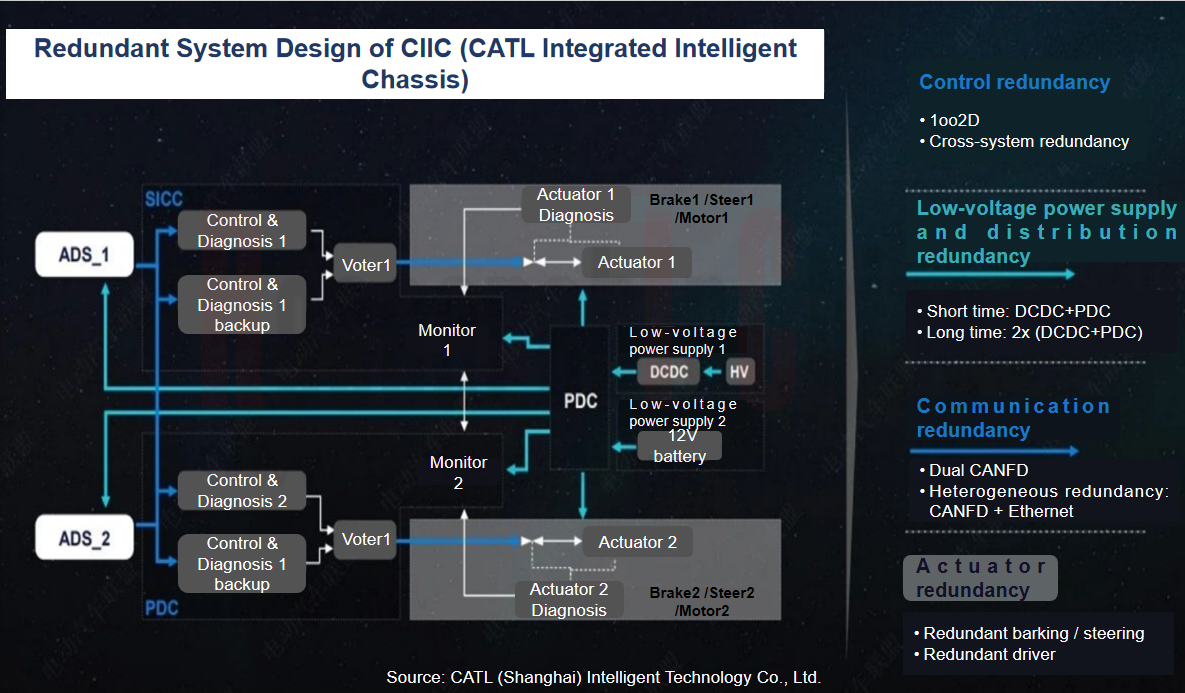
With the in-depth application of intelligent connection and autonomous driving technologies, vehicle braking and steering systems are heading in the direction of integration. The central EEA and integrated chassis launched by some OEMs and suppliers combine the braking system, steering system, drive system, etc., and adopt an integrated and fully redundant design concept.
CATL Integrated Intelligent Chassis (CIIC) of CATL (Shanghai) Intelligent Technology Co., Ltd.
CIIC (CATL Integrated Intelligent Chassis) launched by CATL (Shanghai) Intelligent Technology Co., Ltd. is a highly intelligent skateboard chassis, with core features of "upper and lower decoupling, high integration, and openness".
CIIC highly integrates vehicle drive system, brake system, steering system, suspension system, etc. into the physical underbody, and the platform design enables scalable software and hardware;
CIIC-M (middle platform) adopts fully wired-control technology, eliminating the mechanical connection between the brake pedal and ECU, and completely decoupling the upper and lower bodies; meanwhile, it adds software redundancy strategy, safety monitoring, and fault handling mechanism to ensure system safety and robustness.
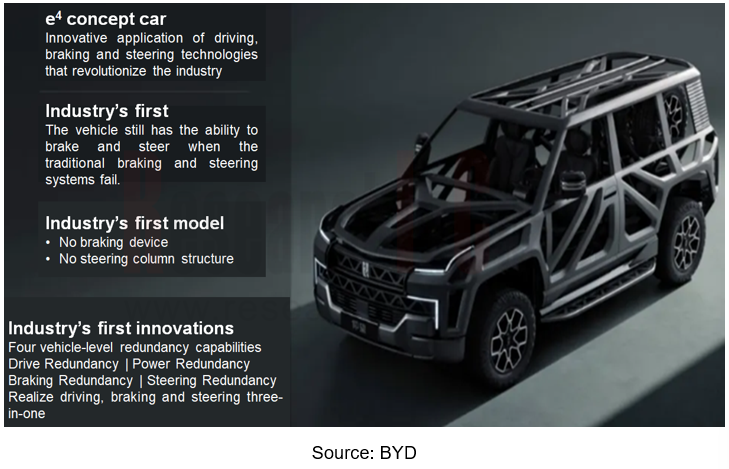
BYD e4 Platform
BYD's e4 Platform cancels the steering column and brake caliper, and uses the driving-braking-steering three-in-one technology to achieve steering and braking, thereby realizing vehicle-level safety redundancy capabilities.
Equipped with four 220-240kW large motors, it achieves the maximum braking deceleration of 1g and braking through precise motor torque and speed control, coupled with power blade batteries, new silicon carbide motor controller and advanced thermal management technology;
Differential steering technology is used to steer the vehicle. The left and right wheels receive different torques to deflect and thus complete the steering. The minimum turning diameter is 12 meters, and in the 18m pylon course slalom test, the maximum speed is 60km/h.
The e4 Platform features a distributed drive form with four independently driven motors, and it enables basic driving capabilities even if only one motor is working. In addition, the e4 Platform's innovative technology can provide braking and steering dual redundant backup based on existing braking and steering.
Control redundancy: Multi-ECU redundancy is still the mainstream solution, and will develop towards single-chip redundancy in the future
The control system must meet fail-operational requirements to achieve L3 and above autonomous driving functions, that is, after a sensor fails, the vehicle can still perform corresponding functions and complete driving safely. To this end, controlling system will use two or three ECUs, and implant some redundant safety measures on some sensors, or achieve control redundancy by adding chips in the domain controller.
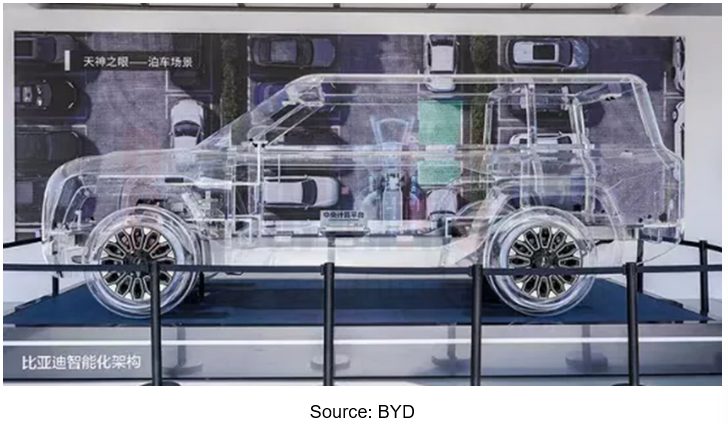
Multi-ECU Redundancy Solution - Dual Computing Platforms of BYD Xuanji Intelligent Architecture
As the main computing platform, Tianxuan cross-domain computing platform integrates the power domain, body domain and chassis domain, and adopts a multi-PCB design scheme for cooperative control of power domain, body domain and chassis domain;
A backup computing platform Tianji is added as backup redundancy. It is connected to the front and rear control domains via dual Gigabit Ethernet for case of need.
Single-chip redundant layout - based on Renesas multi-domain fusion SoC R-Car X5
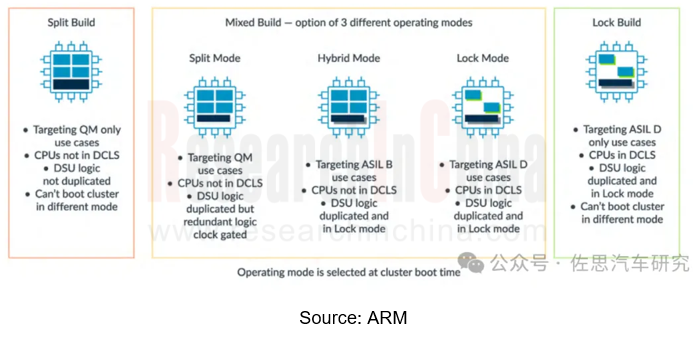
R-Car X5, Renesas Electronics' the latest generation of automotive multi-domain fusion SoC (using ARM Cortex-A720AE core, meeting ASIL-B to ASIL-D functional safety requirements; 32-core design, CPU computing power up to 1000kDMIPS), supports the safety isolation of multiple domains with different functional safety level requirements, and adopts hardware-based "Freedom From Interference (FFI)" technology. This hardware design achieves the isolation of critical safety functions (such as brake-by-wire) from non-critical functions, and critical functions that are considered to be related to safety can be assigned to their own independent and redundant domain. Each domain has its own independent CPU core, memory, and interface, thereby preventing potential catastrophic failures in the vehicle when hardware or software in different domains fails.
AI-Defined Vehicle (AIDV) OEMs' Deployment Strategies Research Report, 2026
AIDV Research: Deployment Strategies of 22 OEMs
The AI-Defined Vehicle (AIDV) OEMs' Deployment Strategies Research Report, 2026, released by ResearchInChina, analyzes the AI deployment strategies of ...
OEMs’ Passenger Car Model Planning Research Report, 2026
Vehicle Model Planning Research: Chinese OEMs Launch Sub-Brands Intensively, While Multinational OEMs Apply the Brakes to Electrification Strategies
ResearchInChina released the OEMs’ Passenger Car M...
Autonomous Driving Simulation and World Model Research Report, 2026
Autonomous driving simulation research: "Simulation test + world model"-driven test system has become R&D infrastructure.
The "Autonomous Driving Simulation and World Model Research Report, 2026"...
Cockpit-Driving Integration Central Domain Controller SoC and AI Supercomputing Architecture Research Report, 2026
Cockpit-Driving integration and AI supercomputing research: The One Chip solution is rapidly installed in vehicles, and AI supercomputing architectures are moving towards full-domain integration.
AI ...
Intelligent Driving End-to-End Large Model Research Report, 2026
Research on Intelligent Driving Large Models: A Critical Period for Technological Competition and Paradigm Integration
As autonomous driving technology rapidly iterates from L2 to L3?L4, intelligent...
Automotive Digital Key Industry Trend Report, 2026
Digital Key Research: Automotive BLE, UWB and SLE Hardware Layout
The Automotive Digital Key Industry Trend Report, 2026, released by ResearchInChina, analyzes and predicts the digital key market, co...
Monthly Report on Automotive New Technology (May 2026)
UHD gaze technology, full-color LiDAR, UWB, etc. promote the upgrade of intelligent driving perception capabilities
This report is published once a month and is available for annual subscription.The...
In-Cabin Monitoring Systems (DMS, OMS, etc.) Research Report, 2026
In-Cabin Monitoring System Research: DMS to Become Mandatory in 2027, Expected to be Installed in Over 14 Million Vehicles
ResearchInChina released the In-Cabin Monitoring Systems (DMS, OMS, etc.) Re...
Automotive Service-Oriented Architecture (SOA) and Cross-Domain Middleware Industry Report, 2026
Research on automotive SOA and cross-domain middleware: The era of AI atomic services and AI cross-domain fusion agents is coming.
Automotive SOA evolves towards AI + full SOA servitization Driv...
Automotive Display, Center Console and Cluster Industry Report, 2026
Automotive Display Research: Multi-Screen Application Slows Down, While OLED and MiniLED Are Introduced in Vehicles Quickly
In 2026, automotive displays will no longer excessively pursue the number a...
Global and China Intelligent Vehicle Standard System Construction and Certification Research Report, 2026
Intelligent Driving Standards and Certification: With the Maturing Standardization System, China Will Participate in Formulation of Global Standards
China's automotive industry is transforming from ...
Automotive Intelligent Diagnosis Industry Report, 2026
Automotive Intelligent Diagnosis Research: Powered by AI, Remote Diagnosis Is Being Upgraded towards Intelligence.
ResearchInChina released the Automotive Intelligent Diagnosis Industry Report, 2026....
Automotive Cloud Service Platform Research Report, 2026
Research on automotive cloud service platform: with architecture upgrade and computing power improvement, cloud services enter a new stage
In 2026, the Internet of Vehicles industry generates petaby...
Integrated Battery and Innovative Battery Technology Research Report, 2026
Power Battery Research: Sales of High-Capacity Vehicles Keep Rising, and Solid-State Batteries Begin to Be Installed in Vehicles
I. Sales of High-Capacity Vehicles Sustain Growth, and Those with A C...
Chinese Independent OEMs’ ADAS and Autonomous Driving Report, 2026
Research on OEMs' Intelligent Driving: Era of Physical AI, Standard Configuration of D2D, and Initial Exploration of L3 Commercial Pilot Projects
From 2023 to 2025, the intelligent driving installati...
Intelligent Vehicle New Technology Application Analysis Report, 2025-2026
New Technology Research: Innovative Products such as Bionic Cameras, Vision-LiDAR Fusion Sensors, Auditory Sensors Further Enhance Vehicle Perception Capabilities
ForewordResearchInChina released th...
Automotive Optical Fiber Communication (Optical Fiber Ethernet, PON) and Supply Chain Research Report, 2026
Research on Automotive Optical Fiber Communication: Introduction of Optical Fiber in Vehicles Accelerates, with Priority Deployment in High-Speed Communication Link (10+Gbps) Scenarios
Automotive opt...
Automotive Intelligent Cockpit SoC Research Report, 2026
Automotive Cockpit SoC Research: Passenger Cars in the Price Range of RMB100,000–200,000 Account for Nearly 50% of Total Sales, and New-Generation Cockpit SoC Products Largely Enter Mass Production
P...