Modular platforms and common technology platforms of OEMs are at the core of current technological innovation in automotive industry, aiming to enhance R&D efficiency, reduce costs, and accelerate technological innovation. Modular platforms serve as the cornerstone for the expansion of OEMs' product matrices, while common technology platforms drive industry-wide technological collaboration and ecosystem integration.
In the future, the integration of these two will accelerate the transformation of the automotive industry towards electrification and intelligence, forming a new competitive landscape characterized by "standardized hardware + personalized software."
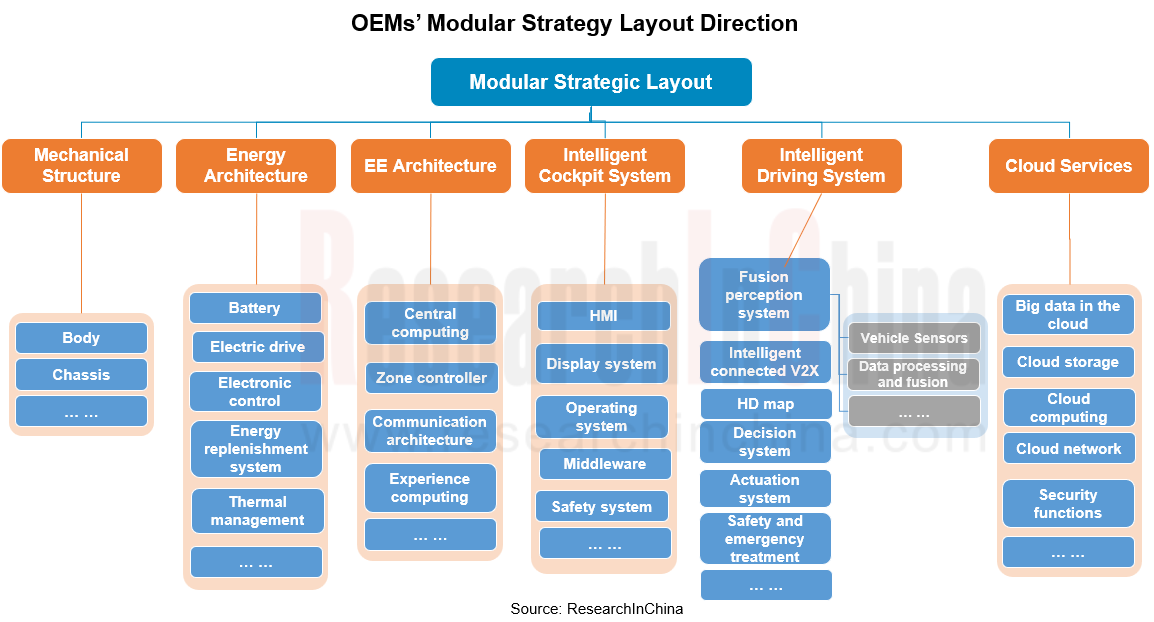
The essence of automotive modular platforms lies in increasing the flexibility of vehicle development and improving the sharing rate of components through modular standards, while providing hardware support for the new generation of EE architectures in the context of new "EISC (Electrification, Intelligentization, Shareability, Connectivity)."
Currently, major global OEMs have launched their own modular platforms, such as Volkswagen's MQB platform, the Renault-Nissan Alliance's CMF platform, Toyota's TNGA architecture, and Volvo's SPA platform, covering a wide range of vehicle models from Class A to Class D, Class E, as well as SUVs and MPVs.
Building upon modular vehicle manufacturing platforms, OEMs have further established systematic common technology platforms, with the domestic emerging car brand XPeng Motors being a standout example in this regard.
XPeng's vehicle manufacturing platforms mainly include the D platform, E platform, F platform, and H platform:
The D platform, also known as the David platform, is XPeng's production platform for Class A and below vehicles. Current models on this platform include the XPeng P5 and XPeng MONA M03 (a collaboration between XPeng and DiDi).
The E platform, or Edward platform, is XPeng's platform for Class B and Class C vehicles, launched after the David platform.
The F platform, known as the "Fuyao Platform," is a mid-sized vehicle platform. Its features include front and rear integrated die-casting, 800V architecture, and advanced EE architecture.
The H platform is XPeng's most high-end platform, targeting mid-to-large-sized vehicles.
The core of XPeng's modular vehicle manufacturing is the SEPA 2.0 Fuyao Architecture. This architecture covers a wide range of vehicle models from Class A to Class D (including sedans, SUVs, and MPVs) and supports a wheelbase range of 1800-3200mm. Through modular design, SEPA 2.0 achieves a parts commonality rate of up to 80%, reduces the R&D cycle by 20%, and integrates technologies such as CIB (Cell Integrated Body) technology and integrated die-casting processes, significantly lowering manufacturing costs and reducing vehicle weight.
With continuous technological iteration and evolution, XPeng has unveiled the new technology topology for its next-generation models, which includes:
5C Ultra-Fast Charging AI Battery: Paired with the S5 liquid-cooled ultra-fast charging station, it can charge over 1 km of range per second, reaching 80% charge in just 12 minutes.
Hybrid Silicon Carbide Coaxial E-Drive: The e-drive system achieves a comprehensive efficiency of 93.5% (CLTC), with a 30% reduction in size compared to traditional motors, freeing up more space for the rear seats.
Silent Range Extender (operating noise of only 1dB): Equipped with XPeng's Kunpeng Super Electric System.
Deep Integration of AI Technologies, including:
AI Battery Doctor: Manages the battery through a dedicated chip, extending battery life by 30%.
AI Powertrain: Intelligently adjusts energy consumption and power output to adapt to different road conditions.
AI Chassis: Combines visual perception to predict road conditions and dynamically adjusts the suspension system.
Next-Generation CIB+ Mid-Floor Integrated Die-Casting Technology: A 16,000T die-casting machine (island) will be expanded to support the production of larger die-cast components. Currently, research is underway on CIB+ mid-floor integrated die-casting technology, which is expected to increase vehicle range by 5% and reduce manufacturing costs by 10-30%.
XPeng Turing AI Autonomous Driving:
Hawkeye Vision Deployment: The AI Hawkeye Vision solution will enter mass production in 2025H1, first installed in the P7+ model and gradually extended to other models.
L3 Autonomous Driving Deployment: L3 autonomous driving will be operational by 2025H2.
End-to-End Foundation Model Deployment: The One-Model end-to-end will deliver a superior autonomous driving experience, achieving less than one intervention per 100 kilometers.
The new modular and common technology platforms have become XPeng's key to success. XPeng has completed the transition from old to new product platforms:
MONA M03: A compact sedan starting at RMB 119,800, selling hot due to its high cost-performance ratio and design advantages.
P7+: Starting at RMB 186,800, it emphasizes the concept of "AI-Defined Vehicle."
2025 XPeng G6: Positioned as an all-electric SUV in the RMB 150,000-200,000 range, starting at RMB 176,800, it focuses on AI, featuring the "Turing AI Autonomous Driving" and "5C Ultra-Fast Charging AI Battery" as standard across all models, making it the next potential bestseller.
2025 XPeng G9: Positioned as an all-electric SUV in the RMB 250,000-300,000 range, starting at RMB 248,800, it shares the same common technology platform as the new G6.
G7: Positioned as an all-electric SUV in the RMB 200,000-250,000 range, slightly above the G6, competing with the Xiaomi YU7 and the refreshed Tesla Model Y.
G01 (First Vehicle of the Kunpeng Super Electric System): Positioned as a C+-Class 6-seat SUV, it introduces plug-in hybrid range-extending technology, based on an 800V high-voltage silicon carbide platform, equipped with the 5C Ultra-Fast Charging AI Battery, hybrid silicon carbide coaxial e-drive, silent range extender (operating noise of only 1dB), AI Battery Doctor, and AI Powertrain. The range-extended version is expected to use the Dong'an engine, offering a battery electric range of 430 km and a comprehensive range of over 1,400 km. The first range-extended model is expected to enter mass production in 2025H2.
In 2024, XPeng's total sales reached 190,000 units, a year-on-year increase of 34.2%. Supported by a series of new product launches and new technology platforms, XPeng aims to achieve sales of 350,000 units in 2025.
AI-Defined Vehicle (AIDV) OEMs' Deployment Strategies Research Report, 2026
AIDV Research: Deployment Strategies of 22 OEMs
The AI-Defined Vehicle (AIDV) OEMs' Deployment Strategies Research Report, 2026, released by ResearchInChina, analyzes the AI deployment strategies of ...
OEMs’ Passenger Car Model Planning Research Report, 2026
Vehicle Model Planning Research: Chinese OEMs Launch Sub-Brands Intensively, While Multinational OEMs Apply the Brakes to Electrification Strategies
ResearchInChina released the OEMs’ Passenger Car M...
Autonomous Driving Simulation and World Model Research Report, 2026
Autonomous driving simulation research: "Simulation test + world model"-driven test system has become R&D infrastructure.
The "Autonomous Driving Simulation and World Model Research Report, 2026"...
Cockpit-Driving Integration Central Domain Controller SoC and AI Supercomputing Architecture Research Report, 2026
Cockpit-Driving integration and AI supercomputing research: The One Chip solution is rapidly installed in vehicles, and AI supercomputing architectures are moving towards full-domain integration.
AI ...
Intelligent Driving End-to-End Large Model Research Report, 2026
Research on Intelligent Driving Large Models: A Critical Period for Technological Competition and Paradigm Integration
As autonomous driving technology rapidly iterates from L2 to L3?L4, intelligent...
Automotive Digital Key Industry Trend Report, 2026
Digital Key Research: Automotive BLE, UWB and SLE Hardware Layout
The Automotive Digital Key Industry Trend Report, 2026, released by ResearchInChina, analyzes and predicts the digital key market, co...
Monthly Report on Automotive New Technology (May 2026)
UHD gaze technology, full-color LiDAR, UWB, etc. promote the upgrade of intelligent driving perception capabilities
This report is published once a month and is available for annual subscription.The...
In-Cabin Monitoring Systems (DMS, OMS, etc.) Research Report, 2026
In-Cabin Monitoring System Research: DMS to Become Mandatory in 2027, Expected to be Installed in Over 14 Million Vehicles
ResearchInChina released the In-Cabin Monitoring Systems (DMS, OMS, etc.) Re...
Automotive Service-Oriented Architecture (SOA) and Cross-Domain Middleware Industry Report, 2026
Research on automotive SOA and cross-domain middleware: The era of AI atomic services and AI cross-domain fusion agents is coming.
Automotive SOA evolves towards AI + full SOA servitization Driv...
Automotive Display, Center Console and Cluster Industry Report, 2026
Automotive Display Research: Multi-Screen Application Slows Down, While OLED and MiniLED Are Introduced in Vehicles Quickly
In 2026, automotive displays will no longer excessively pursue the number a...
Global and China Intelligent Vehicle Standard System Construction and Certification Research Report, 2026
Intelligent Driving Standards and Certification: With the Maturing Standardization System, China Will Participate in Formulation of Global Standards
China's automotive industry is transforming from ...
Automotive Intelligent Diagnosis Industry Report, 2026
Automotive Intelligent Diagnosis Research: Powered by AI, Remote Diagnosis Is Being Upgraded towards Intelligence.
ResearchInChina released the Automotive Intelligent Diagnosis Industry Report, 2026....
Automotive Cloud Service Platform Research Report, 2026
Research on automotive cloud service platform: with architecture upgrade and computing power improvement, cloud services enter a new stage
In 2026, the Internet of Vehicles industry generates petaby...
Integrated Battery and Innovative Battery Technology Research Report, 2026
Power Battery Research: Sales of High-Capacity Vehicles Keep Rising, and Solid-State Batteries Begin to Be Installed in Vehicles
I. Sales of High-Capacity Vehicles Sustain Growth, and Those with A C...
Chinese Independent OEMs’ ADAS and Autonomous Driving Report, 2026
Research on OEMs' Intelligent Driving: Era of Physical AI, Standard Configuration of D2D, and Initial Exploration of L3 Commercial Pilot Projects
From 2023 to 2025, the intelligent driving installati...
Intelligent Vehicle New Technology Application Analysis Report, 2025-2026
New Technology Research: Innovative Products such as Bionic Cameras, Vision-LiDAR Fusion Sensors, Auditory Sensors Further Enhance Vehicle Perception Capabilities
ForewordResearchInChina released th...
Automotive Optical Fiber Communication (Optical Fiber Ethernet, PON) and Supply Chain Research Report, 2026
Research on Automotive Optical Fiber Communication: Introduction of Optical Fiber in Vehicles Accelerates, with Priority Deployment in High-Speed Communication Link (10+Gbps) Scenarios
Automotive opt...
Automotive Intelligent Cockpit SoC Research Report, 2026
Automotive Cockpit SoC Research: Passenger Cars in the Price Range of RMB100,000–200,000 Account for Nearly 50% of Total Sales, and New-Generation Cockpit SoC Products Largely Enter Mass Production
P...