ADAS and Autonomous Driving Tier 1 Suppliers Report, 2018-2019
-
May 2019
- Hard Copy
- USD
$3,200
-
- Pages:145
- Single User License
(PDF Unprintable)
- USD
$3,000
-
- Code:
LY006
- Enterprise-wide License
(PDF Printable & Editable)
- USD
$4,500
-
- Hard Copy + Single User License
- USD
$3,400
-
ADAS and Autonomous Driving Tier 1 Suppliers Report, 2018-2019: Huge Investment, Increasing Orders, and Soaring Labor Cost
From the progress of the world’s main Tier1 suppliers in autonomous driving, it can be seen that the giants like Bosch and Continental are moving forward at their own pace in line with their timetable.
Traditional Tier1 suppliers are sparing no efforts in enlarging talent teams (especially software), developing ADAS/AD domain controllers, acquiring sensor firms and self-development, testing autonomous driving technology in various scenarios (industrial park, highway, parking, etc.), expanding autonomous fleets for road test, building test fields on their own or together with others, establishing operation and data management centers, and allying themselves with more partners.
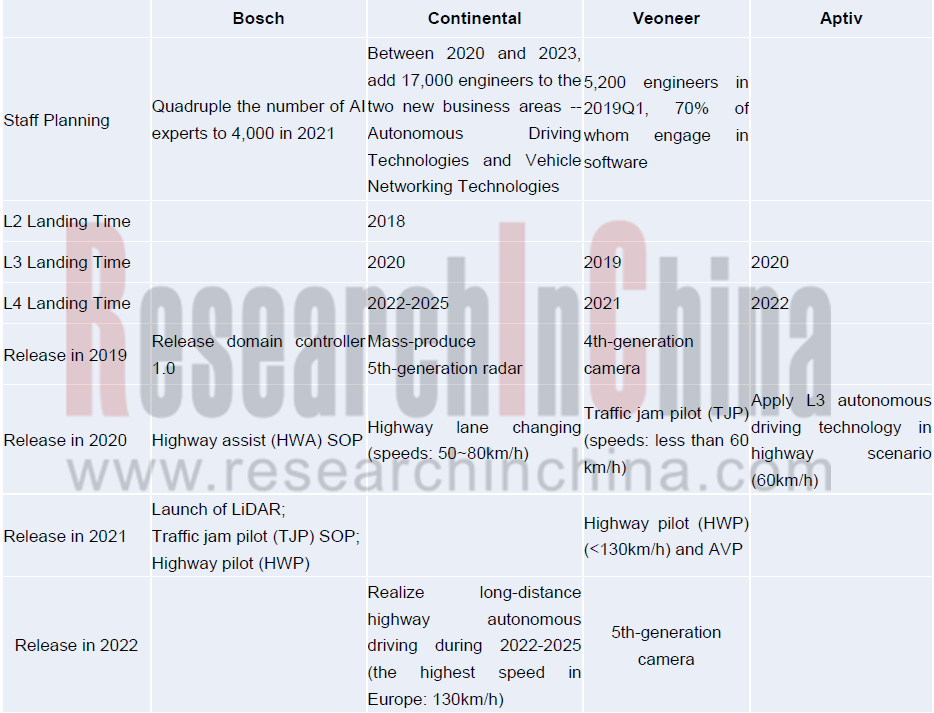
Tier1 suppliers suffer a slump in profits and even a bigger loss because of huge investment in autonomous driving, but there is good news that orders are increasing.
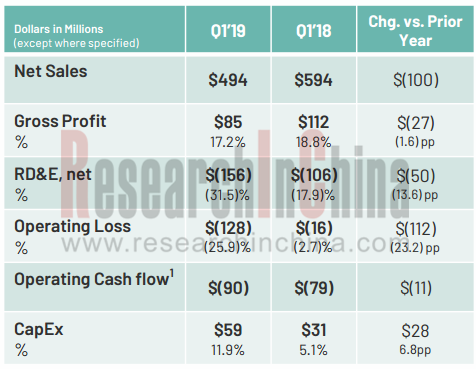
Veoneer’s operating loss for 2019Q1 jumped to USD128 million compared with USD16 million in 2018Q1; its R&D expenses rose to USD156 million from USD106 million in 2018Q1; capital expenditure surged from USD31 million to USD59 million largely for camera capacity expansion, according to Veoneer’s 2019Q1 financial results in the table above.
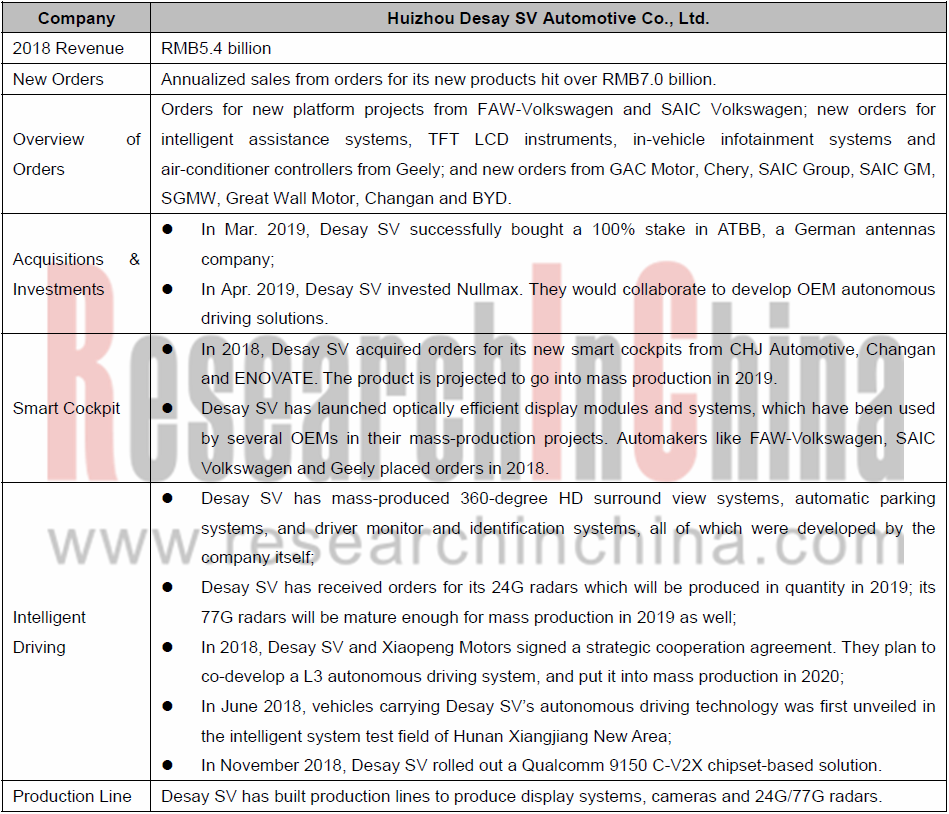
Among Chinese Tier1 suppliers, Huizhou Desay SV Automotive Co., Ltd., a leading player in ADAS and autonomous driving field, also sees its profit decline. The supplier’s operating results for 2019Q1 indicate that its net income attributable to the shareholders of the listed company stood at RMB43.54 million, a 72.82% plunge on an annualized basis, which was caused by a nosedive in China’s 2019Q1 automobile sales and the company’s huge investment in research and development of new technologies. In 2018, the company reported RMB5.4 billion in revenue, with annualized sales from orders for its new products outnumbering RMB7.0 billion.
In April 2019, Huawei made its debut as a Tier1 supplier at Auto Shanghai, and exhibited solutions such as MDC, intelligent connectivity, Huawei Cloud (Octopus) and three types of sensors.
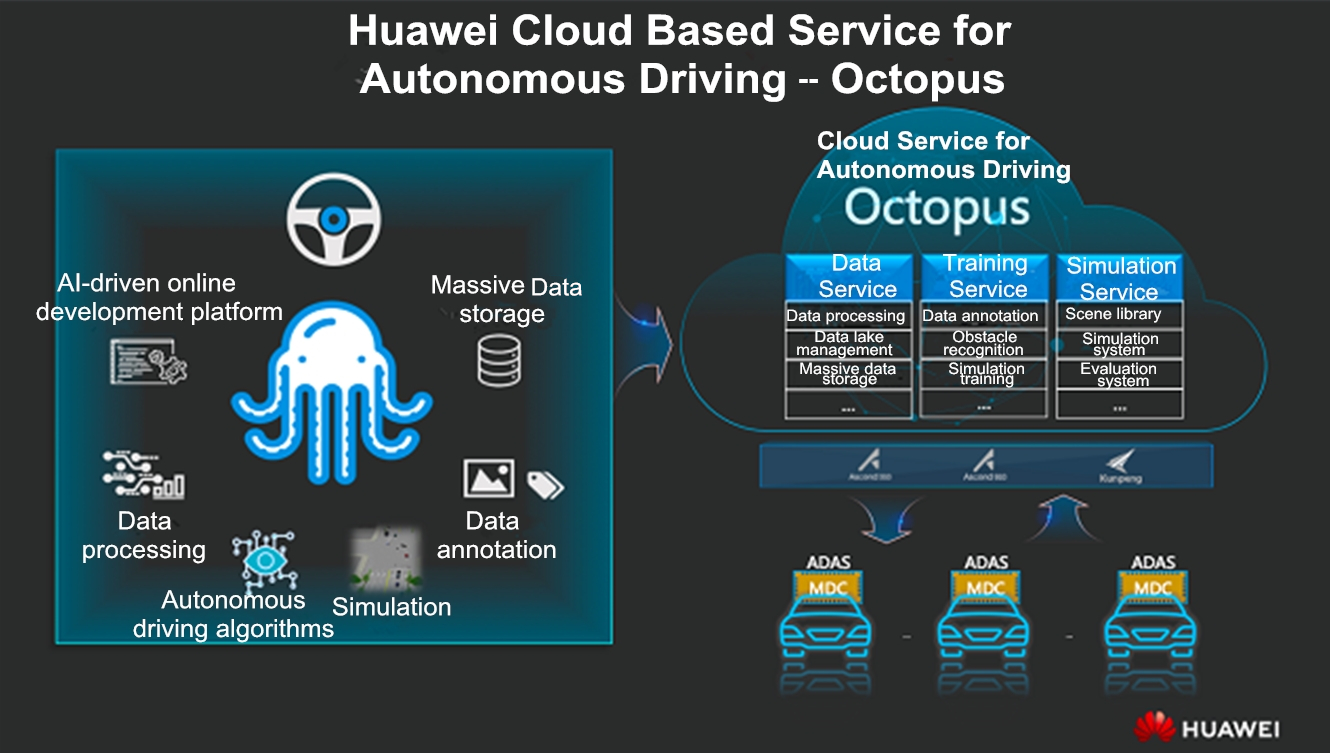
Huawei’s entry will intensify the already fierce competition among Tier1 suppliers of ADAS and autonomous driving solutions.
1 Comparative Analysis of Main ADAS and Autonomous Driving Tier1 Suppliers
1.1 Autonomous Driving System Is Divided into Three Levels
1.2 Autonomous Driving Planning, Commercialization Process and Development Features of Foreign Tier1 Suppliers
1.3 Product Layout of Foreign Tier1 Suppliers
1.4 Comparison of Foreign Tier1 Suppliers (including Revenue, Profit, Orders, Partners and Investment)
1.5 Planning Comparison of Foreign Tier1 Suppliers (including Personnel Planning, Launch Time of L2-L4, Products to Be Launched in 2019-2022)
1.6 Vision Product Investment Comparison of Foreign Tier1 Suppliers (Monocular, Stereo, etc.)
1.7 Radar Investment Comparison of Foreign Tier1 Suppliers (Millimeter Wave Radar, LiDAR, Ultrasonic Radar)
1.8 Other Technology Investment Comparison of Foreign Tier1 Suppliers (V2X, HD Map, High-precision Positioning, Domain Controller)
1.9 Autonomous Driving Application Scenario R&D Comparison of Main Tier1 Suppliers (Minibus, City, Highway, Parking)
1.10 Autonomous Driving Test and Operation Comparison of Main Tier1 Suppliers (Test Field, Test Vehicle, Base, etc.)
1.11 Development Layout Comparison of Chinese Tier1 Suppliers
2 Tier1 Suppliers of ADAS and Autonomous Driving Solutions Worldwide
2.1 Bosch
2.1.1 Profile
2.1.2 Autonomous Driving Sensor
2.1.3 Autonomous Driving Positioning Solution
2.1.4 Decision: Domain Controller
2.1.5 Autonomous Driving Product Layout
2.1.6 Autonomous Shuttle
2.1.7 Autonomous Driving Partners
2.1.8 ADAS and Autonomous Driving in 2018-2019
2.2 Continental
2.2.1 Profile
2.2.2 Performance
2.2.3 Organizational Restructuring Will Be Completed by 2020
2.2.4 Sensors
2.2.5 Autonomous Driving Development Plan
2.2.6 Three Integrated Solutions for Autonomous Driving
2.2.7 CuBE and Seamless Driving & Delivery
2.2.8 Autonomous Driving Layout and Partners
2.2.9 Autonomous Driving Layout in 2018-2019
2.3 Aptiv
2.3.1 Profile
2.3.2 Revenue and Orders
2.3.3 Strategic Positioning
2.3.4 Multi-domain Controller
2.3.5 ADAS Sensor
2.3.6 Autonomous Driving Route
2.3.7 Autonomous Driving Solution CSLP
2.3.8 L4 Test Autonomous Vehicle
2.3.9 Cooperation with Lyft in Autonomous Driving
2.3.10 Expedited Layout in Autonomous Driving Industry Chain through Investments, Acquisitions and Collaborations
2.3.11 Autonomous Driving Layout in 2018-2019
2.4 Valeo
2.4.1 Profile
2.4.2 Sensor Product Layout
2.4.3 Sensing Solution
2.4.4 Three Autonomous Driving Systems and Technology Roadmaps
2.4.5 Cruise4U (Highway)
2.4.6 Drive4U (Urban Road)
2.4.7 Automated Parking System Park4U
2.4.8 Autonomous Driving Partners
2.4.9 Autonomous Driving Dynamics in 2018-2019
2.5 ZF
2.5.1 Profile
2.5.2 Product Layout
2.5.3 ZF Sensors
2.5.4 ProAI
2.5.5 Autonomous Taxi and IoT Platform
2.5.6 Autonomous Driving Partners
2.5.7 Autonomous Driving Dynamics in 2018-2019
2.6 Hyundai Mobis
2.6.1 Profile
2.6.2 Autonomous Driving Layout
2.6.3 Research Progresses of ADAS and Autonomous Driving
2.6.4 ADAS and Autonomous Driving Dynamics in 2018-2019
2.7 Veoneer
2.7.1 Profile
2.7.2 Development in 2018 and Outlook for 2019
2.7.3 Major Projects and Customers
2.7.4 Product Milestones
2.7.5 Autonomous Driving Layout
2.7.6 Vision Products and Functional Planning
2.7.7 Monocular Vision System
2.7.8 Zeus
2.7.9 Autonomous Driving Solutions
2.7.10 ADAS Partners
2.7.11 Planning for Autonomous Driving Development
2.7.12 ADAS and Autonomous Driving Dynamics in 2018-2019
2.8 Visteon
2.8.1 Profile
2.8.2 Operation (Worldwide) in 2018
2.8.3 Operation (China) in 2018
2.8.4 Positioning in the Autonomous Driving Industry Chain
2.8.5 Major Products
2.8.6 Autonomous Driving Domain Controller DriveCore
2.8.7 DriveCore Computing Platform: Compute
2.8.8 DriveCore Algorithm: Studio
2.8.9 DriveCore Middleware: Runtime
2.8.10 ADAS Development History and Autonomous Driving Roadmap
2.8.11 Three ADAS Segments and Features
2.8.12 L3/L4 Autonomous Driving Test
2.8.13 Autonomous Driving Schedule
2.8.14 Autonomous Driving Partners
2.8.15 Autonomous Driving Dynamics in 2018-2019
2.9 Magna
2.9.1 Vision Products
2.9.2 Visual ADAS
2.9.3 MAX4 Domain Controller
2.9.4 MAX4 for L4 Autonomous Driving
2.9.5 Autonomous Driving Dynamics
2.10 Denso
2.10.1 Revenue
2.10.2 Autonomous Driving Investment and R&D Layout
2.10.3 Millimeter Wave Radar
2.10.4 Denso Ten
2.10.5 ADAS and Autonomous Driving Dynamics
3 Tier 1 Suppliers of Intelligent Connected ADAS and Autonomous Driving Solutions in China
3.1 Baidu
3.1.1 Apollo Platform
3.1.2 Apollo Autonomous Driving Open Roadmap
3.1.3 Apollo Open Platform Progress
3.1.4 Apollo Partners
3.1.5 L4 Passenger Car Solution and Partners
3.1.6 L4 Autonomous Park Car Solution
3.1.7 Open Source of V2X CVIS Solution
3.1.8 Upcoming Commercial Packaged Solution
3.1.9 Autonomous Driving Progress
3.2 Tencent
3.2.1 AD Lab
3.2.2 Autonomous Driving Layout
3.2.3 Autonomous Driving Solution
3.2.4 Autonomous Driving Planning
3.3 Neusoft Reach
3.3.1 Profile
3.3.2 Product Line
3.3.3 ADAS
3.3.4 Autonomous Driving
3.3.5 Cooperation
3.4 Huawei
3.4.1 Intelligent Connected Vehicle Business
3.4.2 L4 Computing Platform
3.4.3 C-V2X Technology
3.4.4 Intelligent Connected Vehicle Partners
3.4.5 Octopus
3.5 Foryou Corporation
3.5.1 Automotive Electronics Business
3.5.2 R&D Planning in 2019
3.6 Desay SV
3.6.1 Profile
3.6.2 Intelligent Vehicle Revenue and R&D Investment
3.6.3 Development of Three Major Businesses
3.6.4 Future Development Strategy
Autonomous Driving Domain Controller and Central Computing Unit (CCU) Industry Report, 2026
Autonomous Driving Domain Controller (ADCU) Research: One-Chip CCU solutions are quickly available in vehicles
In China's passenger car market, autonomous driving systems involved in mass production ...
Automotive EMS and ECU Industry Research Report, 2026
Automotive EMS Research: The boundaries between EMS providers and Tier1 suppliers are becoming blurred, and the supply chain model is evolving from a linear chain to a networked structure
Mainstream ...
Automotive Microcontroller Unit (MCU) and Application Scenario Research Report, 2026
Automotive MCU Research: Increased demand for redundant security drives ASIL D-compliant MCU shipments to exceed 100 million units
In a vehicle EEA, MCUs are widely distributed in various functional ...
China Intelligent Cockpit Patent Analysis Report, 2026
Intelligent Cockpit Patent Research: Cockpit AI, In?vehicle Health, and Infotainment Are Upgrade to Scenario?based and Proactive Functions
From a patent perspective, this report explores the cutting?...
Research Report on Application of VLA Large Model in Automobiles and Robots, 2026
Research on Automotive and Robot VLA: Hybrid Architectures Become Mainstream, VLA Integrates with General World Models, and Reinforcement Learning Serves as Core Engine
Vision?Language?Action (VLA) m...
China Charging Infrastructure (Supercharging, Battery Swapping, V2G, etc.) and High-Performance Supercharging Battery Research Report, 2026
Charging and battery swapping research: as 5C+ supercharging vehicle models go into mass production, the pace of OEMs self-building supercharging networks quickens
800-1000V high-voltage platforms ar...
China Passenger Car Electronic Controlled Suspension Industry Report, 2026
Electronic Controlled Suspension Industry Research: As the First Year of Full Active Suspension Unfolds, Three Technical Routes Race Forward
1. Penetration Rate Surges Three Times, and Electronic Con...
Intelligent Driving SoC Research Report, 2026
Research on Intelligent Driving SoCs: Competition Focus Shifts to L3/L4 Embedded Hardware, and Computing Power of Flagship Vehicle Models Exceeds 1,000 TOPS
In terms of intelligent driving system in...
Automotive AI Large Model Technology Research Report, 2026
Automotive AI Large Model Research: Competition Shifts from "Who Has the Stronger Model" to "Who Boasts Higher Link Efficiency"
ResearchInChina released the Automotive AI Large Model Technology Resea...
Intelligent Vehicle Cockpit Domain Controller Research Report, 2026
Cockpit domain controller research: L3 AIDV intelligent cockpit domain controllers are entering a boom period
Driven by multiple factors such as the continuous evolution of the automotive central int...
Automotive Acoustic System (Audio, Multi-Channel) Industry Report, 2026
Automotive Acoustics Research: Multiple Channels, AI Tuning, and Self-Developed Algorithms Drive the Transformation of High-End Cockpit Sound Fields
I. Automotive Audio Hardware Solutions with 6–9 S...
Autonomous Driving Sensor Chip Research Report, 2026
Research on Autonomous Driving Sensor Chips: Deeply Perceiving the Physical World, Sensor Chips Are Playing A “Leading Role” in Intelligence
In 2026, the autonomous driving sensor chip industr...
Passenger Car Corner Module and Wheel‑Side Control System Research Report, 2026
Wheel-side control research: the “last mile” chassis innovation
Wheel-side control dismantles the traditional drive, braking, steering, and suspension control of the chassis from a "centralized" styl...
Embodied Artificial Intelligence (& Humanoid Robot) MCU Research Report, 2026
Research on Humanoid Robot MCUs: Evolution from General-Purpose Control to High-Value Dedicated Chip Solutions Integrated with Edge AI Functions
MCU (Microcontroller Unit) refers to a compact integra...
Intelligent Vehicle Zone Control Unit (ZCU) Research Report, 2026
ZCU Research: Cross-domain integrated ZCUs are becoming the edge computing nodes of the next-generation zonal architecture
Currently, the mainstream zonal architecture is mainly the quasi-central + z...
Automotive Cybersecurity and Data Security Research Report, 2026
Cybersecurity & Data Security Research: Intelligent Connected Vehicles Enter the Era of “Systematic Offense-Defense and AI-Defined Security”.
Centering on the panorama of intelligent connect...
Report on Breakthrough Strategies of OEMs and ADAS Tier 1 Suppliers for Overseas Layout of Intelligent Driving, 2026
Regulatory Breakthrough, Local System Establishment, OEMs Competing for NOA Layout: Overall Trends of China’s Intelligent Driving Overseas Layout in 2026
Research on overseas intelligent driving layo...
OEMs and Tier1s’ Intelligent Cockpit Platform (Hardware and Software) Innovation Strategy Research Report, 2026
Intelligent Cockpit Platform Research: multi-dimensional cockpit system architecture reconstruction for multi-agent collaboration and proactive intelligent services
The intelligent cockpit software s...