IGBT (Insulated Gate Bipolar Transistor) is a fully controlled and voltage-driven power semiconductor device incorporating BJT and MOSFET, superior in small drive power, fast switching speed, low saturation voltage and large current density. IGBT is critical to electrical and electronic system and deemed as the ‘CPU’ of the electrical and electronic industry.
IGBT is given full play under varied voltage class, like its exertion under 650~1200V in electric vehicle, 650V in home appliances and industrial fixing, either 650V or 1200V in new energy vehicle, and above 1700V in PV, industrial motors, high-speed railway, bullet trains, smart grid, etc.
Power semiconductors are exponentially utilized as automotive technologies are transferring to focus on new energy vehicle. Vehicle performance and costs are imposed directly by the technical level of motor control system as an essential part of the NEV industry chain. IGBT, the centerpiece of electronic control system, has the merits like high input impedance, high switching speed and low conduction loss and plays a vitally important role in the high-voltage system. IGBT module serving as high-voltage control switch component constitutes about 40% of motor controller costs. IGBT devices make up about 10% of NEV cost and share roughly 20% of charging pile costs.
In a new energy vehicle, IGBT is found in battery management system, motor control system, electric air-conditioning control system, charging system, positive temperature coefficient (PTC), etc., acting (in master inverter) to convert the direct current (DC) of high-voltage battery into the alternating current (AC) to drive three-phase motor, and (in onboard charger, or OBC) to join conversion of 220V AC into DC for charging the high-voltage battery. Also, IGBT gets widely used in DC/DC converter, PTC, electric air-conditioning compressor and other systems. In addition to its use in battery electric vehicle, IGBT is required in the high-voltage system independent of the low-voltage system in the plug-in hybrid electric vehicle (PHEV), so is the case (but used on a small scale) in the ICE cars partially packed with 48V hybrid system, such as the control module in BSG.
Concerning its use in electric vehicle, a high demanding on IGBT is asked by voltage level, power level, limiting condition, reliability, service life, costs, among others. It remains a big challenge.
IGBT packaging technologies concern chip surface interconnect, tape-up interconnect, and conductive terminals interconnect, securing high reliability and high power density, and the running of electric motor controllers under high temperature. IGBT module packaging is now studied mostly on parameter optimization of new interconnection materials and interconnection modes in a bid for better heat dissipation, smaller footprint and higher reliability.
Market Competition
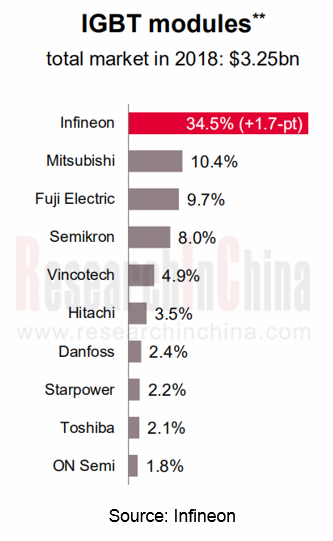
Global IGBT modules market is ruled by giants like Infineon, Mitsubishi Electric, Fuji Electric, ON Semi, and Semikron. The Chinese player Starpower is in the eighth place globally.
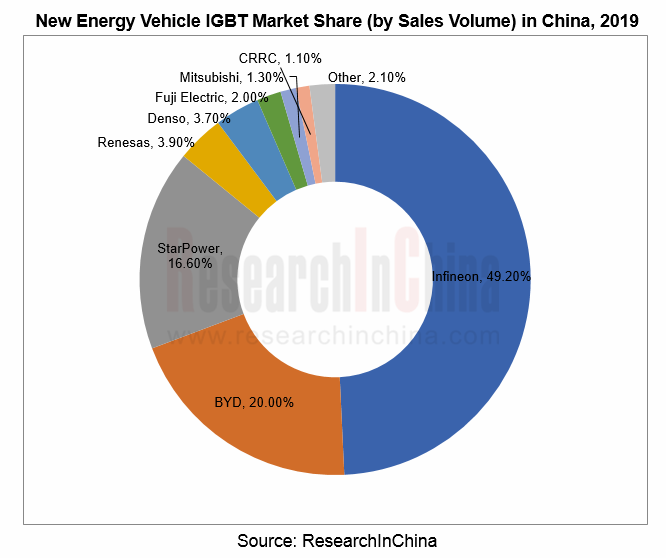
Electric vehicle (EV+PHEV) IGBT market share is learnt from those vehicle sales data, after a survey by ResearchInChina on the IGBT suppliers for EV and PHEV models on offer. Infineon stays far ahead of others, commanding 49.2%, followed by BYD 20.0% and StarPower 16.6%.
IGBT Industry Chain and Business Model
China has long been independent on importing IGBT chips and modules from abroad. It is since 2005 that a large number of overseas IGBT talents has come to China and devoted themselves to IGBT undertaking in China, where a sizable IGBT industry chain has already taken shape.
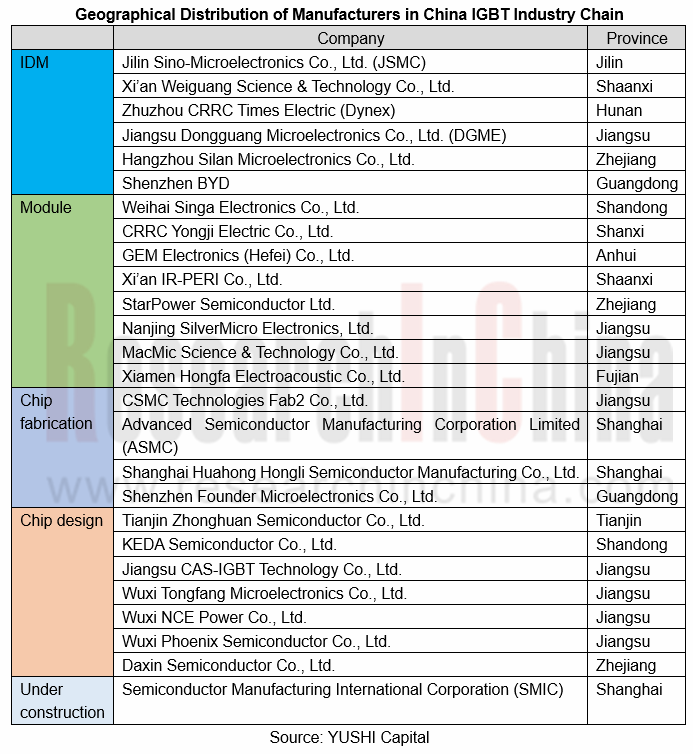
There are three IGBT business models, including Fabless, Packaging, and IDM (Integrated Device Manufacture).
·Fabless refers to the company that is only specialized in chip circuit design and sales with production outsourced, such as StarPower Semiconductor, and Jiangsu CAS-IGBT Technology.
·IDM refers to the company that involves in chip design, fabrication and packaging, such as BYD, Infineon, Mitsubishi, and Silan Microelectronics.
·Packaging model is to purchase chips and then do encapsulation independently, such as Danfoss that is engrossed in packaging technologies. Bosch, Continental and Delphi also have IGBT packaging business.
Danfoss wins support from chip vendors like Infineon and ON Semi. In June 2020, Infineon inked a multi-year deal with Danfoss and would provide the latter with IGBT and diode chipset used for power modules of electric vehicle inverter. In July 2020, ON Semi announced it would provide Danfoss with high-power IGBT and diodes for the inverter drive module of electric vehicle.
Development Status Quo and Future Trend
IGBT has been much sought after amid the trend of vehicle electrification. The IGBT vendors like Infineon, ON Semi and Microsemi now has a supply cycle from 13 weeks to 30 weeks, with a tendency of prolonged delivery, in contrast to the normal IGBT supply periodicity lasting seven weeks to eight weeks, according to Future Electronics.cn.
ResearchInChina studies the supply relations and prices of main automotive chips and founds it that StarPower’s IGBT product P6 is about half price of Infineon’ product of same sort.

Infineon’s automotive HybridPACK family falls into HP1-DC6 and HP-Drive packaging platforms, among which HP-Drive covers 80kW to 180kW applications. HP-Drive modules were in short supply in 2018, and the orders have a supply cycle of 39 weeks, and it will be first delivered to who first places an order. Due to supply inadequacies, NextEV paid RMB100 million in advance for ordering Infineon’s HP-Drive capacities in 2019.
Allured by robust market demand, the IGBT vendors are raising capital to ramp up production.
In April 2019, ON Semi acquired the proprietorship of Global Foundries’ 300mm wafer fab at East Fishkill, New York, to expand production of MOSFET and IGBT chips.
In April 2020, Semikron made a capital increase of more than EUR8 million to ramp up production in China and introduced the state-of-the-art MiniSKiiP manufacturing line to meet the burgeoning market demand in China.
In April 2020, Shenzhen BYD Microelectronics Co., Ltd., an exclusively funded subsidiary of BYD, was successfully reshuffled. BYD Semiconductor fulfilled the series A funding of RMB1,900 million on May 26, 2020 and A+ fundraising of RMB800 million from the investors on June 15, 2020.
StarPower went public on the A-Share market in February 2020 and a total capital of RMB510 million raised via IPO is earmarked for the performance improvement of its existing IGBT module portfolio and for the research and development of new-generation IGBT chips with lower conducting voltage drop and lower switching loss. Since it debuted with an issued price at RMB12.7 on the A-Share, StarPower has skyrocketed by 1073% in 23 days after successive twenty-one “+10%”trading limits.
Technically, it is an effective approach to improve the charging power and efficiency and reduce energy consumption during the driving of electric vehicle as concerns addressing the bottleneck of EV battery capacity and extending the mileage endurance. The general automotive silicon-based power devices are thus possibly replaced by the third-generation semiconductor power devices represented by SiC that has such merits of high voltage resistance, low loss and high efficiency that breaks through the limitations of silicon and brings better conductivity and electrical properties. All players are aggressively making deployments in SiC.
Tesla is a trailblazer in the use of SiC MOSFET (offered by ST) in Model 3 inverter module, for which Infineon also later became the supplier of SiC power semiconductors. In May 2019, CREE became the exclusive SiC partner in Volkwagen’s FAST (Future Automotive Supply Tracks) project. In September 2019, CREE and Delphi announced to collaborate on automotive SiC devices.
In 2020, BYD HAN EV motor controller was first packed with the self-developed SiC MOSFET module, significantly improving motor performance.
Bosch is developing SiC products as well and will commence production in 2020.
The global SiC industry is a tripartite pattern, i.e., USA, Europe and Japan, among which the United States takes a lion’s share since 70% to 80% of world’s SiC capacities come from American companies like CREE, ON Semi, and II-VI. In Europe, there is a complete SiC industry chain from substrates, epitaxial, devices and applications, where the typical companies are ST, Infineon, etc.
Although SiC is a long-term trend, SiC MOSFET is hard to substitute for IGBT in the short run. SiC epitaxy production encounters the inconformity of material stress, resulting in epitaxy layer bonding surface stress beyond tensile limit amid wafer size enlargement, which damages crystal grating and lowers the good yield. SiC chips now have a low yield, and wafer sizes are still mainly 4 inches or 6 inches, which makes it hard to achieve cost efficiency of large-size wafers and the production costs rather high. Of the same kind, SiC MOSFET has the cost eight to twelve folds of Si IGBT. The automotive SiC solutions has the about $300 higher cost than traditional Si IGBT.
SiC devices are costly to date owing to substrates and wafer sizes. With the technical advances in future, the cost of substrates will be ever reduced, while the wafer size will be bigger and bigger, which will undoubtedly lower the price.
SiC single crystal substrate suppliers consist of CREE, Dow Corning, SiCrystal, II-VI, Nippon Steel & Sumitomo Metal, Norstel, etc. Epitaxial companies are represented by DowCorning, II-VI, Norstel, CREE, Rohm, Mitsubishi Electric, and Infineon. Devices providers include Infineon, CREE, Rohm, ST, etc.
As for single crystal substrates, Chinese vendors focus on 4 inches. 6-inch conductive SiC substrate and high-purity semi-insulating SiC substrate have been developed in China. SICC, TankeBlue Semiconductor, Hebei Synlight Crystal, and CISRI-Zhongke Energy Conservation and Technology all succeeded in developing 6-inch substrates, and CETC Beijing Electronic Equipment already developed 6-inch semi-insulating substrate. Additionally, the competitors including EpiWorld International, Tianyu Technology (TYSiC), and Chengdu Guomin Tiancheng Semiconductor are all competent for supply of 4-inch to 6-inch epitaxial wafer.
Autonomous Driving Domain Controller and Central Computing Unit (CCU) Industry Report, 2026
Autonomous Driving Domain Controller (ADCU) Research: One-Chip CCU solutions are quickly available in vehicles
In China's passenger car market, autonomous driving systems involved in mass production ...
Automotive EMS and ECU Industry Research Report, 2026
Automotive EMS Research: The boundaries between EMS providers and Tier1 suppliers are becoming blurred, and the supply chain model is evolving from a linear chain to a networked structure
Mainstream ...
Automotive Microcontroller Unit (MCU) and Application Scenario Research Report, 2026
Automotive MCU Research: Increased demand for redundant security drives ASIL D-compliant MCU shipments to exceed 100 million units
In a vehicle EEA, MCUs are widely distributed in various functional ...
China Intelligent Cockpit Patent Analysis Report, 2026
Intelligent Cockpit Patent Research: Cockpit AI, In?vehicle Health, and Infotainment Are Upgrade to Scenario?based and Proactive Functions
From a patent perspective, this report explores the cutting?...
Research Report on Application of VLA Large Model in Automobiles and Robots, 2026
Research on Automotive and Robot VLA: Hybrid Architectures Become Mainstream, VLA Integrates with General World Models, and Reinforcement Learning Serves as Core Engine
Vision?Language?Action (VLA) m...
China Charging Infrastructure (Supercharging, Battery Swapping, V2G, etc.) and High-Performance Supercharging Battery Research Report, 2026
Charging and battery swapping research: as 5C+ supercharging vehicle models go into mass production, the pace of OEMs self-building supercharging networks quickens
800-1000V high-voltage platforms ar...
China Passenger Car Electronic Controlled Suspension Industry Report, 2026
Electronic Controlled Suspension Industry Research: As the First Year of Full Active Suspension Unfolds, Three Technical Routes Race Forward
1. Penetration Rate Surges Three Times, and Electronic Con...
Intelligent Driving SoC Research Report, 2026
Research on Intelligent Driving SoCs: Competition Focus Shifts to L3/L4 Embedded Hardware, and Computing Power of Flagship Vehicle Models Exceeds 1,000 TOPS
In terms of intelligent driving system in...
Automotive AI Large Model Technology Research Report, 2026
Automotive AI Large Model Research: Competition Shifts from "Who Has the Stronger Model" to "Who Boasts Higher Link Efficiency"
ResearchInChina released the Automotive AI Large Model Technology Resea...
Intelligent Vehicle Cockpit Domain Controller Research Report, 2026
Cockpit domain controller research: L3 AIDV intelligent cockpit domain controllers are entering a boom period
Driven by multiple factors such as the continuous evolution of the automotive central int...
Automotive Acoustic System (Audio, Multi-Channel) Industry Report, 2026
Automotive Acoustics Research: Multiple Channels, AI Tuning, and Self-Developed Algorithms Drive the Transformation of High-End Cockpit Sound Fields
I. Automotive Audio Hardware Solutions with 6–9 S...
Autonomous Driving Sensor Chip Research Report, 2026
Research on Autonomous Driving Sensor Chips: Deeply Perceiving the Physical World, Sensor Chips Are Playing A “Leading Role” in Intelligence
In 2026, the autonomous driving sensor chip industr...
Passenger Car Corner Module and Wheel‑Side Control System Research Report, 2026
Wheel-side control research: the “last mile” chassis innovation
Wheel-side control dismantles the traditional drive, braking, steering, and suspension control of the chassis from a "centralized" styl...
Embodied Artificial Intelligence (& Humanoid Robot) MCU Research Report, 2026
Research on Humanoid Robot MCUs: Evolution from General-Purpose Control to High-Value Dedicated Chip Solutions Integrated with Edge AI Functions
MCU (Microcontroller Unit) refers to a compact integra...
Intelligent Vehicle Zone Control Unit (ZCU) Research Report, 2026
ZCU Research: Cross-domain integrated ZCUs are becoming the edge computing nodes of the next-generation zonal architecture
Currently, the mainstream zonal architecture is mainly the quasi-central + z...
Automotive Cybersecurity and Data Security Research Report, 2026
Cybersecurity & Data Security Research: Intelligent Connected Vehicles Enter the Era of “Systematic Offense-Defense and AI-Defined Security”.
Centering on the panorama of intelligent connect...
Report on Breakthrough Strategies of OEMs and ADAS Tier 1 Suppliers for Overseas Layout of Intelligent Driving, 2026
Regulatory Breakthrough, Local System Establishment, OEMs Competing for NOA Layout: Overall Trends of China’s Intelligent Driving Overseas Layout in 2026
Research on overseas intelligent driving layo...
OEMs and Tier1s’ Intelligent Cockpit Platform (Hardware and Software) Innovation Strategy Research Report, 2026
Intelligent Cockpit Platform Research: multi-dimensional cockpit system architecture reconstruction for multi-agent collaboration and proactive intelligent services
The intelligent cockpit software s...