Automotive voice market: The boom of self-research by OEMs will promote reform in the supply mode
Before the advent of fully automated driving, the user focus on driving, and voice interaction is still the most convenient and safest interaction mode in vehicles.
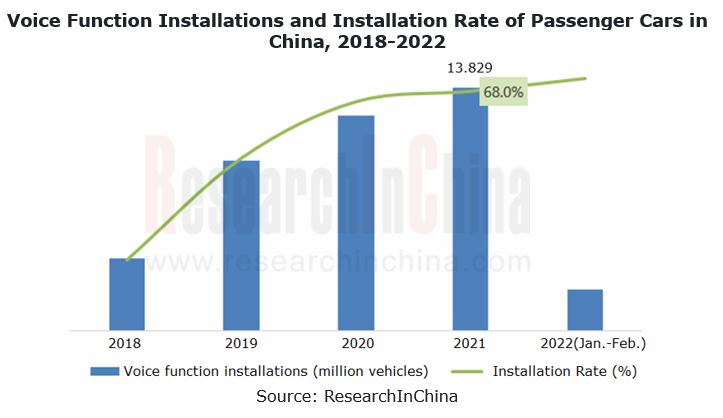
In 2021, over 13 million passenger cars in China carried voice feature, with a year-on-year increase of 13% and an installation rate of 68%. The market bore a rapid bullish trend.
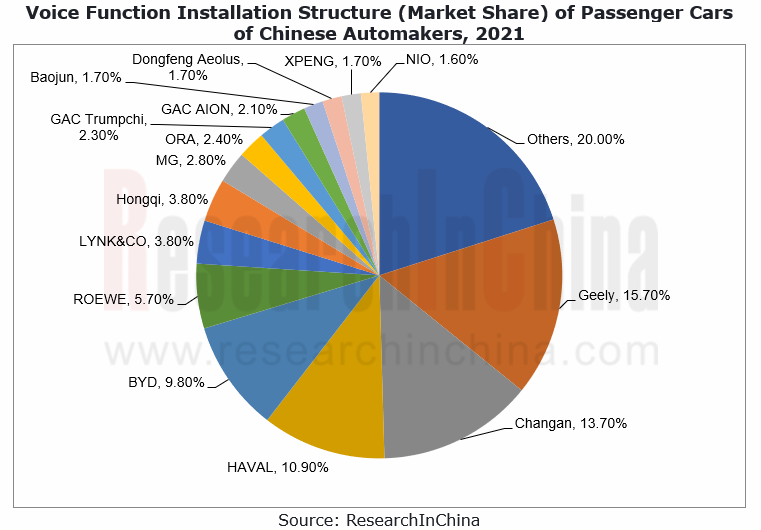
In 2021, more than 5.5 million vehicles of Chinese automakers were outfitted with voice feature, a year-on-year spike of 40.4%. Among the top four brands, BYD saw the voice installations soar by 151% on an annualized basis, and Haval’s rose 53% from a year earlier.
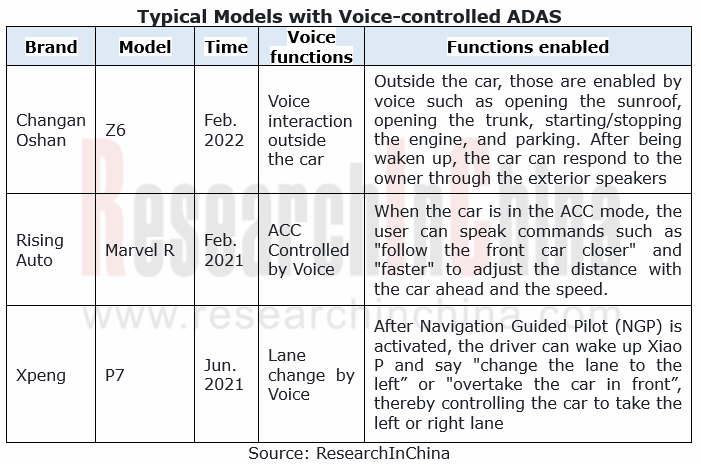
From IVI software to ADAS, voice-enabled functions continue to evolve
In terms of functionality, what is controlled by voice ranges from IVI software (music, navigation, etc.) to hardware (like seats, air conditioner), power systems (such as driving modes), and to ADAS (like ACC control). With more and more automotive interfaces, voice can control lane change, adaptive cruise, and parking.
iFLYTEK and Cerence are the top two leaders
Among suppliers, iFLYTEK and Cerence are in the first echelon, together sweeping more than 70% market shares.
iFLYTEK shipped more than 7 million sets of voice products in 2021, a figure projected to outnumber 9 million sets in 2022 still as the largest supplier in the market.
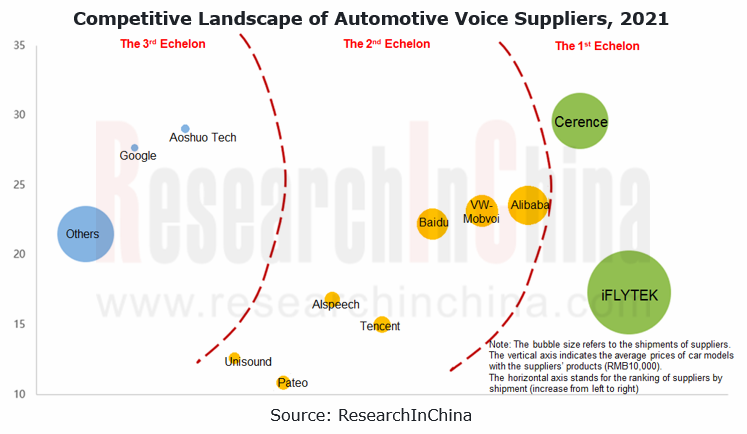
iFLYTEK mainly serves Chinese carmakers, and the average unit price of models supported ranges from RMB150,000 to RMB200,000. In the OEM market, iFlytek’s voice products have been available in excess of 36 million vehicles, being merited as follows:
? iFLYTEK has delved in the automotive field for 19 years as the industry’s leader in multilingual automatic speech recognition (ASR), text-to-speech (TTS) and other technologies;
? The Feiyu (flying fish) system for automakers employs a software and hardware platform design, which can be reused by multiple models and be introduced rapidly to vehicle models with varying market targets, prices and configurations.
With superiorities in AI expertise, data accumulation as well as the software and hardware platforms that can offer custom-made services, iFLYTEK has become a heavyweight in the automotive voice industry. But other rivals should not be underestimated, especially Cerence (separated from Nuance, a world-renowned giant in intelligent voice).
In 2020, Geely’s China Euro Vehicle Technology (CEVT) and Great Wall Motor's strategic partner Bean Tech announced to select Cerence ARK to develop automotive voice assistants. NIO also proclaimed to introduce Cerence’s voice technology. Prior to this, these brands were all customers of iFLYTEK.
Cerence ARK is an end-to-end AI-powered automotive assistant solution that integrates interactive voice AI technologies such as environment-adaptive voice signal enhancement, custom wake-up words, random interruption of dialogue, multi-intent semantic understanding, wake-up-free multi-round dialogue, and cross-domain dialogue in support of context understanding. Cerence ARK is a turnkey automotive product that enables automakers to quickly develop, deploy and manage a fully localized automotive voice assistant.
In addition, Cerence supports more than 70 languages around the world, making it the best choice for Chinese brands to go overseas. Automakers such as SAIC, Geely, Wuling Motors, NIO and Hongqi have all used Cerence's voice technology in their overseas models.
In addition to iFLYTEK, Cerence and the like that can provide OEMs with full-chain voice capabilities, some other suppliers provide a platform that can access the voice capabilities of all companies to satisfy customers who want to "enjoy the benefits of all players". PATEO's IoV Qing AI voice platform is just a reliable choice.
PATEO Qing AI is a voice platform with pluggable capabilities, which supports the access to ASR, NLU, and TTS capabilities of multiple enterprises, provides different voice services to different projects and models, freely configures functions, increases or decreases skills, and facilitates quick application. The platform favors a variety of integration methods of different systems (such as Linux and Android) and different terminals (vehicle and mobile phone).
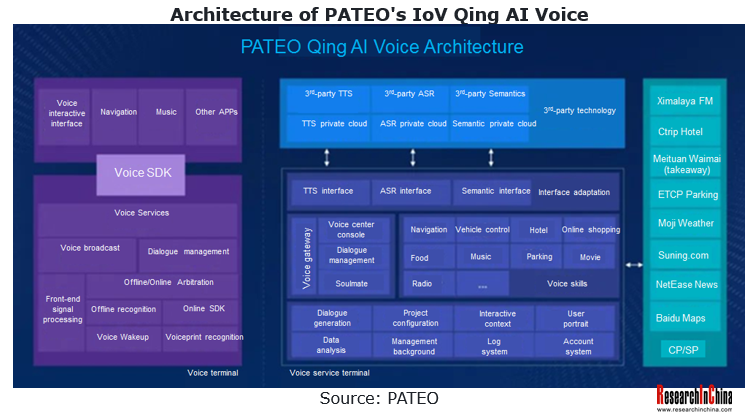
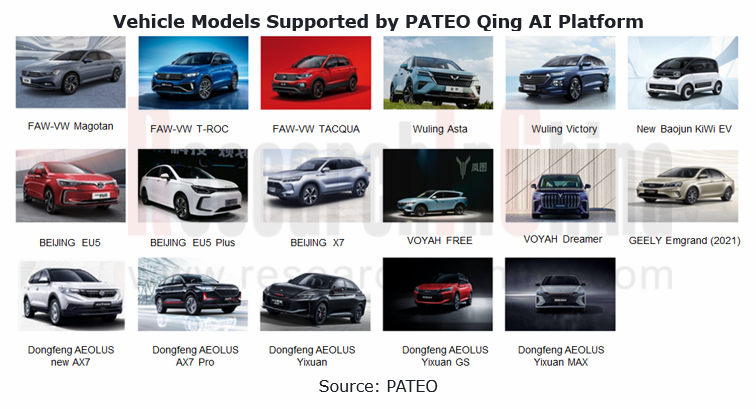
At present, PATEO's Qing AI voice platform has been connected to the voice capabilities of Cerence, Baidu, AIspeech and iFlytek. It enables full-duplex voice interaction, multi-round dialogue, deep contextual memory and understanding, wake-up-free, “what you see is what you can say”, voice source positioning, voiceprint recognition, voice cloning and other functions. It has been seen in FAW VW, Dongfeng Motor, Wuling Motors (Silver Badge), BEIJING Auto, Geely, etc. The PATEO voice product carried by Voyah FREE supports four-tone-zone voice recognition, multi-round dialogue, navigation, music, car control, and “what you see is what you can say about setting interfaces”, greetings and other functions.
No matter how much suppliers offer, it cannot compete with the lucrativeness brought by "mastery of the core data"
Although the solution packages of suppliers are fine, OEMs want more in terms of function differentiation, security guarantee of open automotive interfaces, quick response of OTA and user data. The OEMs represented by Xpeng and Li Auto have adopted the development model of "introducing the underlying technology of suppliers and developing their own voice system".
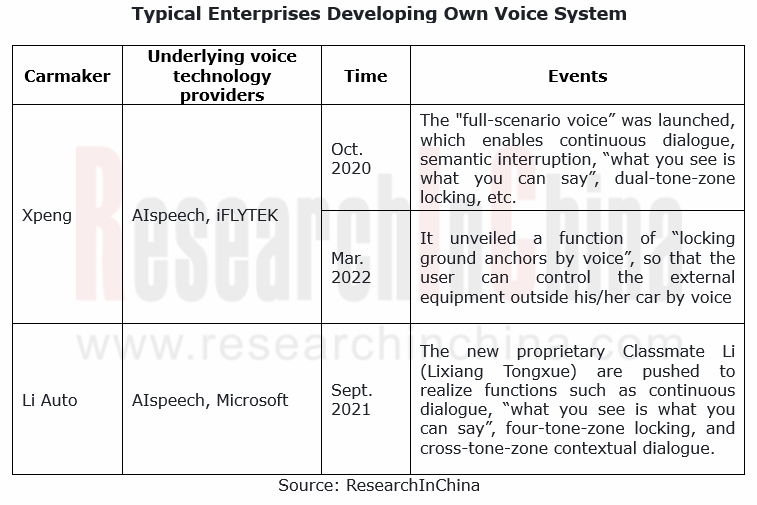
Like Xpeng and Li Auto vigorously developing voice on their own, Volkswagen, Geely, Great Wall Motor, etc. are sparing no efforts in self-developed voice by setting up subsidiaries.
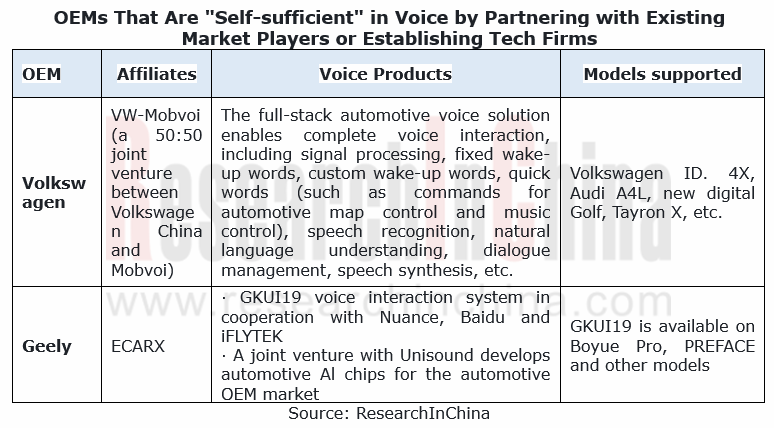
In a nutshell, the mode of traditional OEMs applying suppliers’ solution packages has quietly transferred to the in-depth cooperation between OEMs (with more detailed needs) and technology providers (responsible for delivery). OEMs are not only demanders, but also technology suppliers and system integrators in the voice supply chain. For traditional voice suppliers, the "reform" has kicked off.
Autonomous Driving Domain Controller and Central Computing Unit (CCU) Industry Report, 2026
Autonomous Driving Domain Controller (ADCU) Research: One-Chip CCU solutions are quickly available in vehicles
In China's passenger car market, autonomous driving systems involved in mass production ...
Automotive EMS and ECU Industry Research Report, 2026
Automotive EMS Research: The boundaries between EMS providers and Tier1 suppliers are becoming blurred, and the supply chain model is evolving from a linear chain to a networked structure
Mainstream ...
Automotive Microcontroller Unit (MCU) and Application Scenario Research Report, 2026
Automotive MCU Research: Increased demand for redundant security drives ASIL D-compliant MCU shipments to exceed 100 million units
In a vehicle EEA, MCUs are widely distributed in various functional ...
China Intelligent Cockpit Patent Analysis Report, 2026
Intelligent Cockpit Patent Research: Cockpit AI, In?vehicle Health, and Infotainment Are Upgrade to Scenario?based and Proactive Functions
From a patent perspective, this report explores the cutting?...
Research Report on Application of VLA Large Model in Automobiles and Robots, 2026
Research on Automotive and Robot VLA: Hybrid Architectures Become Mainstream, VLA Integrates with General World Models, and Reinforcement Learning Serves as Core Engine
Vision?Language?Action (VLA) m...
China Charging Infrastructure (Supercharging, Battery Swapping, V2G, etc.) and High-Performance Supercharging Battery Research Report, 2026
Charging and battery swapping research: as 5C+ supercharging vehicle models go into mass production, the pace of OEMs self-building supercharging networks quickens
800-1000V high-voltage platforms ar...
China Passenger Car Electronic Controlled Suspension Industry Report, 2026
Electronic Controlled Suspension Industry Research: As the First Year of Full Active Suspension Unfolds, Three Technical Routes Race Forward
1. Penetration Rate Surges Three Times, and Electronic Con...
Intelligent Driving SoC Research Report, 2026
Research on Intelligent Driving SoCs: Competition Focus Shifts to L3/L4 Embedded Hardware, and Computing Power of Flagship Vehicle Models Exceeds 1,000 TOPS
In terms of intelligent driving system in...
Automotive AI Large Model Technology Research Report, 2026
Automotive AI Large Model Research: Competition Shifts from "Who Has the Stronger Model" to "Who Boasts Higher Link Efficiency"
ResearchInChina released the Automotive AI Large Model Technology Resea...
Intelligent Vehicle Cockpit Domain Controller Research Report, 2026
Cockpit domain controller research: L3 AIDV intelligent cockpit domain controllers are entering a boom period
Driven by multiple factors such as the continuous evolution of the automotive central int...
Automotive Acoustic System (Audio, Multi-Channel) Industry Report, 2026
Automotive Acoustics Research: Multiple Channels, AI Tuning, and Self-Developed Algorithms Drive the Transformation of High-End Cockpit Sound Fields
I. Automotive Audio Hardware Solutions with 6–9 S...
Autonomous Driving Sensor Chip Research Report, 2026
Research on Autonomous Driving Sensor Chips: Deeply Perceiving the Physical World, Sensor Chips Are Playing A “Leading Role” in Intelligence
In 2026, the autonomous driving sensor chip industr...
Passenger Car Corner Module and Wheel‑Side Control System Research Report, 2026
Wheel-side control research: the “last mile” chassis innovation
Wheel-side control dismantles the traditional drive, braking, steering, and suspension control of the chassis from a "centralized" styl...
Embodied Artificial Intelligence (& Humanoid Robot) MCU Research Report, 2026
Research on Humanoid Robot MCUs: Evolution from General-Purpose Control to High-Value Dedicated Chip Solutions Integrated with Edge AI Functions
MCU (Microcontroller Unit) refers to a compact integra...
Intelligent Vehicle Zone Control Unit (ZCU) Research Report, 2026
ZCU Research: Cross-domain integrated ZCUs are becoming the edge computing nodes of the next-generation zonal architecture
Currently, the mainstream zonal architecture is mainly the quasi-central + z...
Automotive Cybersecurity and Data Security Research Report, 2026
Cybersecurity & Data Security Research: Intelligent Connected Vehicles Enter the Era of “Systematic Offense-Defense and AI-Defined Security”.
Centering on the panorama of intelligent connect...
Report on Breakthrough Strategies of OEMs and ADAS Tier 1 Suppliers for Overseas Layout of Intelligent Driving, 2026
Regulatory Breakthrough, Local System Establishment, OEMs Competing for NOA Layout: Overall Trends of China’s Intelligent Driving Overseas Layout in 2026
Research on overseas intelligent driving layo...
OEMs and Tier1s’ Intelligent Cockpit Platform (Hardware and Software) Innovation Strategy Research Report, 2026
Intelligent Cockpit Platform Research: multi-dimensional cockpit system architecture reconstruction for multi-agent collaboration and proactive intelligent services
The intelligent cockpit software s...