Commercial vehicle industry is characterized by large output value, long industry chain, high relevance, high technical requirements, wide employment and large consumer pull, and is a barometer of national economic development. China is currently the world's largest single market for commercial vehicle sales, contributing nearly half of global sales each year. In 2022, Scania held the launching ceremony for the construction of the manufacturing base in Rugao, Jiangsu Province, and the launch of heavy truck joint venture between Daimler Benz and BAIC Foton, opening a new prelude to the industry.
With the technological revolution of "electrification and intelligence" of automobiles, commercial vehicle chassis also ushered in the technological change from conventional chassis, electric chassis to intelligent chassis. The future development of intelligent chassis technology, the construction of the industry chain and the layout of the supply chain will have a profound impact on the development trend of commercial vehicles.
As an important intersection of electrification and intelligence, the intelligent chassis has been highly valued by automotive industry and strongly sought after by capital in recent years, with a large number of companies entering and laying out a strong position to carry out related core technology.
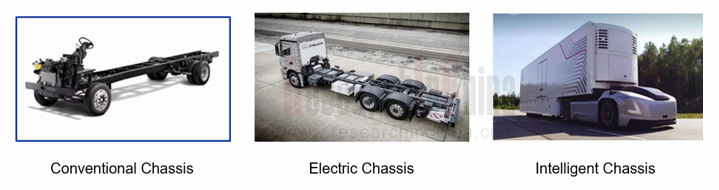
The intelligent chassis for commercial vehicles is moving in step with "electrification, intelligence, software and sharing" and is showing the following trends:
Trend 1: Technological changes and business model changes to support the sharing of intelligent chassis for commercial vehicles
The efficient operation of logistics needs to be based on specialization of commercial vehicles, but the challenge of generalization in turn limits the ability to apply vehicles across industries, or will have an impact on vehicle utilization. The contradiction between specialization and versatility can be balanced in the future by the intelligent chassis installation and the separation of chassis, and the design of scenario-based installations and chassis standardization. Scenario-based installation, which can meet the professional requirements of each scenario in a differentiated way and maximize the use efficiency in the scenario; Chassis standardization meets the requirements of mass production for product standardization, thereby reducing production costs. The development of new energy and autonomous driving technology will accelerate the landing of standard chassis and provide technical support for the sharing development of commercial vehicle chassis.
The skateboard chassis highly concerned by the industry is expected to be implemented firstly in commercial vehicle field. The "wire-controlled technology, cell to chassis (CTC), casting of large chassis parts, corner module, battery replacement" promoted by the intelligent chassis of passenger cars or various application scenarios of commercial vehicles have been realized one by one.
Trend 2: More and more start-ups focus on commercial vehicle chassis industry
Several domestic and foreign companies have already entered the commercial vehicle intelligent chassis track, including Gaussin, which has set up its headquarters in China to bring its latest pure electric and hydrogen truck technologies and products to the Chinese market in the form of a next-generation Skateboard Truck Platform.
Super Panther is the first technology company in China to focus on intelligent chassis for new energy commercial vehicles. It is different from the "skateboard chassis" technology company for passenger cars, and will combine the ecological needs of logistics by creating a new chassis system to help transform the logistics industry in the new energy trend.
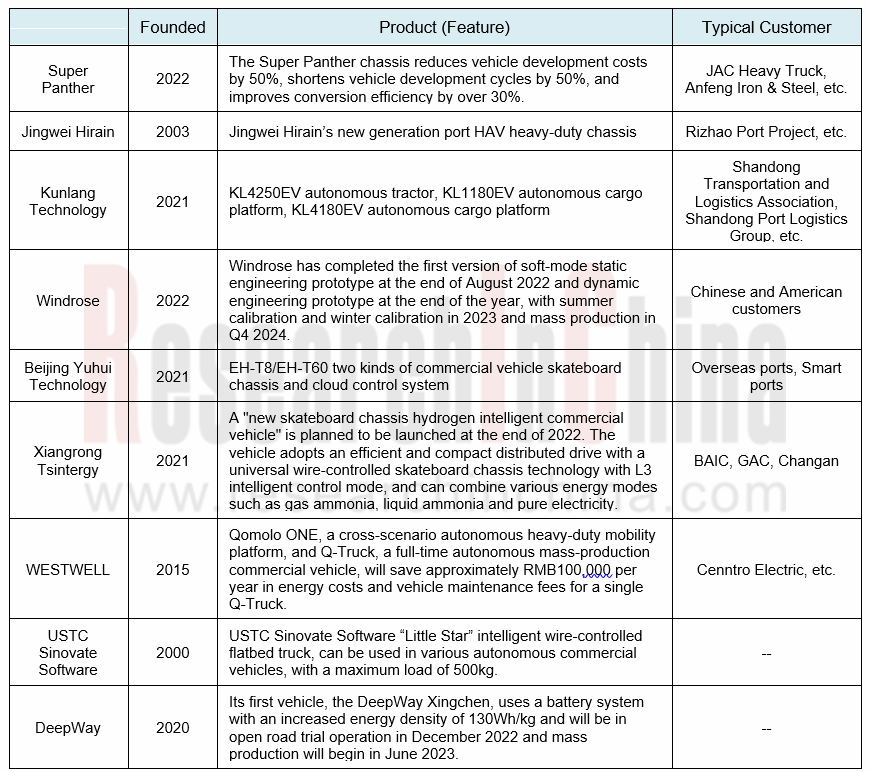
Trend 3: Intelligent chassis design for commercial vehicles is gradually becoming passenger car-oriented
The commercial vehicle chassis needs to be deeply integrated with intelligent cockpit, autonomous driving and powertrain in order to become a true intelligent chassis, which can actively control, adaptive and self-learning and can be OTA upgraded according to the user preferences to decide the character of the vehicle.
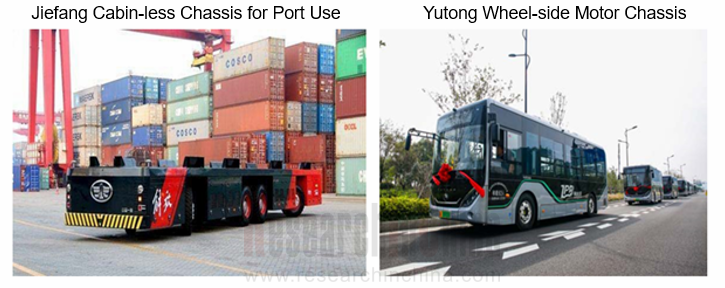
Trend 4: Intelligent chassis for commercial vehicles enables diversified fuel platforms
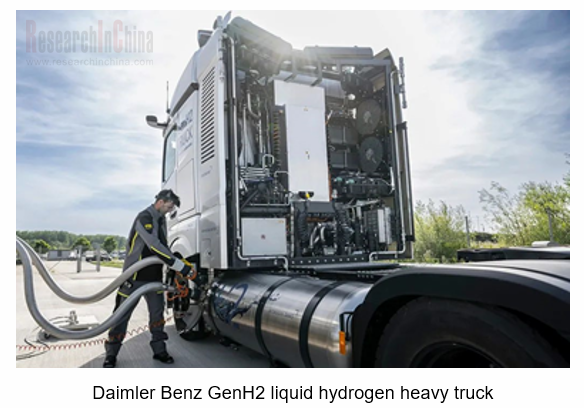
Daimler Benz GenH2 liquid hydrogen heavy truck chassis comes with two tanks for storing liquid hydrogen, each holding around 40kg of liquid hydrogen, and is matched with two 150kW fuel cell systems. The intensive test scenarios for Mercedes-Benz hydrogen fuel cell prototype are said to include internal test lanes and public roads, with the development goal of achieving a range of over 1,000km and being able to cope with flexible and demanding road conditions in heavy long-distance transport. Daimler Trucks plans to have hydrogen fuel cell trucks join the production model line-up in the next 5-10 years as well.
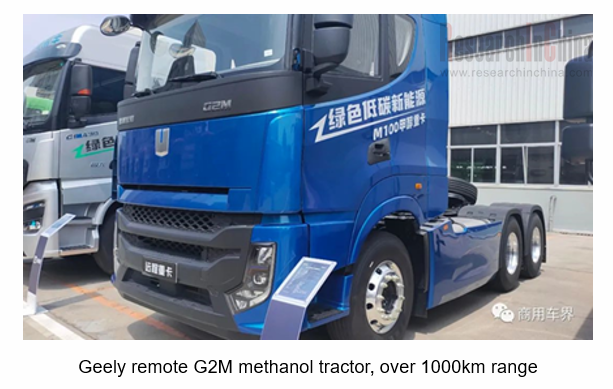
Due to the impact of technology and cost, trunk logistics vehicles are the short board of new energy development. How can we use mature technology and lower costs to help trunk logistics achieve low-carbon green transport? Geely's new energy commercial vehicles have undergone 17 years of R&D and have released a multi-motor central drive power chain and a new energy green methanol powered solution - the remote G2M methanol tractor.
Trend 5: Goals and technical paths for development of intelligent chassis
According to the “Intelligent Chassis Technology Roadmap” published by the Electric Vehicle Alliance Wire-Controlled Working Group in 2021, the goals for the development of intelligent chassis for commercial vehicles are shown in the following diagram:
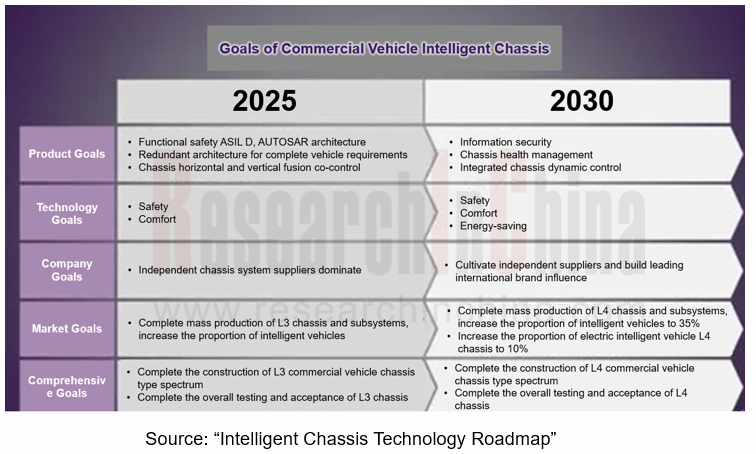
 Goals in 2025: The intelligent chassis equipped with independent brands of braking-by-wire and steering -by-wire will be applied in batches in influential enterprises in the industry; The key technical indicators of the intelligent chassis have reached the international advanced level; The industrial chain of key components is independent and controllable.
Goals in 2030: The initial formation of the brand effect of independent intelligent chassis and wire-controlled actuation of the automakers and parts enterprises; intelligent chassis in general to reach the international advanced level, key technical indicators to reach the international leading level; intelligent chassis to form a complete independent controllable industrial chain; cultivate internationally competitive enterprises.
The key technology path for the intelligent chassis of commercial vehicles is: to cope with the demand of L3 autonomous driving, the chassis realizes subsystem redundancy, adopts distributed control structure, independent longitudinal and horizontal active control, and system health alarm; to cope with the demand of L4 autonomous driving, the chassis domain control realizes minimal backup of autonomous driving and collaborative longitudinal and horizontal control; to cope with the demand of L5 autonomous driving, the chassis domain control realizes full functional backup of autonomous driving and integrated longitudinal and horizontal collaborative control.
Automotive Microcontroller Unit (MCU) and Application Scenario Research Report, 2026
Automotive MCU Research: Increased demand for redundant security drives ASIL D-compliant MCU shipments to exceed 100 million units
In a vehicle EEA, MCUs are widely distributed in various functional ...
China Intelligent Cockpit Patent Analysis Report, 2026
Intelligent Cockpit Patent Research: Cockpit AI, In?vehicle Health, and Infotainment Are Upgrade to Scenario?based and Proactive Functions
From a patent perspective, this report explores the cutting?...
Research Report on Application of VLA Large Model in Automobiles and Robots, 2026
Research on Automotive and Robot VLA: Hybrid Architectures Become Mainstream, VLA Integrates with General World Models, and Reinforcement Learning Serves as Core Engine
Vision?Language?Action (VLA) m...
China Charging Infrastructure (Supercharging, Battery Swapping, V2G, etc.) and High-Performance Supercharging Battery Research Report, 2026
Charging and battery swapping research: as 5C+ supercharging vehicle models go into mass production, the pace of OEMs self-building supercharging networks quickens
800-1000V high-voltage platforms ar...
China Passenger Car Electronic Controlled Suspension Industry Report, 2026
Electronic Controlled Suspension Industry Research: As the First Year of Full Active Suspension Unfolds, Three Technical Routes Race Forward
1. Penetration Rate Surges Three Times, and Electronic Con...
Intelligent Driving SoC Research Report, 2026
Research on Intelligent Driving SoCs: Competition Focus Shifts to L3/L4 Embedded Hardware, and Computing Power of Flagship Vehicle Models Exceeds 1,000 TOPS
In terms of intelligent driving system in...
Automotive AI Large Model Technology Research Report, 2026
Automotive AI Large Model Research: Competition Shifts from "Who Has the Stronger Model" to "Who Boasts Higher Link Efficiency"
ResearchInChina released the Automotive AI Large Model Technology Resea...
Intelligent Vehicle Cockpit Domain Controller Research Report, 2026
Cockpit domain controller research: L3 AIDV intelligent cockpit domain controllers are entering a boom period
Driven by multiple factors such as the continuous evolution of the automotive central int...
Automotive Acoustic System (Audio, Multi-Channel) Industry Report, 2026
Automotive Acoustics Research: Multiple Channels, AI Tuning, and Self-Developed Algorithms Drive the Transformation of High-End Cockpit Sound Fields
I. Automotive Audio Hardware Solutions with 6–9 S...
Autonomous Driving Sensor Chip Research Report, 2026
Research on Autonomous Driving Sensor Chips: Deeply Perceiving the Physical World, Sensor Chips Are Playing A “Leading Role” in Intelligence
In 2026, the autonomous driving sensor chip industr...
Passenger Car Corner Module and Wheel‑Side Control System Research Report, 2026
Wheel-side control research: the “last mile” chassis innovation
Wheel-side control dismantles the traditional drive, braking, steering, and suspension control of the chassis from a "centralized" styl...
Embodied Artificial Intelligence (& Humanoid Robot) MCU Research Report, 2026
Research on Humanoid Robot MCUs: Evolution from General-Purpose Control to High-Value Dedicated Chip Solutions Integrated with Edge AI Functions
MCU (Microcontroller Unit) refers to a compact integra...
Intelligent Vehicle Zone Control Unit (ZCU) Research Report, 2026
ZCU Research: Cross-domain integrated ZCUs are becoming the edge computing nodes of the next-generation zonal architecture
Currently, the mainstream zonal architecture is mainly the quasi-central + z...
Automotive Cybersecurity and Data Security Research Report, 2026
Cybersecurity & Data Security Research: Intelligent Connected Vehicles Enter the Era of “Systematic Offense-Defense and AI-Defined Security”.
Centering on the panorama of intelligent connect...
Report on Breakthrough Strategies of OEMs and ADAS Tier 1 Suppliers for Overseas Layout of Intelligent Driving, 2026
Regulatory Breakthrough, Local System Establishment, OEMs Competing for NOA Layout: Overall Trends of China’s Intelligent Driving Overseas Layout in 2026
Research on overseas intelligent driving layo...
OEMs and Tier1s’ Intelligent Cockpit Platform (Hardware and Software) Innovation Strategy Research Report, 2026
Intelligent Cockpit Platform Research: multi-dimensional cockpit system architecture reconstruction for multi-agent collaboration and proactive intelligent services
The intelligent cockpit software s...
Automotive AIOS Research Report, 2026
Automotive AIOS Research: Mass Production Solutions Are Implemented
Mass Production Solutions Are Implemented on A Small Scale.
In 2026, AIOS starts small-scale implementation, helping to improve v...
Automotive Telematics Service Provider (TSP) Research Report, 2026
TSP Research: Leading providers collectively turn to AI agents to provide all-scenario active services
Telematics Service Providers (TSPs) are the core hub of the telematics industry chain, connectin...