China Passenger Car Highway & Urban NOA (Navigate on Autopilot) Research Report, 2024
NOA industry research: seven trends in the development of passenger car NOA
In recent years, the development path of autonomous driving technology has gradually become clear, and the industry is accelerating from L2 to L2.5/L2.9 and even L3. In this process, promoting popularization of Highway NOA and rapid development of Urban NOA has become a consensus of entire industry. Since 2023H2, the market competition for Urban NOA has become increasingly fierce. Major OEMs have accelerated the implementation of Urban NOA technology and gradually disclosed their development plans. Since 2023Q3, the development of passenger car NOA has entered the second half stage. Many automakers have actively deployed and used end-to-end foundation models and map-free solutions to promote the development of national intelligent driving into a new stage.
Currently, passenger car NOA faces the following evolution trends:
Trend 1: Highway NOA and Urban NOA penetration rates continue to increase
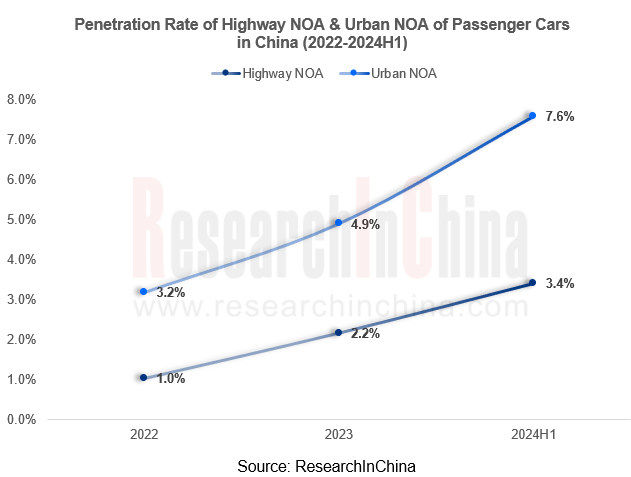
Since Tesla first introduced Highway NOA to China in 2019, it has been rapidly implemented in 2022 and has now covered many domestic independent and joint venture brands. By the end of 2023, sales volume of domestic ADAS passenger cars with L2.5 and above reached 1.484 million, with a penetration rate of 7.1%, of which sales increased by 78.3% year-on-year.
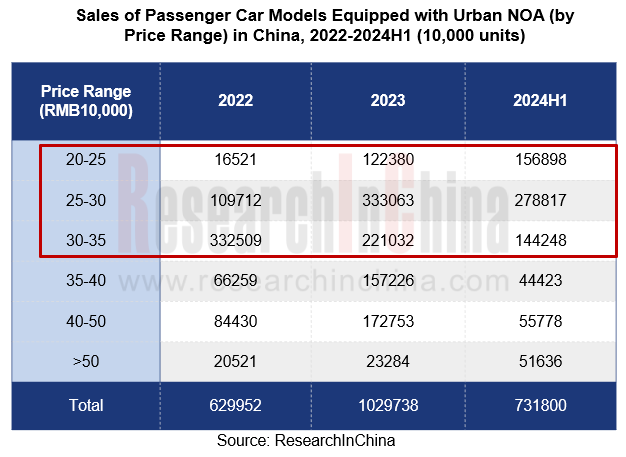
By the end of 2024H1, sales volume of domestic new passenger cars with L2.5 and above ADAS models was 1.06 million, with a penetration rate of 11%; among them, sales volume of Highway NOA models was 328,000, with a penetration rate of 3.4% (excluding models with both Highway NOA and Urban NOA functions). Sales volume of Urban NOA models was 732,000, with a penetration rate of 7.6%.
Trend 2: Urban NOA entering an arms race in 2023~2024
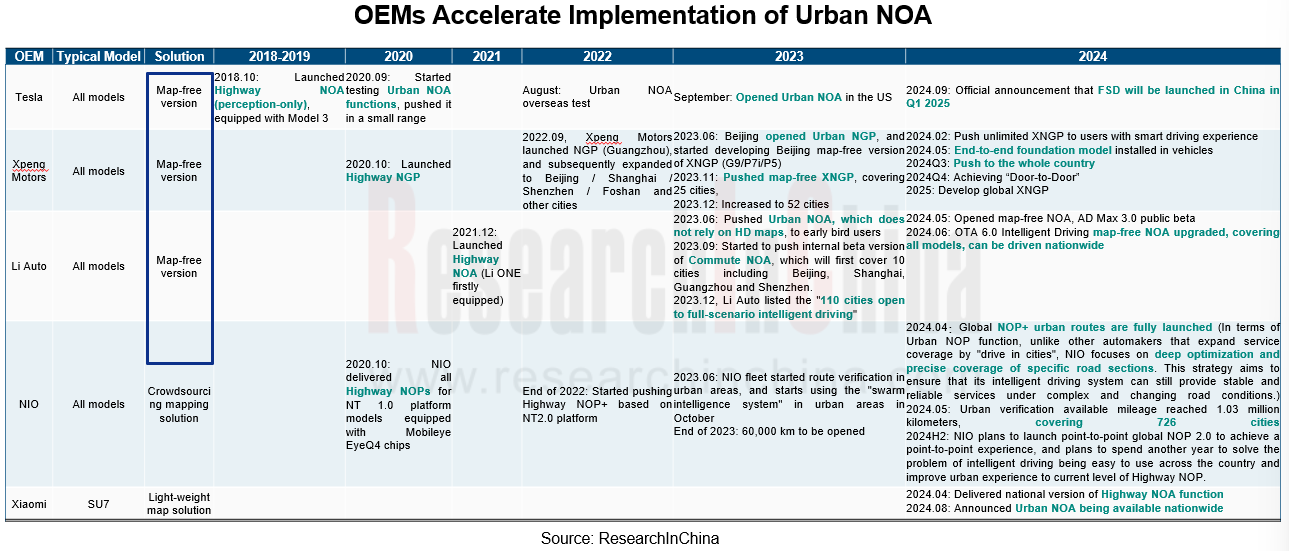
Led by OEMs such as Tesla, NIO/Xpeng Motors/Li Auto, and Huawei System, major domestic OEMs and solution providers have all moved towards Urban NOA, some of which have begun to installed in vehicles in 2023. From 2023 to 2024, Urban NOA enters an arms race, and many OEMs have successfully mass-produced L2.9.
Trend 3: Since 2023, joint venture OEMs have accelerated their follow-up of Highway NOA
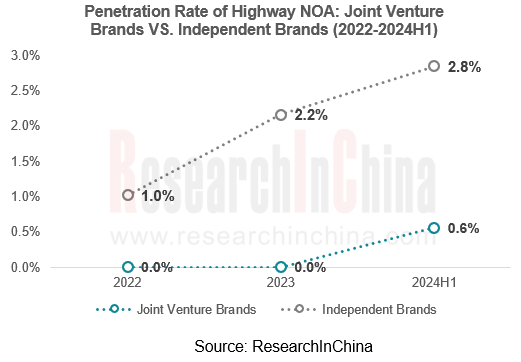
From the perspective of OEM type, in 2022, Highway NOA enterprises concentrated in local market, and no foreign capital has entered. Since 2023, joint venture OEMs have begun to accelerate their follow-up of Highway NOA. As of 2024H1, sales of joint venture OEM Highway NOA models in China reached 54,000 units, with a penetration rate of 0.6%. From 2022 to 2024H1, the sales and penetration rate of independent OEM Highway NOA models continued to rise. By the end of 2023, its sales had reached 454,000 units, a year-on-year increase of 124.5%; the penetration rate reached 2.2%, an increase of 1.2 percentage points year-on-year. In 2024H1, its sales reached 275,000 units, with a penetration rate of 2.8%.
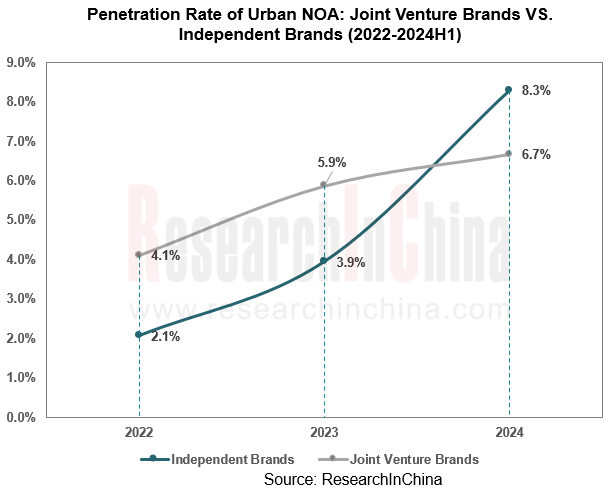
In 2023, sales volume of joint venture brand Urban NOA was 604,000 units, with a penetration rate of 5.9%, up 1.8 percentage points year-on-year; sales volume of independent brand models was 423,000 units, with a penetration rate of 3.9%, up 1.8 percentage points year-on-year. From 2023 to 2024H1, the penetration rate of independent brand Urban NOA models further accelerated. As of 2024H1, the sales penetration rate of independent brand Urban NOA increased from 3.9% at the end of 2023 to 8.3%. This trend shows the rapid layout of many independent brands in intelligent driving field and the increasing acceptance of domestic consumers for L2.9 ADAS products.
Trend 4: L2.9 and L2.5 are accelerating their penetration into the mid- and low-end markets, and the era of technological equality is quietly approaching.
From the perspective of price, Urban NOA functions have grown most significantly in models priced at 200,000-300,000 yuan. In 2024H1, especially in the "200,000-250,000 yuan" market segment, Urban NOA's installation volume grew fastest, and the era of technological equality has quietly arrived. This trend shows that in 2024, ADAS technology is accelerating its penetration into mid- and low-end markets, gradually becoming popular, and becoming a standard configuration for future daily family cars.
In the field of Highway NOA, L2.5 has been extended to models in two price ranges of "100,000-150,000 yuan" and "150,000-200,000 yuan". According to ResearchInChina data, penetration rate of domestic passenger car Highway NOA models priced at "100,000-150,000 yuan" and "150,000-200,000 yuan" increased from 0.02% and 0.29% at the end of 2023 to 0.08% and 1.39% in 2024H1, respectively. Taking the iCAR03 Family, a new energy electric brand under Chery Group, as an example, on June 12, 2024, iCAR 03 launched two new intelligent driving versions with an official price of 149,800 yuan and 159,800 yuan. iCAR 03 Intelligent Driving belongs to the L2.5 and has Highway NOA functions.
Trend 5: The first year of map-free Urban NOA has arrived, and many OEMs have launched national intelligent driving solutions without HD maps
At present, the debate around "map-free" technology route has also risen to an unprecedented height, and getting rid of HD maps has begun to become a key R&D direction of more and more Chinese companies. Among many domestic OEMs, OEMs that have adopted map-free NOA solutions include but are not limited to: Li Auto, Xpeng Motors, Huawei System, GAC, Great Wall Motor, Zeekr, etc., and Xiaomi adopts the low-weight map solution. Taking Huawei as an example, the NCA (Navigation Cruise Assist) system launched by Huawei in December last year does not require HD maps and covers all types of public roads across China. Based on ADS2.0 platform, the system integrates BEV and GOD networks to improve road analysis capabilities. In 2024, Huawei released Qiankun ADS3.0 system, which makes driving behavior more humanized through bionic neural networks and AI algorithms. In May 2024, Xpeng Motors announced that XNGP has achieved 100% map-free, and in cities and counties, core sections will be opened first to ensure the continuity of user experience. Even in areas without HD maps, through the combination of "navigation map + XNet perception capability + driving strategy", XNGP's functional performance is close to that in areas with HD maps.
Trend 6: End-to-end foundation models are being adopted in vehicles to help upgrade intelligent driving
In 2024, emerging OEMs announced that their self-developed foundation model would be applied to vehicles. Introduction of foundation model made the system more accurate and efficient in dealing with complex environments and dynamic changes. Through deep learning and real-time data processing, the foundation model can analyze road conditions in real time, make intelligent decisions, and provide drivers with a safer and more reliable driving experience. With the promotion of this solution, autonomous driving systems can be more widely used nationwide, improving driving flexibility and adaptability.
Li Auto believes that it is not possible to achieve autonomous driving above L4 by relying solely on One Model end-to-end. It proposed a new solution: "System 1 + System 2", namely, E2E (end-to-end foundation model) + VLM (visual language model). Currently, System 1 is in the "second generation: map-free, segmented end-to-end", which consists of two models, namely perception and planning. The biggest change is the removal of NPN, which does not rely on prior information. This generation of technology allows Li Auto to truly be able to drive across the country and can be driven with navigation only.
Trend 7: Vision-only perception route is regarded as one of new directions of technological development by more Chinese OEMs
In the evolution of Chinese intelligent driving technology, core technology architecture of the first half is highly dependent on LiDAR and HD map. This mode ensures the stability and safety of autonomous driving functions through complex sensor fusion technology and support of geographic information systems, especially in real-time updating and precise matching of HD maps.
As the second half of intelligent driving competition begins, the technical routes are showing a diversified development trend, which can be mainly divided into two categories:
The first technical route, represented by Huawei, adopts the strategy of "LiDAR multi-fusion perception + map-free solution/lightweight map solution + end-to-end foundation model". Under this framework, LiDAR provides high-precision perception data, combined with map-free or lightweight map solutions, reducing the system's dependence on HD maps. Meanwhile, the application of end-to-end foundation model further enhances system's autonomous learning and decision capabilities, making the autonomous driving system more flexible and reliable in complex environments.
The second technical route, represented by Tesla, Xpeng Motors, Jiyue, etc., mainly adopts the technical combination of "vision-only + map-free solution / HD map + end-to-end foundation model". In August 2024 , Xpeng Motors officially launched the AI Eagle Eye Vision Solution, which is a high-level intelligent driving solution with light radar (LiDAR has changed from mandatory to optional in L3). The first model equipped with AI Eagle Eye Vision Solution is the P7+, which will be officially launched in Q4.
Automotive Microcontroller Unit (MCU) and Application Scenario Research Report, 2026
Automotive MCU Research: Increased demand for redundant security drives ASIL D-compliant MCU shipments to exceed 100 million units
In a vehicle EEA, MCUs are widely distributed in various functional ...
China Intelligent Cockpit Patent Analysis Report, 2026
Intelligent Cockpit Patent Research: Cockpit AI, In?vehicle Health, and Infotainment Are Upgrade to Scenario?based and Proactive Functions
From a patent perspective, this report explores the cutting?...
Research Report on Application of VLA Large Model in Automobiles and Robots, 2026
Research on Automotive and Robot VLA: Hybrid Architectures Become Mainstream, VLA Integrates with General World Models, and Reinforcement Learning Serves as Core Engine
Vision?Language?Action (VLA) m...
China Charging Infrastructure (Supercharging, Battery Swapping, V2G, etc.) and High-Performance Supercharging Battery Research Report, 2026
Charging and battery swapping research: as 5C+ supercharging vehicle models go into mass production, the pace of OEMs self-building supercharging networks quickens
800-1000V high-voltage platforms ar...
China Passenger Car Electronic Controlled Suspension Industry Report, 2026
Electronic Controlled Suspension Industry Research: As the First Year of Full Active Suspension Unfolds, Three Technical Routes Race Forward
1. Penetration Rate Surges Three Times, and Electronic Con...
Intelligent Driving SoC Research Report, 2026
Research on Intelligent Driving SoCs: Competition Focus Shifts to L3/L4 Embedded Hardware, and Computing Power of Flagship Vehicle Models Exceeds 1,000 TOPS
In terms of intelligent driving system in...
Automotive AI Large Model Technology Research Report, 2026
Automotive AI Large Model Research: Competition Shifts from "Who Has the Stronger Model" to "Who Boasts Higher Link Efficiency"
ResearchInChina released the Automotive AI Large Model Technology Resea...
Intelligent Vehicle Cockpit Domain Controller Research Report, 2026
Cockpit domain controller research: L3 AIDV intelligent cockpit domain controllers are entering a boom period
Driven by multiple factors such as the continuous evolution of the automotive central int...
Automotive Acoustic System (Audio, Multi-Channel) Industry Report, 2026
Automotive Acoustics Research: Multiple Channels, AI Tuning, and Self-Developed Algorithms Drive the Transformation of High-End Cockpit Sound Fields
I. Automotive Audio Hardware Solutions with 6–9 S...
Autonomous Driving Sensor Chip Research Report, 2026
Research on Autonomous Driving Sensor Chips: Deeply Perceiving the Physical World, Sensor Chips Are Playing A “Leading Role” in Intelligence
In 2026, the autonomous driving sensor chip industr...
Passenger Car Corner Module and Wheel‑Side Control System Research Report, 2026
Wheel-side control research: the “last mile” chassis innovation
Wheel-side control dismantles the traditional drive, braking, steering, and suspension control of the chassis from a "centralized" styl...
Embodied Artificial Intelligence (& Humanoid Robot) MCU Research Report, 2026
Research on Humanoid Robot MCUs: Evolution from General-Purpose Control to High-Value Dedicated Chip Solutions Integrated with Edge AI Functions
MCU (Microcontroller Unit) refers to a compact integra...
Intelligent Vehicle Zone Control Unit (ZCU) Research Report, 2026
ZCU Research: Cross-domain integrated ZCUs are becoming the edge computing nodes of the next-generation zonal architecture
Currently, the mainstream zonal architecture is mainly the quasi-central + z...
Automotive Cybersecurity and Data Security Research Report, 2026
Cybersecurity & Data Security Research: Intelligent Connected Vehicles Enter the Era of “Systematic Offense-Defense and AI-Defined Security”.
Centering on the panorama of intelligent connect...
Report on Breakthrough Strategies of OEMs and ADAS Tier 1 Suppliers for Overseas Layout of Intelligent Driving, 2026
Regulatory Breakthrough, Local System Establishment, OEMs Competing for NOA Layout: Overall Trends of China’s Intelligent Driving Overseas Layout in 2026
Research on overseas intelligent driving layo...
OEMs and Tier1s’ Intelligent Cockpit Platform (Hardware and Software) Innovation Strategy Research Report, 2026
Intelligent Cockpit Platform Research: multi-dimensional cockpit system architecture reconstruction for multi-agent collaboration and proactive intelligent services
The intelligent cockpit software s...
Automotive AIOS Research Report, 2026
Automotive AIOS Research: Mass Production Solutions Are Implemented
Mass Production Solutions Are Implemented on A Small Scale.
In 2026, AIOS starts small-scale implementation, helping to improve v...
Automotive Telematics Service Provider (TSP) Research Report, 2026
TSP Research: Leading providers collectively turn to AI agents to provide all-scenario active services
Telematics Service Providers (TSPs) are the core hub of the telematics industry chain, connectin...